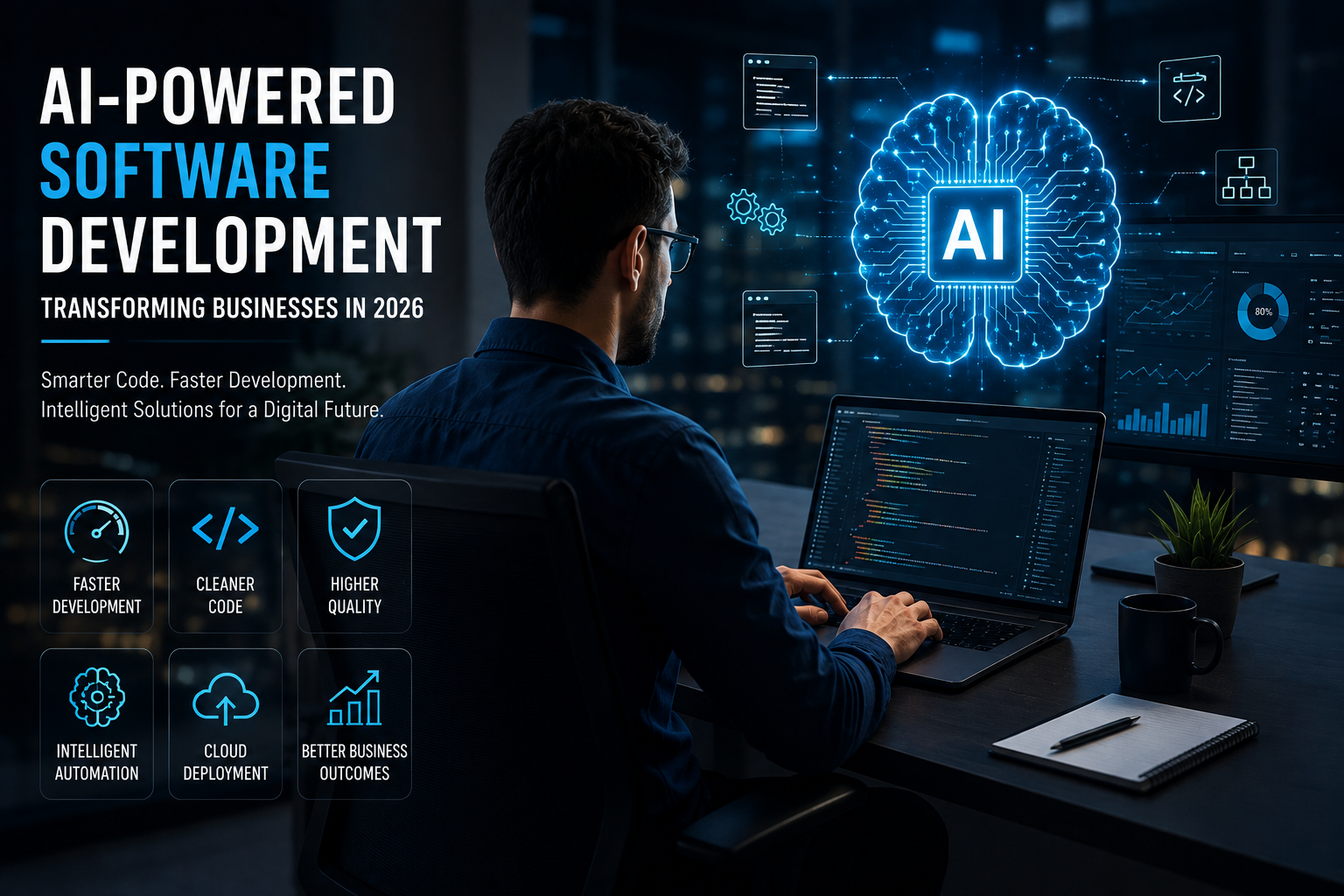
AI-Powered Software Development: Transforming Businesses in 2026
How AI-Powered Software Development Is Transforming Businesses in 2026
Artificial intelligence is changing the way businesses design, develop, deploy, and manage software. What was once primarily used for code suggestions and basic productivity tasks is increasingly becoming part of the broader software development lifecycle.
In 2026, AI-powered software development is moving toward more intelligent and connected workflows. AI systems can support requirements analysis, coding, testing, documentation, debugging, and other development activities. At the same time, businesses are exploring AI agents and intelligent applications that can perform multi-step tasks and interact with business systems.
Industry research indicates that AI is increasingly affecting the complete software development process rather than simply assisting developers with individual coding tasks.
For businesses, this shift creates an opportunity to build software faster, improve operational efficiency, and deliver more intelligent digital experiences.
What Is AI-Powered Software Development?
AI-powered software development refers to the use of artificial intelligence technologies throughout the software development and delivery process.
Instead of relying entirely on traditional development methods, teams can use AI to assist with activities such as:
- Requirements analysis
- Code generation and optimization
- Software testing
- Bug detection
- Documentation
- Data analysis
- Application monitoring
- Workflow automation
- Predictive analytics
- Intelligent customer experiences
The goal is not simply to replace conventional software development. The real opportunity is to combine human expertise with AI capabilities to create software that is faster to build, easier to maintain, and more responsive to business requirements.
Why AI-Powered Software Development Matters in 2026
The software industry is experiencing a significant transition. AI coding assistants are evolving toward more capable development agents that can support multiple stages of the development lifecycle. McKinsey reports that autonomous AI capabilities are increasingly able to support activities such as specification, coding, testing, and deployment.
However, technology adoption alone does not guarantee business value. Gartner reports that software engineering leaders are under pressure to demonstrate measurable ROI from AI investments, making productivity, developer experience, security, and business outcomes increasingly important considerations.
This means businesses need a strategic approach rather than simply adding AI tools to an existing workflow.
Key Benefits of AI-Powered Software Development
1. Faster Software Development
AI-assisted development can help developers complete repetitive tasks more efficiently.
AI can assist with:
- Generating code structures
- Creating test cases
- Explaining existing code
- Identifying potential bugs
- Producing documentation
- Automating repetitive development tasks
This can reduce the amount of manual work required for routine activities and allow developers to spend more time on architecture, problem-solving, and product innovation.
2. Improved Software Quality
Testing and quality assurance are critical components of software development.
AI can analyze code and testing information to identify potential issues earlier in the development lifecycle. It can also assist with generating test cases and detecting patterns that may indicate defects.
Human review remains essential, particularly for security-sensitive, business-critical, or complex applications.
3. Intelligent Business Applications
AI is increasingly becoming part of the application itself.
Businesses can develop applications that support:
- Personalized recommendations
- Predictive analytics
- Intelligent search
- Natural-language interfaces
- Automated customer support
- Document processing
- Fraud detection
- Business forecasting
This allows software to move beyond simply storing and processing information toward helping businesses make better decisions.
4. Better Customer Experiences
Modern customers expect digital services to be fast, personalized, and convenient.
AI-powered applications can analyze customer behavior and preferences to provide more relevant experiences.
For example, an e-commerce platform can use AI to recommend products, while a customer service application can identify the nature of a request and route it to the appropriate workflow.
5. Improved Operational Efficiency
AI becomes particularly valuable when integrated with business processes.
An AI-powered system can connect data, applications, and workflows to reduce repetitive manual work.
For example:
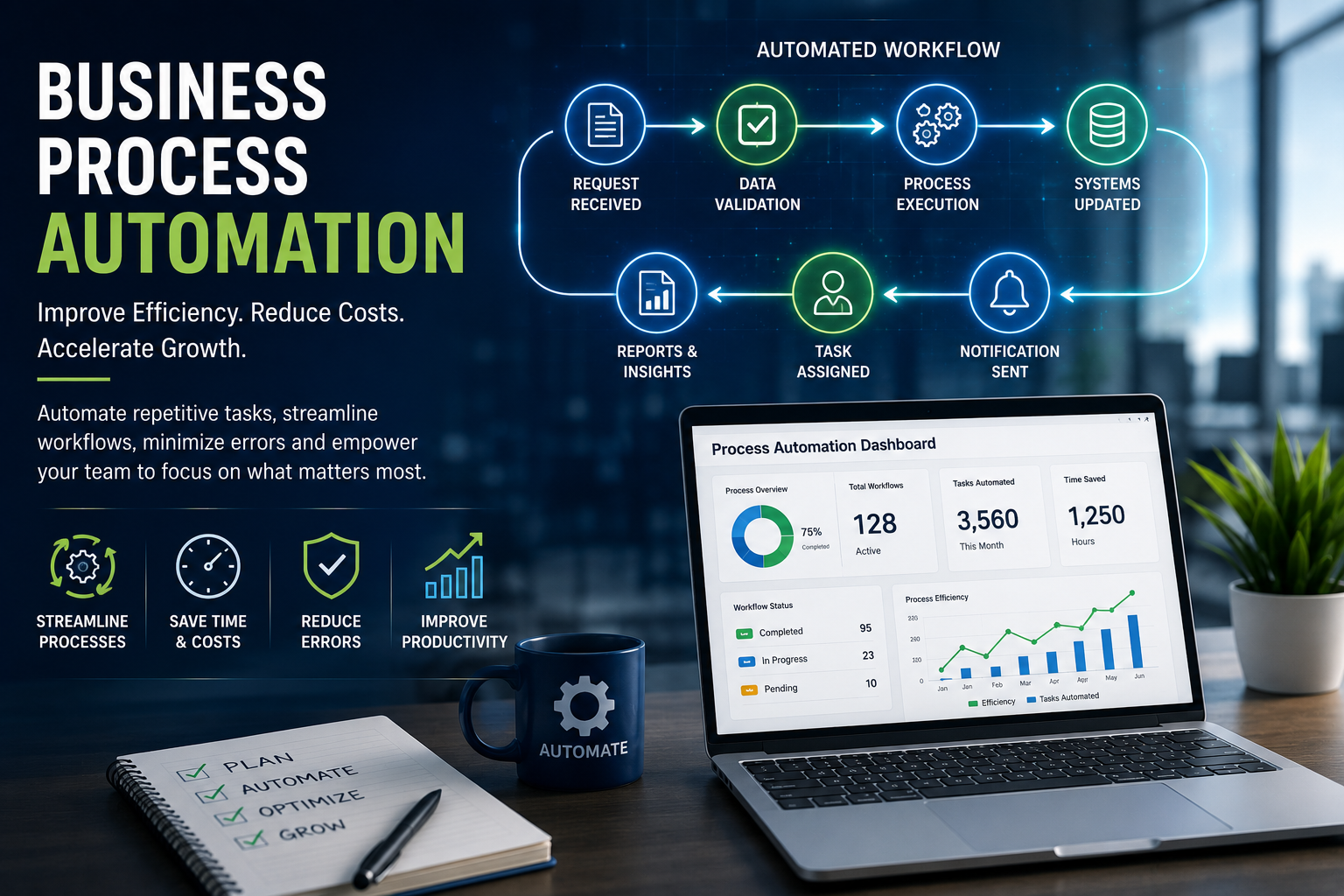
Customer inquiry → AI classification → Lead qualification → CRM update → Sales notification
Instead of requiring employees to perform every step manually, software can automate parts of the workflow while keeping humans involved where judgment is required.
The Rise of AI Agents in Software and Business Applications
One of the most important developments in 2026 is the movement from simple AI assistants toward AI agents.
Traditional AI applications may answer questions or generate content. AI agents can go further by interpreting a goal, planning multiple steps, interacting with systems, and completing tasks under defined permissions.
Google Cloud identifies agentic workflows as an important 2026 business trend, particularly for automating complex, multi-step processes.
For businesses, this can create opportunities such as:
- Automated lead qualification
- Intelligent customer service
- Automated report generation
- IT support workflows
- Data analysis
- Document processing
- Appointment management
- Internal knowledge management
However, organizations should implement appropriate security controls, permissions, monitoring, and human approval mechanisms for sensitive operations.
AI-Powered Software Development and Cloud Technology
Cloud platforms provide the infrastructure required to build and scale modern AI-powered applications.
Businesses can use cloud environments for:
- AI model integration
- Data storage
- Application hosting
- API management
- Scalable computing
- Analytics
- Monitoring
- Automated deployment
Cloud-based architecture also makes it easier to scale applications as demand changes.
A well-designed architecture should consider performance, security, cost, scalability, data governance, and future AI requirements from the beginning.
Challenges Businesses Should Consider
AI-powered software development offers significant opportunities, but organizations should also consider its limitations.
Security
AI-generated code and AI-powered applications must be reviewed for potential security vulnerabilities.
Data Privacy
Businesses need clear policies for handling confidential and customer data when AI systems are involved.
Quality Control
AI-generated output should not automatically be treated as production-ready. Testing, code review, and human validation remain important.
Integration
AI solutions must integrate properly with existing applications, databases, APIs, and business workflows.
Cost Management
AI usage can create infrastructure and model-processing costs. Organizations should select technology based on business value rather than simply choosing the most powerful model available.
Recent industry discussions have also highlighted the importance of controlling AI-related infrastructure and model usage costs as businesses scale AI deployments.
How Businesses Can Start With AI-Powered Software Development
A successful AI strategy does not require transforming every system at once.
Businesses can begin with a focused approach:
Step 1: Identify a Business Problem
Start with a measurable problem rather than a technology.
Step 2: Evaluate Existing Processes
Identify repetitive tasks, bottlenecks, and areas where employees spend significant time on manual work.
Step 3: Select the Right AI Approach
Depending on the requirement, the solution may involve generative AI, predictive analytics, AI agents, machine learning, or intelligent automation.
Step 4: Build a Controlled Pilot
Develop a limited proof of concept and measure its performance.
Step 5: Integrate With Existing Systems
Connect the AI solution with relevant databases, APIs, CRM systems, websites, or enterprise applications.
Step 6: Measure Business Results
Track metrics such as:
- Development time
- Processing time
- Operational costs
- Customer satisfaction
- Error rates
- Employee productivity
- Conversion rates
Step 7: Scale Strategically
Once the solution demonstrates measurable value, expand it across additional processes or departments.
The Future of AI-Powered Software Development
The future of software development will increasingly involve collaboration between developers and intelligent systems.
AI is unlikely to eliminate the need for skilled software professionals. Instead, the role of developers is evolving toward architecture, system design, validation, security, governance, and strategic problem-solving.
The most successful organizations will be those that treat AI as part of a broader technology strategy rather than as a standalone feature.
Conclusion
AI-powered software development is becoming an important part of modern digital transformation. From accelerating development workflows to enabling intelligent applications and automated processes, AI can help businesses build more efficient and scalable technology solutions.
However, successful implementation requires more than simply adopting AI tools. Businesses need the right architecture, data strategy, security controls, development processes, and measurable objectives.
By combining artificial intelligence with experienced software engineering, organizations can create digital solutions that are designed not only for today's requirements but also for future growth.
Frequently Asked Questions
What is AI-powered software development?
AI-powered software development uses artificial intelligence to assist with software development activities such as coding, testing, debugging, documentation, analysis, and application functionality.
How can AI improve software development?
AI can automate repetitive development tasks, assist developers with coding and testing, identify potential issues, and accelerate parts of the software development lifecycle.
Is AI replacing software developers?
AI is changing software development roles, but human expertise remains essential for architecture, security, business requirements, quality assurance, decision-making, and complex problem-solving.
Can small businesses use AI-powered software?
Yes. Small and medium-sized businesses can use AI for customer support, workflow automation, data analysis, marketing, document processing, and customized business applications.
How can Riotech help with AI-powered software development?
Riotech can help businesses plan, develop, integrate, and optimize custom digital solutions based on their technology and business requirements, including software development, intelligent applications, automation, and digital transformation solutions.
Build Smarter Software With Riotech
Businesses looking to integrate AI into their applications or modernize their software infrastructure need a solution that aligns technology with measurable business objectives.
Riotech can help transform business requirements into scalable, secure, and intelligent digital solutions.
Ready to explore AI-powered software development for your business? Contact Riotech to discuss your requirements and identify the right technology approach.
Recent Posts

15 May 2026