Business Process Automation: Improve Efficiency and Reduce Costs
How Business Process Automation Improves Efficiency and Reduces Operational Costs
Businesses across industries are under constant pressure to improve productivity, reduce operational costs, and deliver better customer experiences.
At the same time, many organizations still depend on repetitive manual processes. Employees may spend hours entering information, moving data between systems, preparing reports, processing documents, responding to routine requests, and completing administrative tasks.
Business process automation provides a practical way to address these challenges.
By using software, APIs, workflow engines, cloud platforms, artificial intelligence, and intelligent automation technologies, organizations can automate repetitive processes while allowing employees to focus on higher-value activities.
In 2026, automation is increasingly moving beyond simple rule-based workflows toward intelligent and agentic automation capable of supporting more complex business processes.
What Is Business Process Automation?
Business process automation is the use of technology to automate repetitive and structured business activities.
A traditional process may look like:
Employee receives request → checks information → enters data → sends email → updates system → creates report
With automation, the workflow can become:
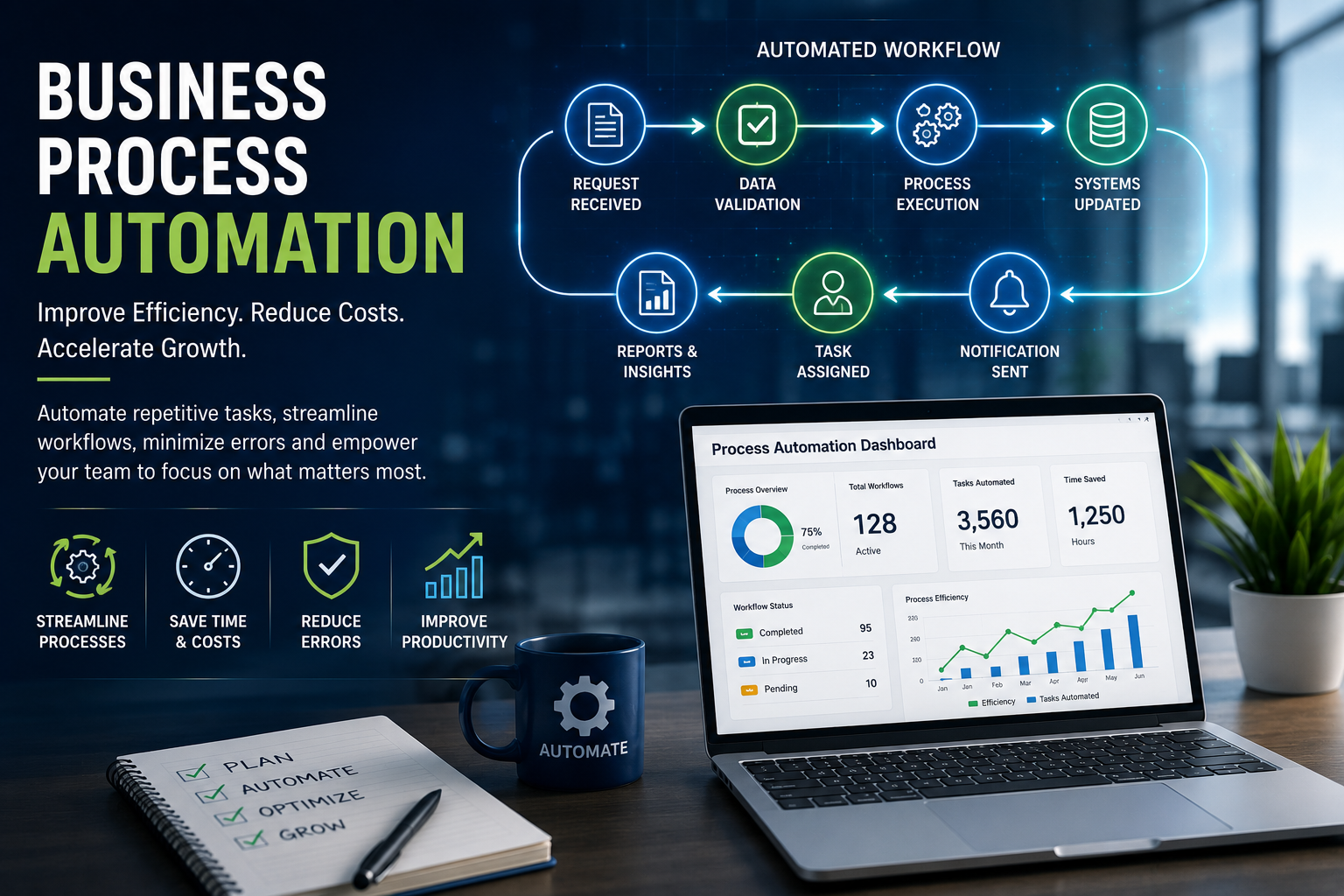
Request received → system validates information → workflow executes actions → relevant systems are updated → notification is generated
The objective is to make processes faster, more consistent, measurable, and scalable.
Why Business Process Automation Matters in 2026
Organizations are managing increasingly complex digital operations.
Businesses may use multiple systems for:
- Customer relationship management
- Accounting
- Human resources
- E-commerce
- Inventory
- Communication
- Project management
- Analytics
- Customer support
When these systems operate independently, employees often have to move information manually between platforms.
Automation can connect these systems and create a more efficient digital workflow.
Modern business process management is also incorporating artificial intelligence, process mining, intelligent automation, cloud BPM, and other technologies to make workflows more adaptive and data-driven.
Key Benefits of Business Process Automation
1. Reduced Manual Work
One of the most immediate benefits of automation is reducing repetitive tasks.
Examples include:
- Data entry
- Email notifications
- Invoice processing
- Report generation
- Lead assignment
- Appointment reminders
- Document routing
- Customer onboarding
Automating these activities can allow employees to focus on strategic and customer-facing responsibilities.
2. Improved Operational Efficiency
Manual processes often involve multiple handoffs.
Every additional handoff creates an opportunity for delay.
Automation can create predefined workflows that automatically move tasks from one stage to another.
For example:
New Lead → Lead Validation → Lead Assignment → CRM Update → Sales Notification → Follow-Up
This creates a structured process that can operate consistently.
3. Fewer Human Errors
Manual data entry can result in:
- Incorrect information
- Duplicate records
- Missing fields
- Incorrect calculations
- Delayed updates
Automation can apply predefined validation rules and transfer data between systems without repeated manual entry.
This does not eliminate all errors, but it can significantly reduce errors associated with repetitive processes.
4. Faster Customer Service
Customers expect fast responses.
Automation can help businesses acknowledge requests, route support tickets, send notifications, retrieve information, and initiate workflows without waiting for manual intervention.
AI can further enhance these workflows by interpreting unstructured information such as emails and documents.
This is particularly important because traditional rule-based automation can struggle with unstructured inputs and exceptions. Newer AI-driven approaches can help organizations handle more contextual workflows.
5. Better Employee Productivity
Automation should not simply be viewed as a cost-cutting mechanism.
Its greater value can come from allowing employees to spend more time on activities that require:
- Creativity
- Strategic thinking
- Customer relationships
- Problem-solving
- Decision-making
- Business development
Instead of spending hours on repetitive administrative work, employees can focus on tasks that contribute more directly to business growth.
Examples of Business Process Automation
Sales Automation
A business can automate lead capture and qualification.
Example workflow:
Website form submission → Lead validation → CRM entry → Lead scoring → Sales assignment → Follow-up notification
This can help sales teams respond more quickly to potential customers.
Finance Automation
Finance teams can automate:
- Invoice processing
- Payment reminders
- Expense approvals
- Financial reports
- Transaction notifications
This can improve consistency while reducing repetitive administrative work.
Human Resources Automation
HR processes that can benefit from automation include:
- Employee onboarding
- Leave requests
- Document collection
- Interview scheduling
- Employee notifications
- Offboarding workflows
Customer Support Automation
Customer support automation can include:
- Ticket creation
- Ticket categorization
- Priority assignment
- Automated notifications
- Knowledge-base recommendations
- Escalation workflows
E-Commerce Automation
Online businesses can automate:
- Order confirmation
- Inventory notifications
- Customer communication
- Shipping updates
- Abandoned-cart workflows
- Customer segmentation
Business Process Automation and AI
Traditional automation generally follows predefined rules.
For example:
If payment is received → update order status.
AI-enabled automation can handle more complex scenarios.
For example:
Analyze customer email → understand intent → identify relevant order → determine required action → initiate workflow → notify employee when human approval is required.
This combination of AI and automation is increasingly important because businesses deal with large amounts of unstructured data.
AI can help interpret information while automation can execute the resulting workflow.
The Rise of Agentic Automation
A major development in 2026 is the growing interest in agentic workflows.
AI agents can interpret objectives, plan multiple steps, interact with systems, and perform actions within defined boundaries.
Google Cloud describes agentic workflows as a major direction for business operations, where multiple AI capabilities can work together to automate complex processes.
For example, an automated customer onboarding process could involve:
- Receiving customer information
- Validating submitted documents
- Extracting required data
- Checking business rules
- Creating a customer record
- Sending confirmation
- Assigning follow-up tasks
- Escalating exceptions to an employee
This represents a significant evolution from simple task automation.
How Automation Reduces Operational Costs
Automation can influence operational costs in several ways.
Lower Administrative Effort
Employees spend less time performing repetitive tasks.
Reduced Processing Time
Automated workflows can operate continuously without waiting for manual intervention.
Fewer Errors
Reducing data-entry and processing errors can decrease rework.
Better Resource Allocation
Employees can spend more time on activities that generate business value.
Scalable Operations
Automated systems can often handle increased transaction volumes without requiring a proportional increase in manual effort.
However, businesses should evaluate automation based on measurable outcomes rather than assuming every process should be automated.
How to Identify Processes That Should Be Automated
Not every business process requires automation.
Good candidates typically have several of these characteristics:
- Highly repetitive
- Rule-based
- High volume
- Time-consuming
- Prone to manual errors
- Dependent on multiple systems
- Easy to measure
- Frequently delayed
A useful starting point is to identify processes where employees repeatedly perform the same sequence of actions.
A Practical Business Process Automation Strategy
Step 1: Map Existing Processes
Document how the process currently works.
Identify:
- Inputs
- Tasks
- Employees involved
- Systems used
- Approvals
- Outputs
- Common bottlenecks
Step 2: Identify Bottlenecks
Determine where delays, errors, or unnecessary manual work occur.
Step 3: Prioritize High-Value Processes
Start with processes where automation can produce measurable benefits.
Step 4: Select the Appropriate Technology
Depending on the process, businesses may use:
- Workflow automation
- API integrations
- Cloud applications
- RPA
- AI
- Business process management platforms
- Custom software
Step 5: Build and Test
Create the workflow and test it with real-world scenarios, including exceptions.
Step 6: Monitor Performance
Track metrics such as:
- Processing time
- Error rate
- Cost per transaction
- Employee hours saved
- Customer response time
- Workflow completion rate
Step 7: Continuously Improve
Automation should be reviewed regularly. As business requirements change, workflows should evolve as well.
Common Mistakes to Avoid
Automating a Poor Process
Automation cannot automatically fix a fundamentally inefficient process.
Businesses should optimize the process before automating it.
Ignoring Exceptions
Real-world processes rarely follow one perfect path. Automation systems should account for exceptions and escalation.
Choosing Technology Before Defining the Problem
The business objective should come first. Technology should support the requirement.
Ignoring Security
Automated systems often access sensitive business information. Access controls, authentication, monitoring, and security policies are essential.
Focusing Only on Cost Reduction
The best automation strategies also consider customer experience, employee productivity, scalability, quality, and business growth.
The Future of Business Process Automation
Business automation is moving toward intelligent, connected, and increasingly adaptive workflows.
AI, cloud computing, analytics, process mining, and agentic technologies are creating new possibilities for organizations to automate processes that previously required significant human intervention.
However, human oversight remains important.
The future is not simply about automating everything. It is about determining which tasks should be automated, which decisions require human judgment, and how technology can support employees more effectively.
Conclusion
Business process automation can help organizations improve efficiency, reduce repetitive work, minimize errors, accelerate operations, and create scalable workflows.
As AI becomes increasingly integrated with automation, businesses can move beyond basic rule-based workflows toward more intelligent systems capable of handling complex processes and unstructured information.
The organizations that gain the most value will be those that approach automation strategically. Instead of automating processes simply because technology is available, they will identify measurable business problems, select the right technology, monitor results, and continuously improve their workflows.
Frequently Asked Questions
What is business process automation?
Business process automation uses technology to automate repetitive and structured business processes, reducing manual work and improving operational efficiency.
What processes can businesses automate?
Businesses can automate sales, customer support, finance, HR, e-commerce, reporting, document processing, notifications, approvals, data entry, and many other repetitive workflows.
How does automation reduce business costs?
Automation can reduce the amount of manual work required, decrease processing time, reduce repetitive errors, and allow employees to focus on higher-value activities.
What is the difference between automation and AI automation?
Traditional automation generally follows predefined rules, while AI automation can interpret information, identify patterns, and support more complex or variable workflows.
Is business process automation suitable for small businesses?
Yes. Small businesses can begin with individual high-volume processes such as lead management, invoicing, customer communication, appointment scheduling, or reporting and expand automation as they grow.
How can Riotech help businesses with automation?
Riotech can help businesses identify automation opportunities and develop technology solutions that connect applications, automate workflows, improve operational processes, and support digital transformation.
Improve Your Business Processes With Riotech
Manual processes can limit productivity and make it difficult for businesses to scale efficiently.
Riotech can help organizations evaluate their workflows and develop customized software and automation solutions designed around their operational requirements.
Looking to automate repetitive business processes? Contact Riotech to discuss your requirements and identify opportunities for smarter, more efficient operations.
Recent Posts


15 May 2026