Cybersecurity for Businesses: Protect Data & Digital Assets
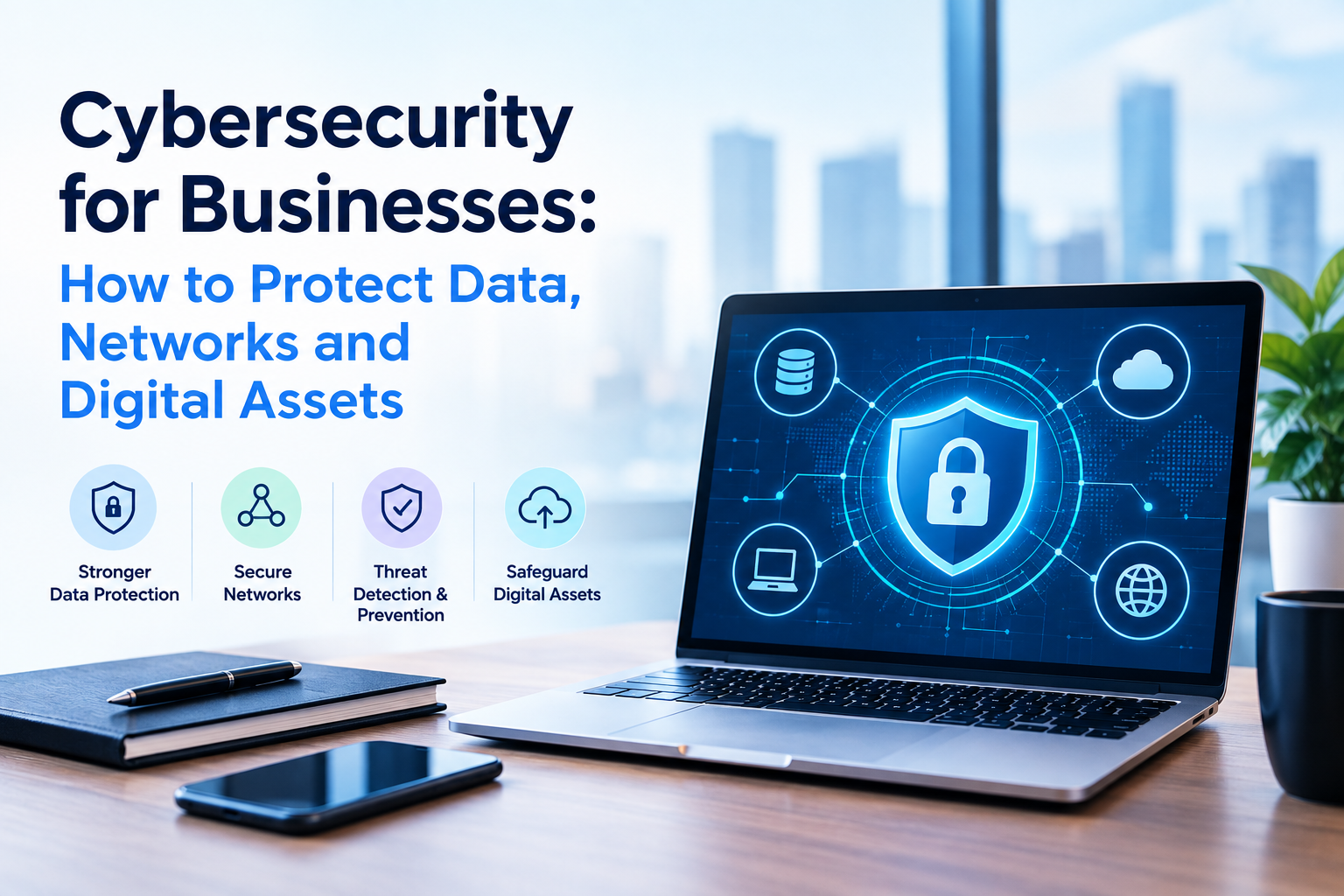
Cybersecurity for Businesses: How to Protect Data, Networks and Digital Assets
Businesses today rely on digital systems for almost every aspect of their operations. Customer information, financial records, employee data, applications, cloud platforms, and business communications are all connected through digital networks.
This growing dependence on technology also increases cybersecurity risks. Data breaches, phishing attacks, ransomware, malware, unauthorized access, and other cyber threats can disrupt operations and expose sensitive information.
For businesses of every size, cybersecurity is no longer only an IT responsibility. It is an important part of protecting business continuity, customer trust, and long-term digital growth.
What Is Business Cybersecurity?
Business cybersecurity refers to the technologies, processes, policies, and practices used to protect an organization's digital infrastructure and information from unauthorized access, attacks, damage, or disruption.
A comprehensive cybersecurity strategy can cover:
- Business networks
- Websites and applications
- Databases
- Cloud environments
- Employee devices
- Customer information
- Business accounts
- Internal systems
- Digital communication platforms
The objective is to identify potential risks, reduce vulnerabilities, detect suspicious activity, and respond effectively when security incidents occur.
1. Protect Sensitive Business Data
Data is one of the most valuable digital assets for modern businesses. Customer records, payment information, employee details, intellectual property, and confidential documents need appropriate protection.
Businesses should implement measures such as:
- Data encryption
- Secure access controls
- Regular backups
- Password protection
- Data classification
- Access monitoring
- Secure data storage
Access to sensitive information should be limited according to employees' actual business requirements.
2. Secure Business Networks
A company's network connects employees, systems, applications, servers, and devices. If the network is poorly protected, attackers may find opportunities to gain unauthorized access.
Network security can involve:
- Firewalls
- Network monitoring
- Secure Wi-Fi configuration
- Intrusion detection
- Network segmentation
- Access controls
- Regular vulnerability assessments
RioTech provides Cyber Security Solutions focused on protecting business networks and digital infrastructure from unauthorized access and cyber threats.
3. Strengthen Password and Authentication Security
Weak or reused passwords can create unnecessary security risks. Businesses should establish strong authentication policies across important systems and accounts.
Recommended practices include:
- Using strong, unique passwords
- Enabling multi-factor authentication
- Using password managers where appropriate
- Reviewing account permissions
- Removing inactive accounts
- Protecting administrator accounts
Multi-factor authentication provides an additional security layer by requiring more than just a password to access an account.
4. Protect Against Phishing Attacks
Phishing remains a common method used to target employees and organizations. Attackers may use emails, messages, fake login pages, or impersonation techniques to trick users into revealing credentials or opening malicious content.
Businesses can reduce this risk through:
- Employee security awareness training
- Email security controls
- Multi-factor authentication
- Suspicious-link awareness
- Regular security testing
- Clear incident-reporting procedures
Employees should know how to identify suspicious messages and where to report potential security incidents.
5. Secure Websites and Applications
Websites and business applications can become targets if vulnerabilities are not identified and addressed.
Application security should include:
- Secure coding practices
- Vulnerability testing
- Authentication controls
- Input validation
- Secure APIs
- Regular software updates
- Security testing before deployment
Security should be considered throughout the application development lifecycle rather than only after an application has been launched.
6. Protect Cloud Environments
Cloud platforms provide flexibility and scalability, but businesses still need to manage security responsibilities carefully.
Cloud security practices can include:
- Identity and access management
- Role-based permissions
- Data encryption
- Secure configuration
- Activity monitoring
- Backup strategies
- Regular security assessments
Businesses should regularly review cloud permissions to ensure users and applications have only the access they actually require.
7. Keep Software and Systems Updated
Outdated software can contain vulnerabilities that attackers may exploit. Operating systems, applications, plugins, frameworks, and security tools should therefore be updated regularly.
A structured patch-management process can help organizations:
- Identify outdated software.
- Monitor relevant security updates.
- Test important updates where necessary.
- Deploy patches systematically.
- Verify that systems remain operational.
Keeping technology updated is one of the fundamental components of a proactive cybersecurity strategy.
8. Create Reliable Backup and Recovery Plans
Cybersecurity is not only about preventing attacks. Businesses also need to prepare for situations where systems or data become unavailable.
Regular backups can help organizations recover from incidents such as:
- Ransomware
- Hardware failures
- Accidental deletion
- System corruption
- Data loss
- Operational disruptions
Backups should be protected from unauthorized access and periodically tested to confirm that data can actually be restored.
9. Monitor Security Events
Prevention alone is not enough. Businesses should also monitor systems for suspicious activity.
Security monitoring can help identify:
- Unusual login attempts
- Unauthorized access
- Suspicious network traffic
- Malware activity
- Unexpected changes
- Abnormal system behaviour
Continuous threat monitoring can help organizations identify and respond to potential security issues before they cause greater operational impact. RioTech's cybersecurity services include threat monitoring as part of its security offering.
10. Develop an Incident Response Plan
Even organizations with strong security controls can experience incidents. Having a predefined response plan can help reduce confusion during a cybersecurity event.
An incident response plan should define:
- Who is responsible for responding
- How incidents are reported
- Which systems should be isolated
- How evidence is preserved
- How customers or stakeholders are notified when required
- How systems are restored
- How the incident is reviewed afterward
A clear process allows teams to respond in a structured way instead of making decisions under pressure.
11. Train Employees Regularly
Technology cannot completely protect an organization if employees are unaware of common security risks.
Regular cybersecurity awareness training can cover:
- Phishing
- Password security
- Social engineering
- Safe browsing
- Device security
- Data handling
- Suspicious attachments
- Incident reporting
Security awareness should be treated as an ongoing process rather than a one-time training session.
12. Conduct Regular Security Assessments
Cybersecurity threats and business technology continuously evolve. Regular security assessments can help organizations identify weaknesses before attackers discover them.
Businesses can evaluate:
- Network security
- Application vulnerabilities
- Access permissions
- Cloud configurations
- Endpoint protection
- Data security
- Backup systems
- Security policies
The results can then be used to prioritize improvements according to the organization's risk profile and business requirements.
Why Cybersecurity Matters for Business Growth
A cybersecurity strategy protects more than technical infrastructure. It can support business continuity, customer confidence, regulatory requirements, and the safe adoption of new technologies.
When businesses integrate security into their digital strategy, they can build stronger foundations for:
- Cloud adoption
- Digital transformation
- E-commerce
- Remote work
- Business applications
- Data-driven operations
- AI and automation
Cybersecurity should therefore be considered an ongoing business investment rather than a one-time technical expense.
Conclusion
Protecting digital assets requires a combination of technology, processes, employee awareness, and continuous monitoring. Businesses should secure their networks, protect sensitive data, strengthen authentication, update systems, maintain reliable backups, and prepare for potential security incidents.
As digital operations continue to expand, organizations need cybersecurity strategies that can evolve alongside their technology.
RioTech Softwares provides cybersecurity solutions covering areas such as network protection, data security, threat monitoring, and firewall management for modern digital environments.
Businesses looking to strengthen their digital infrastructure can explore RioTech's Cyber Security Services and evaluate solutions based on their security requirements.