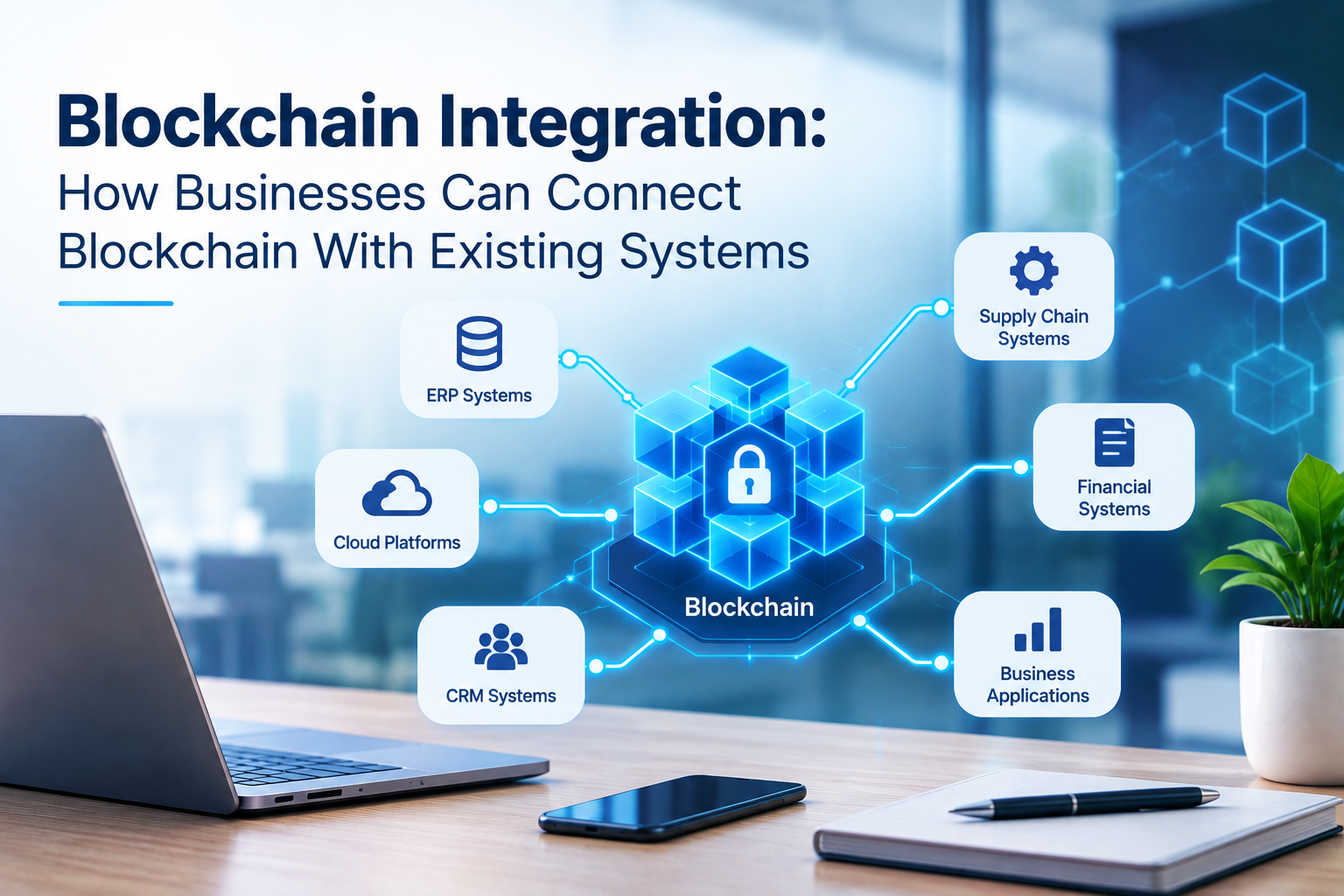
Blockchain Integration: How Businesses Can Connect Blockchain With Existing Systems
Blockchain Integration: How Businesses Can Connect Blockchain With Existing Systems
Blockchain technology is no longer limited to cryptocurrency. Businesses across finance, supply chain, healthcare, real estate, e-commerce, and other industries are exploring blockchain to improve transparency, transaction security, traceability, and process automation.
However, adopting blockchain does not necessarily mean replacing an organization's existing software infrastructure. In many cases, businesses can integrate blockchain with their current ERP, CRM, payment platforms, databases, APIs, and enterprise applications.
This approach allows organizations to introduce blockchain capabilities while continuing to use the systems that already support their daily operations.
What Is Blockchain Integration?
Blockchain integration is the process of connecting a blockchain network or blockchain-based application with existing business software and infrastructure.
For example, a company may already use:
- ERP software for business operations
- CRM software for customer management
- Payment systems for transactions
- Databases for operational data
- Cloud platforms for application hosting
- APIs for connecting applications
Blockchain can be introduced as an additional technology layer rather than replacing these systems completely.
A well-designed integration can allow information and transaction events to move between traditional applications and blockchain networks.
Why Businesses Are Considering Blockchain Integration
Traditional business systems can work effectively, but organizations may face challenges when multiple parties need to share and verify transaction information.
Blockchain can provide a shared and tamper-resistant record of selected transactions, depending on the blockchain architecture and implementation.
Potential business applications include:
- Transaction verification
- Supply chain traceability
- Digital asset management
- Automated agreements
- Identity and credential verification
- Payment workflows
- Audit trails
- Multi-party data sharing
The objective is not to put every piece of business data on a blockchain. Instead, businesses should identify specific processes where blockchain provides a meaningful technical advantage.
How Blockchain Works With Existing Business Systems
A typical blockchain integration can include several layers:
Existing Business Application → API / Integration Layer → Blockchain Network → Smart Contract → Blockchain Record
For example, when an order is created in an ERP system, an integration layer could send selected transaction information to a blockchain network.
The blockchain can then record the relevant event, while the ERP continues to manage the organization's internal operational data.
This allows businesses to maintain their existing applications while introducing blockchain capabilities where they are required.
Key Systems That Can Be Connected With Blockchain
1. ERP Systems
Enterprise Resource Planning systems manage important business processes such as procurement, inventory, finance, manufacturing, and operations.
Blockchain can complement an ERP by recording selected transactions that require shared verification between different organizations.
For example:
Purchase Order → Supplier Confirmation → Blockchain Record → Delivery Verification → Payment Process
The ERP remains the primary operational system, while blockchain can provide an additional layer for transaction verification and traceability.
2. CRM Platforms
Customer Relationship Management systems contain valuable customer and sales information.
Blockchain integration can be considered for specific use cases involving customer identity, transaction verification, loyalty programs, digital credentials, or multi-party data sharing.
Businesses should carefully determine what information belongs on-chain and what should remain within the CRM or database.
Sensitive customer information generally should not automatically be placed on a public blockchain.
3. Payment Systems
Blockchain can also interact with payment infrastructure.
Depending on the use case and applicable regulations, blockchain-based systems can support transaction tracking, digital assets, automated settlement processes, and smart-contract-based payment conditions.
For example:
Transaction Initiated → Conditions Verified → Smart Contract Triggered → Transaction Recorded → System Updated
The existing payment or financial platform can continue to perform its required functions while blockchain handles specific verification or settlement processes.
4. Supply Chain Management Systems
Supply chains involve multiple participants, including manufacturers, suppliers, logistics providers, distributors, and retailers.
Because information moves between multiple organizations, blockchain can be considered for improving traceability.
A blockchain-integrated supply chain may record events such as:
- Product creation
- Shipment dispatch
- Transportation updates
- Delivery confirmation
- Quality verification
- Ownership transfers
Existing supply chain software can continue managing operational information while selected events are recorded on the blockchain.
5. Databases and APIs
APIs are one of the most important components of blockchain integration.
Instead of allowing every existing application to communicate directly with the blockchain network, businesses can use an integration layer or API to control communication.
A simplified architecture may look like:
Business Application → REST API → Integration Service → Blockchain Network
This architecture can make the overall system easier to manage and allows organizations to control authentication, validation, data transformation, logging, and error handling.
The Role of Smart Contracts
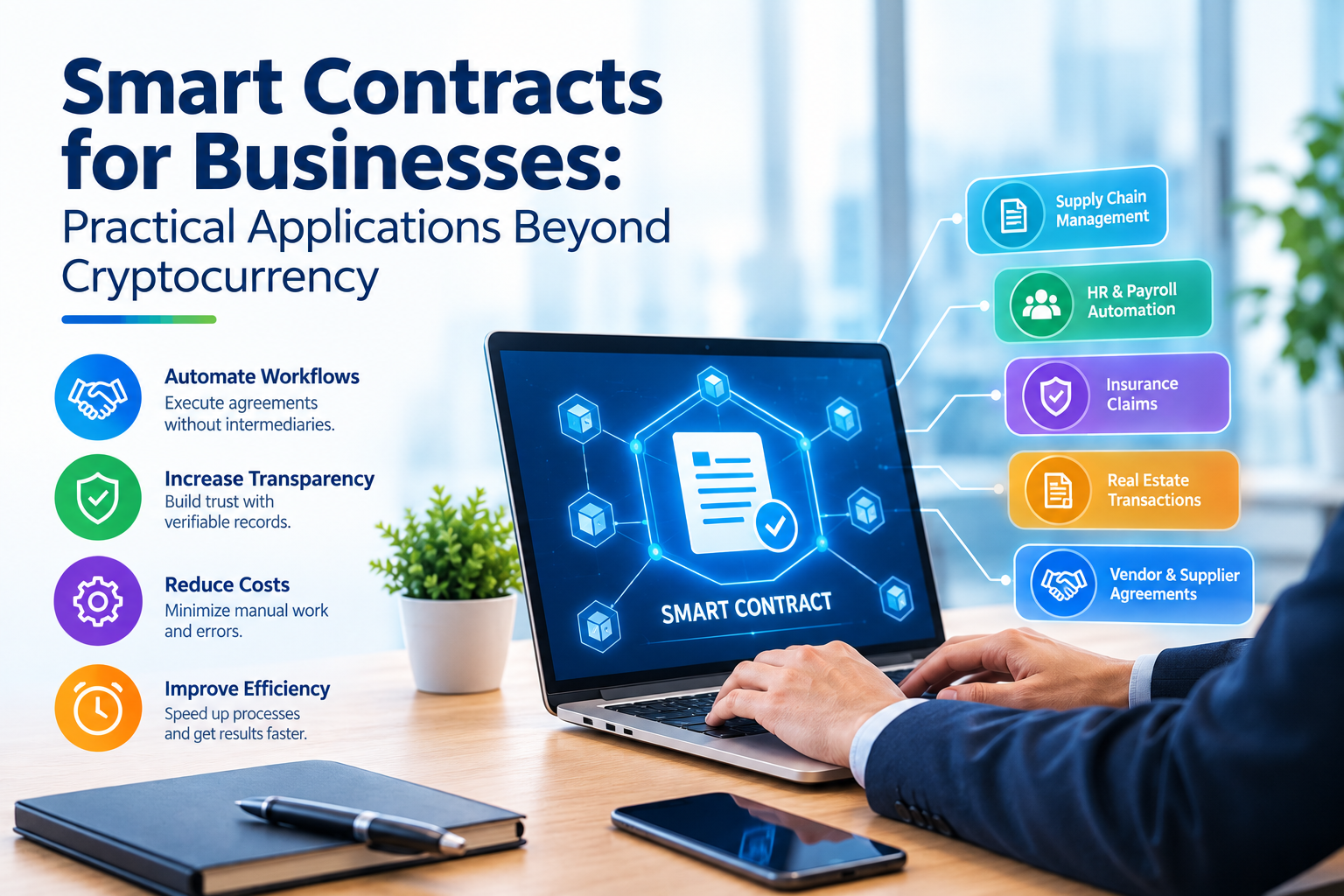
Smart contracts can automate predefined actions when specific conditions are satisfied.
For example, a supply-chain workflow might use a smart contract to trigger a predefined action after a verified delivery event.
A simplified workflow could be:
Order Created → Delivery Confirmed → Smart Contract Executes → Transaction Status Updated
RIOTECH's Blockchain Development services include smart contract solutions designed for automated digital transactions and workflows.
However, smart contracts should be designed carefully because their logic directly affects the automated process. Businesses should test the code thoroughly and establish appropriate security and governance procedures.
Benefits of Connecting Blockchain With Existing Systems
1. Better Traceability
Blockchain can provide a chronological record of selected transactions and events.
This can be useful when businesses need to track the movement or history of assets, transactions, or documents across multiple participants.
2. Improved Transparency
Depending on the blockchain architecture, authorized participants can access a shared record of relevant transactions.
This can reduce the need for different organizations to maintain completely separate versions of the same transaction history.
3. Process Automation
Smart contracts can automate predefined steps based on specified conditions.
This can reduce manual intervention in suitable business workflows.
4. Stronger Transaction Verification
Blockchain can provide cryptographically secured records that can help participating parties verify transaction history.
However, blockchain does not automatically guarantee that the information entered into the system is accurate. External data sources and input validation remain important.
5. Integration Without Complete System Replacement
One of the major advantages of an integration-focused approach is that businesses do not necessarily need to replace their entire existing technology stack.
Blockchain can be introduced gradually alongside existing applications.
Challenges of Blockchain Integration
Blockchain integration also introduces technical and operational considerations.
Data Privacy
Businesses need to determine which information should be stored on-chain and which information should remain in traditional databases.
Sensitive or personally identifiable information may require additional privacy protections.
Scalability
Blockchain networks can have different performance and throughput characteristics compared with traditional databases.
The architecture should therefore be designed according to the expected transaction volume and business requirements.
Integration Complexity
Connecting blockchain with ERP, CRM, payment systems, databases, and APIs can require careful system architecture.
Data formats, authentication, error handling, monitoring, and synchronization all need to be considered.
Smart Contract Security
Smart contracts can automate important business processes, which makes security testing particularly important.
Code should be reviewed and tested before being used in production environments.
Regulatory Requirements
Blockchain applications may involve financial transactions, digital assets, customer information, or other regulated activities.
Businesses should evaluate applicable legal and regulatory requirements before deployment.
A Practical Blockchain Integration Roadmap
Businesses can approach blockchain integration in several stages.
Step 1: Identify the Business Problem
Start with a specific business requirement rather than choosing blockchain simply because it is a current technology trend.
Ask:
- What problem are we trying to solve?
- Which parties need to share information?
- Is there a need for a shared transaction record?
- Can blockchain provide measurable value?
Step 2: Analyze the Existing Technology Stack
Review the current ERP, CRM, databases, APIs, payment systems, cloud infrastructure, and other applications.
This helps determine where blockchain should connect with the existing architecture.
Step 3: Select the Right Blockchain Architecture
Businesses should evaluate whether a public, private, or permissioned blockchain architecture is appropriate for the use case.
The choice depends on factors such as participants, privacy requirements, transaction volume, governance, and business objectives.
Step 4: Design the Integration Layer
APIs and middleware can provide communication between traditional applications and blockchain networks.
The integration layer can manage:
- Authentication
- Data validation
- Data transformation
- Transaction requests
- Error handling
- Monitoring
- Logging
Step 5: Develop and Test Smart Contracts
If smart contracts are required, their logic should be clearly defined and extensively tested.
Security testing should be performed before production deployment.
Step 6: Start With a Pilot
Rather than integrating blockchain across the entire organization immediately, businesses can begin with one clearly defined use case.
A pilot makes it easier to measure performance, identify integration challenges, and refine the architecture.
Step 7: Scale Gradually
After validating the initial implementation, the organization can expand blockchain integration to additional workflows and systems.
Blockchain Integration vs. Complete Blockchain Replacement
Businesses sometimes assume that adopting blockchain requires replacing their existing systems.
That is not necessarily the case.
| Traditional Approach | Blockchain Integration Approach |
|---|---|
| Existing systems remain isolated | Blockchain connects with existing systems |
| Data primarily stored in internal databases | Selected records can be stored or verified through blockchain |
| Manual verification may be required | Selected processes can use automated verification |
| Traditional workflows | Hybrid workflows |
| Large-scale system replacement may be considered | Gradual technology adoption |
For many organizations, a hybrid architecture can provide a practical way to introduce blockchain without disrupting core business operations.
How RIOTECH Softwares Can Support Blockchain Integration
Successful blockchain adoption requires more than blockchain development alone. Businesses also need software architecture, APIs, security, application integration, and an understanding of existing enterprise systems.
RIOTECH Softwares provides Blockchain Development solutions focused on secure and scalable blockchain applications, including smart contracts, decentralized applications, crypto wallet solutions, and blockchain integration.
Businesses can explore RIOTECH's blockchain services here:
RIOTECH Blockchain Development
The objective is to connect blockchain capabilities with practical business requirements while maintaining compatibility with the organization's existing digital infrastructure.
Conclusion
Blockchain integration provides businesses with an opportunity to introduce decentralized technology without necessarily replacing their existing software systems.
By connecting blockchain with ERP platforms, CRM systems, payment infrastructure, databases, APIs, and supply-chain applications, organizations can build hybrid technology environments that combine traditional software with blockchain capabilities.
The most effective implementations begin with a clearly defined business problem. Companies should evaluate privacy, scalability, security, integration complexity, and regulatory requirements before selecting an architecture.
Rather than treating blockchain as a complete replacement for existing technology, businesses can approach it as an additional technology layer that solves specific problems where shared records, verification, traceability, or automated transactions provide measurable value.
For organizations planning their next blockchain initiative, explore RIOTECH Softwares' Blockchain Development solutions to learn how blockchain technology can be integrated into modern business applications.