Cloud Application Development in 2026: Build Scalable & Secure Apps
Cloud Application Development in 2026: How Businesses Can Build Scalable, Secure and AI-Ready Applications
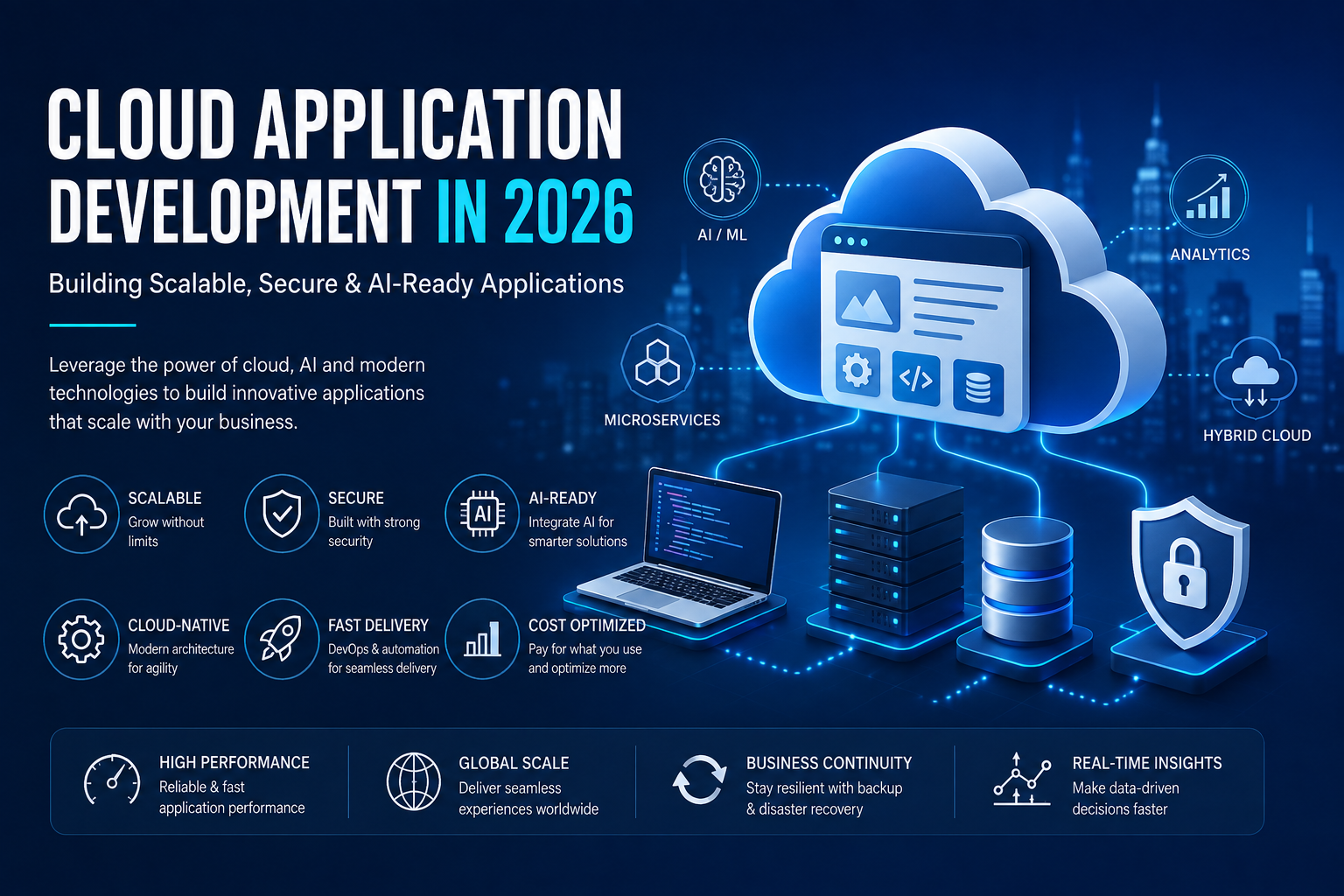
Businesses are rapidly moving beyond traditional software infrastructure and adopting cloud-based applications that can scale with changing business requirements.
In 2026, cloud application development is evolving further as organizations combine cloud computing, artificial intelligence, automation, data analytics and modern application architectures.
This transformation is particularly important for businesses that need applications capable of handling growing users, increasing data volumes and AI-powered workloads.
India's cloud-native ecosystem is also expanding rapidly. A 2026 CNCF and SlashData report estimates that India has 2.25 million cloud-native developers, while hybrid cloud adoption has reached 44%, making it the most popular deployment model among Indian developers.
For businesses, the question is no longer simply whether to use the cloud. The focus is increasingly on how to build cloud applications that are scalable, secure, cost-efficient and ready for AI-driven workloads.
What Is Cloud Application Development?
Cloud application development is the process of designing, developing, deploying and managing software applications using cloud infrastructure and services.
Unlike traditional applications that may depend heavily on physical servers and fixed infrastructure, cloud applications can use resources dynamically according to business requirements.
Modern cloud applications commonly use technologies such as:
- Cloud computing platforms
- APIs
- Microservices
- Containers
- Kubernetes
- Serverless computing
- Databases
- DevOps and CI/CD
- Artificial intelligence
- Data analytics
- Cloud security services
This architecture enables businesses to develop applications that can adapt to changing workloads and user requirements.
Why Cloud Application Development Matters in 2026
Modern businesses need software that can evolve quickly.
A traditional application architecture may become difficult to scale when user traffic, data volume or business operations increase.
Cloud application development addresses these challenges by providing access to flexible infrastructure and modern development technologies.
Businesses can use cloud applications to:
- Scale applications more efficiently
- Reduce dependence on physical infrastructure
- Support remote access
- Improve deployment speed
- Integrate AI capabilities
- Automate infrastructure management
- Improve business continuity
- Connect multiple applications through APIs
Cloud strategies are also changing because organizations are increasingly balancing AI requirements, security, cost and operational flexibility. Industry research points to AI workloads, multi-cloud, security and observability as major considerations for cloud strategies in 2026.
Key Cloud Application Development Trends in 2026
1. AI-Ready Cloud Applications
One of the biggest changes in cloud development is the integration of AI into business applications.
Businesses are adding capabilities such as:
- AI-powered search
- Intelligent recommendations
- Automated customer support
- Predictive analytics
- Document processing
- AI assistants
- Intelligent workflow automation
- Natural language interfaces
This means modern applications increasingly need architectures capable of supporting AI models, data pipelines and real-time processing.
Cloud infrastructure provides the scalability required for many of these workloads.
2. Hybrid Cloud Architecture
Hybrid cloud is becoming increasingly important for organizations that need flexibility over where applications and data are hosted.
A hybrid cloud environment can combine:
Private infrastructure + Public cloud + On-premise systems
This can allow businesses to keep certain workloads under tighter control while using public cloud infrastructure for scalable workloads.
The 2026 CNCF and SlashData India report identifies hybrid cloud as the leading deployment model among Indian developers, with adoption reaching 44%.
For enterprises with complex infrastructure requirements, hybrid cloud can provide a practical path toward modernization.
3. Cloud-Native Application Development
Cloud-native development focuses on building applications specifically for cloud environments rather than simply moving existing applications to the cloud.
Common cloud-native technologies include:
- Containers
- Kubernetes
- Microservices
- APIs
- Serverless platforms
- Infrastructure as Code
- Automated CI/CD pipelines
- Cloud-native applications can be designed as smaller, modular components that can be developed, deployed and scaled independently.
This can make large applications easier to maintain and evolve.
4. Application Modernization
Many businesses still operate applications built on older technologies.
These legacy systems can create challenges related to:
- Maintenance
- Scalability
- Security
- Integration
- Development speed
- Infrastructure costs
- Application modernization involves updating these systems using modern technologies and architectures.
- Modernization does not always require completely replacing an existing system.
- Businesses can gradually modernize applications through approaches such as:
- API integration
- Database modernization
- Containerization
- Microservices
- Cloud migration
- Infrastructure automation
- User interface modernization
Cloudflare's 2026 application innovation research found that organizations prioritizing application modernization were more likely to report AI benefits, while legacy technology and technical debt were associated with security and development challenges.
5. Cloud Security Is Becoming More Important
As businesses move more applications and data into cloud environments, security becomes a fundamental part of application architecture.
The cloud threat landscape is also evolving.
The Cloud Security Alliance's 2026 research identifies identity, AI, third-party dependencies and APIs among major cloud security concerns. It also highlights AI-enhanced attacks and AI system compromise as emerging threats.
Businesses should therefore consider security throughout the development lifecycle.
Important measures include:
- Identity and access management
- Multi-factor authentication
- Encryption
- API security
- Secure development practices
- Vulnerability management
- Continuous monitoring
- Backup and recovery
- Security testing
6. DevOps and Continuous Delivery
Cloud application development works closely with DevOps practices.
Instead of manually deploying every software update, development teams can automate many stages of the delivery pipeline.
A modern CI/CD pipeline can include:
Code → Build → Test → Security Scan → Deploy → Monitor
This approach can help teams release updates faster while reducing repetitive manual processes.
DevOps also enables closer collaboration between development and operations teams.
7. Observability and Real-Time Monitoring
As cloud environments become more distributed, monitoring individual servers is no longer enough.
Businesses need visibility across:
- Applications
- APIs
- Databases
- Containers
- Cloud infrastructure
- Networks
- User activity
Observability tools can help development and operations teams understand application performance and identify problems more quickly.
This becomes especially important when applications depend on multiple services and external APIs.
Benefits of Cloud Application Development
Scalability
Cloud applications can be designed to handle changing workloads.
Businesses can increase resources when demand rises and optimize infrastructure when demand decreases.
Faster Development
Cloud services, APIs, managed databases and development platforms can reduce the amount of infrastructure developers need to build manually.
Cost Optimization
Cloud-based infrastructure can help businesses move away from large upfront hardware investments and adopt more flexible infrastructure models.
However, cloud cost management remains important, particularly for AI-intensive workloads.
Better Accessibility
Cloud applications can support users across different locations and devices, depending on application architecture and security policies.
Easier Integration
APIs and cloud services make it easier to connect applications with:
- CRM platforms
- Payment systems
- Analytics tools
- AI services
- Business databases
- Communication platforms
Improved Business Agility
Modern cloud architectures allow businesses to introduce new features and services without completely rebuilding their technology infrastructure.
How to Build a Successful Cloud Application
Step 1: Define Business Requirements
Before choosing technology, clearly identify:
- Target users
- Business objectives
- Required features
- Expected traffic
- Data requirements
- Security requirements
- Integration requirements
Step 2: Choose the Right Architecture
Depending on the project, businesses may choose:
- Monolithic architecture
- Microservices
- Serverless architecture
- Event-driven architecture
- Hybrid architecture
The architecture should be selected according to business requirements rather than technology trends alone.
Step 3: Select the Cloud Environment
Businesses should evaluate factors such as:
- Performance
- Security
- Cost
- Compliance
- Availability
- Geographic requirements
- Existing technology ecosystem
Step 4: Build Security Into Development
Security should be considered from the initial architecture stage rather than added after development is completed.
Step 5: Implement DevOps
Automated testing, deployment and monitoring can improve development efficiency and reliability.
Step 6: Monitor and Optimize
After deployment, continuously monitor:
- Performance
- Infrastructure usage
- Security
- Costs
- User behavior
- Application availability
- Optimization should be an ongoing process.
Cloud Application Development and AI: A Powerful Combination
The convergence of cloud computing and AI is creating new opportunities for businesses.
Cloud platforms can provide the infrastructure required for:
- AI model deployment
- Data processing
- Machine learning workloads
- AI APIs
- Intelligent automation
- Real-time analytics
At the same time, AI can improve cloud operations through intelligent monitoring, predictive analysis and automation.
This creates a technology cycle where:
- Cloud provides scalable infrastructure.
- Data provides business intelligence.
- AI provides intelligent capabilities.
- Automation improves operational efficiency.
Together, these technologies can form the foundation of modern digital products.
Challenges Businesses Should Consider
Cloud application development offers major advantages, but businesses should also plan for potential challenges.
Cloud Costs
Poorly managed infrastructure can lead to unnecessary spending.
Security Risks
Misconfigured cloud services, weak identity controls and insecure APIs can create vulnerabilities.
Technical Complexity
Distributed applications can be more complex to monitor and maintain.
Legacy Integration
Connecting modern cloud applications with older systems may require additional architecture and development work.
Vendor Dependency
Businesses should carefully evaluate cloud service dependencies and portability requirements.
Skills
Cloud-native development requires knowledge of modern technologies, architecture, security and DevOps practices.
The Future of Cloud Application Development
The future of cloud application development will be increasingly connected to AI, automation and intelligent infrastructure.
Applications will not simply run in the cloud. They will increasingly use cloud infrastructure to:
- Process large amounts of data
- Run AI models
- Automate business processes
- Deliver personalized experiences
- Scale dynamically
- Monitor themselves more intelligently
- Connect distributed business systems
At the same time, security and governance will become increasingly important as AI and cloud environments become more interconnected.
Google's 2026 cybersecurity forecast warns that attackers are using AI to increase the speed and effectiveness of attacks, while defenders are also adopting AI agents to strengthen security operations.
This makes secure-by-design cloud architecture increasingly important for businesses.
Final Thoughts
Cloud application development is becoming a strategic technology choice for businesses that want to build scalable and adaptable digital products.
In 2026, the strongest cloud strategies are moving beyond basic migration.
Businesses are increasingly focusing on:
Cloud-native architecture + AI + Automation + Security + Observability
Organizations that invest in modern application architecture can create technology platforms capable of evolving with changing customer expectations and market conditions.
The goal is not simply to move an application to the cloud.
The goal is to build a smarter, more scalable, secure and future-ready digital platform.
Frequently Asked Questions
What is cloud application development?
Cloud application development is the process of building, deploying and managing software applications using cloud infrastructure and services.
What are the main benefits of cloud applications?
Key benefits include scalability, flexibility, faster deployment, easier integration, improved accessibility and the ability to support modern technologies such as AI and automation.
What is cloud-native application development?
Cloud-native development involves designing applications specifically for cloud environments using technologies such as containers, microservices, Kubernetes, APIs and serverless platforms.
Is cloud application development suitable for small businesses?
Yes. Small businesses can use cloud applications to access scalable infrastructure and modern software capabilities without investing heavily in physical infrastructure.
Why is cloud security important?
Cloud applications often handle business data, APIs and user identities. Strong security controls help protect applications from unauthorized access, data exposure and evolving cyber threats.
How does AI work with cloud applications?
Cloud platforms can provide the computing, storage and data infrastructure required to deploy AI models and integrate AI capabilities into business applications.
Build Your Next Cloud Application With Riotech
Modern businesses need more than basic software. They need digital platforms that can scale, integrate with emerging technologies and remain secure as the business grows.
Riotech helps businesses develop modern digital solutions using cloud application development, software engineering, AI integration, automation and modern technology architectures.
If your business is planning a new cloud application or looking to modernize an existing system, connect with Riotech to discuss your requirements and build a scalable, secure and future-ready solution.