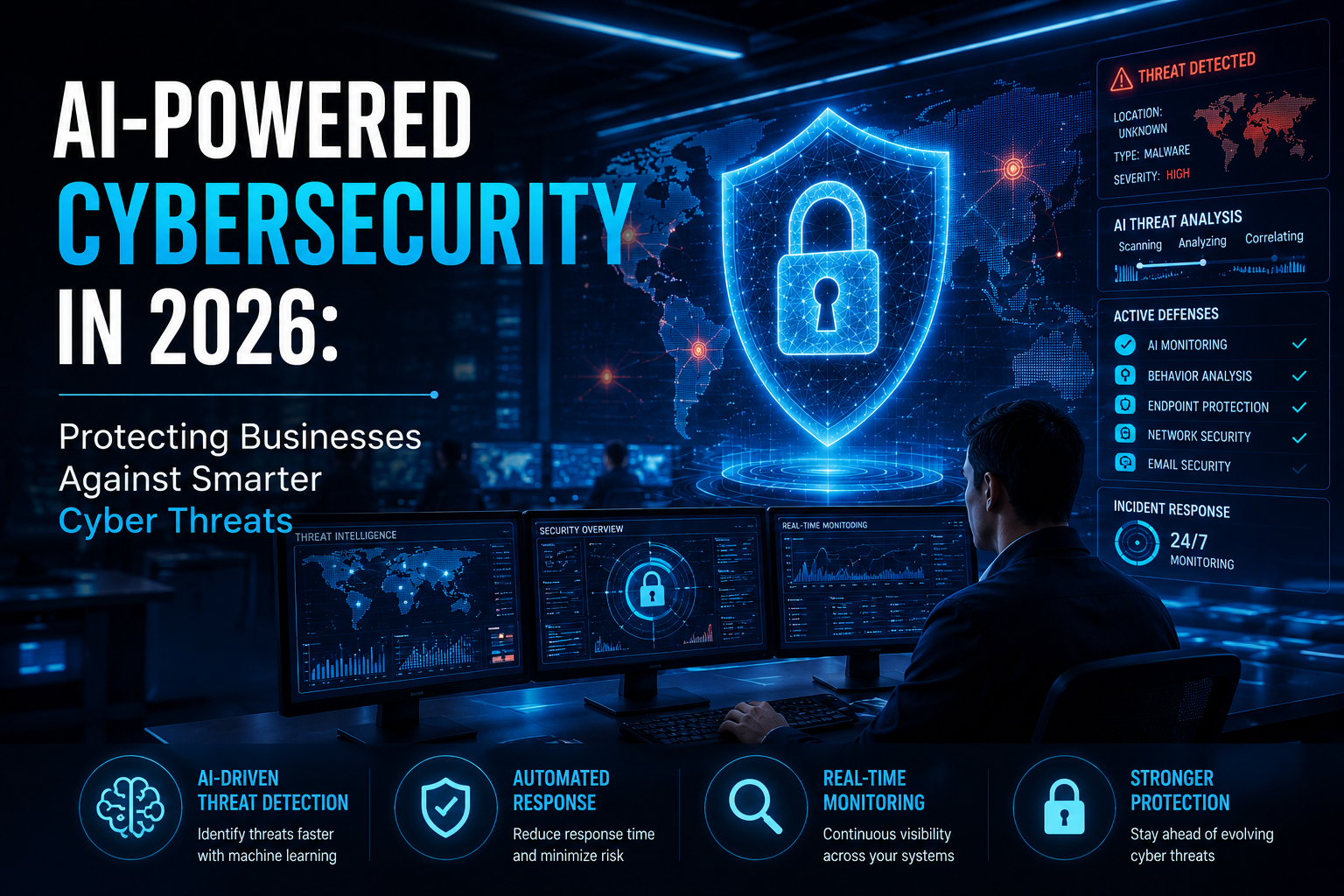
AI-Powered Cybersecurity in 2026: Protecting Businesses Against Smarter Cyber Threats
AI-Powered Cybersecurity in 2026: Protecting Businesses Against Smarter Cyber Threats
Cybersecurity is entering a new phase.
Artificial intelligence is being used not only by organizations defending their systems but also by attackers attempting to automate reconnaissance, phishing, vulnerability discovery and other malicious activities.
This creates an emerging AI security arms race, where organizations increasingly need intelligent systems to detect and respond to increasingly automated threats.
Google Cloud's 2026 cybersecurity forecast highlights AI-driven attacks, AI-assisted security operations, identity risks and evolving ransomware threats as important security challenges.
Why Traditional Cybersecurity Is Under Pressure
Modern businesses operate across:
- Cloud platforms
- Remote devices
- SaaS applications
- APIs
- Mobile applications
- Third-party services
- Connected databases
- AI systems
This creates an enormous amount of security data.
Security teams may need to process thousands of alerts while determining which events represent genuine threats.
Manual analysis alone can make it difficult to respond quickly.
This is where AI-powered cybersecurity can provide significant value.
What Is AI-Powered Cybersecurity?
AI-powered cybersecurity uses machine learning, generative AI and intelligent automation to support security activities such as:
- Threat detection
- Anomaly detection
- Security monitoring
- Malware analysis
- Phishing detection
- Vulnerability analysis
- Incident investigation
- Automated response
- Security intelligence
Instead of relying exclusively on predefined rules, AI systems can identify patterns and anomalies across large volumes of data.
How AI Is Changing Threat Detection
Traditional security systems often depend heavily on known signatures and predefined rules.
AI can add another layer by analyzing behavioral patterns.
For example, an organization might detect:
Normal behavior:
Employee accesses applications during regular working hours.
Potential anomaly:
The same account suddenly accesses unusual systems, downloads large quantities of data and attempts activity inconsistent with its normal behavior.
An AI-driven security platform can identify these unusual patterns and prioritize them for investigation.
AI-Powered Security Operations
Security Operations Centers, or SOCs, receive enormous amounts of security information.
AI agents can assist analysts by:
- Collecting security alerts.
- Correlating related events.
- Prioritizing suspicious activity.
- Summarizing potential incidents.
- Investigating available evidence.
- Recommending response actions.
This allows cybersecurity professionals to spend more time on complex threats rather than manually reviewing every low-priority alert.
Google Cloud expects AI agents to increasingly support security operations by helping automate alert triage and investigation.
AI Is Also Creating New Security Risks
AI should not be treated as a cybersecurity solution without considering its own risks.
Businesses deploying AI systems must consider:
Prompt Injection
Attackers may attempt to manipulate AI systems through malicious instructions embedded in external content.
Excessive Permissions
An AI agent with unnecessary access to internal systems can create significant security risks.
Sensitive Data Exposure
Employees may unintentionally submit confidential information to unauthorized AI tools.
AI Supply-Chain Risks
Organizations increasingly depend on external models, APIs, libraries and AI services, expanding the technology supply chain.
Autonomous Actions
An AI agent capable of taking actions creates a different risk profile from a system that only generates text.
The Rise of AI Security Platforms
AI security itself is becoming a distinct technology category.
Gartner's 2026 strategic technology trends include AI Security Platforms and Preemptive Cybersecurity, reflecting the broader movement toward securing AI systems while using AI to strengthen cybersecurity operations.
This means organizations increasingly need to address two questions:
How can AI improve our cybersecurity?
and
How can we secure the AI we are deploying?
Both are becoming essential.
Building an AI-Ready Cybersecurity Strategy
Businesses should consider a layered approach.
1. Strengthen Identity Security
Implement strong authentication, access controls and least-privilege principles.
2. Monitor User and System Behavior
Identify unusual activity across users, devices, applications and cloud environments.
3. Automate Routine Security Tasks
Use automation for repetitive investigation and response processes where appropriate.
4. Secure AI Applications
Assess AI models, APIs, data flows and agent permissions before deployment.
5. Maintain Detailed Audit Logs
Organizations should be able to understand what systems, users and AI agents accessed and what actions were performed.
6. Keep Humans in the Loop
Critical security decisions should have appropriate human oversight.
The Future of Cybersecurity
The cybersecurity landscape is becoming increasingly dynamic.
AI can help defenders analyze information faster, identify patterns and automate repetitive security operations. At the same time, attackers can use AI to increase the speed and scale of their activities.
This means cybersecurity strategies must evolve from reactive protection toward continuous monitoring, intelligent detection and proactive risk management.
Conclusion
AI-powered cybersecurity is becoming an important part of modern enterprise security.
The objective is not to replace cybersecurity professionals with AI. Instead, AI should help security teams process more information, identify threats faster and respond more effectively.
As businesses adopt cloud platforms, AI applications and increasingly connected digital infrastructure, cybersecurity must become an integral part of technology strategy rather than an afterthought.
Riotech helps organizations build secure, scalable and modern digital solutions aligned with evolving business and technology requirements. Contact our team to explore your cybersecurity and technology needs.