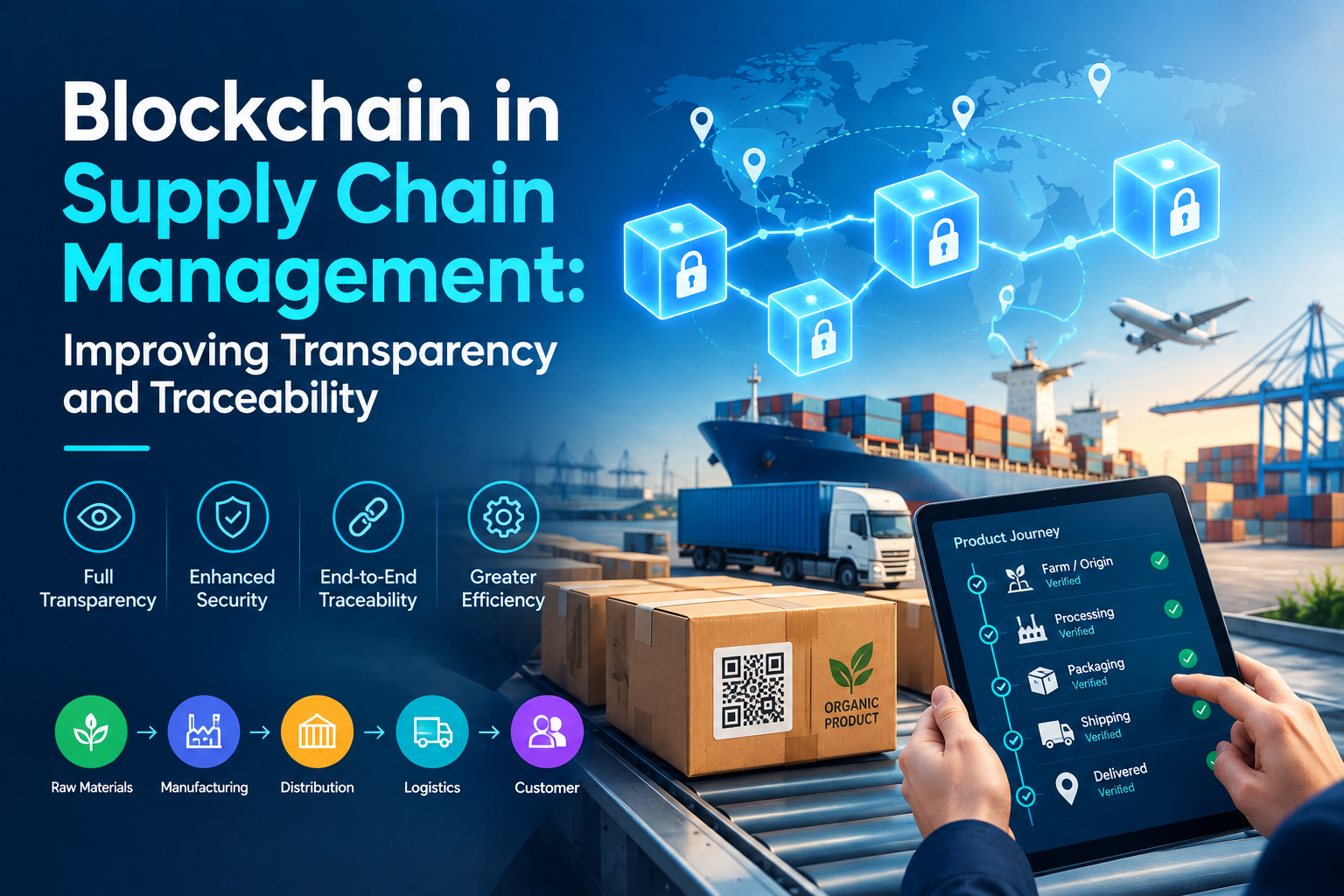
Blockchain in Supply Chain Management: Transparency & Traceability
Blockchain in Supply Chain Management: Improving Transparency and Traceability
Modern supply chains are becoming increasingly complex.
A single product may move through manufacturers, suppliers, distributors, logistics providers, warehouses, retailers, and customers before reaching its final destination. With so many participants involved, businesses need reliable ways to track products, verify information, monitor transactions, and identify problems quickly.
Traditional supply chain systems often depend on separate databases operated by different organizations. This can create information gaps, delayed updates, manual reconciliation, and limited visibility across the entire supply chain.
Blockchain in supply chain management offers a different approach.
By creating a shared, tamper-evident digital record of transactions and product movements, blockchain can help businesses improve transparency, traceability, and trust between supply chain participants.
As organizations continue investing in digital transformation, blockchain is becoming an important technology to evaluate for building more connected and intelligent supply chains.
What Is Blockchain in Supply Chain Management?
Blockchain is a distributed-ledger technology that allows multiple participants to share records without relying entirely on a single centralized database.
In a supply chain environment, blockchain can record relevant events such as:
- Product manufacturing
- Shipment initiation
- Warehouse receipt
- Quality inspection
- Ownership transfer
- Transportation
- Delivery
- Product verification
Each authorized participant can access information according to the permissions defined by the system.
For example, a manufacturer could record when a product was produced, a logistics provider could update its shipment status, and a distributor could confirm receipt.
This creates a connected digital trail from the origin of a product to its destination.
Why Supply Chains Need Greater Transparency
Supply chain visibility has become increasingly important for modern businesses.
Organizations need to answer questions such as:
- Where was a product manufactured?
- Which supplier provided the raw materials?
- Has the product passed quality checks?
- Where is the shipment currently located?
- Who handled the product at each stage?
- Has the product been modified or replaced?
- Is the product authentic?
- When did ownership change?
When information is spread across disconnected systems, answering these questions can take time.
Blockchain can help create a shared source of verified information, allowing authorized participants to access the same transaction history.
How Blockchain Improves Supply Chain Traceability
One of the strongest applications of blockchain is end-to-end traceability.
Consider a product moving through the following stages:
Raw Material → Manufacturer → Warehouse → Logistics → Distributor → Retailer → Customer
Blockchain can record important events at each stage.
Instead of maintaining isolated records, organizations can connect these events into a continuous digital history.
If a quality issue occurs, businesses can potentially trace the affected products back through the supply chain more efficiently.
This can be particularly valuable in industries where product origin and quality are critical.
Key Benefits of Blockchain in Supply Chain Management
1. Improved Transparency
Blockchain can provide authorized participants with access to a shared record of relevant supply chain events.
This can reduce information gaps between suppliers, manufacturers, logistics providers, and customers.
Greater visibility can also improve collaboration because participants can work from consistent records.
2. Better Product Traceability
Businesses can track products throughout their lifecycle.
For example:
Production → Packaging → Shipment → Warehouse → Distribution → Sale
Each event can be recorded and associated with relevant product or shipment information.
This makes it easier to investigate delays, quality problems, or inconsistencies.
3. Stronger Product Authentication
Counterfeit products are a significant concern across several industries.
Blockchain can support product authentication by creating a digital record associated with a product, batch, or shipment.
A business or customer could potentially verify whether the product's recorded history corresponds with the expected supply chain.
Blockchain does not by itself prove that a physical product is genuine, however. Reliable integration with identifiers, sensors, inspections, and trusted data sources remains important.
4. Reduced Fraud and Data Manipulation
Blockchain records can be designed to make unauthorized modification more difficult and easier to detect.
This can help strengthen trust in supply chain records, particularly when multiple organizations need to collaborate.
5. Faster Auditing
Auditing supply chain transactions can require collecting information from multiple systems.
A blockchain-based record can provide a structured history of relevant events, potentially reducing the time required to reconcile information.
This can be useful for:
- Compliance
- Quality control
- Supplier verification
- Financial audits
- Product recalls
6. Improved Recall Management
Product recalls can become difficult when businesses do not have sufficient visibility into where products originated or where they were distributed.
With stronger traceability, organizations can identify affected batches and relevant supply chain participants more efficiently.
This can help reduce unnecessary recalls and improve response times.
Blockchain Supply Chain Use Cases
Blockchain can support a wide range of supply chain applications.
1. Pharmaceutical Supply Chains
Pharmaceutical companies require strong controls over product authenticity, storage, distribution, and traceability.
Blockchain can help maintain records across manufacturers, distributors, pharmacies, and other authorized participants.
Combined with IoT sensors, blockchain can also support records related to environmental conditions such as temperature during transportation.
2. Food Supply Chain
Food businesses need visibility into product origins, processing, transportation, and distribution.
Blockchain can create a digital history of food products and ingredients.
If contamination or quality problems occur, businesses can potentially trace affected batches more efficiently.
3. Manufacturing
Manufacturers often depend on complex networks of suppliers.
Blockchain can help businesses track components and materials from suppliers through production and distribution.
This can improve supplier visibility and support quality management.
4. Logistics and Transportation
Blockchain can support the exchange of trusted shipment information between manufacturers, carriers, warehouses, and distributors.
Shipment events can be recorded as products move through different locations.
5. Retail
Retailers can use blockchain-based systems to improve product provenance and authenticity.
For premium products, electronics, luxury goods, or ethically sourced products, customers may benefit from greater visibility into product history.
6. Automotive Industry
Automotive supply chains involve thousands of components and multiple tiers of suppliers.
Blockchain can help organizations maintain records of component origin, supplier information, quality checks, and movement through the supply chain.
Blockchain and IoT: Creating Real-Time Supply Chain Visibility
Blockchain becomes even more useful when combined with the Internet of Things (IoT).
IoT devices can collect real-time information from products, vehicles, warehouses, and manufacturing environments.
Examples include:
- GPS location
- Temperature
- Humidity
- Storage conditions
- Shipment status
- Equipment performance
This information can be transmitted to connected systems and used as part of a blockchain-supported supply chain record.
For example:
IoT Sensor → Data Platform → Blockchain Record → Supply Chain Dashboard
This combination can help businesses move toward more automated and data-driven supply chain management.
Blockchain and Smart Contracts in Supply Chains
Smart contracts are another important part of blockchain-based supply chain solutions.
A smart contract is a program that can automatically execute predefined rules when specified conditions are met.
For example:
Shipment Delivered → Delivery Confirmed → Payment Processed
Or:
Temperature Threshold Exceeded → Alert Generated → Quality Review Triggered
Smart contracts can reduce manual intervention in repetitive processes and improve workflow automation.
However, smart contracts should be designed carefully because errors in automated business logic can create operational and financial risks.
Blockchain and AI for Intelligent Supply Chains
The combination of blockchain and artificial intelligence can take supply chain management further.
Blockchain can provide trusted transaction and traceability records, while AI can analyze supply chain data and identify patterns.
AI can potentially help businesses with:
- Demand forecasting
- Supplier risk analysis
- Fraud detection
- Predictive maintenance
- Inventory optimization
- Route optimization
- Anomaly detection
For example, AI could identify an unusual shipment pattern while blockchain provides the historical records needed to investigate the event.
Together, these technologies can support a more intelligent supply chain ecosystem.
Blockchain vs Traditional Supply Chain Systems
Blockchain should not automatically replace existing supply chain software.
ERP, warehouse management systems, transportation management systems, CRM platforms, and databases remain important components of enterprise operations.
Blockchain can instead serve as an additional trust and data-sharing layer.
| Traditional Approach | Blockchain-Supported Approach |
|---|---|
| Separate databases | Shared distributed records |
| Manual reconciliation | Automated record synchronization |
| Limited cross-company visibility | Controlled information sharing |
| Difficult product tracing | End-to-end traceability |
| Centralized verification | Distributed verification |
| Manual workflows | Smart-contract automation |
The best architecture depends on the organization's business requirements and existing technology environment.
Challenges of Blockchain in Supply Chain Management
Blockchain offers significant potential, but businesses should consider its limitations.
Data Accuracy
Blockchain can preserve information once recorded, but it does not automatically guarantee that the original information is correct.
If incorrect information enters the system, blockchain can preserve that incorrect record.
This makes trusted data sources and validation mechanisms important.
Integration
Supply chain systems often involve ERP platforms, warehouse systems, logistics software, IoT devices, and external APIs.
Blockchain solutions need to integrate with these existing technologies.
Scalability
Large supply chains can generate significant transaction volumes.
The chosen blockchain architecture must be capable of supporting the required scale and performance.
Privacy
Businesses may not want competitors or unrelated supply chain participants to see sensitive commercial information.
Permissioned blockchain architectures and appropriate access controls may therefore be required.
Cost
Blockchain implementation involves development, infrastructure, integration, security, maintenance, and governance costs.
Businesses should evaluate the expected return on investment before deployment.
Industry Adoption
Blockchain delivers greater value when relevant supply chain participants use compatible systems.
Achieving ecosystem-wide adoption can therefore be challenging.
How Businesses Can Implement Blockchain in Supply Chains
A successful blockchain implementation should begin with a clearly defined business problem.
Step 1: Identify the Problem
Determine whether the primary objective is:
- Traceability
- Counterfeit prevention
- Supplier verification
- Compliance
- Faster settlement
- Product authentication
- Shipment visibility
Step 2: Map the Supply Chain
Identify all major participants, processes, information flows, and points where data is currently lost or duplicated.
Step 3: Select the Right Blockchain Architecture
Businesses should evaluate whether a public, private, or permissioned blockchain is appropriate.
Step 4: Integrate Existing Systems
Connect blockchain infrastructure with ERP, CRM, warehouse, logistics, IoT, and other enterprise systems.
Step 5: Establish Data Governance
Define who can create, access, update, verify, and use supply chain information.
Step 6: Run a Pilot
Start with a limited supply chain process or product category.
Measure the results before expanding the system.
The Future of Blockchain in Supply Chain Management
The future of supply chain management is likely to be increasingly connected.
Blockchain, AI, IoT, cloud computing, automation, and analytics can work together to create digital supply chains with greater visibility and responsiveness.
Instead of simply tracking where products are located, businesses can build systems that understand:
What happened → Where it happened → Who was involved → Why it happened → What should happen next
Blockchain can provide the trusted transaction layer, IoT can provide real-world data, AI can provide intelligence, and automation can execute predefined actions.
This combination can help businesses move from reactive supply chain management toward proactive and predictive operations.
Why Businesses Should Consider Blockchain for Supply Chains
Blockchain is not suitable for every supply chain.
However, it can be particularly valuable when multiple independent organizations need to share trusted information and maintain a common transaction history.
Businesses should consider blockchain when they need:
- Multi-party data sharing
- Strong traceability
- Product provenance
- Trusted records
- Automated workflows
- Greater transparency
- Improved auditability
The objective should always be to solve a specific business problem rather than implementing blockchain simply because it is a trending technology.
How RioTech Softwares Can Help
Modern blockchain supply chain solutions require more than blockchain development. They require expertise in software development, cloud infrastructure, AI, cybersecurity, APIs, enterprise applications, automation, and system integration.
RioTech Softwares helps businesses build and modernize technology solutions designed around their operational requirements.
By combining blockchain with technologies such as AI, cloud, CRM, ERP, automation, and custom software development, businesses can create connected digital ecosystems that improve visibility and support long-term growth.
Explore RioTech Softwares:
RioTech Softwares
Whether the objective is supply chain visibility, enterprise blockchain, business automation, or technology modernization, the right solution starts with understanding the organization's processes and building technology around them.
Conclusion
Blockchain in supply chain management can transform how businesses track, verify, and share information across complex ecosystems.
By creating trusted and traceable digital records, blockchain can improve transparency, product provenance, auditing, authentication, and collaboration between supply chain participants.
Its greatest potential emerges when blockchain is integrated with AI, IoT, smart contracts, cloud platforms, ERP systems, and enterprise automation.
However, successful implementation requires more than choosing a blockchain platform. Businesses need to address data quality, privacy, integration, scalability, governance, and ecosystem adoption.
The future of supply chain management will not be defined by one technology.
It will be defined by how effectively businesses connect trusted data, intelligent analytics, automation, and secure digital infrastructure.
Blockchain can be an important part of that transformation.
Frequently Asked Questions
What is blockchain in supply chain management?
Blockchain in supply chain management uses distributed-ledger technology to record and share trusted information about products, transactions, shipments, and other supply chain events.
How does blockchain improve supply chain transparency?
Blockchain can provide authorized participants with access to a shared record of relevant supply chain events, reducing information gaps between organizations.
Can blockchain prevent counterfeit products?
Blockchain can support product authentication and provenance tracking, but it cannot independently guarantee that a physical product is genuine. Physical identifiers and trusted verification processes are also important.
How does blockchain improve traceability?
Blockchain can connect records from different stages of a product's lifecycle, helping businesses trace products from their origin through manufacturing, transportation, distribution, and delivery.
Can blockchain work with AI and IoT?
Yes. IoT can provide real-world supply chain data, blockchain can support trusted records, and AI can analyze the resulting information for forecasting, anomaly detection, optimization, and risk management.
Is blockchain suitable for every supply chain?
No. Blockchain is most useful when multiple parties need to share trusted information or maintain a common transaction history. Businesses should evaluate the specific business case before implementation.