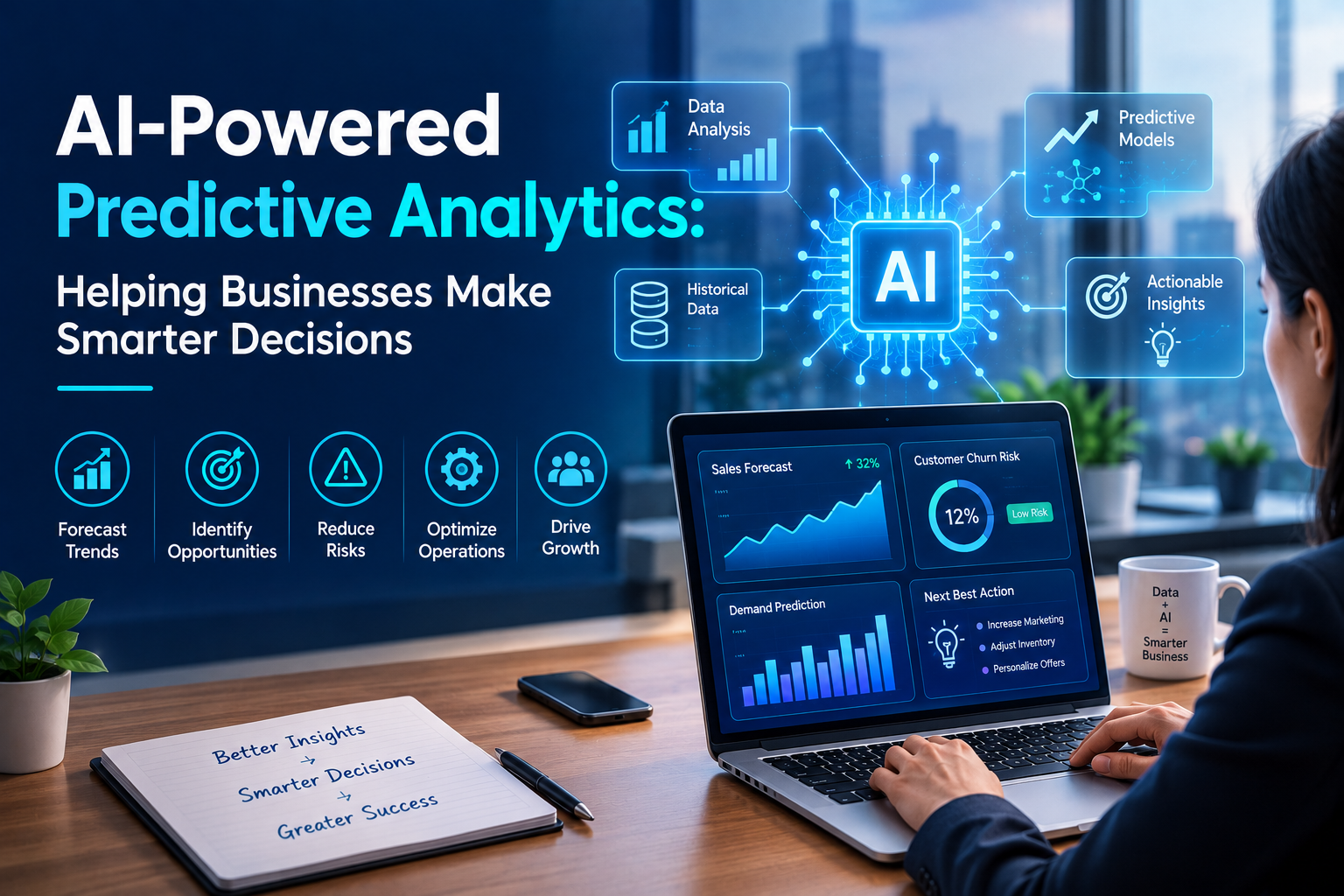
AI-Powered Predictive Analytics: Smarter Business Decisions in 2026
AI-Powered Predictive Analytics: Helping Businesses Make Smarter Decisions
Businesses generate enormous amounts of data every day—from customer interactions and sales transactions to website activity, operational performance, financial records, and supply chain information.
However, having data is not the same as knowing what to do with it.
Traditional analytics mainly focuses on understanding what has already happened. AI-powered predictive analytics takes business intelligence a step further by analyzing historical and real-time data to identify patterns, estimate future outcomes, and support proactive decision-making.
Instead of asking only:
“What happened?”
Businesses can ask:
“What is likely to happen next, and what should we do about it?”
With advances in artificial intelligence, machine learning, automation, and cloud computing, predictive analytics is becoming an important component of modern digital transformation strategies.
What Is AI-Powered Predictive Analytics?
AI-powered predictive analytics combines artificial intelligence, machine learning, statistical models, and business data to predict potential future outcomes.
The system analyzes historical and current data, identifies relationships and patterns, and generates forecasts or predictions.
For example, an e-commerce company can analyze:
- Previous purchases
- Customer browsing behavior
- Product demand
- Seasonal trends
- Marketing campaigns
- Customer demographics
The resulting model can help predict which products are likely to experience increased demand or which customers may be more likely to make a purchase.
The goal is not simply to predict the future. It is to give decision-makers actionable intelligence before an event occurs.
Why Predictive Analytics Matters for Businesses
Business environments are becoming increasingly competitive and data-driven. Decisions based solely on assumptions or historical reports may not be sufficient when markets, customers, and operational conditions change quickly.
AI-powered predictive analytics can help businesses move from reactive decision-making to proactive planning.
Key benefits include:
1. Better Decision-Making
AI can process large volumes of structured and unstructured data faster than traditional manual analysis.
Business leaders can use predictive insights to evaluate potential outcomes and make more informed strategic decisions.
Instead of relying only on intuition, decision-makers can combine experience with data-driven predictions.
2. Improved Demand Forecasting
Accurate demand forecasting can help organizations maintain the right balance between supply and customer demand.
Predictive models can analyze:
- Historical sales
- Seasonal patterns
- Market trends
- Customer behavior
- Pricing changes
- Promotional activity
This can help businesses improve inventory planning and reduce the risk of overstocking or stock shortages.
3. More Effective Customer Insights
Customer expectations continue to evolve.
Predictive analytics can identify patterns in customer behavior and help businesses understand which customers are likely to:
- Make another purchase
- Stop using a service
- Respond to a campaign
- Upgrade a product
- Require additional support
These insights can support more personalized customer experiences and targeted marketing strategies.
4. Risk Identification and Prevention
Businesses face risks across finance, cybersecurity, operations, supply chains, and customer management.
Predictive analytics can identify unusual patterns or risk indicators before they become larger problems.
For example, financial institutions can use predictive models to support fraud detection and risk assessment, while manufacturers can identify operational conditions associated with equipment failure.
The earlier a potential risk is identified, the more opportunities a business has to respond.
5. Predictive Maintenance
For companies that depend on machinery, infrastructure, or connected devices, unexpected equipment failure can lead to downtime and financial losses.
AI-powered predictive maintenance analyzes information such as:
- Equipment performance
- Sensor data
- Temperature
- Vibration
- Usage patterns
- Maintenance history
The system can identify conditions associated with potential failures and help organizations plan maintenance before a serious breakdown occurs.
How AI-Powered Predictive Analytics Works
A typical predictive analytics workflow consists of several stages.
Step 1: Data Collection
The first step is collecting relevant business data from multiple sources.
These may include:
- CRM systems
- ERP platforms
- Websites and applications
- Sales systems
- Customer support platforms
- IoT devices
- Financial systems
- Marketing platforms
- Cloud applications
The quality and relevance of this data significantly influence the quality of predictive models.
Step 2: Data Preparation
Raw business data often contains missing values, duplicate records, inconsistencies, or irrelevant information.
Before applying machine learning models, the data needs to be cleaned, structured, and prepared.
This stage may include:
- Data cleansing
- Data integration
- Feature engineering
- Data transformation
- Data validation
Step 3: Pattern Identification
Machine learning algorithms analyze historical data to identify relationships and patterns.
Depending on the business problem, organizations may use techniques such as:
- Regression
- Classification
- Time-series forecasting
- Clustering
- Anomaly detection
- Machine learning models
The selected approach depends on the type of prediction the organization wants to make.
Step 4: Model Training
The predictive model is trained using historical data.
The system learns from previously observed patterns and outcomes to estimate how similar situations may behave in the future.
The model should then be evaluated using appropriate validation techniques to determine whether its predictions are reliable enough for the intended business use.
Step 5: Prediction and Business Insights
Once the model is deployed, it can process new data and generate predictions.
These predictions can be presented through:
- Business dashboards
- Reports
- Alerts
- Automated workflows
- CRM systems
- ERP platforms
- Decision-support applications
The most valuable predictive analytics systems connect insights directly to business actions.
AI Predictive Analytics Use Cases Across Industries
Predictive analytics is not limited to a single industry. Organizations across different sectors can apply it to improve planning and operational efficiency.
Retail and E-commerce
Retail businesses can use predictive analytics for:
- Demand forecasting
- Customer segmentation
- Product recommendations
- Inventory optimization
- Customer churn prediction
- Sales forecasting
For example, a retailer can analyze historical purchasing patterns to predict future product demand and optimize inventory levels.
Banking and Financial Services
Financial organizations can apply predictive analytics to:
- Fraud detection
- Credit risk assessment
- Customer churn prediction
- Financial forecasting
- Transaction monitoring
AI can help identify unusual transaction patterns and prioritize potentially risky activities for further review.
Healthcare
Predictive analytics can support healthcare organizations in areas such as:
- Patient risk assessment
- Resource planning
- Operational forecasting
- Appointment management
- Hospital capacity planning
When used responsibly and with appropriate safeguards, predictive models can help organizations make better operational decisions.
Manufacturing
Manufacturers can use AI-powered analytics for:
- Predictive maintenance
- Production forecasting
- Quality monitoring
- Supply chain optimization
- Demand planning
Combining predictive analytics with IoT data can provide organizations with deeper visibility into equipment and production processes.
Logistics and Supply Chain
Supply chain organizations can analyze historical and real-time information to forecast:
- Product demand
- Delivery delays
- Inventory requirements
- Transportation requirements
- Potential supply disruptions
This can help companies improve planning and respond faster to changing conditions.
Predictive Analytics vs Traditional Analytics
Traditional analytics and predictive analytics serve different purposes.
| Analytics Type | Main Question | Business Purpose |
|---|---|---|
| Descriptive Analytics | What happened? | Understand historical performance |
| Diagnostic Analytics | Why did it happen? | Identify causes and patterns |
| Predictive Analytics | What may happen? | Forecast future outcomes |
| Prescriptive Analytics | What should we do? | Recommend potential actions |
AI-powered predictive analytics primarily focuses on forecasting future possibilities, while more advanced systems can combine predictive insights with prescriptive recommendations.
The Role of AI in Making Predictive Analytics More Powerful
Traditional statistical models can be highly useful, but AI and machine learning can expand predictive analytics capabilities by processing larger and more complex datasets.
AI can help organizations:
Process Large Volumes of Data
Modern businesses may generate data across dozens of systems. AI-based analytics can process these datasets at scale.
Identify Complex Patterns
Machine learning can detect relationships that may be difficult to identify through manual analysis.
Adapt to New Data
Some machine learning systems can be updated as new data becomes available, helping models remain relevant as business conditions change.
Automate Insights
Instead of requiring analysts to manually examine every report, AI-powered systems can surface important trends, anomalies, or predictions automatically.
Challenges Businesses Should Consider
Although predictive analytics offers significant potential, organizations should not treat it as a simple plug-and-play solution.
Data Quality
Poor-quality data can result in unreliable predictions.
Better data leads to better analytical outcomes.
Data Privacy and Security
Businesses often process sensitive customer, financial, or operational information.
Strong security controls, appropriate access management, governance, and compliance practices are essential when implementing AI-driven analytics.
Model Accuracy
No predictive model can guarantee the future.
Predictions represent estimated probabilities based on available data and assumptions. Models should therefore be continuously evaluated and monitored.
Integration With Existing Systems
Predictive analytics becomes more useful when connected with existing business applications such as CRM, ERP, cloud platforms, and operational systems.
Poor integration can create data silos and limit the practical value of predictions.
Human Oversight
AI should support business decisions rather than automatically replace human judgment in every situation.
Strategic decisions often require business context, ethical considerations, domain expertise, and human oversight.
How Businesses Can Start With Predictive Analytics
Organizations do not necessarily need to transform their entire technology environment at once.
A practical approach is to start with a clearly defined business problem.
Step 1: Identify a High-Value Problem
Choose a measurable challenge such as:
- Customer churn
- Demand forecasting
- Sales forecasting
- Equipment failure
- Fraud detection
- Inventory optimization
Step 2: Assess Available Data
Determine what data is available, where it is stored, and whether it is accurate enough for predictive modeling.
Step 3: Build a Focused Pilot
Start with a small use case that can demonstrate measurable business value.
Step 4: Measure Results
Track relevant metrics such as forecasting accuracy, cost reduction, conversion rates, downtime, or operational efficiency.
Step 5: Scale Gradually
Once the model demonstrates value, organizations can integrate predictive analytics into additional departments and business processes.
The Future of AI-Powered Predictive Analytics
Predictive analytics is moving toward increasingly intelligent and automated decision-support systems.
The next generation of business analytics is likely to combine:
- Artificial intelligence
- Machine learning
- Real-time data
- Cloud computing
- IoT
- Business intelligence
- Automation
- Generative AI
- AI agents
This evolution can move organizations from simply understanding data toward continuously using data to anticipate changes and support business actions.
The competitive advantage will not come from collecting the largest amount of data. It will come from turning relevant data into timely, reliable, and actionable intelligence.
Final Thoughts
AI-powered predictive analytics is changing how businesses approach decision-making.
From forecasting demand and identifying customer behavior to predicting equipment failures and detecting potential risks, predictive analytics can help organizations become more proactive, efficient, and data-driven.
However, successful implementation requires more than an AI model. Businesses need high-quality data, secure infrastructure, appropriate technology integration, reliable models, and a clear understanding of the business problem.
Organizations that combine these elements can use predictive analytics not just to understand what happened yesterday, but to prepare more effectively for what could happen tomorrow.
How RioTech Softwares Can Help
RioTech Softwares helps businesses build and modernize technology solutions designed around their operational and growth requirements.
From custom software development and AI solutions to CRM, ERP, cloud, cybersecurity, and business automation, the right technology foundation can help organizations turn business data into actionable insights.
If your business is looking to explore AI-powered predictive analytics, intelligent automation, or data-driven software solutions, RioTech Softwares can help you identify practical opportunities and build scalable technology solutions.
Explore RioTech Softwares to discover technology solutions designed for smarter, more scalable business growth.
Frequently Asked Questions
1. What is AI-powered predictive analytics?
AI-powered predictive analytics uses artificial intelligence, machine learning, and historical or real-time data to identify patterns and estimate potential future outcomes.
2. How can predictive analytics help businesses?
It can help businesses forecast demand, understand customer behavior, identify risks, optimize operations, predict equipment failures, and make more informed decisions.
3. Is predictive analytics useful for small businesses?
Yes. Small and mid-sized businesses can start with focused use cases such as sales forecasting, customer churn prediction, inventory planning, or marketing optimization.
4. What data is required for predictive analytics?
The required data depends on the business objective. It may include sales records, customer information, operational data, transaction history, website activity, sensor data, or other relevant business information.
5. Can predictive analytics be integrated with CRM and ERP systems?
Yes. Predictive analytics can be integrated with CRM, ERP, cloud applications, databases, dashboards, and other business systems to make predictions available within existing workflows.
6. Is AI predictive analytics completely accurate?
No. Predictive models estimate likely outcomes based on available data. Their effectiveness depends on data quality, model design, changing business conditions, and ongoing monitoring.