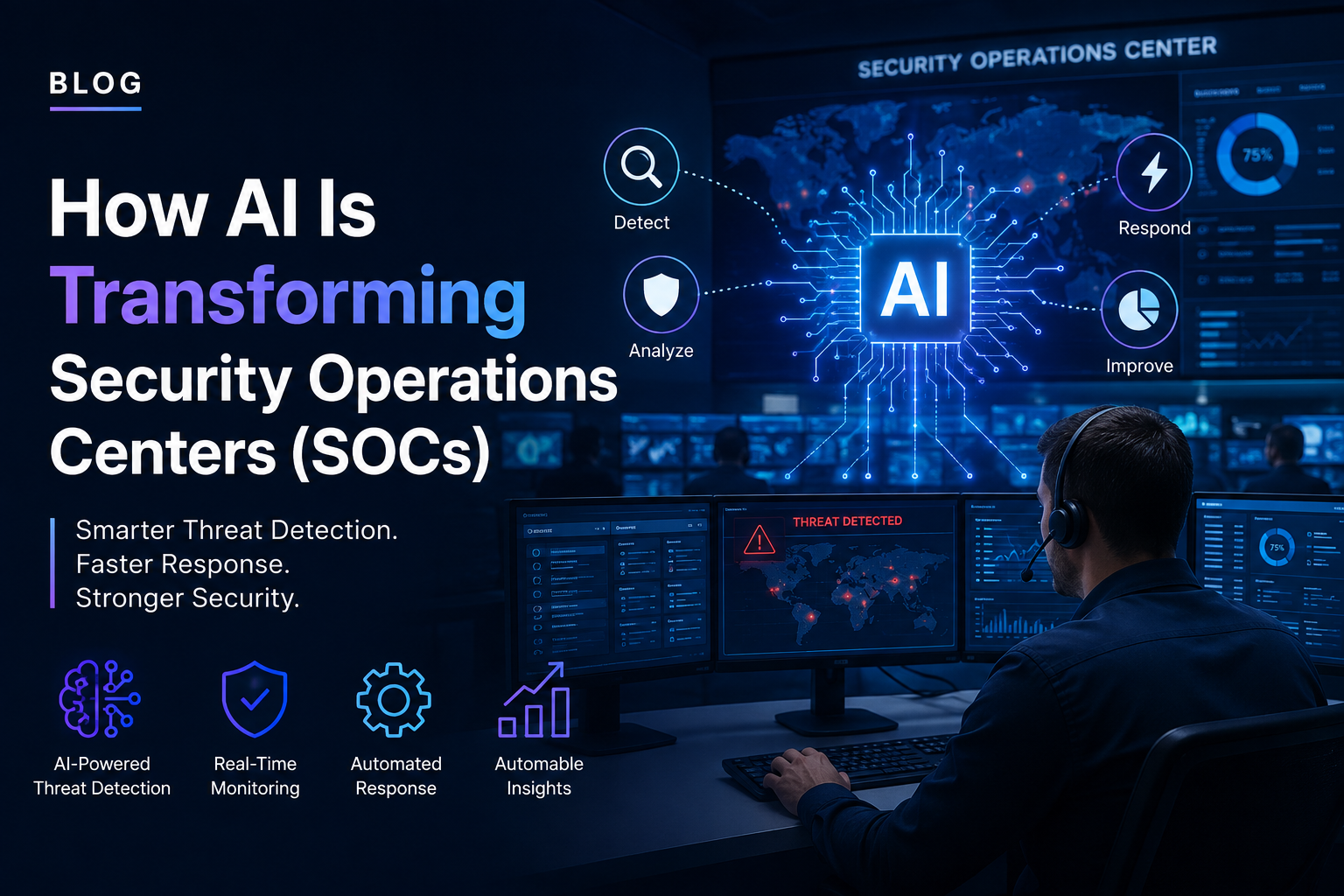
How AI Is Transforming Security Operations Centers (SOCs)
How AI Is Transforming Security Operations Centers (SOCs)
Cybersecurity teams are facing a rapidly changing threat landscape. Organizations now manage cloud infrastructure, remote endpoints, SaaS applications, APIs, connected devices and large volumes of business data. At the same time, cybercriminals are using automation and increasingly sophisticated techniques to identify and exploit vulnerabilities.
Traditional Security Operations Centers (SOCs) rely heavily on security analysts to monitor alerts, investigate suspicious activity and coordinate incident response. As the volume and complexity of security events increase, manually processing every alert becomes difficult and inefficient.
Artificial Intelligence (AI) is changing this model.
AI-powered SOCs can analyze large volumes of security data, identify unusual behavior, prioritize incidents, automate repetitive investigation tasks and help security teams respond faster. In 2026, industry discussions increasingly focus on AI moving beyond simple automation toward intelligent and adaptive security operations.
What Is a Security Operations Center (SOC)?
A Security Operations Center is a centralized function responsible for monitoring, detecting, investigating and responding to cybersecurity threats.
A traditional SOC typically performs several important activities:
- Security monitoring
- Threat detection
- Alert triage
- Incident investigation
- Threat hunting
- Vulnerability monitoring
- Incident response
- Security reporting
- Compliance support
Security teams collect information from multiple sources, including endpoints, networks, applications, cloud environments, identity systems and security tools.
The challenge is that modern organizations can generate enormous amounts of security data. Analysts need to determine which events represent genuine threats and which are harmless anomalies.
This is where AI can provide significant value.
How AI Is Transforming the Modern SOC
AI is not simply replacing traditional cybersecurity tools. Instead, it is being integrated into different stages of the SOC workflow—from data analysis and detection to investigation and response.
1. Intelligent Threat Detection
One of the most important applications of AI in cybersecurity is detecting suspicious activity.
Traditional security systems often depend on predefined rules and known indicators. While these approaches remain valuable, they can struggle with previously unseen or constantly changing attack patterns.
Machine learning can analyze historical and real-time security data to identify patterns that may indicate malicious behavior.
For example, AI can help detect:
- Unusual login activity
- Abnormal network traffic
- Suspicious file behavior
- Unexpected privilege escalation
- Unusual data transfers
- Account compromise indicators
- Potential malware activity
This allows SOC teams to move toward more behavior-based detection rather than relying exclusively on known signatures.
2. Reducing Alert Fatigue
Alert overload is one of the biggest challenges faced by security analysts.
A SOC may receive thousands of alerts, but not every alert represents a serious security incident. Analysts can spend significant amounts of time investigating false positives and low-priority events.
AI can analyze multiple signals and help determine which alerts deserve immediate attention.
Instead of treating every alert equally, AI-assisted systems can consider factors such as:
- User behavior
- Asset importance
- Historical activity
- Threat intelligence
- Attack patterns
- Related security events
- Potential business impact
This enables security teams to focus their attention on the incidents that matter most. Current AI-SOC approaches increasingly emphasize intelligent prioritization and contextual analysis rather than simply increasing automation.
3. Faster Incident Investigation
Security investigations often require analysts to correlate information from multiple systems.
For example, an investigation into a compromised account may require examining:
- Authentication logs
- Endpoint activity
- Network traffic
- Cloud activity
- Email events
- File access
- Privilege changes
AI can help bring these signals together and identify relationships between seemingly unrelated events.
This can significantly reduce the time analysts spend manually searching through logs and help them understand the potential attack path more quickly.
4. Automated Incident Response
AI can also support automated response workflows.
When certain conditions are met, security platforms can initiate predefined actions such as:
- Isolating a compromised endpoint
- Blocking suspicious IP addresses
- Disabling compromised accounts
- Quarantining malicious files
- Creating incident tickets
- Notifying security teams
- Collecting additional evidence
Modern SOC automation is increasingly evolving from predefined playbooks toward more adaptive, intelligence-driven workflows.
However, organizations should carefully define which actions can be automated and which require human approval.
5. Behavioral Analytics and Anomaly Detection
Cyberattacks do not always look like obvious malicious activity.
An attacker may use legitimate credentials, access normal applications and gradually move through an environment.
AI can establish behavioral baselines and identify deviations from normal activity.
For example:
A user normally accesses business applications from one location during working hours but suddenly authenticates from an unusual location and begins downloading large amounts of sensitive data.
Individually, each event might not look malicious. However, when analyzed together, the behavior could indicate account compromise.
AI-powered behavioral analytics can help identify these subtle patterns.
6. AI-Assisted Threat Hunting
Threat hunting involves proactively searching for suspicious activity that traditional detection systems may have missed.
AI can assist analysts by:
- Identifying unusual patterns
- Searching large datasets
- Correlating security events
- Highlighting suspicious entities
- Generating investigation hypotheses
- Prioritizing potentially compromised systems
This allows security professionals to spend less time on repetitive data searches and more time on strategic threat analysis.
7. Natural Language Interfaces for Security Teams
Another emerging capability is the use of natural-language interfaces.
Instead of manually searching through complex security dashboards, analysts can increasingly interact with security systems using conversational queries.
For example:
“Show me unusual authentication activity from the last 24 hours.”
An AI-powered system can interpret the request, analyze relevant security data and present potentially important findings.
This can make security platforms easier to use while reducing the technical complexity involved in certain investigations.
8. AI and Cloud Security
Modern businesses increasingly operate across hybrid and multi-cloud environments.
This creates additional security challenges because organizations must monitor:
- Cloud workloads
- APIs
- Containers
- Virtual machines
- Identity systems
- Storage resources
- Applications
- Network activity
AI can help correlate security signals across these environments and identify abnormal behavior.
For organizations adopting cloud-native architectures, AI-assisted monitoring can become an important component of a broader cloud security strategy.
AI Does Not Replace Security Analysts
Despite the rapid development of AI-powered security technologies, human expertise remains essential.
AI can analyze data at machine speed, but security analysts provide:
- Context
- Business understanding
- Risk assessment
- Strategic decision-making
- Incident validation
- Ethical oversight
The emerging model is therefore not simply AI replacing the SOC analyst.
Instead, it is AI augmenting the SOC analyst.
SANS describes this shift as the “augmented analyst” model, where AI assists with data collection, detection, triage, investigation and response while analysts focus on higher-value security decisions.
Challenges of Implementing AI in SOCs
AI can significantly improve security operations, but implementation requires careful planning.
Data Quality
AI systems depend on reliable security data. Poor-quality, incomplete or inconsistent data can reduce detection accuracy.
False Positives
AI models can still generate incorrect classifications. Security teams need mechanisms for validation and continuous improvement.
Explainability
Security analysts need to understand why an AI system considers an event suspicious, particularly when automated response actions are involved.
Privacy and Compliance
Organizations must carefully manage sensitive security and user data processed by AI systems.
Model Security
AI systems themselves can become targets for manipulation, evasion or data poisoning. Emerging AI-SOC discussions therefore emphasize protecting the AI layer as well as the infrastructure it monitors.
Human Oversight
High-impact security decisions should have appropriate human governance and approval mechanisms.
The Future of AI-Powered SOCs
The future of security operations is moving toward increasingly intelligent and automated workflows.
The next generation of SOC platforms is expected to combine:
- Machine learning
- Generative AI
- Security analytics
- Threat intelligence
- Automation
- Security orchestration
- AI agents
- Behavioral analytics
- Cloud security
- Human expertise
This evolution is already being described as the transition toward AI SOCs and agentic SOCs, where intelligent systems can coordinate investigation and response activities across complex security environments.
The objective is not simply to automate more tasks. It is to create security operations that can understand context, prioritize risk, adapt to changing threats and help organizations respond at machine speed.
How Riotech Helps Businesses Strengthen Cybersecurity
Modern businesses need cybersecurity strategies that protect applications, infrastructure, networks and sensitive business information.
Riotech Software LLP provides cybersecurity solutions focused on protecting modern digital environments. Its cybersecurity services include network protection, data security and threat monitoring, while its broader technology capabilities include AI and cloud solutions.
Businesses can combine intelligent technologies with proactive monitoring and security best practices to build a stronger cybersecurity foundation.
Conclusion
AI is fundamentally changing how Security Operations Centers detect, investigate and respond to cyber threats.
By analyzing massive amounts of security data, identifying abnormal behavior, reducing alert fatigue and automating repetitive workflows, AI can help security teams operate more efficiently and respond to threats faster.
However, successful AI adoption requires more than simply purchasing an AI-powered security platform. Organizations need quality data, strong security processes, skilled analysts, appropriate governance and continuous monitoring.
The future of cybersecurity will likely be a partnership between artificial intelligence and human expertise, combining machine-scale analysis with human judgment to build more proactive and resilient security operations.
Frequently Asked Questions
What is an AI-powered SOC?
An AI-powered SOC uses artificial intelligence, machine learning and automation to assist with security monitoring, threat detection, investigation, prioritization and response.
How does AI improve threat detection?
AI can analyze large volumes of security data and identify unusual patterns or behaviors that may indicate a cyber threat.
Can AI replace SOC analysts?
No. AI can automate repetitive activities and assist with investigations, but human analysts remain important for context, risk assessment and complex decision-making.
What are the benefits of AI in SOC operations?
Key benefits include faster threat detection, reduced alert fatigue, improved investigation efficiency, automated response and better prioritization of security incidents.
Is AI useful for cloud security?
Yes. AI can help analyze activity across cloud infrastructure, applications, identities, APIs and workloads to identify suspicious behavior and potential threats.
How can businesses start adopting AI for cybersecurity?
Businesses should begin by identifying high-value SOC use cases, improving security data quality, integrating AI with existing security tools and establishing clear human oversight and governance.