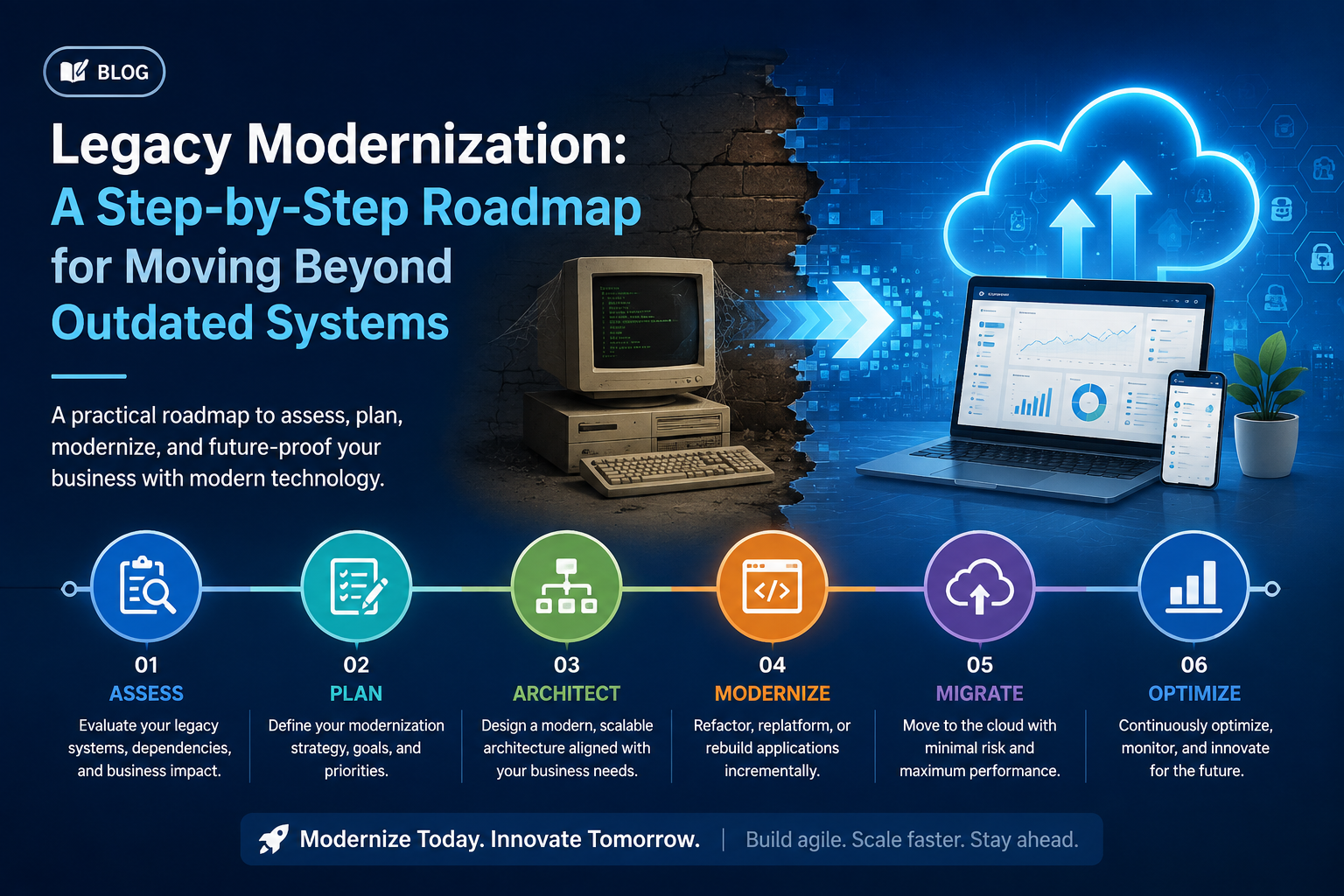
Legacy Modernization: A Step-by-Step Roadmap for Modern Businesses
Legacy Modernization: A Step-by-Step Roadmap for Moving Beyond Outdated Systems
Many businesses continue to rely on legacy applications that were developed years or even decades ago. These systems may still support important business operations, but maintaining them can become increasingly difficult as technology evolves.
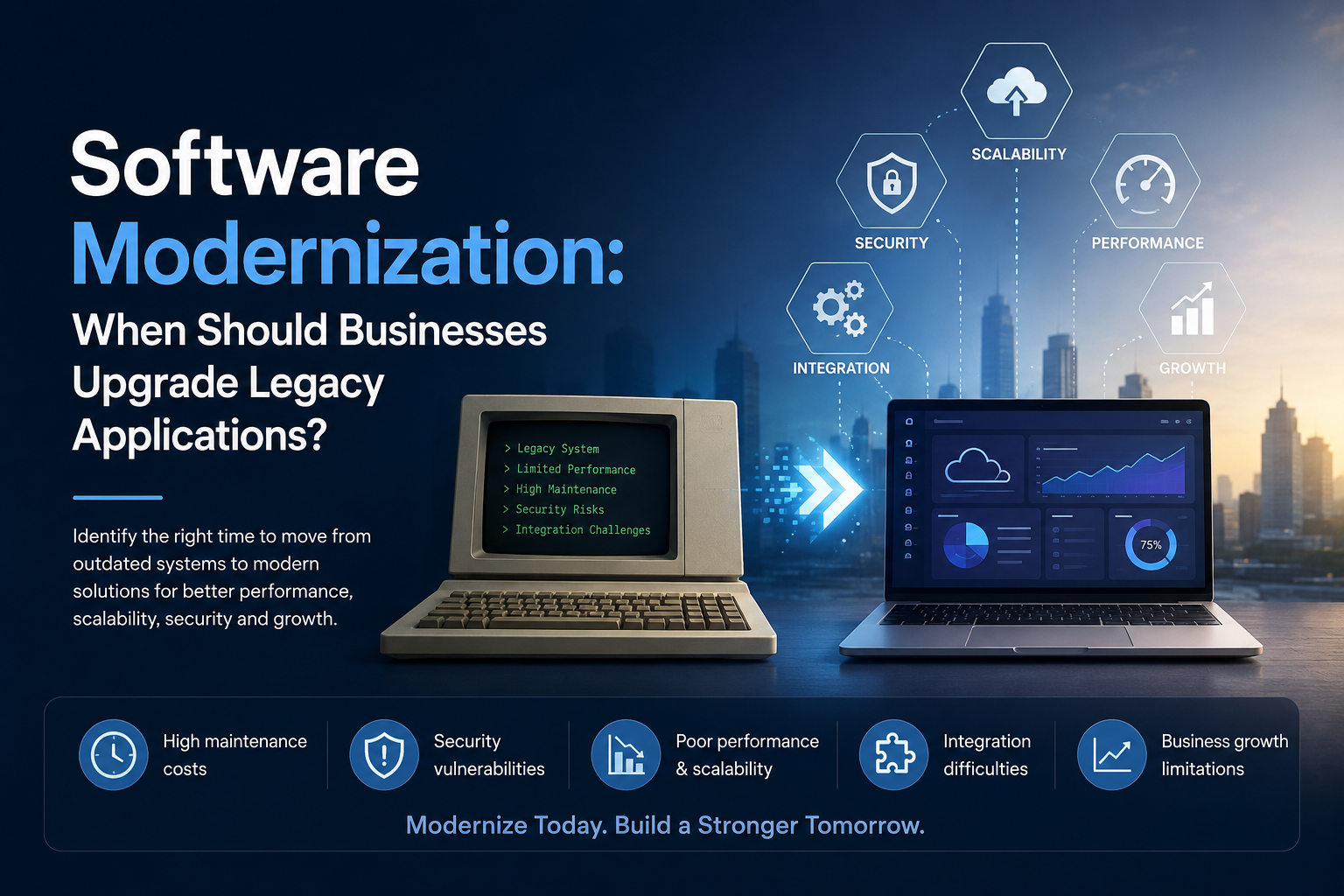
Legacy systems often create challenges such as high maintenance costs, limited scalability, security vulnerabilities, outdated technology stacks, poor integration capabilities, and dependency on specialized technical resources.
However, replacing a legacy application completely is not always practical. Business-critical systems may contain valuable processes, data, and functionality that cannot simply be discarded.
This is where legacy modernization becomes important.
Legacy modernization is the process of transforming outdated software, applications, infrastructure, or technology architecture into modern, scalable, secure, and maintainable systems while preserving the business capabilities that organizations depend on.
A structured modernization strategy allows businesses to reduce technical debt while creating an IT environment capable of supporting future growth.
What Is Legacy Modernization?
Legacy modernization involves upgrading or transforming existing technology systems to align them with current business and technical requirements.
Depending on the condition of the existing system and the organization's objectives, modernization can involve:
- Updating outdated application components
- Migrating applications to cloud infrastructure
- Refactoring legacy code
- Rebuilding applications using modern architectures
- Replacing obsolete systems with new platforms
- Introducing APIs and modern integrations
- Modernizing databases
- Improving application security
- Automating deployment and monitoring
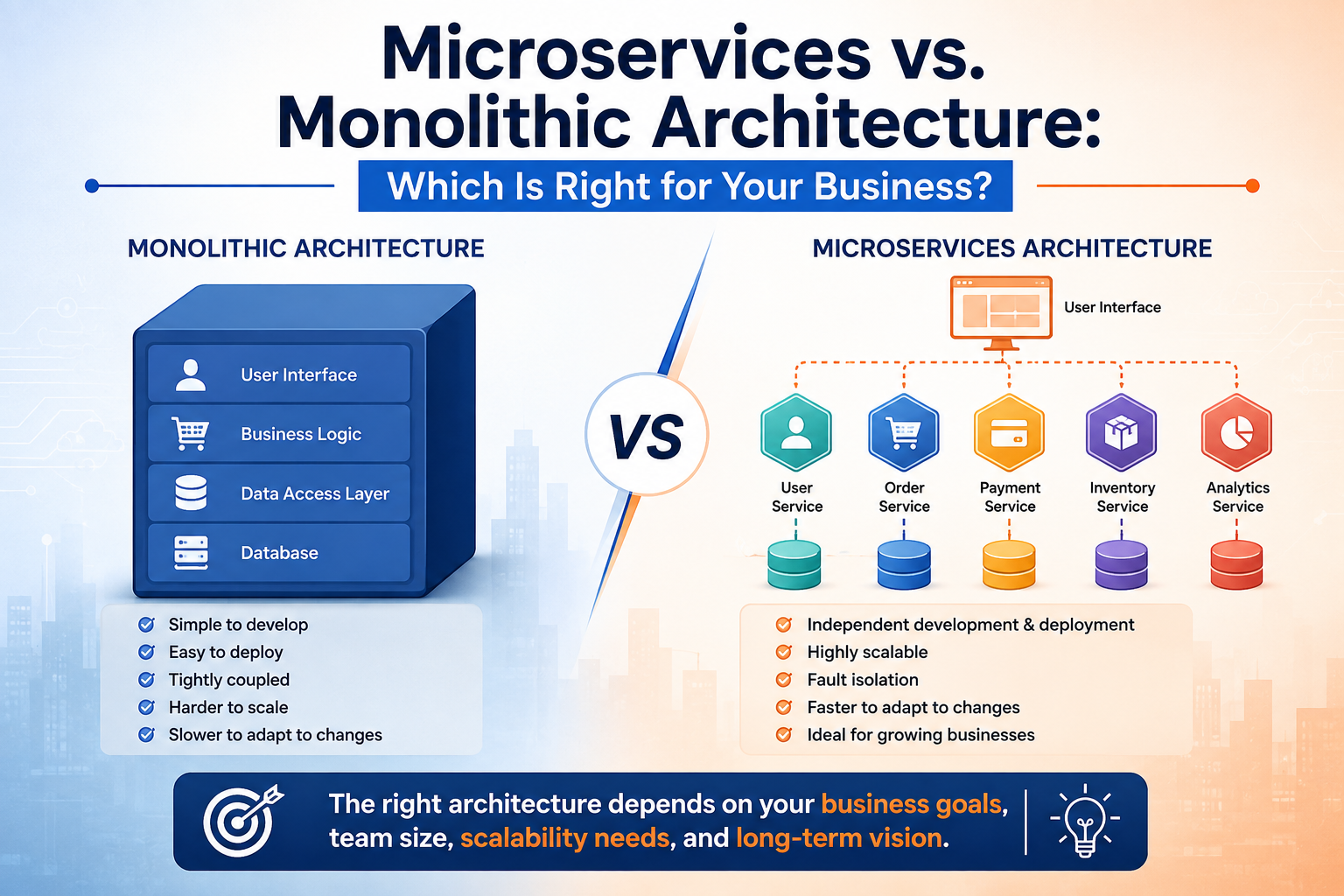
- Implementing microservices or cloud-native architectures
The goal is not simply to use newer technology. The real objective is to create a technology environment that is more scalable, secure, efficient, maintainable, and aligned with business goals.
Why Businesses Need Legacy Modernization
1. Rising Maintenance Costs
Older systems often require specialized developers who understand outdated programming languages, frameworks, or infrastructure.
As experienced specialists become harder to find, maintenance costs can increase significantly.
Modernization can reduce dependency on obsolete technologies and simplify long-term maintenance.
2. Security Risks
Legacy applications may depend on unsupported frameworks, outdated libraries, or infrastructure that no longer receives regular security updates.
Modernizing these systems provides an opportunity to introduce current security practices, improved access controls, vulnerability management, and stronger monitoring.
3. Limited Scalability
Traditional architectures may struggle to handle rapidly increasing workloads, users, transactions, or data volumes.
Modern architectures and cloud infrastructure can provide greater flexibility and allow businesses to scale resources according to demand.
4. Integration Challenges
Modern businesses depend on interconnected systems such as CRM, ERP, payment platforms, analytics tools, cloud services, and AI applications.
Legacy systems may lack modern APIs and integration capabilities, making it difficult to connect them with newer technologies.
5. Slow Innovation
When teams spend most of their time maintaining outdated systems, less time is available for developing new products and capabilities.
Modernization can simplify development processes and help organizations introduce new features faster.
A Step-by-Step Legacy Modernization Roadmap
Successful modernization requires more than replacing old software with new technology. Businesses need a structured approach that minimizes operational disruption while delivering measurable improvements.
Step 1: Assess the Existing Environment
The first step is understanding what you currently have.
Organizations should evaluate:
- Applications and software components
- Programming languages and frameworks
- Databases
- Infrastructure
- Integrations
- Security controls
- Performance
- Dependencies
- Maintenance costs
- Business-critical processes
- Technical debt
This assessment helps identify which systems require immediate attention and which can continue operating with minimal changes.
Step 2: Identify Business and Technical Priorities
Not every legacy application needs to be modernized at the same time.
Organizations should prioritize applications based on factors such as:
- Business importance
- Security risk
- Operational cost
- Performance limitations
- Scalability requirements
- Integration requirements
- Customer impact
- Future growth plans
A high-impact, high-risk application may deserve modernization before a low-priority internal system.
Step 3: Define the Modernization Strategy
There is no single modernization approach that works for every application.
Businesses can select from several strategies.
Rehost
Also known as "lift and shift," rehosting moves an existing application to a new infrastructure environment with minimal code changes.
It can be useful when businesses need faster infrastructure modernization without immediately redesigning the application.
Replatform
Replatforming introduces selected improvements while keeping much of the existing application architecture intact.
For example, an application could be moved to a managed cloud database or modern hosting platform.
Refactor
Refactoring involves restructuring existing code to improve maintainability, performance, and scalability without fundamentally changing the application's business functionality.
Rebuild
When an application has severe architectural limitations, rebuilding may be the better option.
The business requirements are retained, but the application is developed using modern technologies and architecture.
Replace
In some cases, replacing the legacy application with a modern commercial or custom solution is more practical than continuing to maintain it.
The right strategy depends on the application's complexity, business value, technical condition, budget, and modernization goals.
Step 4: Develop a Modern Architecture
After selecting the modernization approach, businesses should define the target architecture.
Depending on requirements, this may include:
- Cloud infrastructure
- Microservices
- Containerization
- API-based integration
- Modern databases
- Event-driven architecture
- DevOps practices
- Automated CI/CD pipelines
- Centralized monitoring
- Identity and access management
The architecture should be designed around business requirements rather than simply adopting technology trends.
Step 5: Plan Data Migration
Data is often one of the most critical components of legacy modernization.
Before migration, organizations should identify:
- What data needs to be transferred
- Data quality issues
- Duplicate records
- Data dependencies
- Compliance requirements
- Backup requirements
- Migration downtime
- Validation processes
A well-designed migration plan should include testing and validation to ensure that business-critical data remains accurate and accessible.
Step 6: Modernize in Phases
Large-scale modernization projects can introduce significant operational risk if everything is changed simultaneously.
A phased approach can reduce this risk.
Businesses can begin with a selected application, module, service, or business process and gradually expand modernization efforts.
This approach allows teams to:
- Validate the architecture
- Identify unexpected challenges
- Improve processes
- Measure business outcomes
- Reduce disruption
Incremental modernization is often more manageable than attempting a complete transformation at once.
Step 7: Implement Security From the Beginning
Security should not be treated as a final-stage activity.
Modernization provides an opportunity to strengthen:
- Identity and access management
- Encryption
- Authentication
- Authorization
- Network security
- Application security
- Vulnerability management
- Logging and monitoring
- Backup and disaster recovery
Security requirements should be incorporated into the architecture and development lifecycle from the beginning.
Step 8: Test Thoroughly
Modernized applications must be tested against both technical and business requirements.
Testing can include:
- Functional testing
- Integration testing
- Performance testing
- Security testing
- User acceptance testing
- Compatibility testing
- Data validation
- Disaster recovery testing
Testing should confirm that the modernized application performs correctly without disrupting critical business processes.
Step 9: Deploy and Monitor
After testing, the modernized solution can be deployed using a controlled rollout strategy.
Businesses should continuously monitor:
- Application performance
- Infrastructure utilization
- Error rates
- Security events
- User activity
- System availability
- Business performance
Modern monitoring and observability tools can provide valuable insights into application health and help teams identify issues before they become major problems.
Step 10: Continuously Improve
Modernization is not a one-time project.
Technology, customer expectations, security requirements, and business objectives continue to evolve.
Organizations should establish a continuous improvement process that includes:
- Regular architecture reviews
- Security assessments
- Performance optimization
- Technology upgrades
- Infrastructure optimization
- Application enhancements
- Technical debt management
This helps prevent newly modernized systems from becoming outdated again.
Common Challenges in Legacy Modernization
Despite its benefits, modernization can be complex.
Business Disruption
Critical applications cannot always be taken offline for extended periods. Businesses need migration and deployment strategies that minimize downtime.
Data Complexity
Legacy databases may contain inconsistent, duplicated, or poorly documented data, making migration challenging.
Technical Debt
Years of modifications can make legacy applications difficult to understand and change.
Budget Constraints
Modernization requires investment in development, infrastructure, testing, security, and training.
Organizational Resistance
Employees may be comfortable with existing processes and systems. Effective communication and training are essential for successful adoption.
Integration Dependencies
Legacy applications often depend on other systems. Changing one component may affect multiple business processes.
How Businesses Can Reduce Modernization Risks
Organizations can improve modernization outcomes by following several best practices:
Start with a detailed assessment
Align technology decisions with business objectives
Prioritize systems based on risk and business value
Modernize in manageable phases
Protect and validate business-critical data
Build security into the architecture
Automate testing and deployment where possible
Maintain clear documentation
Measure modernization outcomes
Plan for continuous improvement
Benefits of a Successful Legacy Modernization Strategy
A well-executed modernization initiative can deliver significant long-term benefits, including:
- Improved application performance
- Lower maintenance costs
- Better scalability
- Stronger security
- Faster development cycles
- Easier system integration
- Improved reliability
- Greater operational visibility
- Better customer experiences
- Increased ability to adopt emerging technologies
Most importantly, modernization can transform technology from a maintenance burden into a platform for business growth.
Final Thoughts
Legacy systems do not necessarily need to be discarded simply because they are old. The right approach is to understand their business value, identify their limitations, and create a structured modernization strategy.
Whether the solution involves rehosting, replatforming, refactoring, rebuilding, or replacing an application, modernization should be driven by clear business objectives.
A carefully planned roadmap enables organizations to reduce technical debt, strengthen security, improve scalability, and create a more flexible technology foundation for the future.
Rio Tech Softwares helps businesses modernize applications and technology environments with solutions designed around their operational requirements, scalability goals, and long-term digital transformation strategy. Visit Rio Tech Softwares to explore our technology solutions and services.
Ready to move beyond legacy technology? Connect with Rio Tech Softwares to discuss your application modernization requirements and build a roadmap for a more scalable, secure, and future-ready technology environment.