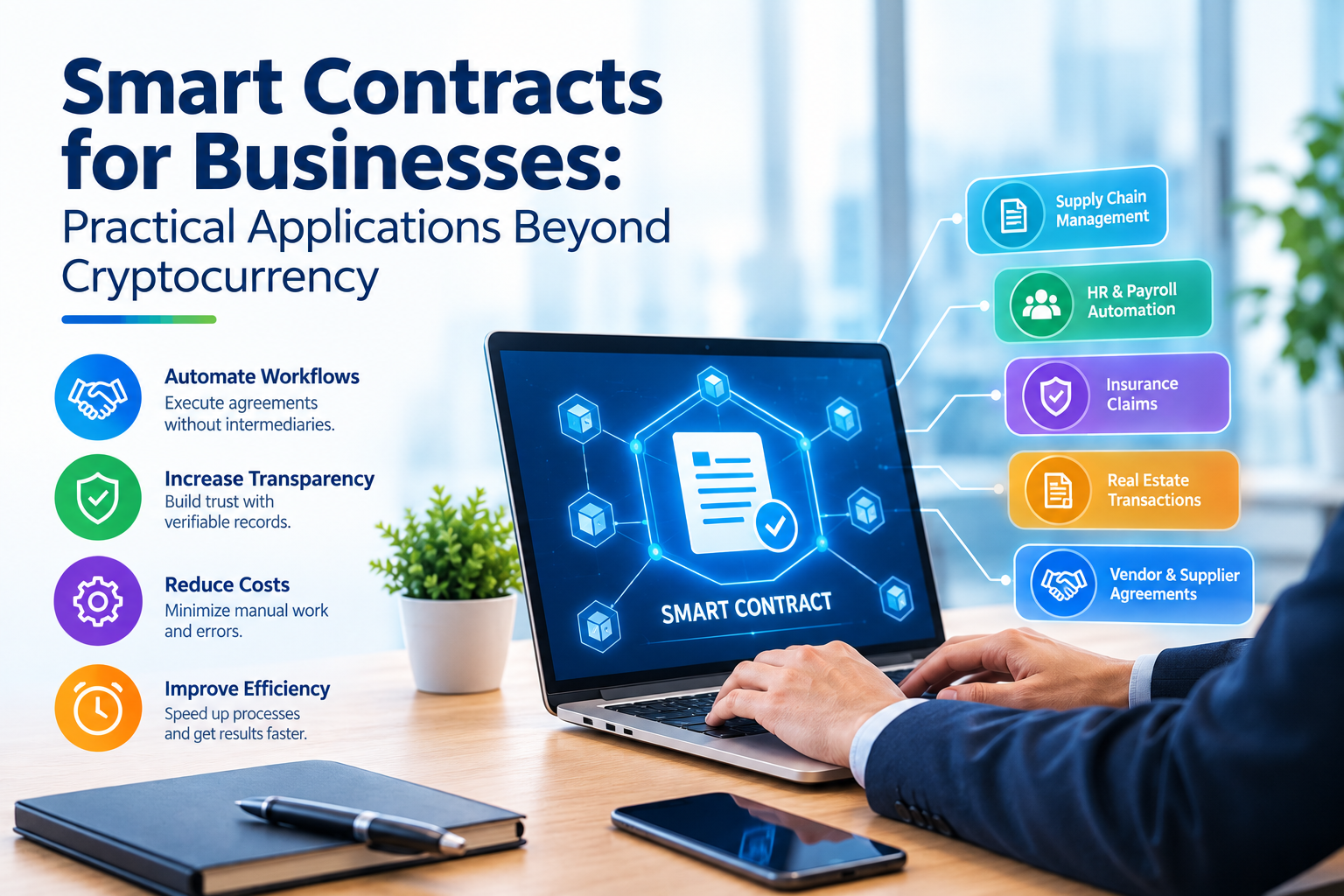
Smart Contracts for Businesses: Practical Applications Beyond Cryptocurrency
Smart Contracts for Businesses: Practical Applications Beyond Cryptocurrency
Smart contracts are often associated with cryptocurrency and blockchain-based financial transactions. However, their potential extends far beyond digital currencies. Businesses across industries can use smart contracts to automate agreements, verify transactions, reduce administrative work, and improve transparency between multiple parties.
As organizations continue to adopt blockchain technology, smart contracts are becoming a practical tool for automating business processes that traditionally depend on manual approvals, paperwork, or intermediaries.
What Are Smart Contracts?
A smart contract is a program stored on a blockchain that automatically executes predefined actions when specified conditions are met.
For example, a business agreement could be programmed so that once a verified delivery is recorded, payment is automatically released to the supplier.
Unlike traditional contracts, smart contracts combine contractual rules with software-based execution. This can help reduce manual intervention and create a transparent record of transactions.
How Businesses Can Use Smart Contracts
1. Supply Chain Management
Supply chains involve multiple participants, including manufacturers, suppliers, logistics providers, distributors, and retailers.
Smart contracts can automate processes when predefined events occur.
For example:
Order Confirmed → Goods Shipped → Delivery Verified → Payment Released
Each stage can trigger a corresponding action based on verified information.
This can improve visibility across the supply chain and reduce delays caused by manual processing.
2. Automated Payments
Businesses frequently depend on invoices, approvals, payment schedules, and reconciliation.
Smart contracts can automate payments when contractual conditions are satisfied.
For example, a service agreement could specify that payment is released after an approved milestone is completed and verified.
This can reduce administrative work and provide greater transparency around payment conditions.
3. Insurance Processing
Insurance companies handle large volumes of claims that require verification and processing.
Smart contracts can support automated claim workflows when reliable external information confirms that predefined conditions have been met.
For example, certain insurance products could automatically initiate a payout after an independently verified event.
Automation can potentially reduce processing time while improving consistency.
4. Real Estate Transactions
Real estate transactions involve contracts, ownership records, payments, approvals, and multiple parties.
Smart contracts can be used to automate parts of the transaction process, such as:
- Agreement verification
- Payment conditions
- Escrow processes
- Ownership-related workflows
- Transaction records
Blockchain-based records can also provide a transparent history of transactions, although legal and regulatory requirements still need to be addressed.
5. Vendor and Procurement Management
Large organizations often work with hundreds or thousands of suppliers.
Smart contracts can help automate procurement agreements by connecting predefined conditions with business events.
For example, a contract could trigger an approval or payment process when the required quantity of goods is received and verified.
This can make vendor management more structured and reduce repetitive administrative tasks.
6. Intellectual Property and Licensing
Businesses frequently license software, digital content, patents, trademarks, and other intellectual property.
Smart contracts can help manage licensing conditions and automate actions based on predefined rules.
For example, a licensing agreement could automatically track usage periods or trigger payments when specified licensing conditions are met.
7. Trade Finance
International trade involves exporters, importers, banks, insurers, logistics providers, and other participants.
Smart contracts can support trade-finance workflows by connecting payment or documentation requirements to verified events.
This can potentially reduce paperwork and improve coordination between participating organizations.
8. Employee and Contractor Agreements
Organizations can also explore smart contracts for specific workforce-related processes.
For example, a contractor agreement could define milestone-based payments and automatically initiate a payment workflow after approved deliverables are recorded.
However, businesses must ensure that automated agreements comply with employment, tax, and contract laws applicable to their jurisdiction.
Benefits of Smart Contracts for Businesses
When appropriately designed and implemented, smart contracts can provide several potential benefits.
Automation
Routine contractual processes can be executed automatically when predefined conditions are satisfied.
Transparency
Blockchain-based records can provide participating parties with a shared transaction history, depending on the blockchain architecture used.
Reduced Administrative Work
Automating repetitive verification and approval processes can reduce manual processing.
Improved Traceability
Transactions and contract-related events can be recorded in a way that supports easier auditing and tracking.
Faster Processing
Automated workflows can reduce delays associated with manual approvals and reconciliation.
Challenges Businesses Should Consider
Smart contracts are not a universal replacement for traditional contracts. Businesses should evaluate their limitations before implementation.
Code Errors
A smart contract executes according to its programmed logic. Errors in the code can produce unintended outcomes.
Legal Recognition
The legal treatment of smart contracts varies by jurisdiction and by the specific nature of the agreement. Businesses should obtain appropriate legal advice before using smart contracts for legally significant transactions.
External Data
Many business contracts depend on real-world information, such as delivery status, prices, weather events, or identity verification.
Smart contracts may require trusted external data sources, commonly known as oracles, to obtain this information.
Privacy
Blockchain transparency can create privacy challenges when sensitive business information is involved. Organizations need to carefully determine what information should be stored on-chain and what should remain off-chain.
Integration
A smart contract may need to interact with existing ERP, CRM, payment, supply-chain, or enterprise systems. Integration architecture should therefore be considered from the beginning.
Smart Contracts vs Traditional Contracts
Traditional contracts generally depend on human interpretation, approval, and execution.
Smart contracts introduce software-based automation into specific contractual processes.
| Traditional Contracts | Smart Contracts |
|---|---|
| Manual execution | Automated execution |
| Paper or digital documents | Blockchain-based program logic |
| Human approvals | Predefined conditions |
| Manual verification | Automated verification where supported |
| Traditional record keeping | Distributed transaction records |
| Flexible interpretation | Logic defined in code |
Smart contracts do not necessarily replace traditional legal agreements. In many business applications, they can instead complement traditional contracts by automating selected operational steps.
What Businesses Should Do Before Implementing Smart Contracts
Before adopting smart contracts, organizations should:
- Identify a suitable business process.
- Define the conditions that can be automated.
- Assess legal and regulatory requirements.
- Determine which data needs blockchain verification.
- Design secure integrations with existing systems.
- Test the smart contract extensively.
- Establish monitoring and governance processes.
- Start with a controlled pilot before expanding deployment.
A practical use case with measurable business value is generally a better starting point than attempting to put an entire business process on a blockchain.
The Future of Smart Contracts in Business
As blockchain platforms, enterprise integrations, identity systems, and digital infrastructure continue to develop, smart contracts may become increasingly useful for automated business workflows.
Their strongest business applications are likely to focus on processes where multiple parties need shared records, predefined rules, verification, and automated execution.
For organizations, the important question is not simply whether blockchain should be adopted. Instead, businesses should identify specific processes where smart-contract automation can provide measurable operational value.
How Riotech Softwares Can Help
Implementing blockchain-based business solutions requires more than writing smart-contract code. It involves software architecture, system integration, security, data management, and an understanding of the organization's existing technology environment.
Riotech Softwares provides technology and software development solutions that can help businesses explore modern digital technologies and develop scalable technology solutions.
To learn more about Riotech Softwares and its technology services, visit https://www.riotechsoftwares.com/.
Conclusion
Smart contracts have applications far beyond cryptocurrency. From supply chain management and automated payments to insurance, procurement, licensing, and trade finance, they can help businesses automate specific processes and improve coordination between multiple parties.
However, successful adoption requires careful consideration of security, legal requirements, privacy, external data, and integration with existing systems.
For businesses exploring blockchain, the most practical approach is to begin with a clearly defined process where automation and shared transaction records can deliver measurable value.
Website: https://www.riotechsoftwares.com/