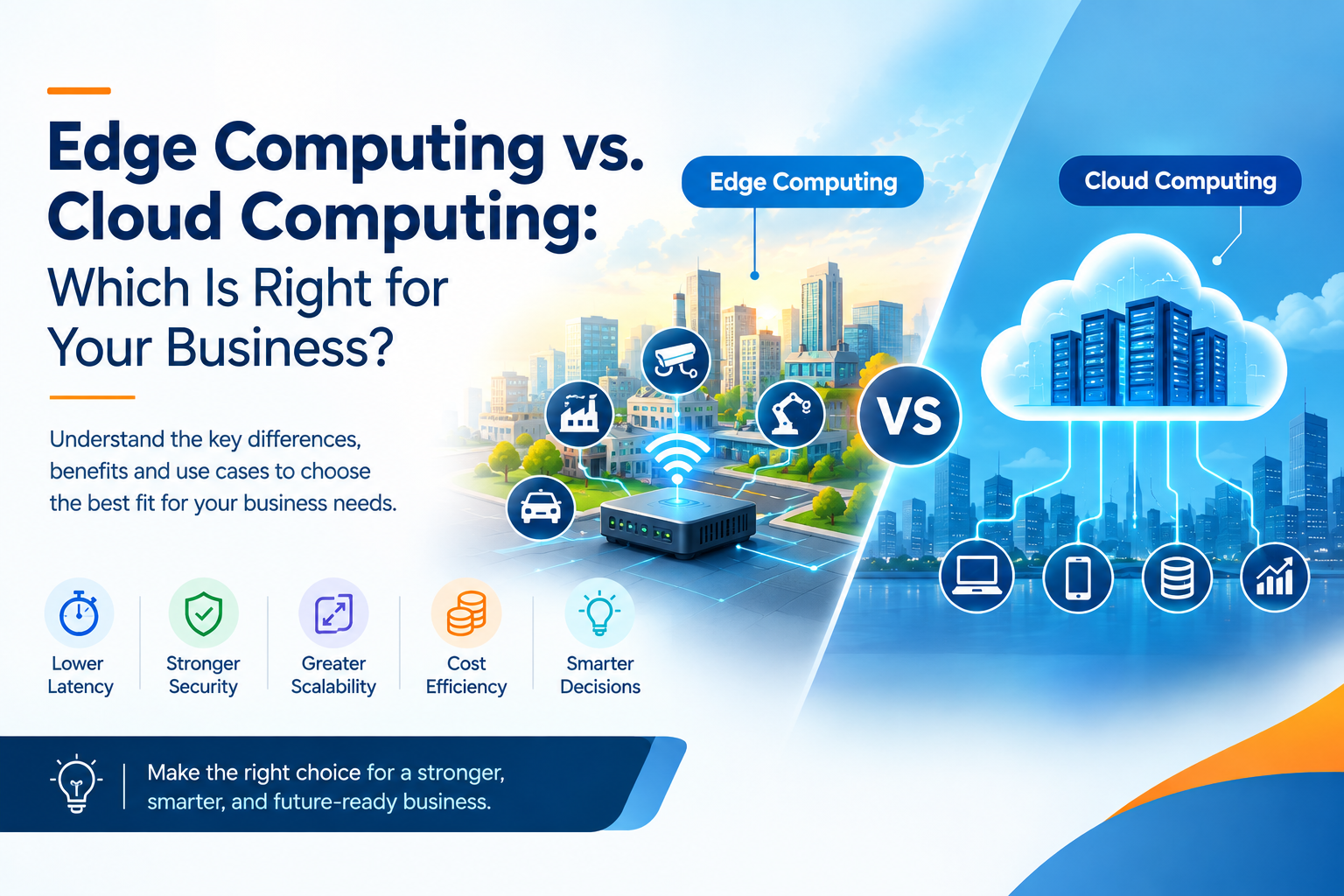
Edge Computing vs. Cloud Computing: Which Is Right for Your Business?
Edge Computing vs. Cloud Computing: Which Is Right for Your Business?
As businesses become increasingly dependent on digital technologies, the ability to process, store, and analyze data efficiently has become a critical part of modern technology strategy. From artificial intelligence and Internet of Things (IoT) devices to enterprise applications, connected vehicles, smart infrastructure, and real-time analytics, organizations are generating and processing enormous amounts of data every day.
For many years, cloud computing has been the foundation of modern digital infrastructure. Businesses use cloud platforms to host applications, store information, run analytics, manage databases, and scale computing resources according to demand.
However, the rapid growth of connected devices and real-time applications has created new challenges. Sending every piece of data to a centralized cloud environment can sometimes introduce latency, increase bandwidth consumption, and create operational challenges.
This is where edge computing becomes important.
Edge computing processes data closer to the location where it is generated, allowing applications to respond faster and operate more efficiently in certain environments.
This raises an important question:
Should your business use edge computing, cloud computing, or a combination of both?
The answer depends on several factors, including application requirements, latency, data volume, connectivity, security, scalability, infrastructure costs, and long-term business objectives.
Understanding Cloud Computing
Cloud computing is a technology model in which computing resources such as servers, storage, databases, networking, software, and analytics capabilities are delivered through remote data centers.
Instead of purchasing and maintaining large amounts of physical infrastructure, businesses can access computing resources when required. This approach has transformed the way organizations build and operate their digital systems.
Cloud computing is commonly used for:
- Enterprise applications
- Websites and web applications
- Customer relationship management systems
- Data storage and backup
- Business analytics
- Artificial intelligence workloads
- Software development and testing
- Database management
- Collaboration platforms
- Business continuity and disaster recovery
One of the biggest advantages of cloud computing is scalability.
A business can increase computing resources when demand increases and reduce them when demand falls. This provides greater flexibility compared with traditional on-premises infrastructure.
For organizations planning digital transformation, cloud infrastructure can also reduce the need for significant upfront hardware investment.
Businesses can work with technology partners such as Riotech Softwares to develop and implement software solutions that support evolving digital and business requirements.
What Is Edge Computing?
Edge computing is a distributed computing approach in which data processing takes place closer to the location where data is generated.
Instead of sending every piece of information to a centralized cloud data center, an edge device, local server, gateway, or computing node can process certain data locally.
Examples of edge environments include:
- Manufacturing facilities
- IoT sensors
- Smart retail stores
- Connected vehicles
- Healthcare devices
- Telecommunications infrastructure
- Energy systems
- Security cameras
- Smart cities
- Industrial automation systems
Consider a manufacturing facility with hundreds or thousands of sensors monitoring machines.
These sensors may continuously generate information about temperature, vibration, pressure, speed, and equipment performance.
Sending every data point to a remote cloud server for immediate processing could consume significant bandwidth and introduce network delays.
With edge computing, the system can process critical information locally.
For example, if a machine begins showing unusual vibration patterns, an edge system can identify the problem immediately and trigger an alert or automated response.
The relevant information can then be transferred to the cloud for long-term storage, reporting, machine learning, and advanced analytics.
This approach makes edge computing particularly useful for applications where speed, reliability, and real-time decision-making are important.
Edge Computing vs. Cloud Computing: Key Difference
The fundamental difference between edge computing and cloud computing is where data processing takes place.
Cloud computing generally processes data within centralized or distributed cloud data centers, while edge computing moves certain processing capabilities closer to the source of the data.
| Factor | Cloud Computing | Edge Computing |
|---|---|---|
| Data Processing | Centralized cloud infrastructure | Closer to data source |
| Latency | Can be higher depending on network distance | Generally lower |
| Scalability | Highly scalable | Scalable but depends on deployment |
| Data Storage | Large-scale centralized storage | Usually limited local storage |
| Connectivity Dependency | Generally higher | Can operate locally for some workloads |
| Real-Time Processing | Suitable, depending on architecture | Particularly suitable |
| Infrastructure | Centralized | Distributed |
| Management | Easier centralized management | More complex distributed management |
| Best Use Cases | Enterprise apps, analytics, storage | IoT, automation, real-time applications |
Neither technology is universally better.
The right architecture depends on the specific requirements of the application and business.
Why Businesses Are Adopting Edge Computing
The rapid growth of IoT devices, connected systems, artificial intelligence, automation, and real-time applications is increasing the demand for local data processing.
Organizations may need to analyze information immediately instead of waiting for data to travel to a remote data center.
Edge computing can provide several important benefits.
1. Faster Response Times
Latency can be critical for applications where decisions must be made within milliseconds or seconds.
Because edge computing processes information closer to the source, it can reduce the amount of time required for data to travel between the device and a centralized infrastructure.
This can be valuable for:
- Industrial automation
- Autonomous systems
- Real-time monitoring
- Smart manufacturing
- Connected vehicles
- Video analytics
- Healthcare monitoring
For example, an automated manufacturing system may need to stop equipment immediately when it detects a potentially dangerous condition.
Processing that information locally can help reduce unnecessary network delays.
2. Reduced Bandwidth Consumption
Modern organizations can generate enormous quantities of data.
Consider thousands of IoT sensors, cameras, machines, and connected devices transmitting information continuously.
Sending all raw data to the cloud can increase bandwidth requirements and operational costs.
Edge computing allows organizations to filter and analyze data locally.
Instead of transmitting every raw data point, an edge system can send only relevant information to the cloud.
For example:
Raw Sensor Data → Local Processing → Important Events → Cloud Storage
This approach can reduce unnecessary data transmission.
3. Improved Operational Reliability
Cloud connectivity is highly reliable in many environments, but some businesses operate in locations where network connectivity may be limited or inconsistent.
Edge systems can allow certain applications to continue performing local processing even when connectivity with the central cloud environment is temporarily unavailable.
This can be useful for:
- Remote industrial sites
- Transportation systems
- Offshore facilities
- Agricultural operations
- Remote monitoring
- Critical infrastructure
Once connectivity is restored, relevant information can be synchronized with centralized systems.
4. Better Real-Time Analytics
Traditional cloud architectures may require data to travel to a centralized environment before it can be analyzed.
Edge computing allows certain analytics workloads to happen closer to the data source.
This can help businesses identify operational events more quickly.
For example, a retail store could analyze camera or sensor information locally to identify customer movement patterns, inventory events, or security incidents.
The cloud can then be used for broader analysis across multiple locations.
Why Cloud Computing Remains Essential
The growth of edge computing does not mean that cloud computing is becoming obsolete.
Cloud computing remains one of the most important foundations of modern business technology.
Cloud platforms provide:
- Scalable computing resources
- Centralized data management
- Large-scale storage
- Advanced analytics
- AI and machine learning capabilities
- Backup and disaster recovery
- Application hosting
- Centralized monitoring
- Global accessibility
For applications that do not require extremely low latency, centralized cloud infrastructure can often be easier to manage.
Cloud computing is also highly valuable for organizations that need to access large datasets from multiple locations.
For example, a company operating across several cities may use cloud infrastructure to maintain centralized customer databases, enterprise applications, reporting systems, and business analytics platforms.
Cloud Computing for Business Applications
Many organizations use cloud computing as the foundation for their digital operations.
Typical workloads include:
Enterprise Software
Business applications such as ERP, CRM, HR management, accounting, and project management systems can be hosted in cloud environments.
Data Analytics
Businesses can centralize information from multiple sources and use analytics platforms to identify trends and support decision-making.
Artificial Intelligence
Cloud infrastructure provides scalable computing resources for AI model development, training, deployment, and analytics.
Software Development
Development teams can use cloud environments for application development, testing, deployment, and collaboration.
Backup and Disaster Recovery
Cloud infrastructure can provide scalable backup storage and recovery capabilities to help businesses protect important information.
Edge Computing and Cloud Computing Can Work Together
For many businesses, the most effective strategy is not choosing between edge computing and cloud computing.
Instead, organizations can combine both technologies through a hybrid edge-cloud architecture.
In this model:
Edge infrastructure handles time-sensitive processing close to the source, while cloud infrastructure provides centralized storage, analytics, management, and large-scale computing.
A simplified architecture can look like this:
Connected Device → Edge Processing → Cloud Platform → Advanced Analytics → Business Insights
This approach allows businesses to use each technology where it provides the greatest value.
For example, a logistics company using connected vehicles could process critical vehicle information locally.
The vehicle's edge system might identify unusual engine behavior immediately.
Important information can then be transmitted to the cloud, where the organization can analyze data from its entire fleet.
The cloud can be used for:
- Fleet analytics
- Historical data storage
- Predictive maintenance
- Reporting
- Performance monitoring
- Centralized management
This creates a technology architecture that combines low-latency processing with cloud scalability.
Businesses looking to build such technology environments can explore modern software and digital solutions from Riotech Softwares.
Edge Computing and Artificial Intelligence
Artificial intelligence is another area where edge computing and cloud computing can complement each other.
AI applications often require significant computing resources, but not every AI task needs to be performed in a centralized cloud environment.
For example, an intelligent camera could use edge processing to detect objects or unusual activity locally.
Instead of sending continuous video footage to the cloud, the device could send only relevant events.
This can reduce bandwidth usage while enabling faster responses.
At the same time, cloud infrastructure can be used for:
- Model training
- Large-scale analytics
- Data aggregation
- AI model management
- Historical analysis
- Centralized reporting
This combination is often referred to as Edge AI.
As AI adoption expands across industries, edge-based AI applications are likely to become increasingly important.
Which Industries Can Benefit from Edge Computing?
Edge computing can support a wide range of industries.
Manufacturing
Manufacturing organizations can use edge computing for:
- Equipment monitoring
- Industrial automation
- Predictive maintenance
- Quality control
- Production monitoring
- Machine performance analysis
By processing information close to machines, businesses can identify operational problems faster.
Healthcare
Healthcare organizations can use connected medical devices and monitoring systems to process information closer to patients and equipment.
Potential applications include:
- Patient monitoring
- Medical device analytics
- Remote healthcare systems
- Connected hospital infrastructure
Because healthcare environments involve sensitive information, security and compliance should be carefully considered.
Retail
Retail businesses can use edge computing for:
- Smart stores
- Inventory monitoring
- Video analytics
- Security systems
- Customer experience applications
- Point-of-sale optimization
Processing selected information locally can help retailers respond to events more quickly.
Transportation and Logistics
Connected vehicles and logistics systems generate large amounts of data.
Edge computing can support:
- Fleet monitoring
- Vehicle analytics
- Route optimization
- Predictive maintenance
- Real-time tracking
Cloud platforms can then provide centralized reporting and long-term analytics.
Telecommunications
Telecommunications providers can use edge infrastructure to support applications requiring low latency and high network performance.
This becomes particularly relevant as 5G networks and connected applications continue to expand.
Energy and Utilities
Energy companies can use edge computing for monitoring distributed infrastructure, analyzing equipment performance, and detecting operational issues.
Local processing can be especially valuable for remote infrastructure where network connectivity may not always be consistent.
Security Considerations for Edge and Cloud Computing
Security should be a central part of any edge or cloud strategy.
Cloud environments provide centralized security controls, identity management, access policies, monitoring, encryption, and security services.
However, cloud security still depends heavily on proper configuration and ongoing management.
Edge computing introduces additional security considerations because computing resources may be distributed across multiple locations.
Organizations implementing edge infrastructure should consider:
- Device authentication
- Data encryption
- Identity and access management
- Secure software updates
- Network segmentation
- Endpoint protection
- Security monitoring
- Physical security
- Vulnerability management
- Incident response
The distributed nature of edge infrastructure means businesses need to secure not only their centralized systems but also the devices and locations where edge processing occurs.
A strong cybersecurity strategy should therefore cover the entire technology environment.
Edge Computing vs. Cloud Computing: Cost Considerations
Cost is another important factor when choosing an architecture.
Cloud computing can reduce the need for businesses to purchase and maintain large physical infrastructure.
However, cloud costs can increase depending on:
- Data transfer
- Storage requirements
- Computing workloads
- Application usage
- Database operations
- Analytics requirements
Edge computing may reduce certain network and cloud processing costs by processing information locally.
However, businesses also need to consider the cost of:
- Edge devices
- Local servers
- Hardware maintenance
- Software deployment
- Device management
- Security
- Physical infrastructure
- Technical support
Therefore, businesses should evaluate the total cost of ownership rather than focusing on one infrastructure cost.
How Should Your Business Choose Between Edge and Cloud Computing?
There is no universal solution for every organization.
Businesses should evaluate their specific requirements before choosing an architecture.
Choose Edge Computing When:
Edge computing may be appropriate if your applications require:
- Extremely low latency
- Real-time decision-making
- Local data processing
- Continuous operation
- Limited network connectivity
- Reduced data transmission
- Distributed infrastructure
Examples include industrial automation, connected vehicles, real-time monitoring, and certain AI applications.
Choose Cloud Computing When:
Cloud computing may be more appropriate when your organization needs:
- Centralized data storage
- Large-scale computing
- Scalable infrastructure
- Remote accessibility
- Advanced analytics
- Centralized application management
- Large datasets
Examples include enterprise applications, websites, business analytics, software development, and centralized data management.
Choose a Hybrid Approach When:
A hybrid edge-cloud architecture may be the best option when your organization requires both:
Fast local processing + centralized cloud scalability
For many modern organizations, this approach can provide greater flexibility than relying exclusively on one architecture.
Important Factors to Consider Before Implementation
Before adopting edge computing, cloud computing, or both, businesses should evaluate several factors.
Application Requirements
Determine whether applications require real-time processing or can tolerate some network latency.
Data Volume
Analyze how much data your devices and applications generate.
Network Connectivity
Evaluate the reliability, speed, and availability of your network infrastructure.
Security Requirements
Identify the sensitivity of your data and determine the security controls required at both edge and cloud layers.
Scalability
Consider how infrastructure requirements may change as the business grows.
Infrastructure Costs
Compare hardware, software, network, storage, maintenance, and operational costs.
Technical Expertise
Distributed edge environments can require additional expertise for deployment and management.
Long-Term Technology Strategy
The selected architecture should support the organization's future plans for AI, automation, IoT, analytics, and digital transformation.
The Future of Edge and Cloud Computing
The future of enterprise computing is moving toward increasingly distributed, intelligent, and connected infrastructure.
Several technologies are contributing to this transformation:
- Artificial Intelligence
- Internet of Things
- 5G
- Automation
- Smart manufacturing
- Connected vehicles
- Real-time analytics
- Industrial IoT
- Intelligent infrastructure
As these technologies evolve, businesses will generate even larger amounts of data.
Processing all information exclusively in centralized cloud environments may not always be the most efficient approach.
Instead, organizations are increasingly likely to distribute workloads across devices, edge locations, regional infrastructure, and centralized cloud platforms.
This will create more flexible technology architectures capable of processing information where and when it is most valuable.
Rather than replacing cloud computing, edge computing is likely to become an important extension of modern cloud infrastructure.
Edge Computing and Cloud Computing: The Future Is Hybrid
The debate between edge computing and cloud computing should not necessarily be viewed as a competition.
Both technologies solve different problems.
Cloud computing provides centralized scalability, storage, computing resources, analytics, and management.
Edge computing provides localized processing, lower latency, and improved responsiveness for specific workloads.
When combined correctly, they can create a powerful technology architecture.
For example:
IoT Devices → Edge Processing → Secure Network → Cloud Platform → AI & Analytics → Business Decisions
This architecture allows organizations to process critical information locally while using centralized infrastructure for deeper analysis and long-term management.
The result can be a more flexible and scalable digital environment.
Conclusion
Edge Computing and Cloud Computing serve different but complementary purposes.
Cloud computing provides centralized infrastructure, scalable computing resources, large-scale storage, analytics, and advanced technology services.
Edge computing brings processing capabilities closer to the location where data is generated, helping organizations improve response times, reduce unnecessary data transmission, and support real-time applications.
For businesses with latency-sensitive workloads, connected devices, industrial automation, or real-time analytics requirements, edge computing can provide significant advantages.
For organizations that prioritize centralized infrastructure, large-scale storage, remote accessibility, and scalable computing, cloud computing remains an effective solution.
However, many modern businesses do not need to choose only one.
A hybrid edge-cloud architecture can combine the strengths of both technologies, allowing businesses to process critical information locally while using cloud infrastructure for centralized analytics, storage, AI, and management.
The right technology architecture ultimately depends on business requirements, application workloads, data volumes, connectivity, security, budget, and long-term growth plans.
Businesses looking to modernize their technology infrastructure can explore professional software development and digital technology solutions through Riotech Softwares.
With the right technology strategy, organizations can build infrastructure that is more responsive, scalable, secure, and prepared for future digital transformation.
Frequently Asked Questions
What is the main difference between Edge Computing and Cloud Computing?
The primary difference is where data is processed. Cloud computing generally processes data within centralized cloud infrastructure, while edge computing processes certain data closer to where it is generated.
Is Edge Computing better than Cloud Computing?
Neither technology is universally better. Edge computing is particularly useful for low-latency and real-time applications, while cloud computing is highly effective for centralized storage, scalable infrastructure, analytics, and enterprise applications.
Can Edge Computing and Cloud Computing be used together?
Yes. Businesses can combine both technologies through a hybrid edge-cloud architecture. Edge systems can handle time-sensitive processing locally, while cloud platforms manage centralized storage, analytics, AI workloads, and application management.
Which industries use Edge Computing?
Manufacturing, healthcare, retail, transportation, logistics, telecommunications, energy, agriculture, and smart infrastructure are among the industries that can benefit from edge computing.
Does Edge Computing reduce cloud costs?
Edge computing can reduce certain network and cloud processing requirements by filtering and processing data locally. However, the overall cost depends on hardware, deployment, maintenance, security, connectivity, and workload requirements.
Is Edge Computing secure?
Edge computing can be secure when appropriate controls are implemented. Businesses should consider device authentication, encryption, access control, network segmentation, secure updates, endpoint protection, monitoring, and physical security.
What should businesses consider before choosing Edge or Cloud Computing?
Businesses should evaluate latency requirements, data volume, network connectivity, security, scalability, infrastructure costs, application requirements, technical expertise, and long-term technology objectives.
What is a hybrid edge-cloud architecture?
A hybrid edge-cloud architecture combines local edge processing with centralized cloud infrastructure. Edge systems handle workloads that require quick local responses, while cloud platforms provide centralized storage, analytics, AI capabilities, and management.
Is Edge Computing replacing Cloud Computing?
No. Edge computing is generally viewed as complementary to cloud computing rather than a complete replacement. Many modern technology architectures use both approaches to optimize performance, scalability, and data management.
How can businesses implement Edge and Cloud Computing?
Businesses should first analyze their applications, data flows, connectivity, security requirements, and infrastructure. Based on these requirements, they can determine which workloads should remain at the edge and which should be handled by centralized cloud infrastructure. Working with an experienced technology and software development partner can also help organizations design and implement the appropriate architecture.
Recent Posts


12 Sep 2026

