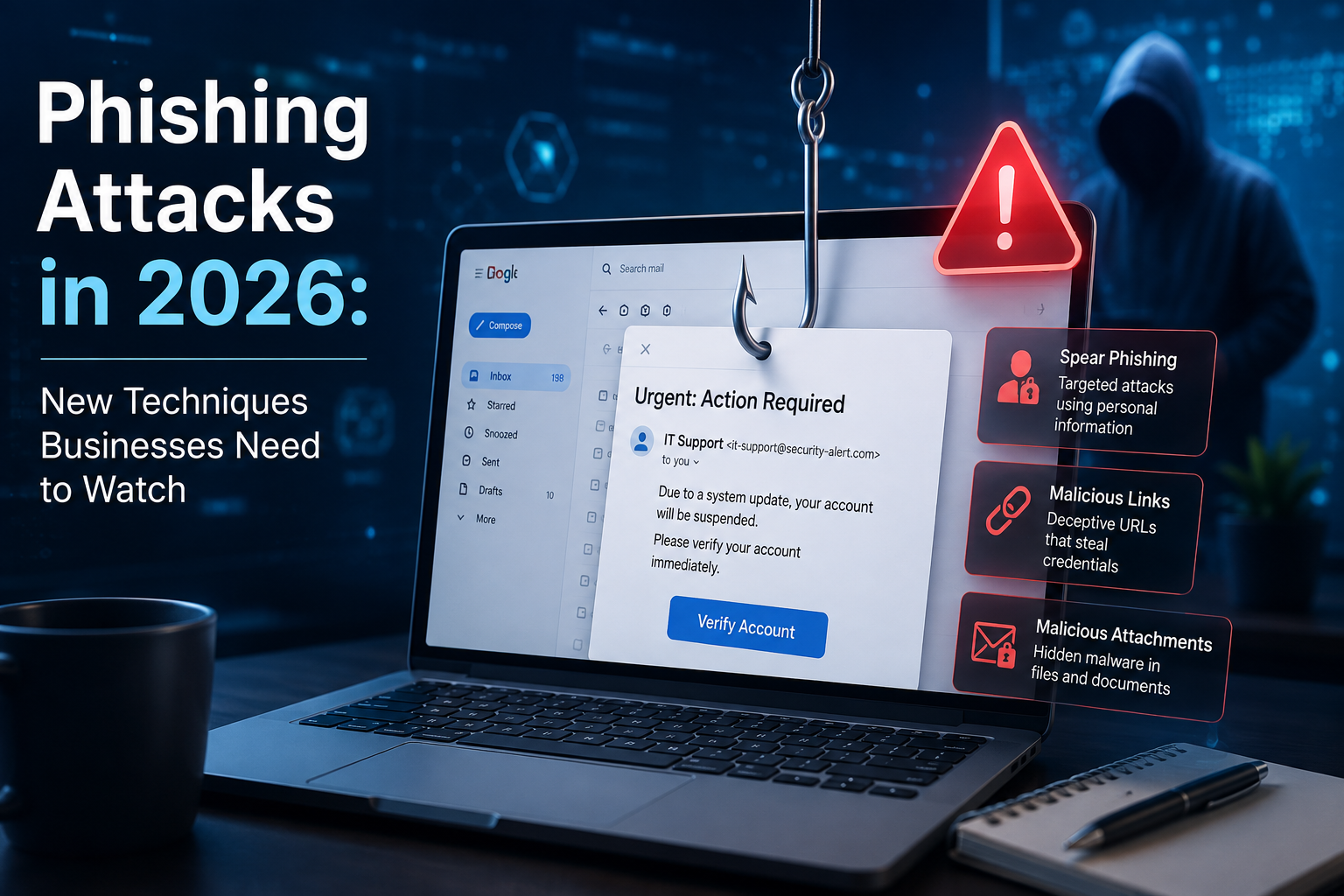
Phishing Attacks in 2026: New Techniques Businesses Need to Watch
Phishing Attacks in 2026: New Techniques Businesses Need to Watch
Cybersecurity has become a critical business priority as organizations increasingly depend on email, cloud applications, digital payments, remote collaboration, artificial intelligence, and connected systems. Among the many cyber threats businesses face, phishing remains one of the most common and effective methods used by attackers to gain unauthorized access to sensitive information and business systems.
However, phishing attacks are no longer limited to poorly written emails containing obvious suspicious links.
In 2026, attackers are using more sophisticated techniques involving artificial intelligence, social engineering, business email compromise, QR codes, cloud applications, impersonation, and multiple communication channels.
These developments make phishing attacks harder to recognize and potentially more damaging for businesses.
For organizations of all sizes, understanding how phishing is evolving is essential for protecting employees, customer information, financial systems, business applications, and digital infrastructure.
This article explores the latest phishing techniques businesses should watch in 2026 and explains practical strategies organizations can use to strengthen their cybersecurity posture.
What Is Phishing?
Phishing is a type of cyberattack in which criminals attempt to trick users into revealing sensitive information, clicking malicious links, opening harmful files, transferring money, or providing access to business systems.
Attackers often pretend to be trusted individuals or organizations.
For example, a phishing message may appear to come from:
- A company executive
- A bank
- An IT administrator
- A customer
- A supplier
- A business partner
- A cloud service provider
- A government organization
- A colleague
- A human resources department
The attacker may ask the recipient to perform an action such as resetting a password, opening an attachment, confirming an invoice, approving a payment, or logging into an account.
The ultimate objective is usually to steal information, compromise accounts, install malware, or gain unauthorized access to business resources.
Why Phishing Attacks Are Becoming More Sophisticated
The digital transformation of businesses has created more opportunities for cybercriminals.
Organizations now use multiple cloud applications, communication platforms, online payment systems, remote-access tools, and digital identities.
At the same time, attackers can use publicly available information and modern technologies to make their campaigns more convincing.
Artificial intelligence is also changing the way phishing content can be created.
Attackers can potentially generate professional-looking messages, personalize communication, adapt content to different languages, and imitate the communication style of specific individuals.
As a result, businesses can no longer rely only on obvious signs such as spelling mistakes or poorly designed emails.
Modern phishing protection requires a combination of employee awareness, identity security, email protection, access controls, monitoring, and incident response.
New Phishing Techniques Businesses Need to Watch in 2026
1. AI-Generated Phishing Attacks
Artificial intelligence is making it easier to create convincing phishing messages.
Traditional phishing emails often contained poor grammar, unusual formatting, generic greetings, or obvious mistakes.
AI can help attackers produce messages that appear much more professional.
AI-generated phishing messages may be:
- Grammatically accurate
- Professionally written
- Highly personalized
- Contextually relevant
- Available in multiple languages
- Adapted to a specific business role
For example, an attacker may research an employee's job responsibilities and create an email that appears related to a current business activity.
This makes it more difficult for employees to identify phishing based only on writing quality.
Businesses should therefore combine security awareness training with technical controls that can detect suspicious links, domains, attachments, login activity, and unusual account behavior.
2. Spear Phishing and Highly Personalized Attacks
Spear phishing is a targeted form of phishing designed for a specific individual or organization.
Instead of sending a generic message to thousands of people, attackers may first research their target.
Information can potentially be collected from:
- Company websites
- Professional networking platforms
- Social media
- Public business information
- Online directories
- Previous data leaks
- Public documents
Attackers can use this information to create a message that appears relevant to the target.
For example, a finance employee might receive a message appearing to come from a senior executive requesting an urgent payment.
Because the request appears connected to the employee's normal responsibilities, the employee may be more likely to trust it.
Organizations should therefore teach employees to verify unusual requests independently, especially when they involve money, credentials, or sensitive information.
3. Business Email Compromise
Business Email Compromise (BEC) is a serious form of social engineering in which attackers impersonate or compromise business email accounts.
The objective may be to convince employees to:
- Transfer money
- Change supplier bank details
- Send confidential documents
- Modify payroll information
- Purchase products or services
- Reveal sensitive business information
For example, an attacker could impersonate a company executive and request an urgent payment.
The email may look legitimate, particularly if the attacker has obtained information about the organization's internal structure.
Businesses should implement independent verification procedures for financial requests.
A payment or bank-account change should not be approved solely because the instruction was received through email.
4. QR Code Phishing
QR code phishing, commonly known as quishing, uses malicious QR codes to redirect victims to fraudulent websites.
The QR code may appear inside:
- Emails
- PDF documents
- Posters
- Business messages
- Digital advertisements
- Meeting invitations
After scanning the code, the user may be directed to a fake login page designed to steal credentials.
QR-based attacks can be challenging because users may not see the destination URL before opening it.
Employees should treat unexpected QR codes with the same caution as suspicious email links.
5. Cloud Account Phishing
Cloud applications have become central to modern business operations.
Employees may use cloud platforms to access:
- Business documents
- Customer information
- Databases
- Collaboration tools
- Financial systems
- Internal applications
If an attacker obtains a cloud account, the impact can extend beyond a single computer.
Attackers may attempt to access files, emails, applications, and other connected services.
Phishing campaigns may therefore imitate cloud security notifications, password-reset requests, account alerts, or login pages.
Organizations should use strong identity controls, multi-factor authentication, access policies, and monitoring to protect cloud accounts.
6. Phishing Through Collaboration Platforms
Business communication has expanded beyond traditional email.
Organizations now depend on messaging and collaboration platforms for daily operations.
Attackers can attempt to exploit these platforms by:
- Impersonating employees
- Sending malicious links
- Sharing fraudulent documents
- Creating fake support messages
- Requesting credentials
- Redirecting users to malicious websites
A message received through a familiar platform may feel trustworthy simply because the platform is commonly used by the organization.
However, the communication channel itself does not guarantee that the message is legitimate.
Businesses should therefore extend security awareness and monitoring across all major communication platforms.
7. Multi-Channel Social Engineering
Modern phishing campaigns may use more than one communication channel.
An attacker could initially contact a victim through email and then follow up through a messaging platform or phone call.
The second interaction can make the original request appear more credible.
For example:
Email → Messaging App → Phone Call → Fraudulent Request
This creates a consistent story across multiple channels.
Employees should therefore verify unexpected requests independently rather than trusting them simply because the same request appears across different platforms.
8. AI-Based Impersonation and Deepfake Risks
Advances in artificial intelligence have also increased concerns around identity impersonation.
Attackers may attempt to imitate the communication style, voice, image, or identity of trusted individuals.
For businesses, this creates an additional challenge.
A voice call or video meeting should not automatically be treated as proof that a financial or sensitive request is legitimate.
For high-risk activities, organizations should use independent verification procedures.
For example, an employee could contact the person using a previously known phone number instead of the contact details provided in the suspicious communication.
Common Warning Signs of Phishing
Even though phishing is becoming more sophisticated, several warning signs remain useful.
Unexpected Urgency
Be cautious when a message creates unusual pressure.
Examples include:
"Complete this immediately."
"Your account will be disabled today."
"Payment must be made urgently."
"Do not tell anyone about this request."
Attackers use urgency to prevent victims from thinking carefully.
Unexpected Login Requests
Employees should be cautious when a message suddenly asks them to log into an account.
Instead of clicking the provided link, users should navigate directly to the official application or website.
Unusual Payment Requests
Any unexpected payment request should receive additional verification.
This is particularly important when the request involves:
- New bank details
- Large payments
- Urgent transfers
- Supplier changes
- Executive requests
Suspicious Attachments
Unexpected attachments should not be opened simply because they appear to come from a familiar person.
Employees should verify the sender and context before opening unfamiliar files.
Suspicious Domains
Attackers may create domains that look similar to legitimate businesses.
Employees should carefully inspect the actual domain rather than relying only on the displayed company name.
How Businesses Can Protect Against Phishing
Effective phishing protection requires multiple layers of security.
Businesses should focus on people, processes, and technology.
1. Enable Multi-Factor Authentication
Multi-factor authentication adds an additional security layer beyond passwords.
Even if an attacker obtains a password through phishing, an additional authentication factor can make unauthorized access more difficult.
MFA should be prioritized for:
- Business email
- Cloud applications
- Administrative accounts
- Financial systems
- Remote access
- Critical applications
2. Strengthen Email Security
Email security controls can help detect and block suspicious content before it reaches employees.
Organizations should consider:
- Spam filtering
- Phishing detection
- Malware scanning
- Attachment analysis
- URL protection
- Domain protection
- Email authentication
Regular security reviews are also important because phishing techniques continue to evolve.
3. Establish Financial Verification Procedures
Financial transactions should have additional verification requirements.
For example, businesses can require independent confirmation for:
- Bank account changes
- Large payments
- Supplier updates
- Payroll modifications
- Executive payment requests
The verification should use a trusted communication method rather than contact information included in the suspicious request.
4. Provide Regular Employee Training
Employee awareness should not be limited to an annual cybersecurity session.
Training should regularly cover:
- Phishing
- Social engineering
- AI-generated scams
- Business Email Compromise
- QR-code phishing
- Password security
- MFA
- Suspicious attachments
- Incident reporting
Employees should understand that modern phishing messages can be professional, personalized, and convincing.
5. Implement Strong Access Controls
Businesses should follow the principle of least privilege.
Employees should only have access to the resources required for their roles.
Organizations should regularly review:
- User accounts
- Administrative privileges
- Inactive accounts
- Third-party access
- Application permissions
- Remote access
Limiting unnecessary privileges can reduce the potential damage caused by a compromised account.
6. Maintain Secure and Tested Backups
A phishing attack can sometimes lead to malware or ransomware.
Businesses should maintain reliable backups of critical information.
A strong backup strategy should include:
- Regular backups
- Protected storage
- Access controls
- Backup testing
- Recovery procedures
- Appropriate isolation from production systems
A backup is useful only if the organization can successfully restore its data when required.
7. Create an Incident Response Plan
Employees should know exactly what to do after interacting with a suspicious message.
A simple process can be:
Identify → Report → Contain → Investigate → Recover → Improve
Employees should be encouraged to report mistakes immediately.
Quick reporting can allow security teams to:
- Reset compromised credentials
- Revoke active sessions
- Block malicious domains
- Isolate affected devices
- Investigate account activity
- Prevent further compromise
A strong security culture should encourage reporting rather than blaming employees for mistakes.
The Role of Cybersecurity Solutions in Phishing Protection
Phishing protection should be part of a broader cybersecurity strategy.
Businesses need to secure multiple layers of their technology environment, including networks, devices, applications, identities, and data.
Organizations looking to strengthen their overall security posture can explore Riotech Softwares for areas such as network protection, data security, threat monitoring, and broader cybersecurity requirements.
A layered approach can help businesses detect suspicious activity earlier and reduce the potential impact of compromised accounts or devices.
Cloud Security and Phishing Protection
As businesses increasingly depend on cloud applications, protecting cloud identities has become an important part of cybersecurity.
Organizations should consider:
- Multi-factor authentication
- Role-based access
- Least-privilege permissions
- Secure cloud configurations
- Activity monitoring
- Backup and recovery
- Access reviews
- Suspicious-login detection
Businesses that are expanding their cloud infrastructure can also evaluate Riotech Softwares for cloud infrastructure, cloud security, backup and recovery, and server management requirements.
Cloud security and phishing protection should work together because compromised credentials can become an entry point into cloud environments.
How AI Can Help Businesses Detect Phishing
AI is not only being used by attackers.
Businesses can also use AI and automation to strengthen cybersecurity.
AI-based security systems can assist with:
- Suspicious email detection
- Behavioral analysis
- Anomaly detection
- Malicious URL analysis
- Account compromise detection
- Automated threat investigation
- Security alert prioritization
However, AI should not be considered a complete replacement for cybersecurity professionals or established security processes.
The strongest approach combines automation with human expertise, security policies, employee awareness, identity protection, and incident response.
Why Small and Medium-Sized Businesses Are at Risk
Small and medium-sized businesses can be attractive targets because they often manage valuable customer, financial, and business information while having fewer cybersecurity resources than large organizations.
SMEs may depend heavily on:
- Cloud applications
- Online payments
- Remote work
- Third-party platforms
- Digital customer systems
A successful phishing attack can result in:
- Financial losses
- Data theft
- Account compromise
- Operational disruption
- Ransomware
- Reputational damage
- Regulatory consequences
However, businesses do not necessarily need extremely complex security infrastructure to improve their defenses.
Implementing MFA, employee training, secure backups, email protection, access controls, and financial verification procedures can significantly improve security.
Phishing Protection Checklist for Businesses
Businesses can use this checklist to strengthen their phishing defenses:
- Enable multi-factor authentication
- Secure administrator accounts
- Implement email security controls
- Train employees regularly
- Verify unusual payment requests
- Avoid unexpected links and attachments
- Check sender domains
- Protect cloud accounts
- Apply least-privilege access
- Maintain tested backups
- Monitor unusual account activity
- Establish an incident reporting process
- Review third-party access
- Keep software updated
- Conduct regular security assessments
- Review cybersecurity policies periodically
The Future of Phishing Attacks
Phishing is unlikely to disappear.
As businesses adopt artificial intelligence, cloud computing, digital payments, remote collaboration, and connected applications, attackers will continue searching for opportunities to exploit digital identities and human behavior.
The major shift is likely to be toward attacks that are:
- More personalized
- More automated
- More convincing
- Multi-channel
- AI-assisted
- More targeted toward business processes
This means organizations should not rely on a single security solution.
Modern phishing protection should combine:
Employee Awareness + Identity Security + Email Protection + Access Controls + Monitoring + Incident Response
This layered strategy can make attacks more difficult to execute and reduce their potential impact.
Conclusion
Phishing attacks in 2026 are becoming more sophisticated, personalized, and difficult to recognize.
AI-generated messages, spear phishing, Business Email Compromise, QR-code phishing, cloud account attacks, collaboration-platform abuse, and AI-based impersonation are creating new challenges for organizations.
Traditional warning signs such as poor grammar or obvious suspicious emails are no longer sufficient on their own.
Businesses need a comprehensive cybersecurity strategy that combines employee awareness, strong authentication, email security, access controls, secure cloud infrastructure, monitoring, backup systems, and effective incident response.
Financial and sensitive business requests should also be independently verified rather than trusted simply because they appear to come from a familiar person.
For businesses looking to strengthen their digital security and technology infrastructure, Riotech Softwares provides modern technology solutions across software development, cloud, cybersecurity, AI, and digital transformation.
Cybersecurity should not be treated as a one-time project. It should be an ongoing part of business operations and technology planning.
The objective is not only to detect phishing attacks after they occur, but to create a secure environment where suspicious activity is harder to execute, easier to identify, and faster to contain.
Frequently Asked Questions
What is phishing?
Phishing is a cyberattack in which criminals impersonate trusted individuals or organizations to trick users into revealing information, clicking malicious links, opening harmful files, transferring money, or providing unauthorized access.
Why are phishing attacks becoming more dangerous in 2026?
Attackers are increasingly using AI, personalization, social engineering, cloud services, QR codes, impersonation, and multiple communication channels to make phishing campaigns appear legitimate.
What is AI-powered phishing?
AI-powered phishing uses artificial intelligence to help attackers create convincing and personalized messages, adapt content, automate campaigns, and imitate communication styles.
What is Business Email Compromise?
Business Email Compromise is an attack in which criminals impersonate or compromise business email accounts to manipulate employees into transferring money, sharing sensitive information, or performing unauthorized actions.
What is QR-code phishing?
QR-code phishing, also called quishing, uses malicious QR codes to redirect users to fraudulent websites or login pages designed to steal credentials or other information.
Can MFA stop phishing attacks?
MFA can significantly reduce the risk of unauthorized access using stolen credentials, but it does not eliminate all phishing threats. MFA should be combined with other security controls.
What should an employee do after clicking a phishing link?
The incident should be reported immediately according to the organization's security procedure. Security teams may need to reset credentials, revoke sessions, isolate devices, and investigate the activity.
How can SMEs protect against phishing?
SMEs should prioritize MFA, email security, employee training, access controls, secure backups, payment verification, software updates, monitoring, and incident response.
Is employee training enough to prevent phishing?
No. Training is important, but effective protection requires multiple security layers, including identity security, email protection, access controls, monitoring, backups, and incident response.
Why is cybersecurity important for businesses?
A successful cyberattack can cause financial losses, data exposure, operational disruption, reputational damage, and regulatory problems. Strong cybersecurity helps businesses reduce these risks and improve digital resilience.
Recent Posts

12 Sep 2026

