How Does Real-Time Reporting Support Better Decisions?
Introduction
In today's fast-moving business environment, making timely and informed decisions is essential for success. Businesses generate large amounts of data through sales, customer interactions, marketing campaigns, operations, and digital platforms. However, this data becomes more valuable when it is available at the right time and presented in a meaningful way.
Real-time reporting enables businesses to monitor current activities, track performance, and identify issues as they occur. Instead of relying only on outdated reports, decision-makers can use updated information to respond quickly and improve business outcomes.
With the right software solutions, organizations can transform raw data into actionable insights and build a more responsive decision-making process.
What Is Real-Time Reporting?
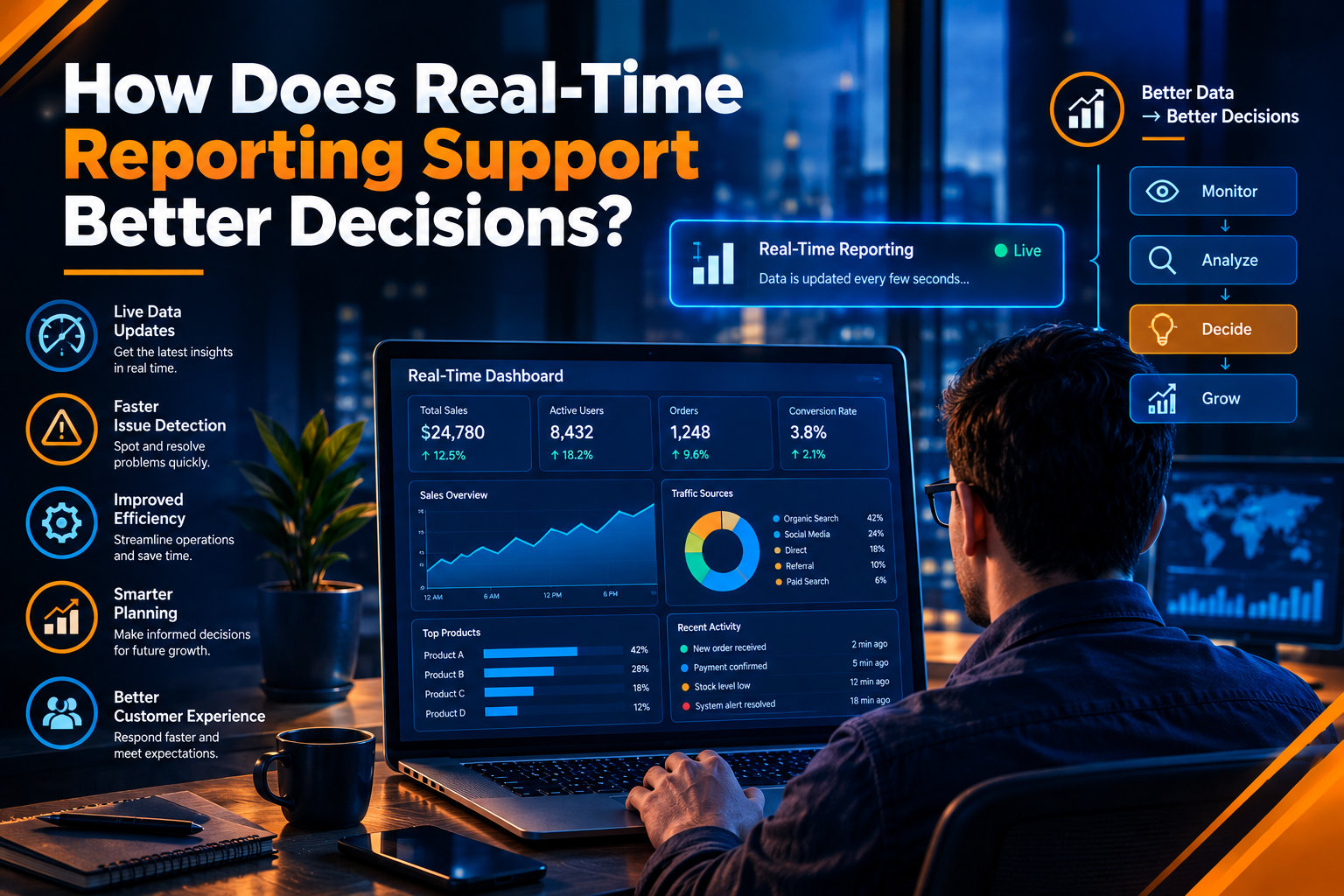
Real-time reporting is the process of collecting, processing, and presenting data as events occur or shortly after they happen. It allows businesses to view current performance indicators through dashboards, charts, alerts, and automated reports.
For example, an e-commerce company can monitor incoming orders, inventory levels, customer activity, and payment status through a centralized dashboard. If inventory starts running low, the team can take action before the product becomes unavailable.
Businesses can explore software development solutions at https://www.riotechsoftwares.com/softwaredevelopment.php to understand how customized software can support reporting and business processes.
How Real-Time Reporting Supports Better Decisions
1. Provides Timely and Accurate Insights
Traditional reports may rely on information collected hours, days, or weeks earlier. Real-time reporting gives decision-makers access to more current information, helping them understand what is happening across their business.
When managers can view updated performance data, they can make decisions based on recent activity rather than assumptions or outdated figures.
2. Helps Identify Problems Faster
Operational issues can affect productivity, customer satisfaction, and revenue if they remain unnoticed. Real-time dashboards and automated alerts help teams detect unusual activity, system errors, and performance changes earlier.
For example, a software team can monitor application errors and server performance to identify potential service disruptions. Faster visibility helps the team investigate issues and reduce their impact.
3. Improves Operational Efficiency
Real-time reporting allows organizations to identify delays, bottlenecks, and resource shortages. Teams can use these insights to adjust workloads, streamline processes, and allocate resources more effectively.
Businesses can also identify repetitive tasks that may benefit from automation. This reduces manual reporting efforts and allows employees to focus on higher-value activities.
4. Strengthens Financial and Business Planning
Financial teams need timely information to monitor expenses, revenue, cash flow, and budget performance. Real-time or near-real-time financial dashboards can highlight changes that require attention.
For instance, if operational expenses rise unexpectedly, managers can investigate the reasons and adjust spending plans. Current financial information also supports more informed forecasting and resource allocation.
5. Enhances Customer Experience
Customer expectations can change quickly. Real-time reporting helps businesses monitor service requests, response times, order status, and customer feedback.
Support teams can prioritize urgent requests, identify recurring complaints, and respond to service issues more effectively. These improvements can contribute to stronger customer relationships and greater satisfaction.
6. Supports Data-Driven Team Collaboration
When departments rely on separate spreadsheets and disconnected reports, it can be difficult to maintain a shared understanding of business performance.
A centralized reporting dashboard gives teams access to consistent information and shared performance indicators. Marketing, sales, operations, and technical teams can coordinate their activities using the same data.
Customized software development can help connect business systems and make relevant information more accessible. Learn more at https://www.riotechsoftwares.com/softwaredevelopment.php.
Key Features of an Effective Real-Time Reporting System
A useful reporting system should present relevant information clearly and reliably. Important features include:
Live Dashboards: Display current business metrics in an easy-to-understand format.
Automated Alerts: Notify teams when performance indicators cross defined thresholds.
Data Integration: Connect relevant applications, databases, and business platforms.
Custom Reports: Allow users to focus on metrics that match their responsibilities.
Role-Based Access: Ensure users can access the information appropriate to their roles.
Historical Comparisons: Compare current performance with previous periods to identify trends.
Data Security: Protect sensitive business information through appropriate access controls and security measures.
The right combination of features depends on the organization's reporting needs, technology environment, and business objectives.
Real-Time Reporting Use Cases Across Industries
Retail and E-commerce
Retail businesses can monitor sales, inventory, order fulfillment, and product demand. This information helps teams respond to changing purchasing patterns and manage stock more efficiently.
Healthcare
Healthcare organizations can use reporting dashboards to monitor operational workflows, appointment schedules, resource availability, and other relevant service indicators. Access controls and privacy safeguards are essential when handling sensitive information.
Information Technology
IT teams can track system availability, application performance, error rates, and support tickets. These insights help technical teams prioritize incidents and maintain service quality.
Manufacturing
Manufacturers can monitor production output, equipment performance, quality indicators, and material availability. Timely alerts can help teams investigate production disruptions and improve operational planning.
Digital Marketing
Marketing teams can review campaign traffic, engagement, leads, and conversion performance. Updated campaign data helps them evaluate which activities are performing well and where adjustments may be needed.
Challenges in Implementing Real-Time Reporting
Although real-time reporting offers several benefits, implementation requires careful planning.
Data quality: Incorrect, incomplete, or inconsistent data can lead to misleading conclusions.
System integration: Connecting multiple applications and legacy systems may require additional development work.
Infrastructure costs: Processing frequent data updates may increase infrastructure and maintenance requirements.
Information overload: Too many dashboards and alerts can make it difficult to identify important issues.
Security and privacy: Sensitive data must be protected through suitable permissions, monitoring, and security controls.
Businesses can address these challenges by defining clear reporting objectives, selecting relevant metrics, validating data sources, and reviewing system performance regularly.
Best Practices for Better Reporting and Decision-Making
To gain meaningful value from real-time reporting, organizations should follow a structured approach:
Define the business decisions the reporting system needs to support.
Select measurable key performance indicators aligned with business goals.
Integrate reliable data sources and establish data validation processes.
Design dashboards that prioritize important information.
Configure alerts for significant changes rather than every minor event.
Train employees to interpret metrics correctly and take appropriate action.
Review reporting accuracy, security, and usefulness over time.
It is also important to understand that real-time information does not automatically guarantee better decisions. Data must be interpreted in context, and important decisions should consider business priorities, risks, and relevant expertise.
Conclusion
Real-time reporting supports better decisions by giving businesses timely access to operational, financial, customer, and performance information. It helps organizations identify problems earlier, improve resource utilization, coordinate teams, and respond to changing business conditions.
By investing in suitable reporting tools and reliable software systems, businesses can build a stronger foundation for data-driven decision-making. The key is to focus on accurate information, meaningful metrics, and insights that lead to practical action.
Visit Website
Explore Riotech Softwares for software development solutions that support business processes, digital transformation, and technology-driven growth.
https://www.riotechsoftwares.com/softwaredevelopment.php
Visit the website to learn more about the available software development services for your business.
Recent Posts

15 Oct 2026