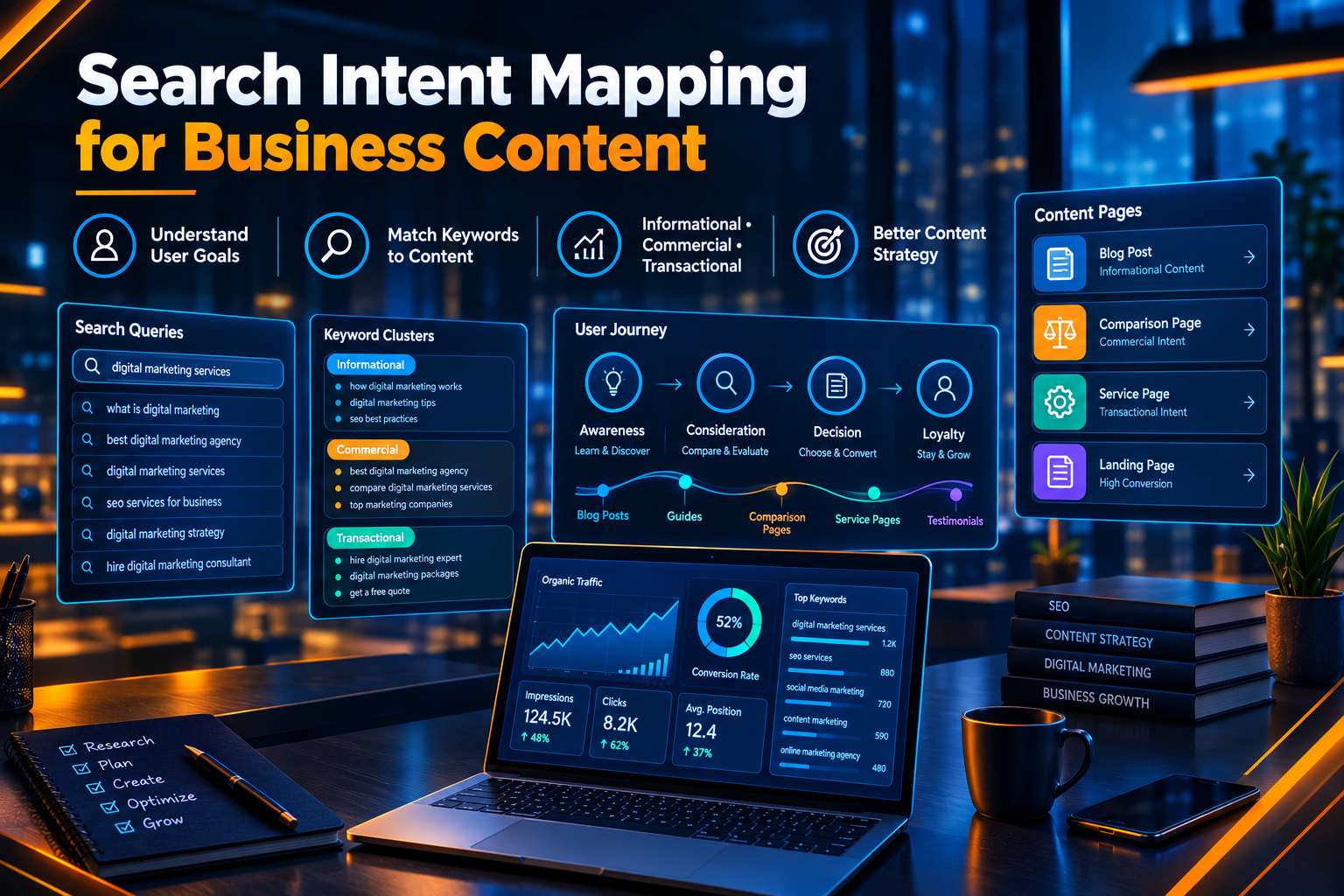
Search Intent Mapping for Business Content: A Practical Guide to Better SEO
Introduction
Creating business content that ranks on search engines requires more than adding keywords to a webpage. Businesses need to understand what users are searching for and why they are searching for it. This process is known as search intent mapping.
Search intent mapping helps businesses align their website content with user expectations. By identifying the purpose behind a search query, marketers can create relevant blogs, service pages, landing pages, and informational resources that attract the right audience.
For businesses investing in SEO and digital marketing, understanding search intent can improve content relevance, user experience, and organic search performance.
What Is Search Intent?
Search intent refers to the primary goal a user has when entering a query into a search engine. Some users want information, while others are comparing solutions or looking for a specific service.
Understanding search intent allows businesses to develop content that answers users' questions and supports their decision-making process.
The four common types of search intent are:
Informational Intent: Users want to learn about a topic, concept, or process.
Navigational Intent: Users want to find a particular website, brand, or webpage.
Commercial Investigation: Users are comparing services, tools, or solutions before making a decision.
Transactional Intent: Users are ready to take an action, such as purchasing a product, booking a service, or requesting a consultation.
Identifying these intent types helps businesses choose the right format and message for each page.
Why Search Intent Mapping Matters for Business Content
Search intent mapping connects keyword research with content planning. Instead of producing articles based only on search volume, businesses can prioritize topics that match their audience's needs.
Its key benefits include:
Creating content that directly answers user queries.
Improving keyword targeting and topical relevance.
Supporting visitors at different stages of the buying journey.
Reducing mismatches between search queries and landing pages.
Identifying opportunities for new blogs and service pages.
Improving the overall usefulness of website content.
A well-planned content strategy considers both what people search for and what they expect to find.
How to Map Search Intent for Business Content
1. Research Relevant Keywords
Start by collecting keywords related to your products, services, industry, and customer problems. Include broad terms, specific questions, comparison searches, and service-related queries.
Keyword research tools can help identify search volume, keyword difficulty, and related search terms. However, the meaning behind each query should guide the final content decision.
2. Analyze Search Engine Results
Review the search results for your target keywords. Look at the types of pages ranking for each query, including blog posts, guides, service pages, product pages, and comparison articles.
These results provide useful clues about the format and depth of content users expect.
3. Assign an Intent to Each Keyword
Group keywords according to their dominant search intent. For example, a query asking how SEO works generally indicates informational intent, while a query about comparing digital marketing agencies may indicate commercial investigation.
Some keywords can have mixed intent, so examine the search results before making a final classification.
4. Match Intent With the Right Content Format
Choose a content format that satisfies the searcher's goal.
Informational keywords can be targeted through educational blogs, tutorials, and detailed guides.
Navigational keywords are best supported by clear brand pages and website navigation.
Commercial investigation keywords can be addressed through comparisons, case studies, and service evaluations.
Transactional keywords are suited to service pages, pricing information, contact pages, and consultation forms.
The goal is to provide the most relevant answer rather than forcing every keyword into a blog post.
5. Map Keywords to Specific Website Pages
Assign each keyword group to the most appropriate existing or planned page. Avoid creating multiple pages that target the same intent without a clear reason.
A keyword-to-page map helps maintain a logical website structure and reduces unnecessary content duplication.
6. Optimize Content for User Expectations
Use the primary keyword naturally in the title, introduction, headings, and relevant page elements. Answer the main question early and provide supporting information that helps readers take the next step.
Internal links should guide visitors toward related resources or relevant services. Content should remain clear, accurate, and useful instead of being written solely to include keywords.
Businesses can also explore digital marketing services at https://www.riotechsoftwares.com/digitalmarketing.php to understand how content planning and SEO activities can support their online visibility.
Search Intent Mapping Examples
A practical mapping table can help content teams apply the concept consistently.
| Target Keyword | Search Intent | Recommended Content |
|---|---|---|
| What is digital marketing | Informational | Educational blog |
| Search intent mapping guide | Informational | Step-by-step guide |
| Best digital marketing agency | Commercial investigation | Comparison or evaluation page |
| Digital marketing services | Commercial or transactional | Service landing page |
| Riotech Softwares digital marketing | Navigational | Brand or service page |
| Hire an SEO consultant | Transactional | Service page with a contact option |
These classifications are examples. Actual intent can vary depending on the search results, location, and wording of the query.
Common Search Intent Mapping Mistakes
Even experienced content teams can make mistakes when assigning search intent. Common issues include:
Targeting keywords without reviewing search results.
Publishing a blog when users expect a service page.
Creating several pages with overlapping keyword targets.
Ignoring commercial and transactional keywords.
Focusing on search volume instead of audience relevance.
Failing to update content as user needs and search results change.
Avoiding these mistakes helps maintain a focused content strategy and a better experience for website visitors.
How to Measure Search Intent Mapping Performance
Once content has been published, review its performance regularly. Google Search Console can help identify queries, impressions, clicks, and average search positions.
Analytics tools can provide additional information about engagement, landing-page performance, and conversions. Compare results against the goals of each page rather than judging every page by the same metric.
For example, an informational blog may be successful when it attracts relevant organic traffic and directs readers to useful resources. A service page may be more successful when it generates qualified enquiries.
Use these insights to improve existing content, refine keyword groups, and identify new opportunities.
Conclusion
Search intent mapping is an essential part of effective business content planning. By understanding why users search, assigning keywords to the correct intent, and matching them with relevant website pages, businesses can create more useful content and strengthen their SEO strategy.
Consistent keyword research, search-result analysis, content optimization, and performance monitoring help businesses keep their content aligned with audience needs. Rather than focusing only on rankings, a strong strategy prioritizes relevance, usability, and meaningful business outcomes.
Visit Website
Explore Riotech Softwares for digital marketing and website-related solutions:
https://www.riotechsoftwares.com/digitalmarketing.php
Visit the website to learn more about the available services and digital marketing support for your business.
Recent Posts


15 Oct 2026