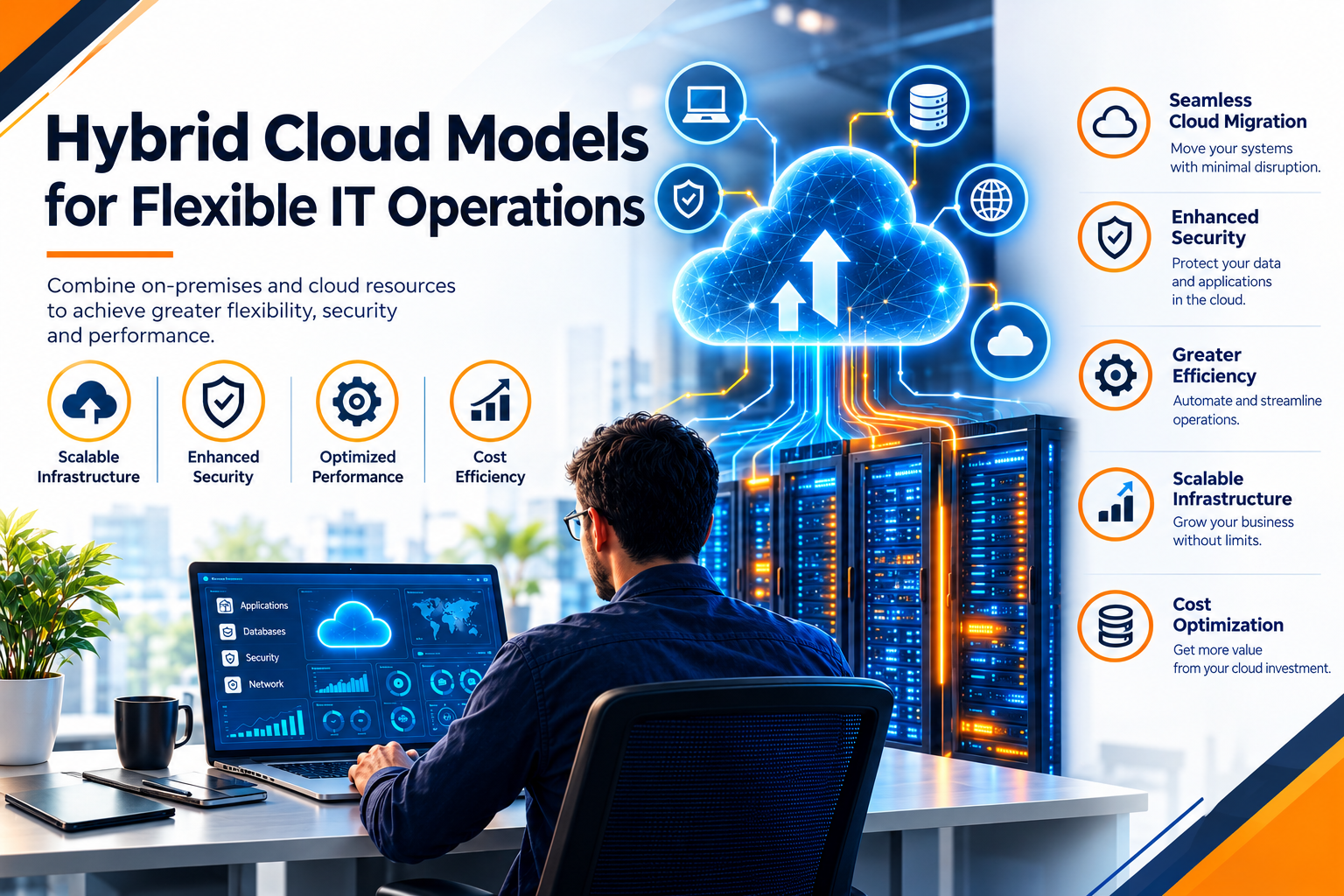
Hybrid Cloud Models for Flexible IT Operations
Introduction
Modern businesses need IT infrastructure that is flexible, secure, and capable of supporting changing workloads. Traditional IT systems may struggle to meet growing storage, computing, and application requirements. Hybrid cloud models offer a practical solution by combining on-premises infrastructure with public and private cloud environments.
With the right hybrid infrastructure, businesses can manage resources efficiently, maintain control over critical data, and scale operations as required. These models help organizations balance performance, security, and operational costs while preparing for future technology demands.
What Are Hybrid Cloud Models?
A hybrid cloud model combines on-premises IT infrastructure with cloud-based resources. It allows businesses to distribute applications, workloads, and data across different environments according to their operational requirements.
For example, a company may store sensitive business information in a private environment while using public cloud resources for website hosting, application testing, or additional computing capacity.
This approach provides flexibility without requiring businesses to move every system to the cloud. Organizations can choose the most suitable environment for each workload and adjust their infrastructure as their needs change.
Types of Hybrid Cloud Models
1. On-Premises and Public Cloud
This model combines existing company servers with public cloud services. Businesses can continue using their current infrastructure while accessing additional computing power and storage whenever required.
It is particularly useful for organizations experiencing seasonal demand, rapid growth, or temporary increases in workload.
2. Private and Public Cloud Integration
A private cloud provides greater control over selected applications and data, while a public cloud offers scalable computing resources. Integrating both environments allows businesses to balance data protection with operational flexibility.
Organizations can use this model to support sensitive workloads while maintaining the ability to expand their IT capacity.
3. Hybrid Cloud with Edge Computing
Some businesses process data close to where it is generated, such as manufacturing facilities, connected devices, and remote locations. Edge computing can work alongside cloud infrastructure to reduce unnecessary data transfers and support faster processing.
This model is beneficial for businesses that require timely insights and efficient communication between devices and central systems.
Best Practices for Managing Hybrid Cloud Environments
Successful hybrid infrastructure requires proper planning and continuous management. Businesses should begin by assessing their existing systems, application dependencies, security requirements, and future resource needs.
The following practices can help organizations build a reliable environment:
Define workload requirements: Determine which applications should remain on-premises and which can operate in cloud environments.
Strengthen security: Implement access controls, encryption, identity management, and regular security assessments.
Monitor performance: Track resource utilization, application response times, storage capacity, and network performance.
Plan data backup and recovery: Establish clear recovery procedures and regularly test backup systems.
Manage cloud expenses: Review resource consumption and remove unused services to control operational costs.
Maintain integration: Ensure that applications, databases, and networks communicate reliably across different environments.
Businesses seeking professional assistance can explore https://www.riotechsoftwares.com/cloud.php for cloud infrastructure, migration, cloud security, and backup solutions.
Common Challenges in Hybrid Cloud Adoption
Although hybrid cloud models provide several advantages, implementation requires careful coordination. Managing multiple environments can increase operational complexity, particularly when systems use different management tools or security policies.
Data movement between environments may also introduce network latency, transfer costs, and compliance considerations. Businesses should evaluate these factors before migrating critical workloads.
A clear cloud strategy, consistent security policies, centralized monitoring, and regular infrastructure reviews can help minimize these challenges.
Organizations can also review https://www.riotechsoftwares.com/cloud.php to learn more about cloud solutions that support scalable and reliable IT operations.
How to Choose the Right Hybrid Cloud Model
Selecting the appropriate model depends on business objectives, existing infrastructure, security requirements, and budget.
Small businesses may benefit from retaining essential systems while using public cloud services for additional capacity. Larger organizations may require more advanced integration between private cloud platforms, public cloud services, and distributed infrastructure.
Before choosing a model, businesses should evaluate application compatibility, data sensitivity, expected workloads, disaster recovery requirements, and long-term maintenance costs.
Working with an experienced technology provider can help organizations plan implementation, improve infrastructure performance, and establish a sustainable cloud management strategy.
Conclusion
Hybrid cloud models provide businesses with a flexible approach to managing modern IT operations. By combining on-premises infrastructure with public and private cloud resources, organizations can improve scalability, maintain data control, optimize costs, and strengthen business continuity.
The key to success is selecting the right architecture and managing it through effective security, monitoring, integration, and recovery practices. With a well-planned strategy, hybrid infrastructure can support business growth while keeping IT operations adaptable and efficient.
For more information about cloud migration, infrastructure management, and scalable cloud services, visit https://www.riotechsoftwares.com/cloud.php.
Recent Posts
21 Oct 2026
19 Oct 2026