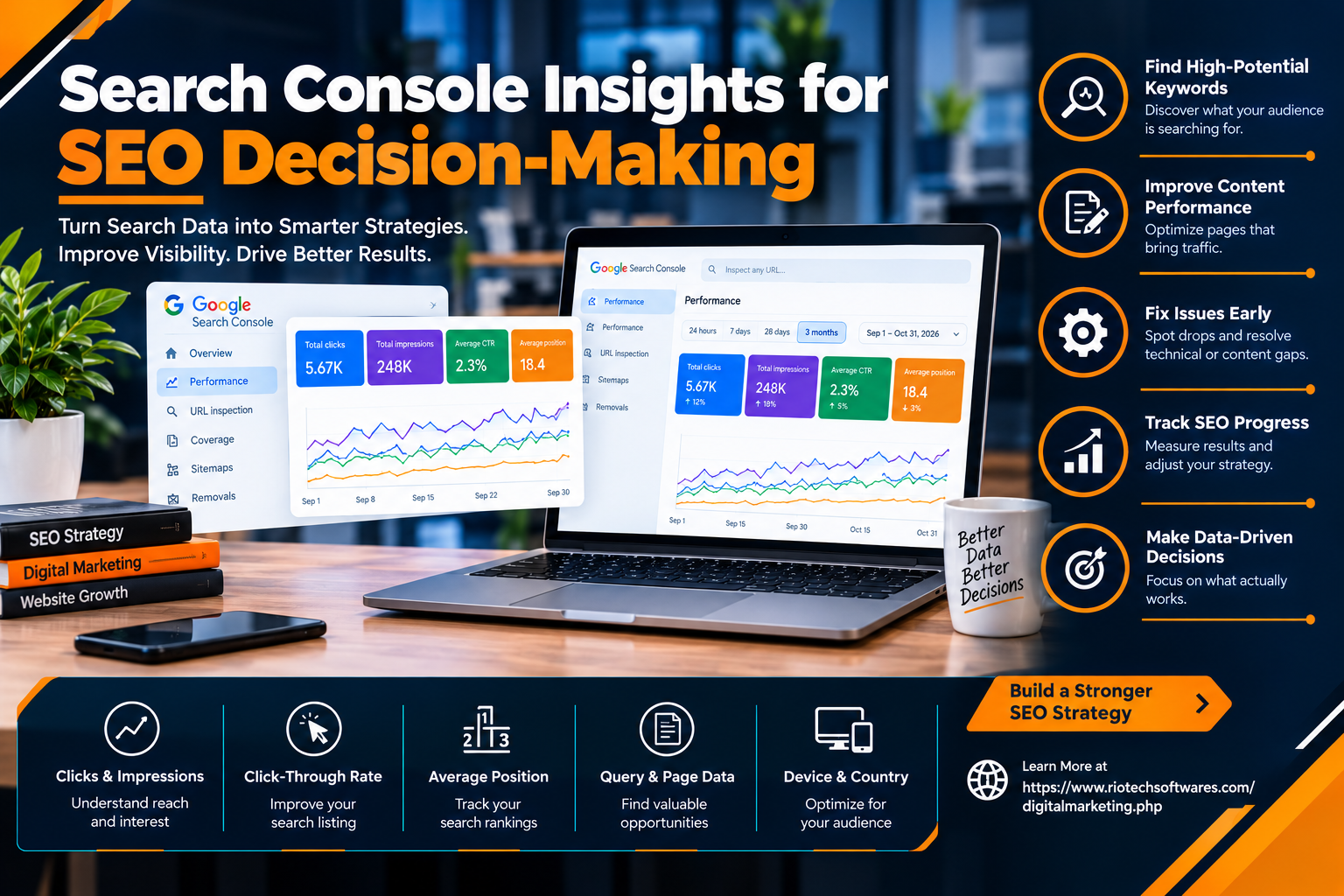
Search Console Insights for SEO Decision-Making
Introduction
Search engine optimization is not just about adding keywords to a website. It also involves understanding how users discover your content, which pages attract visitors, and where improvements are needed. Google Search Console provides useful data that helps businesses make informed SEO decisions and improve their online visibility.
By reviewing search performance regularly, digital marketers can identify opportunities, resolve website issues, and create content that better matches user search intent.
What Is Google Search Console?
Google Search Console is a free tool that helps website owners monitor their website's presence in Google Search results. It provides information about clicks, impressions, click-through rates (CTR), and average search position.
These metrics help marketers understand how their pages perform in search results and identify areas that require attention.
Important Search Performance Metrics
1. Total Clicks
Clicks show how many times users visited a website from Google Search results. Pages receiving fewer clicks than expected may need better titles, clearer descriptions, or more relevant content.
2. Total Impressions
Impressions indicate how often a website appears in Google Search results. A page with many impressions but few clicks may have an opportunity to improve its title, meta description, or relevance to the search query.
3. Click-Through Rate (CTR)
CTR represents the percentage of impressions that resulted in clicks. Comparing CTR across pages and queries helps marketers identify search listings that could attract more visitors.
4. Average Search Position
Average position provides an overview of where a website appears in search results. Tracking this metric over time can help identify pages gaining visibility and pages that may require further optimization.
How Search Console Insights Support SEO Decisions
Identify High-Potential Keywords
Search Console reveals the search queries that bring users to a website. Marketers can review queries receiving impressions but generating limited clicks and improve the relevant pages to better match user expectations.
Improve Existing Website Content
Pages that receive search traffic can be updated with clearer explanations, useful examples, relevant headings, and accurate information. Content improvements should focus on user needs rather than simply repeating keywords.
Discover Pages That Need Attention
A decline in clicks or impressions may indicate changing search demand, increased competition, or a technical or content-related issue. Reviewing page-level and query-level data helps narrow down which areas need investigation.
Measure SEO Campaign Performance
Comparing performance over different periods helps marketers understand whether website optimization and content activities are contributing to better search visibility. Comparisons should use equivalent date ranges and consider seasonal changes.
Turning Search Data Into an Action Plan
To make search data useful, businesses should follow a consistent process:
Open Google Search Console and select the correct website property.
Navigate to the Performance report.
Choose a relevant date range and review clicks, impressions, CTR, and average position.
Compare results by query, page, country, and device where relevant.
Identify the pages or queries with the clearest improvement opportunities.
Update content or investigate technical issues where needed.
Review the results after making changes.
This approach helps digital marketers prioritize improvements based on evidence instead of assumptions.
Common SEO Mistakes to Avoid
Focusing only on keyword rankings while ignoring clicks and impressions.
Changing page titles without considering search intent.
Treating every decline in traffic as a technical problem.
Comparing different date ranges without accounting for seasonality.
Making several changes at once without tracking their individual effects.
Ignoring mobile usability and page experience.
How Professional Digital Marketing Supports SEO Growth
Search performance analysis is most effective when combined with keyword research, content optimization, technical SEO, and regular reporting. Businesses need a clear strategy that connects search data with practical improvements to their website and marketing activities.
For support with SEO planning, website optimization, and online growth, explore https://www.riotechsoftwares.com/digitalmarketing.php.
A structured digital marketing strategy can help businesses identify opportunities, improve search visibility, and build a stronger online presence.
Frequently Asked Questions
1. Is Google Search Console useful for SEO?
Yes. It helps website owners monitor search performance, understand the queries that generate visibility, and identify potential indexing or technical issues.
2. How often should Search Console data be reviewed?
A weekly review can help identify changes, while monthly comparisons are useful for measuring broader SEO performance. The ideal frequency depends on website activity and campaign goals.
3. What does a high impression count with a low CTR mean?
It may indicate that a page appears frequently in search results but attracts relatively few clicks. Reviewing the query, search intent, title, and description can help identify possible improvements.
4. Does Google Search Console improve rankings automatically?
No. The tool provides data and reports, but improvements depend on the actions taken based on those insights.
Conclusion
Google Search Console helps businesses make more informed SEO decisions by showing how their websites perform in Google Search. By monitoring important metrics, reviewing queries, improving content, and measuring changes over time, marketers can identify practical opportunities for growth.
Consistent analysis and a user-focused optimization strategy can turn search performance data into meaningful digital marketing improvements.
Visit Website: https://www.riotechsoftwares.com/digitalmarketing.php
Recent Posts
27 Oct 2026

26 Oct 2026


23 Oct 2026