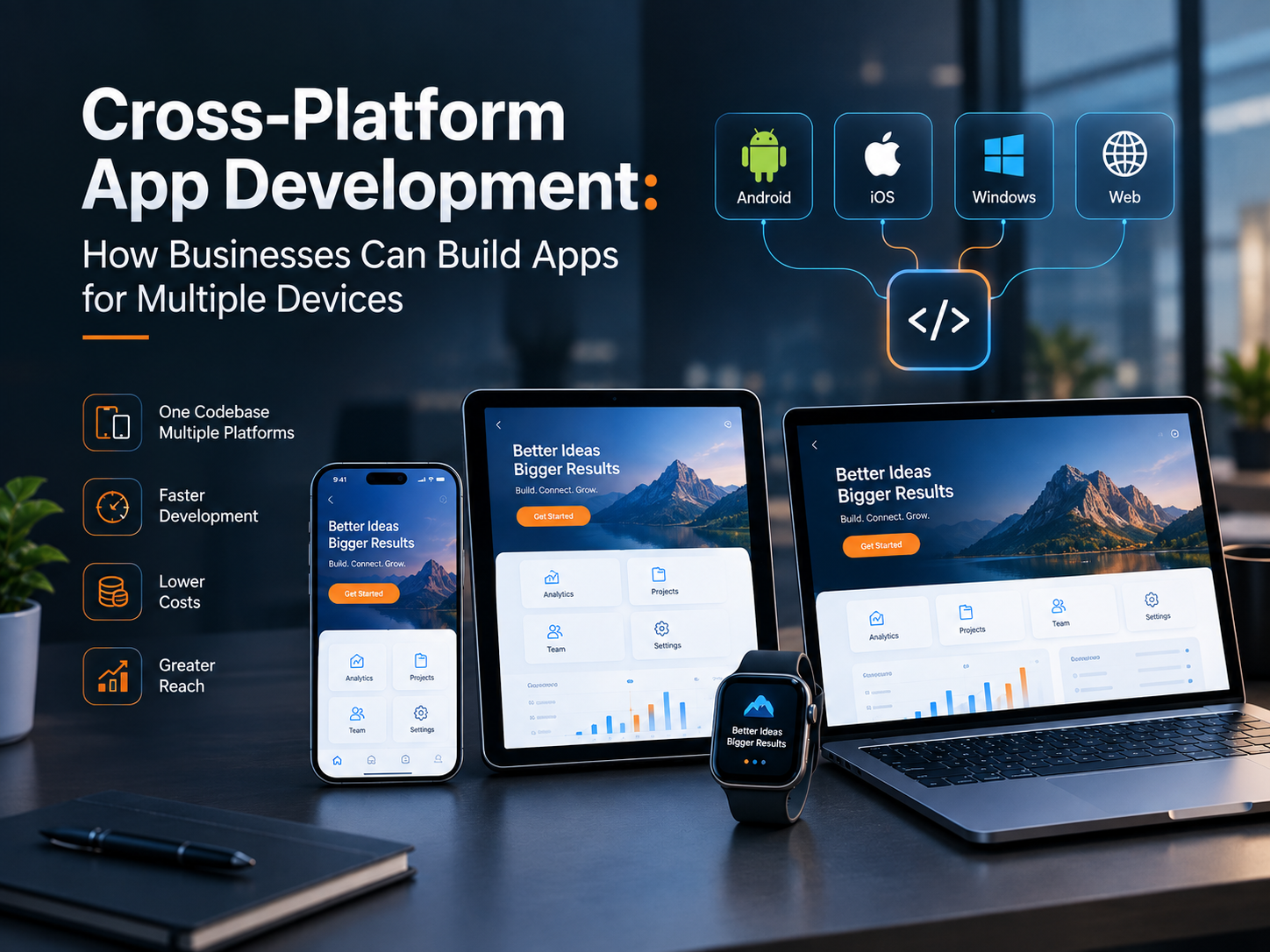
Cross-Platform App Development: Build Apps for Multiple Devices
Cross-Platform App Development: How Businesses Can Build Apps for Multiple Devices
Businesses today need to reach customers across smartphones, tablets, and other digital devices. Developing a separate application for every platform can increase development time, maintenance requirements, and overall costs. Cross-platform app development provides an alternative approach by allowing businesses to build applications that can operate across multiple platforms using a shared codebase.
For startups, growing businesses, and established enterprises, cross-platform development can simplify the application development process while helping maintain a consistent user experience across devices.
What Is Cross-Platform App Development?
Cross-platform app development is a software development approach in which a single application codebase is designed to work across multiple operating systems and device platforms.
Instead of maintaining completely separate development projects for Android and iOS, businesses can use cross-platform frameworks and technologies to build applications that share a significant portion of their code.
Popular technologies used for cross-platform development include:
- Flutter
- React Native
- .NET MAUI
- Ionic
- Kotlin Multiplatform
The appropriate technology depends on the application's requirements, performance expectations, development resources, and long-term maintenance strategy.
Why Businesses Choose Cross-Platform Development
1. Faster Development
A shared codebase can reduce the amount of duplicated development work required for different platforms.
Developers can implement common functionality once and adapt platform-specific elements where necessary. This can help businesses move from concept to deployment more efficiently.
2. Reduced Development Complexity
Maintaining separate Android and iOS projects can require different development workflows and resources.
Cross-platform development can simplify the process by allowing teams to manage a larger portion of the application from a unified codebase.
This can make development and maintenance easier, particularly for businesses with limited development resources.
3. Consistent User Experience
Customers expect applications to provide a familiar experience regardless of the device they use.
A shared development approach can help maintain consistency in:
- Navigation
- Branding
- Application functionality
- User interfaces
- Business logic
- Customer workflows
Platform-specific adjustments can still be introduced when required.
4. Easier Maintenance
Application maintenance is an important part of the software lifecycle.
When common functionality is maintained through a shared codebase, businesses can potentially implement updates more efficiently across supported platforms.
Examples include:
- Feature improvements
- Bug fixes
- Security updates
- Performance optimization
- UI improvements
- API changes
However, applications still need platform-specific testing to ensure that updates work correctly on different devices.
Cross-Platform vs. Native App Development
Native development involves building applications specifically for an operating system, such as Android or iOS.
Cross-platform development focuses on sharing code across multiple platforms.
| Factor | Cross-Platform | Native |
|---|---|---|
| Codebase | Mostly shared | Platform-specific |
| Development | Unified approach | Separate development |
| Maintenance | Centralized for common features | Platform-specific |
| Platform Reach | Multiple platforms | Individual platforms |
| Native Integration | Strong, with framework support | Maximum platform integration |
| Development Resources | Potentially fewer | Often requires platform-specific expertise |
Neither approach is universally suitable for every application. The decision should be based on the project's functionality, performance requirements, target users, budget, and long-term roadmap.
Popular Cross-Platform Technologies
Flutter
Flutter, developed by Google, uses a single codebase to create applications for multiple platforms. Its widget-based architecture allows developers to build highly customized interfaces.
It can be useful for businesses that need a consistent and visually rich application experience.
React Native
React Native, developed by Meta, allows developers to build mobile applications using JavaScript and React concepts.
Businesses with existing React or JavaScript development expertise may find it suitable for certain mobile application projects.
.NET MAUI
.NET MAUI allows developers to create applications for multiple platforms using the .NET ecosystem.
It can be particularly relevant for organizations already using Microsoft technologies and services.
Ionic
Ionic is another option for developing cross-platform applications using web technologies. It can be useful for applications where web-based development skills are already available within the organization.
How Businesses Can Build a Cross-Platform App
Step 1: Define the Business Objective
Before development begins, businesses should identify the problem the application is intended to solve.
This may involve:
- Customer engagement
- E-commerce
- Internal operations
- Booking services
- Financial services
- On-demand services
- Communication
- Business management
A clearly defined objective helps determine the application's features and technical requirements.
Step 2: Identify Target Platforms
Determine which platforms and devices need to be supported.
For example:
- Android smartphones
- iPhones
- Tablets
- Web browsers
- Desktop devices
Platform requirements should be considered before selecting the development technology.
Step 3: Plan the User Experience
A successful application needs more than technical functionality.
Businesses should plan:
- User journeys
- Navigation
- Screen layouts
- Branding
- Accessibility
- Interaction patterns
- Performance expectations
A consistent design system can help maintain a recognizable brand experience across platforms.
Step 4: Select the Development Framework
The development framework should be selected according to the application's technical requirements.
Important considerations include:
- Performance
- Third-party integrations
- Native device features
- Developer expertise
- Scalability
- Maintenance requirements
- Community and ecosystem support
Step 5: Develop the Core Application
Developers can then implement the application's common business logic, interfaces, APIs, authentication, database connections, and other required functionality.
Platform-specific components can be added where necessary.
Step 6: Integrate Backend Services
Modern applications often depend on backend infrastructure for:
- User authentication
- Databases
- Payments
- Notifications
- APIs
- Cloud services
- Analytics
- Content management
A scalable backend architecture helps the application support increasing numbers of users and transactions.
Step 7: Test Across Multiple Devices
Cross-platform development does not eliminate the need for device testing.
Applications should be tested for:
- Screen sizes
- Operating system versions
- Performance
- Network conditions
- Application crashes
- Security
- User interface consistency
- Device-specific functionality
Testing on real devices can reveal issues that may not appear in development environments.
Step 8: Launch and Maintain the Application
After testing, businesses can publish the application through the relevant app stores and begin monitoring its performance.
Post-launch activities include:
- Bug fixing
- Security updates
- Performance optimization
- Feature enhancements
- Compatibility updates
- User feedback analysis
Continuous maintenance helps keep the application reliable as operating systems and devices evolve.
Challenges of Cross-Platform App Development
Although cross-platform development offers several advantages, businesses should also consider potential challenges.
Platform-Specific Features
Some applications require deep integration with platform-specific hardware or operating-system capabilities. Additional native development may be necessary in such cases.
Performance Requirements
Most modern cross-platform frameworks can support a wide range of applications, but highly performance-sensitive applications may require additional optimization or native components.
Device Fragmentation
Android and other ecosystems include many different devices, screen sizes, hardware configurations, and operating-system versions. Comprehensive testing remains essential.
Third-Party Dependencies
Applications often depend on external libraries, APIs, SDKs, and services. Businesses should evaluate the reliability and long-term compatibility of these dependencies.
When Should a Business Choose Cross-Platform Development?
Cross-platform development can be considered when a business:
- Wants to launch on multiple platforms
- Needs a shared application codebase
- Wants to maintain consistent branding
- Has limited development resources
- Needs faster product development
- Plans to continuously expand application features
For applications requiring extensive platform-specific functionality or specialized performance optimization, native or hybrid approaches may also be evaluated.
The Role of Professional App Development
Building a successful mobile application involves more than writing code. Businesses need to consider product strategy, UI/UX design, backend architecture, security, testing, deployment, and ongoing maintenance.
Professional development teams can help businesses select an appropriate technology stack and create applications that align with their operational and customer requirements.
Riotech Softwares provides mobile application development solutions designed to help businesses build applications for modern digital platforms. Learn more about its mobile app development services through Riotech Softwares – Mobile App Development.
Conclusion
Cross-platform app development provides businesses with a practical way to build applications for multiple devices while sharing a significant portion of the development codebase.
From startups launching their first mobile application to established organizations modernizing their digital platforms, cross-platform technologies can support faster development, consistent user experiences, and streamlined maintenance.
The right approach ultimately depends on the application's objectives, target platforms, technical requirements, scalability needs, and long-term business strategy.
Businesses planning to develop a mobile application should evaluate these factors carefully before selecting a framework and development strategy.