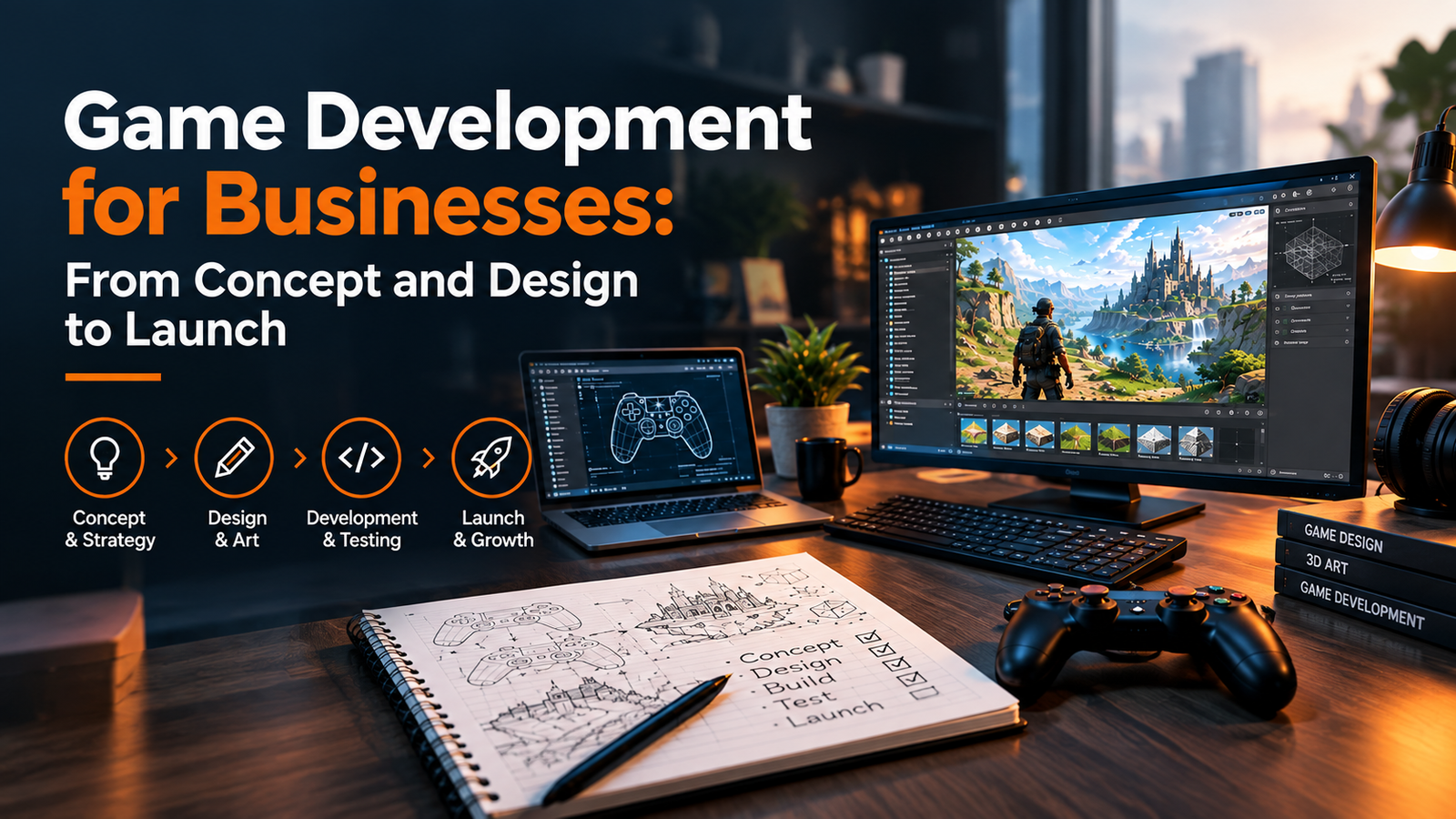
Game Development for Businesses: From Concept to Launch
Game Development for Businesses: From Concept and Design to Launch
Game development is no longer limited to entertainment companies and independent studios. Businesses across industries are exploring interactive applications, branded games, educational experiences, simulations, gamified platforms, and immersive digital products to engage users in new ways.
However, building a successful game requires more than attractive graphics and interesting gameplay. A professional game development process combines business objectives, creative design, technology, user experience, testing, performance optimization, and post-launch support.
From the initial concept to the final launch, every stage plays an important role in creating a reliable and engaging digital experience.
Why Game Development Matters for Businesses
Businesses can use game-based experiences for multiple purposes beyond traditional entertainment.
Depending on the business model, game development can support:
- Customer engagement
- Brand awareness
- Product promotion
- Educational experiences
- Employee training
- Customer loyalty programs
- Interactive marketing campaigns
- Simulations and virtual experiences
- Entertainment platforms
- Gamification of digital products
A well-planned game can provide an interactive way for users to understand a product, learn new concepts, or engage with a brand.
1. Start With a Clear Game Concept
Every successful game begins with a well-defined concept.
Before development begins, the team should determine:
- What is the purpose of the game?
- Who are the target users?
- Which platform will support it?
- What type of gameplay will it provide?
- What makes the experience different?
- What business objective should it support?
For a business-focused game, these questions are particularly important because the final product needs to align with both user expectations and business requirements.
A clear concept helps reduce unnecessary development changes later in the project.
2. Define the Target Audience
Game design should be based on the intended audience.
A game designed for children will have different visual elements, interaction patterns, difficulty levels, and accessibility requirements than a business simulation designed for professionals.
Audience research can help determine:
- Age group
- User interests
- Device preferences
- Gameplay expectations
- Technical requirements
- Accessibility considerations
- Engagement patterns
Understanding the audience early allows designers and developers to create a more relevant user experience.
3. Develop the Game Design Document
Once the concept is established, the development team can create a detailed game design document.
This document can define:
- Game objectives
- Characters
- Storyline
- Levels
- Gameplay mechanics
- Controls
- Scoring systems
- Rewards
- User progression
- Visual direction
- Audio requirements
- Technical specifications
The document serves as a reference throughout development and helps different teams work toward the same product vision.
4. Create UI/UX and Visual Design
Visual design plays an important role in how users experience a game.
The design process may include:
- Character design
- Environment design
- Menus
- Buttons
- Icons
- HUD elements
- Animations
- Level layouts
- Branding elements
UI and UX should make the game easy to understand while maintaining a consistent visual identity.
For business applications, branded elements can also be incorporated without making the experience feel overly promotional.
5. Choose the Right Technology
Technology selection depends on the game's complexity, target platform, performance requirements, and development objectives.
A development team may evaluate:
- Game engines
- Programming languages
- Graphics requirements
- Multiplayer architecture
- Cloud infrastructure
- Backend systems
- Database requirements
- Third-party APIs
- Analytics systems
The technology stack should be selected according to project requirements rather than simply following trends.
6. Game Development and Programming
After the design phase, developers begin implementing the actual game.
This can involve building:
- Gameplay mechanics
- Character movement
- Game physics
- User interfaces
- Level systems
- Scoring
- Rewards
- Audio integration
- Authentication
- Multiplayer functionality
- Backend services
- Data storage
For more complex games, development may involve separate teams working on gameplay programming, backend systems, graphics, animation, audio, and infrastructure.
7. Testing and Quality Assurance
Testing is one of the most important stages of game development.
A game may need to be tested across different devices, operating systems, screen sizes, and hardware configurations.
Testing can identify issues involving:
- Game crashes
- Performance problems
- Loading times
- Incorrect game mechanics
- UI problems
- Audio issues
- Network connectivity
- Security vulnerabilities
- Compatibility problems
Functional testing should be combined with usability and performance testing to create a more stable experience.
8. Performance Optimization
A visually impressive game can still deliver a poor experience if it performs slowly.
Optimization may include:
- Reducing unnecessary assets
- Improving memory management
- Optimizing graphics
- Compressing resources
- Improving loading performance
- Reducing network latency
- Optimizing backend operations
- Managing CPU and GPU usage
Performance requirements should be considered throughout development rather than left entirely to the final stage.
9. Multiplayer and Backend Development
Modern games can require sophisticated backend infrastructure.
Depending on the project, backend systems may manage:
- User accounts
- Profiles
- Game progress
- Leaderboards
- Multiplayer sessions
- In-game purchases
- Notifications
- Analytics
- Cloud saves
For multiplayer games, the architecture must also consider synchronization, authentication, scalability, and network reliability.
10. Monetization Strategy
If the game is intended to generate revenue, monetization should be considered during the planning stage.
Possible models include:
- Paid downloads
- In-app purchases
- Subscriptions
- Advertising
- Premium features
- Virtual goods
- Licensing
- Business partnerships
The appropriate model depends on the target audience, game type, platform, and overall business strategy.
11. Launch Preparation
Before launching the game, the development team should complete a structured release process.
This can include:
- Final testing
- Performance checks
- Security testing
- Store requirements
- App or platform configuration
- Analytics setup
- Error monitoring
- Marketing assets
- User documentation
- Launch campaigns
A controlled launch can help identify unexpected technical issues before the product reaches a larger audience.
12. Post-Launch Support and Updates
Game development does not necessarily end when the product is launched.
Post-launch activities may include:
- Bug fixes
- Performance improvements
- New levels
- New features
- Content updates
- Security patches
- User feedback analysis
- Platform compatibility updates
Analytics and user feedback can help businesses understand how people interact with the game and identify opportunities for improvement.
Game Development for Different Business Requirements
Different organizations can use game development in different ways.
Education
Educational games can turn learning concepts into interactive experiences through challenges, levels, quizzes, rewards, and simulations.
Marketing
Brands can use interactive games as part of promotional campaigns to increase engagement and create memorable digital experiences.
Training
Businesses can use simulations and game-based learning to provide employees with interactive training environments.
Retail and E-Commerce
Gamification can be integrated into loyalty programs, promotions, product discovery, and customer engagement campaigns.
Entertainment
Businesses can develop mobile, desktop, or web games as standalone entertainment products or digital extensions of existing brands.
Key Factors to Consider Before Starting a Game Development Project
Before investing in development, businesses should evaluate:
Target Platform: Determine whether the game will be designed for mobile, desktop, web, or multiple platforms.
Budget: Define development, infrastructure, marketing, maintenance, and update costs.
Scope: Clearly establish the features required for the first release.
Audience: Understand the users and their expectations.
Technology: Select an appropriate development architecture and technology stack.
Monetization: Determine how the product will generate revenue if commercial monetization is required.
Maintenance: Plan for updates, bug fixes, security, and future improvements.
Why Professional Game Development Matters
Game development combines multiple disciplines, including software engineering, UI/UX design, animation, graphics, audio, testing, infrastructure, and product management.
A professional development process helps coordinate these areas from concept through launch.
For businesses, this is particularly important because the game may need to integrate with existing platforms, business systems, analytics tools, customer accounts, or digital marketing campaigns.
RioTech Softwares for Game Development
RioTech Softwares provides game development solutions for mobile, desktop, and web platforms, as part of its broader technology services for modern businesses.
Businesses can explore the service here:
Game Development Services by RioTech Softwares
From initial concept and UI/UX design to development, testing, deployment, and ongoing improvements, a structured development approach can help turn a game idea into a functional digital product.
Conclusion
Game development is a multidisciplinary process that goes far beyond coding and visual design.
A successful project requires a clear concept, defined audience, thoughtful gameplay, suitable technology, professional UI/UX, rigorous testing, performance optimization, and a structured launch strategy.
For businesses, the biggest opportunity lies in connecting game development with a clear objective—whether that means entertainment, education, customer engagement, marketing, training, or creating a new digital product.
By following a structured process from concept and design to development, testing, launch, and continuous improvement, businesses can build interactive experiences that are technically reliable and aligned with their long-term goals.
Frequently Asked Questions
1. What is game development for businesses?
Game development for businesses involves creating interactive digital experiences for purposes such as entertainment, marketing, education, training, customer engagement, simulations, and branded experiences.
2. Which platforms can businesses develop games for?
Games can be developed for platforms such as mobile devices, desktops, and web browsers. The appropriate platform depends on the target audience and project requirements.
3. How long does game development take?
Development time depends on the game's complexity, features, platforms, design requirements, multiplayer functionality, and testing requirements. A simple game generally requires less development time than a complex multiplayer or 3D project.
4. What is included in the game development process?
The process can include concept development, game design, UI/UX design, programming, asset creation, testing, optimization, deployment, analytics, maintenance, and post-launch updates.
5. Can businesses use games for marketing?
Yes. Businesses can use branded games and gamified experiences to support customer engagement, promotional campaigns, loyalty programs, and interactive marketing initiatives.
6. Why is testing important in game development?
Testing helps identify crashes, gameplay issues, performance problems, compatibility issues, usability problems, and other technical defects before and after launch.
7. Does game development continue after launch?
Yes. Post-launch development may include bug fixes, performance improvements, new content, feature updates, security patches, and compatibility improvements.