SEO vs Paid Advertising: How Businesses Can Use Both for Sustainable Growth
SEO vs Paid Advertising: How Businesses Can Use Both for Sustainable Growth
In today's competitive digital marketplace, businesses need more than a website to attract customers. They need a consistent strategy for reaching the right audience, generating qualified traffic, and building long-term online visibility.
Two of the most widely used digital marketing approaches are Search Engine Optimization (SEO) and Paid Advertising. While SEO focuses on improving organic visibility in search engines, paid advertising allows businesses to reach targeted audiences through sponsored campaigns.
Rather than treating SEO and paid advertising as competing strategies, businesses can use both to create a balanced digital marketing approach.
What Is SEO?
Search Engine Optimization is the process of improving a website's visibility in organic search engine results.
SEO typically involves several areas, including:
- Keyword research
- High-quality content creation
- On-page optimization
- Technical SEO
- Website performance optimization
- Internal linking
- Backlink development
- Local SEO
- User experience optimization
The objective is to make a website more relevant, accessible, and useful for both search engines and users.
Unlike paid advertising, organic search traffic does not require a payment for every individual click. However, SEO generally requires consistent effort and time before meaningful results can develop.
What Is Paid Advertising?
Paid advertising allows businesses to promote products, services, or content by paying for placement across digital advertising platforms.
Search advertising can place a business's ads in prominent positions when users search for relevant keywords. Businesses can also use paid campaigns across social media, display networks, video platforms, and other digital channels.
Paid advertising can help businesses:
- Reach specific audiences
- Promote new products or services
- Generate targeted website traffic
- Support lead-generation campaigns
- Test marketing messages
- Promote time-sensitive offers
- Measure campaign performance
Because campaigns can begin delivering exposure shortly after launch, paid advertising can be useful when a business needs targeted visibility within a specific timeframe.
SEO vs Paid Advertising: Key Differences
SEO and paid advertising have different characteristics and should be evaluated according to a company's objectives.
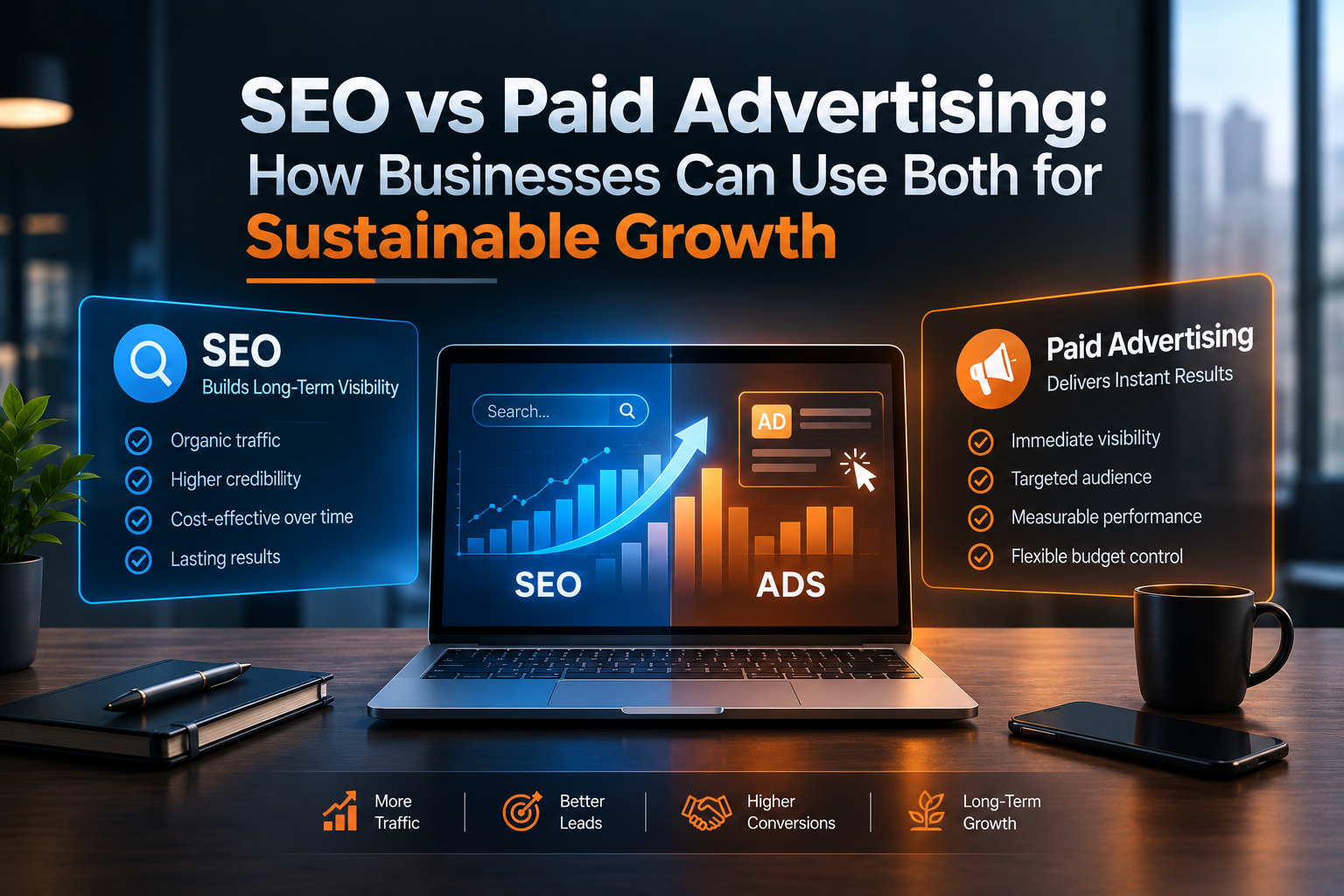
| SEO | Paid Advertising |
|---|---|
| Focuses on organic visibility | Focuses on paid visibility |
| Usually requires sustained effort | Can generate exposure shortly after campaigns launch |
| Builds long-term search presence | Useful for targeted campaigns |
| Content and technical optimization are important | Targeting, bidding, creative, and campaign settings are important |
| Organic traffic does not require payment per click | Advertising typically involves campaign expenditure |
| Results can develop gradually | Results can be measured while campaigns are active |
Neither approach automatically replaces the other. Their effectiveness depends on factors such as competition, industry, budget, website quality, audience, keywords, and campaign objectives.
Why SEO Matters for Long-Term Growth
SEO can help businesses establish a stronger organic presence over time.
For example, a company that consistently publishes useful content around relevant customer questions can potentially build visibility for multiple search queries. Technical improvements can also make the website easier for search engines to crawl and users to navigate.
A strong SEO strategy can support:
1. Organic Visibility
Businesses can increase their opportunities to appear when potential customers search for relevant products, services, or information.
2. Content Authority
Useful, well-structured content can help businesses demonstrate expertise within their industry.
3. Long-Term Traffic Opportunities
Well-optimized pages can continue attracting organic visitors after they are published, although rankings and traffic can change over time.
4. Better Website Experience
SEO often involves improving page speed, mobile usability, navigation, technical structure, and content quality.
Why Paid Advertising Matters
Paid advertising provides businesses with another way to reach potential customers.
Instead of waiting for organic rankings to develop, advertisers can create campaigns targeting specific audiences, search terms, locations, interests, or other criteria supported by the advertising platform.
Paid advertising can be particularly useful for:
- Product launches
- Seasonal promotions
- New service campaigns
- Lead-generation campaigns
- E-commerce promotions
- Local business campaigns
- Testing different offers and messaging
However, paid campaigns require ongoing management. Budget allocation, audience targeting, ad quality, landing pages, conversion rates, and campaign performance all need to be monitored.
Why Businesses Can Use SEO and Paid Advertising Together
Using both approaches allows businesses to address different stages of their digital marketing strategy.
For example, a business could use SEO to build long-term visibility for informational and commercial keywords while simultaneously running paid campaigns for high-priority services.
Paid campaigns can also provide useful marketing data. Search terms, audience responses, advertisements, and landing-page performance can help marketers understand which messages generate engagement.
This information can then contribute to broader marketing decisions, including content planning and landing-page optimization.
How to Combine SEO and Paid Advertising
A combined strategy can be structured around several practical steps.
Step 1: Define Business Objectives
Start by identifying the primary goal.
Is the campaign intended to generate:
- Website traffic?
- Leads?
- Sales?
- Brand awareness?
- Product inquiries?
- Appointments?
The answer will influence how SEO and paid campaigns are planned.
Step 2: Research Relevant Keywords
Identify keywords related to the products, services, and questions that matter to the target audience.
Separate them into groups such as:
- Informational keywords
- Commercial keywords
- Transactional keywords
- Branded keywords
- Local keywords
Step 3: Build Organic Content
Create useful pages and articles that address relevant search intent.
Content should focus on providing genuine value rather than simply inserting keywords repeatedly.
Step 4: Launch Targeted Paid Campaigns
Use paid advertising to promote high-priority products, services, offers, or landing pages.
Campaigns should have clearly defined audiences, budgets, conversion goals, and tracking mechanisms.
Step 5: Optimize Landing Pages
Traffic from both SEO and advertising should lead to relevant, user-friendly landing pages.
Important elements can include:
- Clear headlines
- Relevant information
- Strong calls to action
- Simple navigation
- Mobile-friendly design
- Trust signals
- Fast page loading
Step 6: Measure Performance
Track meaningful metrics rather than focusing only on traffic.
Depending on the campaign, businesses can monitor:
- Organic traffic
- Paid traffic
- Search visibility
- Click-through rate
- Cost per click
- Conversion rate
- Cost per lead
- Leads generated
- Revenue
- Return on advertising spend
Common Mistakes Businesses Should Avoid
Relying Only on Paid Advertising
Paid campaigns can generate visibility, but depending entirely on advertising may limit a business's ability to build organic search visibility.
Expecting Immediate SEO Results
SEO generally requires ongoing optimization, quality content, technical improvements, and consistent effort.
Sending All Traffic to the Homepage
Campaign traffic should ideally be directed to pages that are relevant to the specific advertisement, keyword, product, or service.
Ignoring Conversion Tracking
Traffic alone does not indicate business success. Businesses should understand whether visitors are completing meaningful actions.
Using the Same Strategy for Every Channel
Search engines, social platforms, and display advertising have different audiences and user behaviors. Campaigns should be adapted accordingly.
Building a Sustainable Digital Marketing Strategy
A sustainable strategy does not necessarily mean choosing between SEO and paid advertising.
Instead, businesses can assign different roles to each channel.
SEO can support:
Long-term organic visibility, content discovery, search presence, and website authority.
Paid advertising can support:
Targeted reach, campaign promotions, new offers, product launches, and measurable advertising initiatives.
When coordinated properly, both channels can contribute to a broader digital marketing strategy.
Grow Your Online Presence With Riotech Softwares
A strong digital presence requires more than running advertisements or publishing occasional content. Businesses need a structured approach that connects search visibility, content, audience targeting, website experience, and measurable marketing objectives.
Riotech Softwares provides digital marketing solutions designed to help businesses strengthen their online presence, reach relevant audiences, and build data-driven marketing strategies.
Explore the Digital Marketing Solutions from Riotech Softwares:
Riotech Softwares – Digital Marketing Solutions
Conclusion
SEO and paid advertising serve different purposes, but businesses do not necessarily have to choose one over the other.
SEO can help establish long-term organic visibility, while paid advertising can provide targeted exposure for specific campaigns and business objectives. By combining both approaches with strong content, optimized landing pages, accurate tracking, and continuous performance analysis, businesses can build a more comprehensive digital marketing strategy.
The key is not simply investing in more traffic. It is creating a strategy that connects visibility, relevance, engagement, and conversions with measurable business goals.