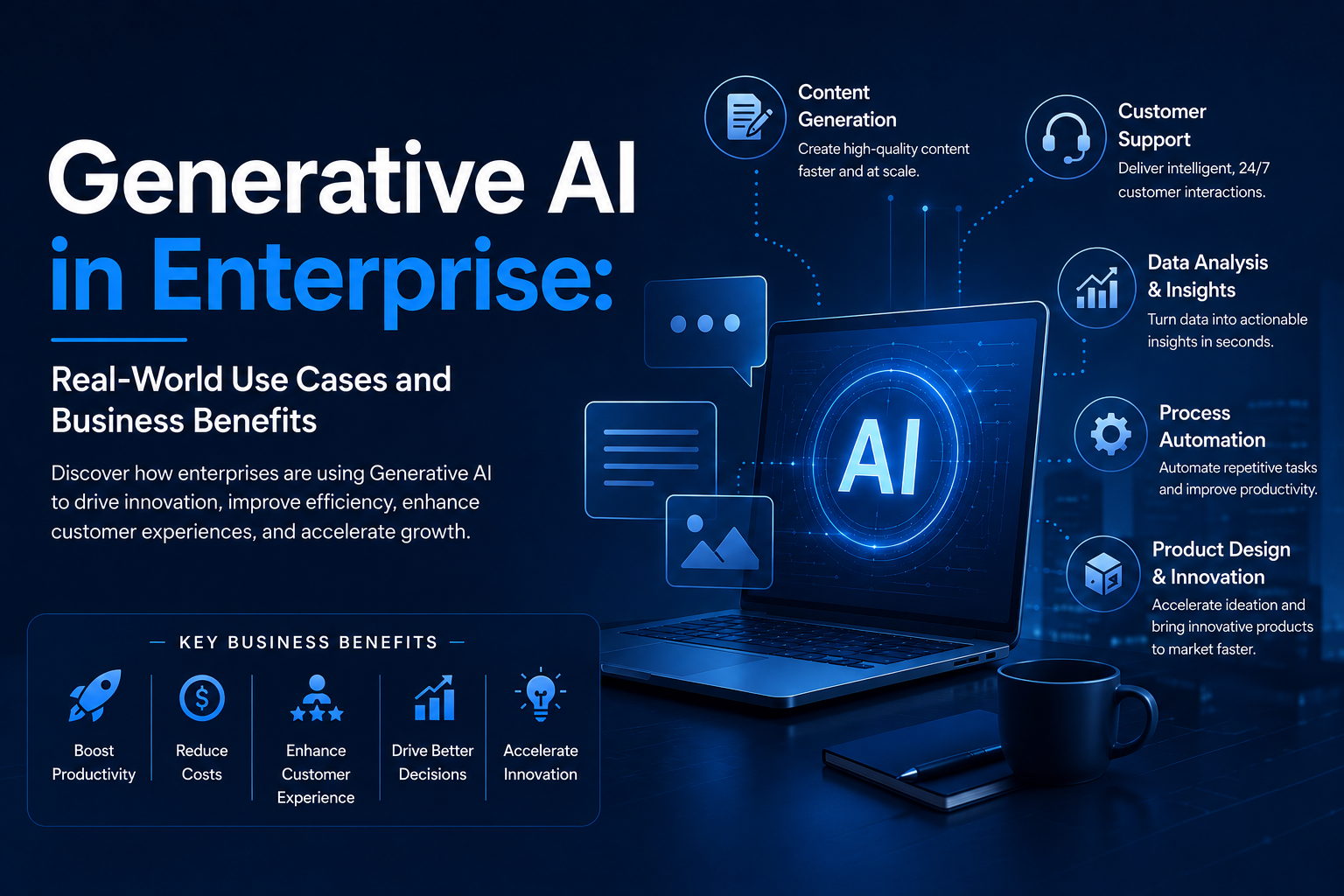
Generative AI in Enterprise: Real-World Use Cases and Business Benefits
Generative AI in Enterprise: Real-World Use Cases and Business Benefits
Introduction
Generative Artificial Intelligence has rapidly moved from an emerging technology to a practical business capability. In 2026, enterprises across industries are using Generative AI to automate repetitive work, improve customer experiences, accelerate decision-making, support employees, and create new digital products and services.
Unlike traditional automation, Generative AI can understand natural language, analyze large volumes of information, generate content, summarize complex data, assist with software development, and interact with users conversationally.
However, successful enterprise adoption is not simply about adding an AI chatbot to a business process. Organizations need to identify meaningful use cases, establish governance, protect sensitive information, and integrate AI into existing workflows.
This article explores practical Generative AI use cases for enterprises and the business benefits they can deliver.
What Is Generative AI?
Generative AI refers to artificial intelligence systems capable of creating new content based on patterns learned from large datasets.
Depending on the technology, Generative AI can produce:
- Text and business documents
- Software code
- Images and graphics
- Audio and voice content
- Video
- Summaries and reports
- Business insights
- Conversational responses
Large language models are particularly useful in enterprise environments because they can process natural-language instructions and work with information from business systems.
Why Enterprises Are Adopting Generative AI
Businesses are under constant pressure to improve productivity while controlling costs and delivering better customer experiences.
Generative AI can support these objectives by assisting employees with time-consuming tasks and enabling organizations to process information faster.
Key drivers include:
- Increasing volumes of business data
- Demand for faster customer service
- Software development requirements
- Workforce productivity challenges
- Growing automation opportunities
- Personalized customer experiences
- Competitive pressure to innovate
The most valuable implementations typically focus on specific business problems rather than adopting AI simply because it is technologically advanced.
Real-World Generative AI Use Cases
1. AI-Powered Customer Support
Customer service is one of the most practical applications of Generative AI.
AI assistants can understand customer questions, retrieve relevant information, generate responses, summarize conversations, and help support agents resolve issues faster.
Enterprise applications include:
- Automated FAQ responses
- Customer-service chatbots
- Ticket classification
- Conversation summaries
- Agent assistance
- Knowledge-base search
- Multilingual support
AI can handle routine interactions while human agents focus on complex or sensitive customer issues.
2. Employee Knowledge Assistants
Large organizations often have information distributed across documents, policies, knowledge bases, emails, and internal systems.
Employees may spend significant amounts of time searching for information.
Generative AI-powered enterprise assistants can provide a conversational interface for accessing approved business information.
For example, an employee could ask:
"What is our current employee travel reimbursement policy?"
Instead of manually searching through multiple documents, an AI assistant can retrieve relevant information and provide a concise response.
This can improve knowledge accessibility and reduce time spent searching.
3. Software Development
Generative AI is increasingly being used throughout the software development lifecycle.
Development teams can use AI to assist with:
- Code generation
- Code explanation
- Debugging
- Test generation
- Documentation
- Refactoring
- Code reviews
- Development research
AI coding assistants can help developers complete routine tasks faster while allowing experienced engineers to focus on architecture, security, and complex problem-solving.
Human review remains essential, particularly for production systems and security-sensitive applications.
4. Document Processing
Enterprises process large numbers of contracts, invoices, reports, applications, forms, and other documents.
Generative AI can help extract information, summarize documents, classify content, and identify important details.
For example, an organization can use AI to analyze contracts and highlight:
- Important clauses
- Renewal dates
- Obligations
- Potential risks
- Payment terms
This can significantly reduce manual document-review effort.
5. Marketing Content Creation
Marketing teams can use Generative AI to accelerate content production.
Potential applications include:
- Blog drafts
- Product descriptions
- Email campaigns
- Social media content
- Advertising variations
- Campaign ideas
- Market research summaries
AI can help teams produce multiple content variations quickly while marketers maintain control over brand voice, accuracy, and final approval.
6. Sales Enablement
Generative AI can support sales teams by turning large amounts of customer and product information into actionable insights.
Sales applications may include:
- Personalized outreach drafts
- Meeting summaries
- Proposal assistance
- Customer research
- Sales-call analysis
- Follow-up recommendations
- Product information retrieval
This allows sales professionals to spend more time engaging with customers instead of performing repetitive administrative work.
7. Financial Analysis
Financial teams can use Generative AI to summarize financial information, analyze reports, generate explanations, and assist with routine analysis.
Potential applications include:
- Financial report summaries
- Variance explanations
- Management reporting
- Data interpretation
- Forecasting assistance
- Invoice processing
- Financial document analysis
AI-generated insights should be validated against authoritative financial data before being used for important business decisions.
8. Human Resources
HR departments can use Generative AI to improve employee services and automate administrative processes.
Common applications include:
- Employee policy assistants
- Job-description creation
- Recruitment support
- Interview-question generation
- Onboarding assistance
- Training content
- Employee FAQ systems
Organizations must apply appropriate privacy, fairness, and governance controls when AI is used with employee or candidate information.
9. Healthcare and Life Sciences
Generative AI is creating opportunities across healthcare and life sciences, particularly in administrative and information-management workflows.
Potential applications include:
- Clinical documentation assistance
- Research summarization
- Medical literature analysis
- Patient communication support
- Drug research assistance
- Administrative automation
Because healthcare involves highly sensitive information and high-impact decisions, AI implementations require strict security, privacy, validation, and human oversight.
10. Supply Chain and Operations
Generative AI can help operations teams analyze information from multiple sources and turn it into understandable business insights.
Applications may include:
- Supplier communication
- Logistics documentation
- Operational summaries
- Inventory analysis
- Risk identification
- Demand-planning assistance
- Process documentation
Combining Generative AI with enterprise data can help organizations respond more quickly to operational changes.
Business Benefits of Generative AI
Increased Employee Productivity
One of the most immediate benefits is reducing the amount of time employees spend on repetitive knowledge tasks.
AI can assist with research, writing, summarization, documentation, and information retrieval, allowing employees to focus on higher-value activities.
Faster Decision-Making
Generative AI can process large volumes of information and present important insights in a more accessible format.
Executives and managers can use AI-generated summaries to understand complex information more quickly.
Improved Customer Experience
AI-powered assistants can provide faster responses and support customers across multiple channels.
When integrated with reliable business information, AI can also deliver more relevant and personalized interactions.
Reduced Operational Costs
Automating repetitive tasks can reduce manual effort and allow organizations to use resources more efficiently.
The greatest savings generally come from integrating AI into high-volume workflows rather than using it only as a standalone chatbot.
Faster Innovation
Generative AI can help organizations experiment with ideas, create prototypes, analyze information, and develop new digital experiences more rapidly.
This can shorten the time between an idea and an initial implementation.
Better Knowledge Management
Enterprise AI systems can make organizational knowledge easier to access.
Employees can interact with information using natural language rather than learning complicated search systems or navigating large document repositories.
Challenges Enterprises Must Consider
Despite its potential, Generative AI introduces new risks and operational challenges.
Data Privacy
Organizations must carefully control what business and customer information is provided to AI systems.
Accuracy and Hallucinations
AI models can sometimes generate incorrect or unsupported information. Enterprise implementations should use validation, reliable data sources, and human oversight where appropriate.
Security
AI applications must be protected against unauthorized access, data leakage, malicious inputs, and other emerging threats.
Governance
Organizations need clear policies covering acceptable AI usage, data handling, model selection, monitoring, and accountability.
Integration
The value of enterprise AI increases when it connects with existing business systems. Integrating AI with CRM, ERP, databases, document repositories, and other platforms can require careful technical planning.
Employee Adoption
Employees need training and clear guidance on how to use AI effectively and responsibly.
How to Build a Successful Enterprise Generative AI Strategy
Organizations should approach Generative AI adoption strategically.
Step 1: Identify High-Value Problems
Start with business challenges rather than technology.
Look for repetitive, information-intensive, high-volume processes where AI can deliver measurable value.
Step 2: Evaluate Data Readiness
Determine whether the organization has reliable, accessible, and appropriately governed data.
Poor-quality information can lead to poor AI outcomes.
Step 3: Start With Controlled Use Cases
Begin with a focused pilot project.
Measure productivity, quality, accuracy, adoption, and business impact before expanding.
Step 4: Establish AI Governance
Define policies for:
- Data privacy
- Security
- Human oversight
- Model usage
- Compliance
- Monitoring
- Responsible AI
Step 5: Integrate AI Into Existing Workflows
Instead of creating isolated AI tools, connect AI capabilities with the applications employees already use.
This can improve adoption and make AI more useful in everyday operations.
Step 6: Measure Business Results
AI initiatives should have measurable objectives.
Relevant metrics can include:
- Time saved
- Cost reduction
- Customer satisfaction
- Employee productivity
- Response time
- Error rates
- Revenue impact
- User adoption
The Future of Enterprise Generative AI
Generative AI is moving beyond simple content generation toward AI systems capable of supporting complex business workflows.
Organizations are increasingly exploring AI agents that can interpret objectives, use business tools, retrieve information, perform actions, and coordinate multiple steps under appropriate controls.
This evolution could transform areas such as customer service, software development, operations, sales, finance, and enterprise knowledge management.
However, successful businesses will not necessarily be those that deploy the most AI. They will be the organizations that integrate AI responsibly into processes where it creates measurable value.
Conclusion
Generative AI is becoming an important component of modern enterprise technology strategy.
From customer support and software development to document processing, marketing, HR, finance, and operations, organizations can use Generative AI to improve productivity, accelerate workflows, enhance customer experiences, and support innovation.
The key is to move beyond experimentation and focus on practical, measurable business outcomes.
Enterprises that combine Generative AI with strong data governance, cybersecurity, human oversight, and thoughtful workflow integration can build AI capabilities that are scalable, secure, and valuable for long-term growth.
The future of enterprise AI is not simply about generating content. It is about intelligently augmenting how businesses operate, make decisions, and serve their customers.
Frequently Asked Questions
What is Generative AI in enterprise?
Enterprise Generative AI refers to the use of generative AI technologies within business processes to create content, analyze information, automate tasks, support employees, and improve customer experiences.
What are the most common enterprise use cases?
Customer support, software development, document processing, employee knowledge management, marketing, sales, financial analysis, HR, and operations are among the major use cases.
Can Generative AI reduce business costs?
Yes. Generative AI can reduce costs by automating repetitive tasks, improving employee productivity, accelerating workflows, and reducing manual effort.
Is Generative AI secure for businesses?
It can be secure when implemented with appropriate identity controls, data protection, access management, monitoring, governance, and security practices.
Should businesses replace employees with Generative AI?
The strongest enterprise use cases generally focus on augmenting employees rather than simply replacing them. AI can handle repetitive work while employees focus on judgment, creativity, relationships, and complex decision-making.
How should a business start using Generative AI?
A business should identify a specific high-value problem, assess its data and security requirements, run a controlled pilot, establish governance, measure results, and gradually scale successful use cases.
About Riotech
Riotech helps businesses adopt modern technology solutions designed around their operational and digital transformation needs. By combining technology expertise with practical business objectives, Riotech supports organizations in building scalable and efficient digital solutions.
Ready to explore how Generative AI can improve your business operations? Connect with Riotech to identify practical AI opportunities for your organization.
Recent Posts

21 Aug 2026