Confidential Computing in 2026: Protecting Data While It Is Being Used
Confidential Computing in 2026: Protecting Data While It Is Being Used
Businesses have traditionally focused on protecting data in two major states:
Data at rest — information stored in databases, servers, or cloud storage.
Data in transit — information moving between systems.
But there is another critical state:
Data in use.
When applications process information, sensitive data may temporarily exist in system memory. This creates a security challenge for organizations running sensitive workloads in cloud and shared infrastructure environments.
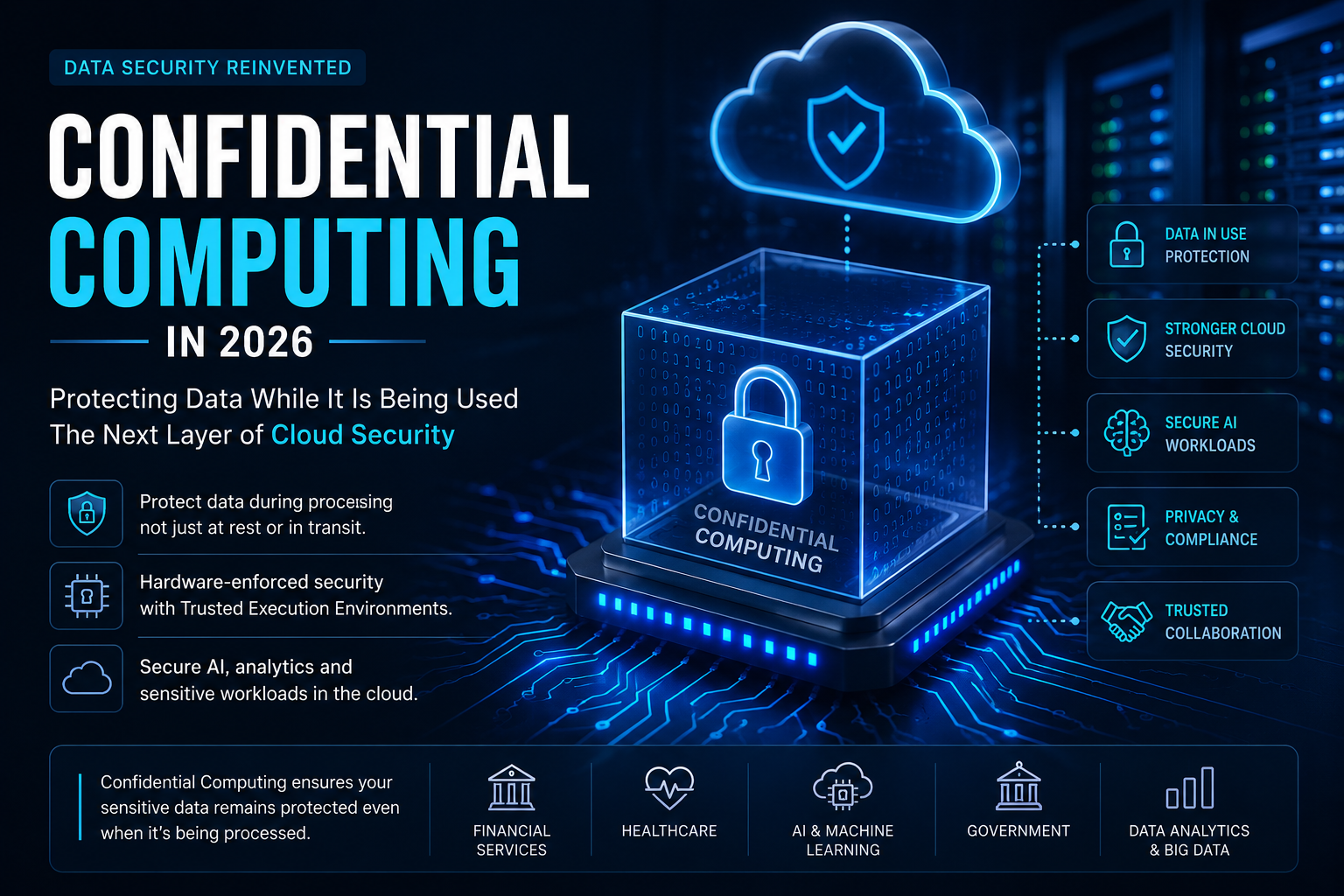
Confidential Computing addresses this challenge by using hardware-based security mechanisms to protect data while it is being processed.
In May 2026, NIST published an initial public draft specifically focused on hardware-enabled security and Confidential Computing for cloud workloads, including protection of AI workloads.
What Is Confidential Computing?
Confidential Computing is a security approach designed to protect sensitive data while it is actively being processed.
It commonly uses hardware-based Trusted Execution Environments (TEEs) to isolate sensitive workloads and restrict unauthorized access to data during computation.
The goal is to extend data protection beyond storage and network transmission into the actual processing environment.
This becomes particularly valuable when businesses use cloud infrastructure for sensitive workloads.
Why Data-in-Use Protection Matters
Traditional encryption protects stored information and information moving across networks.
However, applications need access to data in order to process it.
For example, a business application may need to:
- Analyze customer records
- Process financial transactions
- Run machine-learning models
- Analyze healthcare information
- Process confidential documents
- Perform business intelligence
Confidential Computing introduces mechanisms that help protect sensitive information during these processing operations.
NIST describes this as an important advancement for protecting data in cloud environments, particularly as organizations increasingly move sensitive workloads to cloud platforms.
How Confidential Computing Works
A simplified Confidential Computing architecture typically involves a protected execution environment.
Step 1: Sensitive Data Enters the Protected Environment
Data is provided to a trusted workload rather than being exposed broadly across the underlying infrastructure.
Step 2: Processing Takes Place Inside a TEE
The Trusted Execution Environment isolates sensitive computation and helps prevent unauthorized access.
Step 3: Hardware-Based Controls Protect the Workload
Security mechanisms help ensure that protected data can only be accessed by authorized code running within the trusted environment.
Step 4: Attestation Verifies the Environment
Remote attestation can help verify that the expected workload is running inside an appropriate trusted environment before sensitive information or cryptographic keys are released.
This creates a stronger foundation for cloud security.
Confidential Computing and Artificial Intelligence
The growth of AI makes Confidential Computing particularly relevant.
AI workloads can process highly sensitive information, including:
- Customer data
- Financial information
- Proprietary datasets
- Intellectual property
- Enterprise documents
- Personal information
Organizations may want to use cloud-based AI services without unnecessarily exposing sensitive data during processing.
NIST's 2026 Confidential Computing work specifically discusses protecting data processed by AI workloads in cloud infrastructure.
This makes Confidential Computing an increasingly relevant component of secure AI architecture.
Confidential AI: An Emerging Security Model
As businesses adopt AI, security teams are moving beyond protecting only the AI interface.
They also need to consider:
- Training data
- Model weights
- Inference data
- AI-generated outputs
- APIs
- Credentials
- Processing environments
Confidential Computing can help create stronger security boundaries around sensitive AI workloads.
The technology is also being explored for AI inference and fine-tuning workloads where organizations need stronger privacy guarantees.
Key Benefits of Confidential Computing
1. Protection of Sensitive Data
Confidential Computing extends protection into the processing stage.
2. Stronger Cloud Security
It can help organizations reduce risks associated with sensitive workloads running on shared cloud infrastructure.
3. Secure AI Workloads
Organizations can explore AI applications while applying additional protections to sensitive datasets and processing environments.
4. Improved Data Privacy
Businesses can strengthen privacy controls when handling sensitive information.
5. Stronger Trust Between Organizations
Confidential Computing can provide technical mechanisms for verifying that workloads are running in approved environments.
Where Can Confidential Computing Be Used?
Financial Services
Banks and financial technology companies can use Confidential Computing for sensitive analytics, fraud detection, and financial workloads.
Healthcare
Healthcare organizations can explore protected environments for processing sensitive medical and patient information.
Cloud Applications
SaaS and enterprise applications can use confidential environments for workloads requiring stronger data isolation.
Artificial Intelligence
Confidential Computing can support sensitive AI inference, model processing, and data analysis.
Government
Public-sector organizations handling confidential information can benefit from stronger workload isolation.
Collaborative Data Analysis
Multiple organizations may need to analyze data without unnecessarily exposing the underlying information to one another.
Confidential Computing vs Traditional Encryption
- Traditional encryption remains essential.
- Confidential Computing does not replace encryption.
- Instead, it adds another security layer.
A modern security architecture can protect:
Data at Rest + Data in Transit + Data in Use
This broader approach is particularly relevant for organizations moving sensitive applications to cloud platforms.
Challenges Businesses Should Consider
Confidential Computing is promising, but organizations should evaluate several factors before implementation.
Performance
Security mechanisms can introduce technical overhead depending on the workload and architecture.
Application Compatibility
Existing applications may require changes to operate effectively inside protected execution environments.
Hardware and Cloud Support
Organizations need infrastructure that supports the required Confidential Computing capabilities.
Key Management
Strong key-management processes remain essential.
Operational Complexity
Security teams need appropriate tools and expertise to monitor and manage confidential workloads.
Therefore, Confidential Computing should be implemented as part of a broader security architecture rather than treated as a standalone solution.
How Businesses Can Prepare
Businesses considering Confidential Computing can start by identifying workloads where data sensitivity and cloud exposure create significant security requirements.
A practical approach is:
- Identify sensitive workloads.
- Map where data is processed.
- Assess current cloud security controls.
- Identify workloads suitable for confidential environments.
- Evaluate TEE and cloud compatibility.
- Test performance and application behavior.
- Implement appropriate identity and key-management controls.
- Monitor the environment continuously.
The Future of Cloud Security
Cloud computing continues to become the foundation for modern applications, analytics, and AI.
As workloads become more sensitive, organizations need security mechanisms that protect information throughout its lifecycle.
Confidential Computing represents an important shift toward protecting data during computation, rather than relying only on storage and network encryption.
The growing attention from organizations such as NIST demonstrates that data-in-use protection is becoming an important area of modern cybersecurity research and implementation.
Conclusion
Confidential Computing is emerging as an important security technology for organizations that need to process sensitive information in cloud and AI environments.
Its core principle is simple:
Sensitive data should remain protected not only when it is stored or transmitted, but also when it is being processed.
As businesses adopt cloud services, AI applications, and distributed computing architectures, protecting data in use will become increasingly important.
Organizations that start evaluating Confidential Computing today can build stronger foundations for secure cloud adoption and privacy-focused AI.
Frequently Asked Questions
What is Confidential Computing?
Confidential Computing is a security approach that protects sensitive data while it is being processed, commonly using hardware-based Trusted Execution Environments.
What is a Trusted Execution Environment?
A Trusted Execution Environment, or TEE, is a protected computing environment designed to isolate sensitive workloads and restrict unauthorized access.
Is Confidential Computing useful for AI?
Yes. Confidential Computing can help protect sensitive datasets and AI workloads during processing, particularly in cloud environments.
Does Confidential Computing replace encryption?
No. It complements traditional encryption by addressing security risks associated with data while it is being processed.
Which businesses can benefit from Confidential Computing?
Financial services, healthcare, technology companies, government organizations, cloud-based businesses, and enterprises handling sensitive data can all potentially benefit.
Riotech Perspective
As businesses move toward cloud-first applications and AI-powered operations, security needs to evolve alongside technology.
Riotech focuses on helping organizations build modern, scalable, and technology-driven solutions with security and future readiness in mind.
Looking to modernize your cloud or enterprise technology infrastructure? Connect with Riotech to explore the right technology strategy for your business.