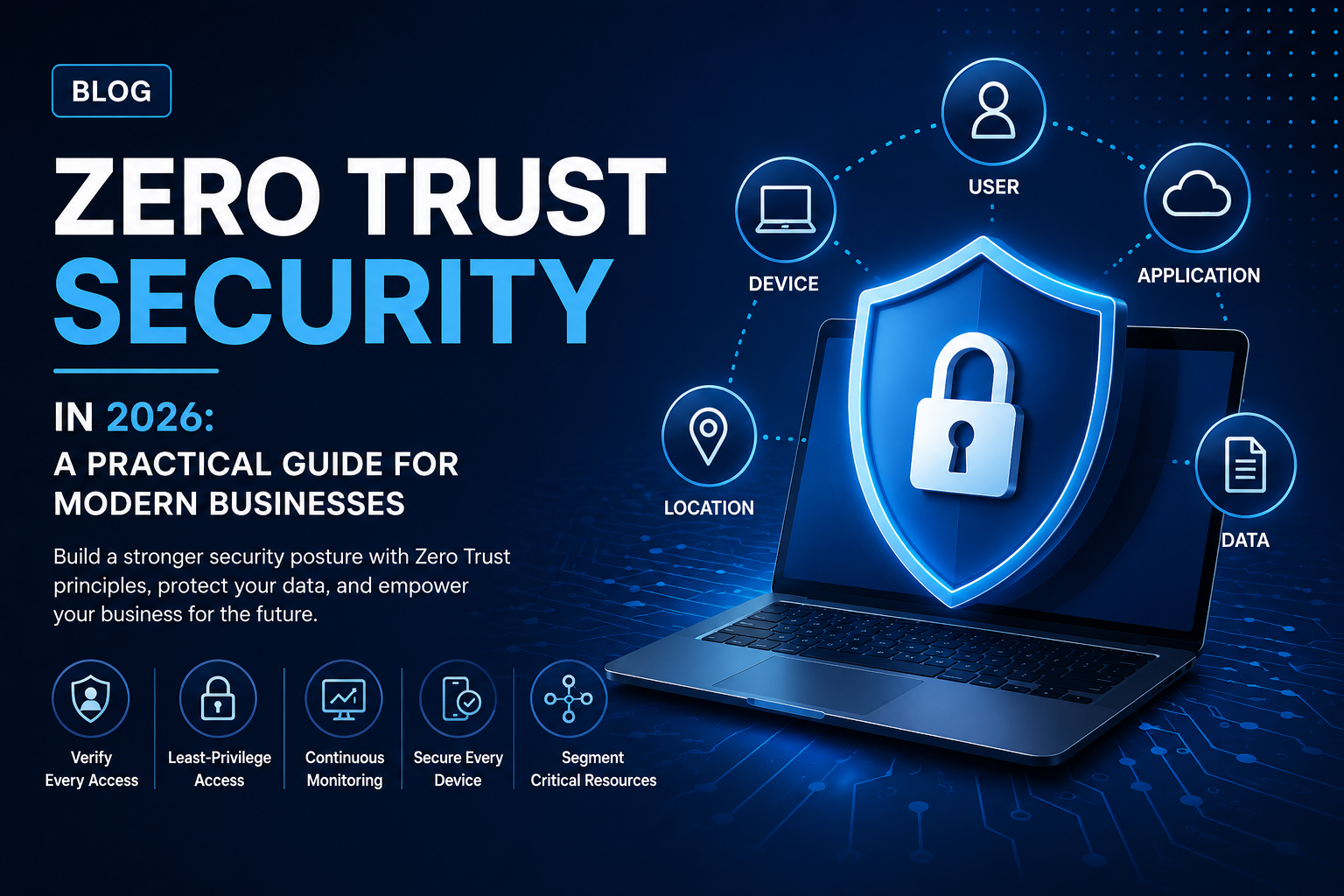
Zero Trust Security in 2026: A Practical Guide for Modern Businesses
Zero Trust Security in 2026: A Practical Guide for Modern Businesses
Introduction
Cybersecurity has evolved significantly as businesses move toward cloud platforms, remote work, hybrid infrastructure, SaaS applications, and increasingly connected digital environments. Traditional security models that rely heavily on a protected corporate network are no longer sufficient.
In 2026, organizations need a security approach that assumes no user, device, application, or network connection should automatically be trusted. This is the foundation of Zero Trust Security.
Zero Trust is not simply a cybersecurity product or technology. It is a security strategy built around continuous verification, least-privilege access, identity protection, device security, and ongoing monitoring.
For modern businesses, adopting Zero Trust can help reduce security risks while enabling employees, customers, applications, and partners to securely access the resources they need.
What Is Zero Trust Security?
Zero Trust Security follows a simple principle:
Never trust automatically. Always verify.
Instead of assuming that users or devices inside the corporate network are trustworthy, Zero Trust requires authentication and authorization before granting access to protected resources.
A Zero Trust architecture typically evaluates:
- User identity
- Device health and security status
- Application and resource access
- Location and network context
- Authentication strength
- User behavior
- Risk level
- Data sensitivity
Access decisions can then be continuously evaluated rather than being treated as a one-time verification.
Why Zero Trust Matters in 2026
The modern business environment has created a much larger attack surface. Employees may work from multiple locations, applications may operate across several cloud platforms, and sensitive information can move between internal systems, SaaS applications, APIs, and external partners.
Several factors make Zero Trust increasingly important:
1. Remote and Hybrid Work
Employees frequently access business systems outside traditional office networks. Zero Trust allows organizations to secure access based on identity, device security, and context rather than relying on physical network location.
2. Cloud Adoption
Cloud infrastructure has changed how applications and data are hosted and accessed. Zero Trust provides a framework for controlling access across cloud, on-premises, and hybrid environments.
3. Increasing Identity-Based Attacks
Compromised credentials can provide attackers with legitimate-looking access. Strong authentication, adaptive access controls, and continuous monitoring can reduce the risk associated with stolen identities.
4. Expanding Digital Ecosystems
Businesses increasingly depend on vendors, contractors, APIs, third-party applications, and connected devices. Each connection can introduce additional security risk.
5. Growing Importance of Data Protection
Organizations need to protect sensitive customer, financial, operational, and intellectual-property data regardless of where it is stored or accessed.
Core Principles of a Zero Trust Architecture
A successful Zero Trust strategy is built around several fundamental principles.
Verify Every Access Request
Every request for access should be evaluated based on relevant security signals. Authentication should not be considered sufficient on its own.
Organizations can combine:
- Multi-factor authentication
- Passwordless authentication
- Single sign-on
- Identity verification
- Risk-based authentication
This creates stronger protection against unauthorized access.
Apply Least-Privilege Access
Users should receive only the permissions required to perform their responsibilities.
For example, an employee who needs access to customer records may not require administrative access to the company's infrastructure.
Least-privilege access limits the potential impact of compromised accounts.
Continuously Monitor Users and Devices
Security does not end after authentication.
Organizations should continuously monitor:
- Login activity
- Device health
- Unusual behavior
- Application usage
- Access patterns
- Privilege changes
- Network activity
Suspicious activity can trigger additional verification or automatically restrict access.
Secure Every Device
A trusted user accessing a compromised device can still create significant risk.
Zero Trust therefore considers device posture, including:
- Operating system security
- Security updates
- Endpoint protection
- Encryption
- Configuration compliance
- Device identity
Only compliant devices should receive appropriate levels of access.
Segment Critical Resources
Network and application segmentation can limit lateral movement if an attacker gains access.
Instead of allowing broad access across the environment, organizations can isolate sensitive systems and require separate authorization.
Key Technologies Supporting Zero Trust
Zero Trust is supported by multiple technologies working together rather than a single security solution.
Identity and Access Management
IAM systems manage digital identities, authentication, authorization, and user permissions.
Multi-Factor Authentication
MFA adds additional verification beyond passwords, making stolen credentials more difficult to exploit.
Endpoint Detection and Response
EDR technologies help organizations detect suspicious activity on laptops, desktops, and other endpoints.
Security Information and Event Management
SIEM platforms collect and analyze security events from multiple systems to identify potential threats.
Secure Access Service Edge
SASE combines networking and security capabilities to provide secure access for distributed users and applications.
Zero Trust Network Access
ZTNA provides controlled access to specific applications and resources rather than giving users broad network-level access.
Data Loss Prevention
DLP technologies help identify and control the movement of sensitive information across business environments.
How Businesses Can Implement Zero Trust
Zero Trust should be implemented gradually rather than treated as a single large technology project.
Step 1: Identify Critical Assets
Start by identifying sensitive applications, databases, systems, and data.
Understand what needs the highest level of protection.
Step 2: Map Users, Devices, and Access
Document who accesses each resource, from which devices, and for what purpose.
This helps identify excessive permissions and unnecessary access pathways.
Step 3: Strengthen Identity Security
Implement strong authentication, MFA, SSO, and role-based access controls.
Identity should become a central component of the organization's security architecture.
Step 4: Introduce Least-Privilege Policies
Review existing permissions and remove unnecessary privileges.
Access should be based on business requirements rather than historical access accumulation.
Step 5: Secure Endpoints
Establish device security policies and ensure endpoints meet minimum security requirements before accessing sensitive resources.
Step 6: Segment Important Systems
Separate critical applications and data from general business infrastructure.
This reduces the potential impact of compromised accounts and devices.
Step 7: Monitor and Improve
Continuously evaluate access activity, security events, and user behavior.
Zero Trust is an ongoing security strategy that should evolve as the organization, technology, and threat landscape change.
Common Zero Trust Challenges
Implementing Zero Trust can provide substantial security benefits, but organizations may encounter challenges.
Legacy Infrastructure
Older applications may not support modern authentication or granular access controls.
Complex Environments
Organizations operating across multiple cloud platforms, data centers, and SaaS applications may need significant integration work.
User Experience
Poorly designed security controls can create unnecessary friction for employees.
Organizations should balance strong security with convenient and productive access.
Lack of Visibility
It is difficult to enforce Zero Trust policies without knowing which users, devices, applications, and services are interacting with business resources.
Cultural and Operational Changes
Zero Trust often requires changes to existing security processes and access-management practices. Security, IT, and business teams need to work together.
Benefits of Zero Trust for Modern Businesses
When implemented effectively, Zero Trust can help organizations:
- Reduce unauthorized access
- Limit the impact of compromised accounts
- Strengthen identity security
- Protect sensitive business data
- Reduce lateral movement during attacks
- Improve visibility across IT environments
- Support secure remote and hybrid work
- Strengthen cloud security
- Improve compliance and access governance
Most importantly, Zero Trust helps organizations move from perimeter-based security toward a more adaptive and identity-centric security model.
Zero Trust and the Future of Business Security
As businesses continue adopting AI, cloud services, automation, APIs, connected devices, and distributed applications, traditional security boundaries will become increasingly difficult to maintain.
Zero Trust provides a scalable framework for protecting these environments by continuously evaluating access and reducing unnecessary trust.
In 2026 and beyond, organizations should view Zero Trust as an ongoing business-security strategy rather than a one-time implementation.
Final Thoughts
Cybersecurity is no longer only about protecting the corporate network. Modern businesses must protect identities, applications, devices, data, APIs, cloud environments, and digital interactions across increasingly distributed ecosystems.
Zero Trust Security provides a practical framework for achieving this goal.
By combining strong identity controls, least-privilege access, device security, continuous monitoring, segmentation, and data protection, businesses can create a more resilient security environment.
For organizations planning their next stage of digital transformation, adopting Zero Trust principles can be an important step toward building secure, scalable, and future-ready technology infrastructure.
Frequently Asked Questions
What is Zero Trust Security?
Zero Trust is a cybersecurity approach that assumes no user, device, or connection should automatically be trusted. Access is continuously verified based on identity, device status, context, and risk.
Is Zero Trust only for large enterprises?
No. Businesses of different sizes can adopt Zero Trust principles. Smaller organizations can begin with foundational measures such as MFA, least-privilege access, endpoint security, and centralized identity management.
Does Zero Trust replace traditional cybersecurity?
No. Zero Trust complements existing cybersecurity technologies and provides a framework for how identity, access, devices, applications, and data should be protected.
How long does Zero Trust implementation take?
Implementation timelines vary depending on the organization's infrastructure, applications, security maturity, and business requirements. A phased approach is generally more practical than attempting to transform the entire environment simultaneously.
What is the first step toward Zero Trust?
Organizations should begin by identifying critical data and systems, understanding who has access to them, evaluating existing security controls, and establishing stronger identity and access policies.
About Riotech
Riotech helps businesses leverage modern technology to build secure, scalable, and efficient digital environments. From software development and cloud solutions to business technology and IT services, Riotech focuses on delivering solutions aligned with evolving business and technology requirements.
Ready to strengthen your organization's digital security? Connect with Riotech to explore practical cybersecurity and technology solutions tailored to your business needs.
Recent Posts

21 Aug 2026