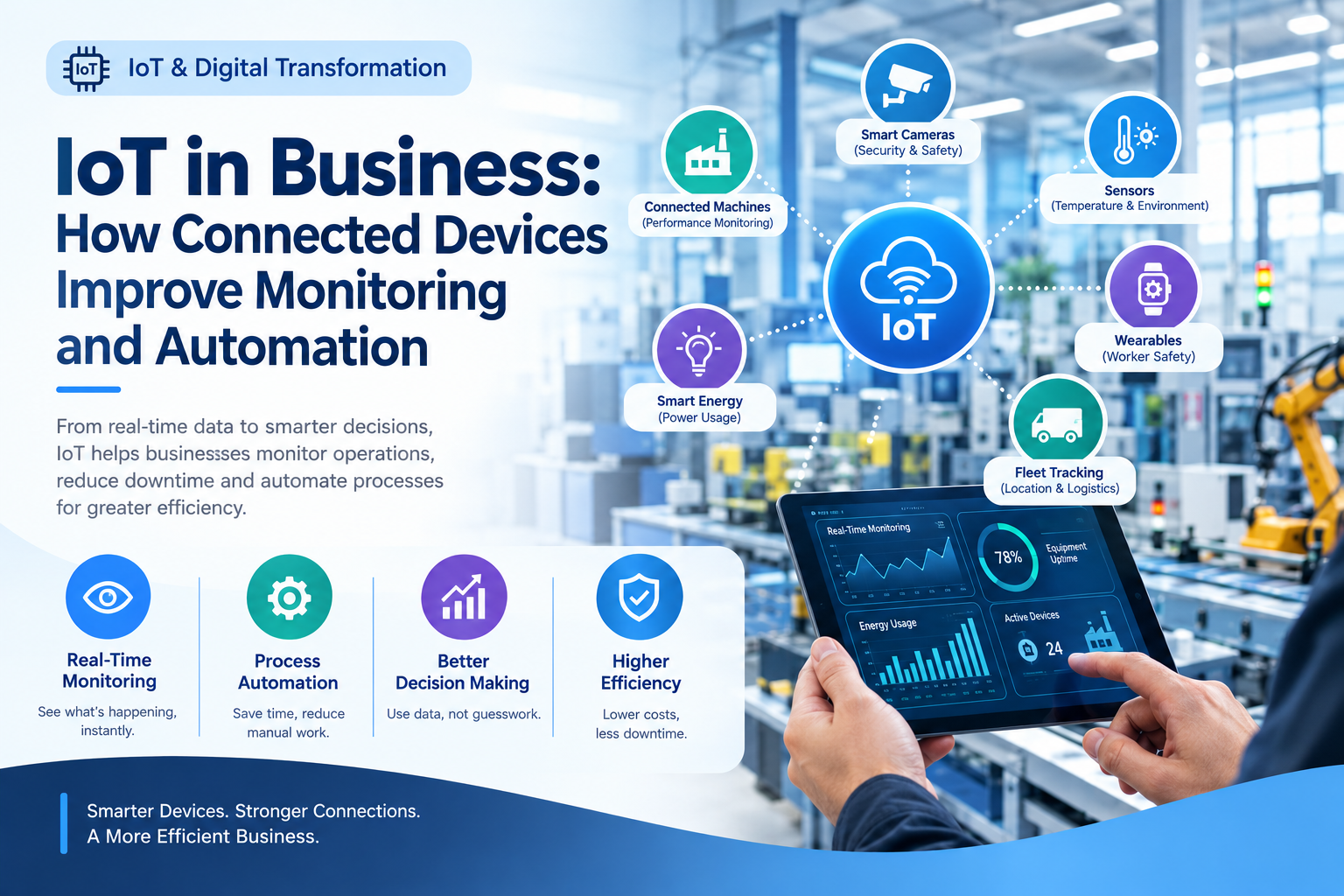
IoT in Business: How Connected Devices Improve Monitoring and Automation
IoT in Business: How Connected Devices Improve Monitoring and Automation
Businesses today need faster access to information, better operational visibility, and more efficient ways to manage physical assets. Traditional monitoring methods often depend on manual inspections, periodic reporting, and disconnected systems, making it difficult to respond quickly when conditions change.
The Internet of Things (IoT) is transforming this approach by connecting devices, sensors, machines, and software systems so they can continuously collect and exchange data. This creates a direct connection between physical operations and digital decision-making.
From manufacturing and logistics to healthcare, retail, smart buildings, and agriculture, IoT can help organizations monitor operations in real time and automate responses based on predefined conditions.
What Is IoT in Business?
IoT in business refers to the use of connected devices and sensors to collect operational data and transmit it to software platforms for monitoring, analysis, and action.
A typical IoT ecosystem may include:
- Sensors and connected devices
- IoT gateways
- Communication networks
- Cloud platforms
- Data processing systems
- Monitoring dashboards
- Automation systems
- Analytics and AI tools
For example, temperature sensors installed in a warehouse can continuously monitor storage conditions. If the temperature moves outside the acceptable range, the system can automatically generate an alert or trigger an appropriate response.
This changes monitoring from a periodic activity into a continuous process.
How IoT Improves Business Monitoring
One of the biggest advantages of IoT is the ability to collect operational information continuously.
Traditional monitoring may require an employee to physically inspect equipment or manually collect readings. Connected devices can transmit data automatically, giving businesses a centralized view of assets and processes.
IoT monitoring can track factors such as:
- Temperature
- Humidity
- Pressure
- Vibration
- Equipment status
- Energy consumption
- Location
- Network connectivity
- Device health
- Production performance
Modern IoT monitoring platforms can also provide alerts and reporting when device conditions or operational metrics move outside expected ranges.
1. Real-Time Equipment Monitoring
Manufacturing and industrial businesses depend heavily on machinery and equipment.
IoT sensors can monitor machine conditions continuously and send operational data to a centralized platform. Managers can then identify abnormal readings without waiting for a scheduled inspection.
For example:
Machine → Sensors → IoT Gateway → Cloud Platform → Dashboard → Alert/Action
This can provide greater visibility into equipment performance and help maintenance teams identify potential problems earlier.
2. Predictive Maintenance
IoT can also support a shift from reactive maintenance to more proactive maintenance strategies.
Sensors can collect information such as vibration, temperature, operating hours, and other machine parameters. Analytics or machine-learning systems can analyze these patterns to identify potential maintenance requirements.
Instead of waiting for a machine to fail, businesses can investigate unusual conditions earlier.
IoT monitoring combined with AI and machine learning can support predictive maintenance by analyzing equipment behavior and identifying deviations from normal operating patterns.
3. Automated Alerts and Responses
Monitoring data becomes significantly more useful when it can trigger an automated response.
For example:
High Temperature → Sensor Detection → Automated Alert → Maintenance Notification
Or:
Abnormal Machine Vibration → Data Analysis → Risk Detection → Maintenance Workflow
Automation reduces the need for employees to constantly monitor dashboards and manually initiate every response.
Depending on the application, IoT systems can send notifications, create maintenance requests, change device settings, or activate another connected system.
4. Better Asset Tracking
Businesses with vehicles, equipment, inventory, or other mobile assets can use connected devices to improve visibility.
IoT-enabled tracking can help organizations understand:
- Where an asset is located
- How it is being used
- Whether it is operating normally
- When it requires maintenance
- How efficiently it is being utilized
This information can support better asset management and reduce unnecessary manual tracking.
5. Smarter Energy Management
Energy consumption is another area where IoT can provide actionable information.
Connected sensors and meters can monitor energy usage across facilities, equipment, and operational areas. Businesses can analyze consumption patterns and identify areas where energy use may be optimized.
For example, smart systems can adjust lighting or environmental controls according to occupancy or operating conditions.
IoT-enabled systems can help businesses improve operational efficiency by providing continuous visibility into connected assets and environments.
6. Improved Supply Chain and Logistics Visibility
IoT is particularly useful when businesses need to monitor products or assets while they are moving between locations.
Connected devices can provide information about:
- Location
- Temperature
- Movement
- Delivery status
- Storage conditions
- Asset utilization
This is especially valuable for temperature-sensitive goods, fleet operations, warehouses, and distributed supply chains.
Instead of relying only on periodic updates, businesses can use connected systems to obtain more continuous operational visibility.
7. Smart Manufacturing
Manufacturing is one of the strongest use cases for Industrial IoT (IIoT).
Connected machines can share operational data with centralized systems, allowing organizations to monitor production performance, equipment conditions, quality indicators, and energy usage.
IoT can also connect monitoring systems with automation technologies to create more responsive production environments.
IIoT systems can use real-time machine data to support process optimization and predictive maintenance.
8. Remote Monitoring and Device Management
Businesses often operate connected devices across multiple locations. Managing these devices individually can become increasingly difficult as the IoT environment grows.
A centralized IoT platform can help teams monitor device health, connectivity, software status, and operational performance.
Remote device management can also support activities such as configuration, software updates, troubleshooting, and security management.
This is particularly useful for businesses with distributed assets where physical access to every device is not practical.
IoT and Automation: From Data to Action
The real business value of IoT is not simply collecting data. It comes from turning that data into useful actions.
A basic IoT workflow may look like:
Sense → Connect → Analyze → Decide → Automate
For example:
Temperature Sensor → Real-Time Data → Threshold Analysis → Abnormal Condition → Automated Alert
A more advanced system could add AI:
Sensor Data → IoT Platform → AI Analysis → Anomaly Detection → Automated Response
This combination can help businesses move from simple monitoring toward intelligent and automated operations.
Key Benefits of IoT for Businesses
When properly designed and implemented, IoT can support several business objectives:
Greater Operational Visibility
Businesses can access real-time information about equipment, assets, and processes instead of relying entirely on manual reporting.
Faster Response
Automated alerts can help teams identify issues sooner and respond based on predefined workflows.
Reduced Manual Monitoring
Connected systems can continuously collect and transmit data, reducing the need for repetitive physical inspections.
Improved Asset Utilization
Businesses can use operational data to understand how equipment and other assets are being used.
Better Maintenance Planning
Continuous equipment monitoring can help maintenance teams identify unusual patterns and investigate potential problems earlier.
Data-Driven Decision Making
IoT generates operational data that can be analyzed to identify trends, inefficiencies, and opportunities for improvement.
Microsoft identifies operational efficiency, improved safety, increased visibility, and automation as important organizational benefits of IoT.
What Businesses Should Consider Before Implementing IoT
IoT implementation requires more than installing sensors. Organizations should consider the complete technology ecosystem.
Device Compatibility
Devices and sensors need to communicate effectively with the chosen platform and infrastructure.
Connectivity
The appropriate communication technology depends on the environment, device requirements, distance, data volume, and reliability needs.
Data Security
Connected devices create additional points that need to be protected. Authentication, encryption, access controls, secure updates, and monitoring should be considered as part of the IoT architecture.
Scalability
An IoT solution should be designed to support future growth in devices, data, users, and locations.
Integration
IoT becomes more valuable when connected with existing business systems such as ERP, CRM, cloud platforms, analytics tools, and operational software.
Data Management
Organizations should determine how IoT data will be collected, stored, processed, analyzed, and retained.
How RIOTECH Softwares Can Help With IoT Solutions
Implementing IoT successfully requires the integration of hardware, connectivity, cloud infrastructure, data processing, monitoring, and automation.
RIOTECH Softwares provides IoT development solutions designed to connect devices, sensors, and business systems for real-time monitoring and automation. Its IoT services include IoT device development, IoT connectivity, cloud IoT platforms, smart automation, and real-time data monitoring.
Businesses looking to build connected and scalable systems can explore RIOTECH's IoT Development Solutions for customized IoT solutions aligned with their operational requirements.
Final Thoughts
IoT is changing how businesses interact with physical assets and operational data. By connecting devices and systems, organizations can move beyond periodic monitoring toward continuous visibility, automated alerts, proactive maintenance, and data-driven operations.
The most effective IoT implementations begin with a clearly defined business problem. Whether the goal is monitoring equipment, tracking assets, optimizing energy consumption, improving logistics visibility, or automating operational workflows, the technology should be designed around measurable business requirements.
As IoT continues to integrate with cloud computing, AI, analytics, and automation, connected devices can become an important part of a modern digital infrastructure.
The future of business operations is not simply connected—it is increasingly intelligent, measurable, and automated.