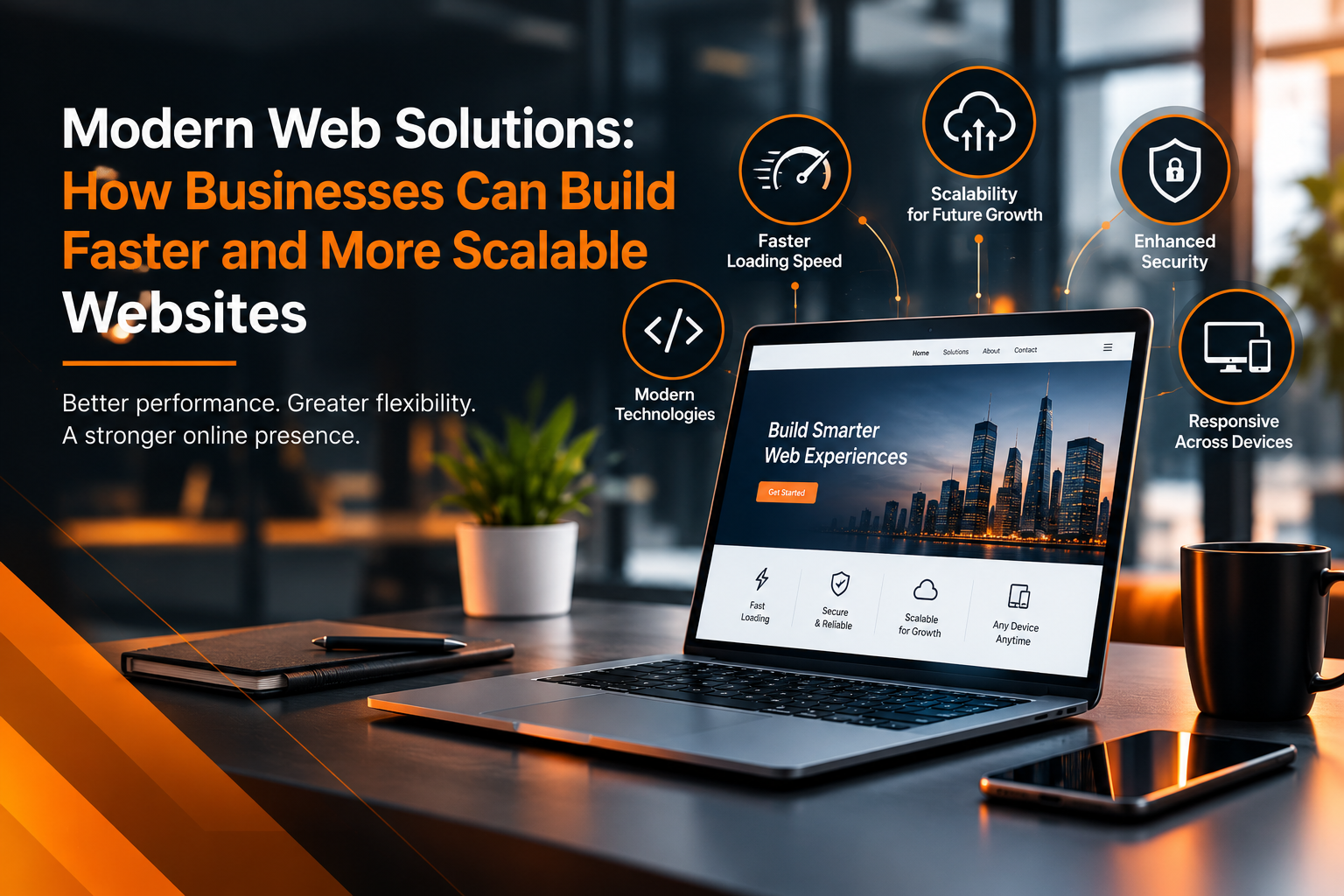
Modern Web Solutions: How Businesses Can Build Faster and More Scalable Websites
Modern Web Solutions: How Businesses Can Build Faster and More Scalable Websites
A business website is more than an online presence. It is often the first point of interaction between a company and its customers. As user expectations continue to increase, businesses need websites that load quickly, work seamlessly across devices, provide secure experiences, and remain scalable as the organization grows.
Modern web solutions help businesses build digital platforms that are not only visually professional but also optimized for performance, usability, security, and long-term growth.
What Are Modern Web Solutions?
Modern web solutions combine contemporary development technologies, responsive design principles, cloud infrastructure, APIs, databases, security practices, and performance optimization to create reliable digital experiences.
Depending on business requirements, a modern web solution may include:
- Corporate websites
- E-commerce platforms
- Web applications
- Customer portals
- Business dashboards
- Content management systems
- API-driven applications
- Cloud-based web platforms
- Custom business applications
The right solution depends on business objectives, target audience, operational requirements, and future growth plans.
Why Website Performance Matters
Website speed plays an important role in user experience. Slow-loading pages can make visitors leave before they interact with a business.
A faster website can contribute to:
- Better user experience
- Improved engagement
- Lower bounce rates
- Better mobile usability
- More efficient conversions
- Stronger search visibility
Businesses should therefore consider performance from the beginning of the development process rather than treating optimization as a final step.
1. Start With a Scalable Architecture
A scalable website should be capable of handling increasing traffic, content, users, and functionality without requiring a complete rebuild.
Developers can consider:
- Modular application architecture
- Efficient database structures
- API-based integrations
- Cloud infrastructure
- Content delivery networks
- Caching mechanisms
- Load management
The architecture should match the expected business requirements and provide room for future expansion.
2. Prioritize Mobile-First Development
A large portion of website traffic comes from smartphones and tablets. A modern website therefore needs to provide a consistent experience across different screen sizes.
Responsive development should consider:
- Flexible layouts
- Touch-friendly navigation
- Readable typography
- Optimized images
- Mobile-friendly forms
- Fast loading on mobile networks
A mobile-first approach can help businesses create websites that work effectively across devices.
3. Optimize Website Loading Speed
Performance optimization involves both front-end and back-end improvements.
Common techniques include:
- Compressing images
- Using modern image formats
- Minifying CSS and JavaScript
- Reducing unnecessary scripts
- Implementing browser caching
- Optimizing database queries
- Using content delivery networks
- Improving server response times
Every unnecessary element can increase page weight and affect the user experience.
4. Build With SEO in Mind
SEO should be considered during website development rather than added after the website is launched.
A technically optimized website should provide:
- Search-friendly URLs
- Proper heading structures
- Descriptive metadata
- Mobile responsiveness
- Fast page loading
- Internal linking
- Structured content
- Crawlable navigation
- Proper redirects
- Optimized images
Technical SEO and high-quality content work together to improve a website's ability to reach relevant users.
5. Focus on User Experience
A technically advanced website can still fail if visitors cannot easily find what they need.
Modern web development should prioritize:
- Clear navigation
- Logical page structures
- Simple forms
- Strong calls to action
- Readable content
- Consistent design
- Accessible interfaces
The goal is to reduce friction and make important information easy to find.
6. Use APIs and System Integrations
Businesses rarely operate with a single digital system. Websites may need to communicate with CRM platforms, payment gateways, ERP systems, marketing platforms, analytics tools, and other applications.
APIs allow different systems to exchange information efficiently.
For example, an e-commerce website can integrate with:
- Payment gateways
- Inventory systems
- CRM platforms
- Shipping providers
- Marketing tools
- Customer support systems
Effective integration can reduce manual work and create a more connected digital ecosystem.
7. Make Security a Core Requirement
Website security should be incorporated throughout the development lifecycle.
Businesses should consider:
- HTTPS implementation
- Secure authentication
- Access controls
- Data encryption
- Regular software updates
- Secure APIs
- Input validation
- Backup and recovery
- Vulnerability monitoring
Security becomes particularly important for websites handling customer information, payments, business data, or user accounts.
8. Prepare for Future Growth
A website that works well today may need significantly more functionality in the future.
Businesses should consider potential future requirements such as:
- Additional users
- New services
- E-commerce functionality
- Mobile applications
- Third-party integrations
- Advanced analytics
- AI-powered features
- Multi-location operations
Building with scalability in mind can make future development more efficient.
9. Monitor and Maintain the Website
Website development does not end when the site goes live.
Regular maintenance can help identify:
- Broken links
- Performance issues
- Security vulnerabilities
- Outdated dependencies
- Database problems
- Compatibility issues
- Technical SEO errors
Continuous monitoring and maintenance help keep a website reliable as technology and business requirements evolve.
Common Mistakes Businesses Should Avoid
Choosing Technology Without a Clear Requirement
The latest technology is not automatically the right technology. Businesses should select tools based on their actual needs.
Ignoring Performance
A visually impressive website can still perform poorly if its pages are overloaded with unnecessary scripts and media.
Building Without Scalability
A website designed only for current requirements may become difficult and expensive to expand later.
Neglecting Security
Security should be integrated into the development process rather than addressed only after an incident.
Forgetting Maintenance
Websites require ongoing updates, monitoring, optimization, and security management.
How Professional Web Solutions Can Help
A professional web development approach combines business strategy, design, development, performance, security, and scalability.
Businesses looking for reliable digital platforms can explore RIOTECH Web Solutions for professional web development and digital solution services.
The right web development approach can help organizations transform business requirements into a functional, performance-focused, and scalable online platform.
Conclusion
Modern websites need to do more than look professional. They should be fast, responsive, secure, scalable, and aligned with business objectives.
By choosing an appropriate architecture, optimizing performance, prioritizing mobile users, implementing strong security, integrating business systems, and planning for future growth, businesses can create websites capable of supporting long-term digital operations.
A well-built website is not simply a digital brochure—it can become an important part of a company's customer experience, marketing strategy, and business infrastructure.