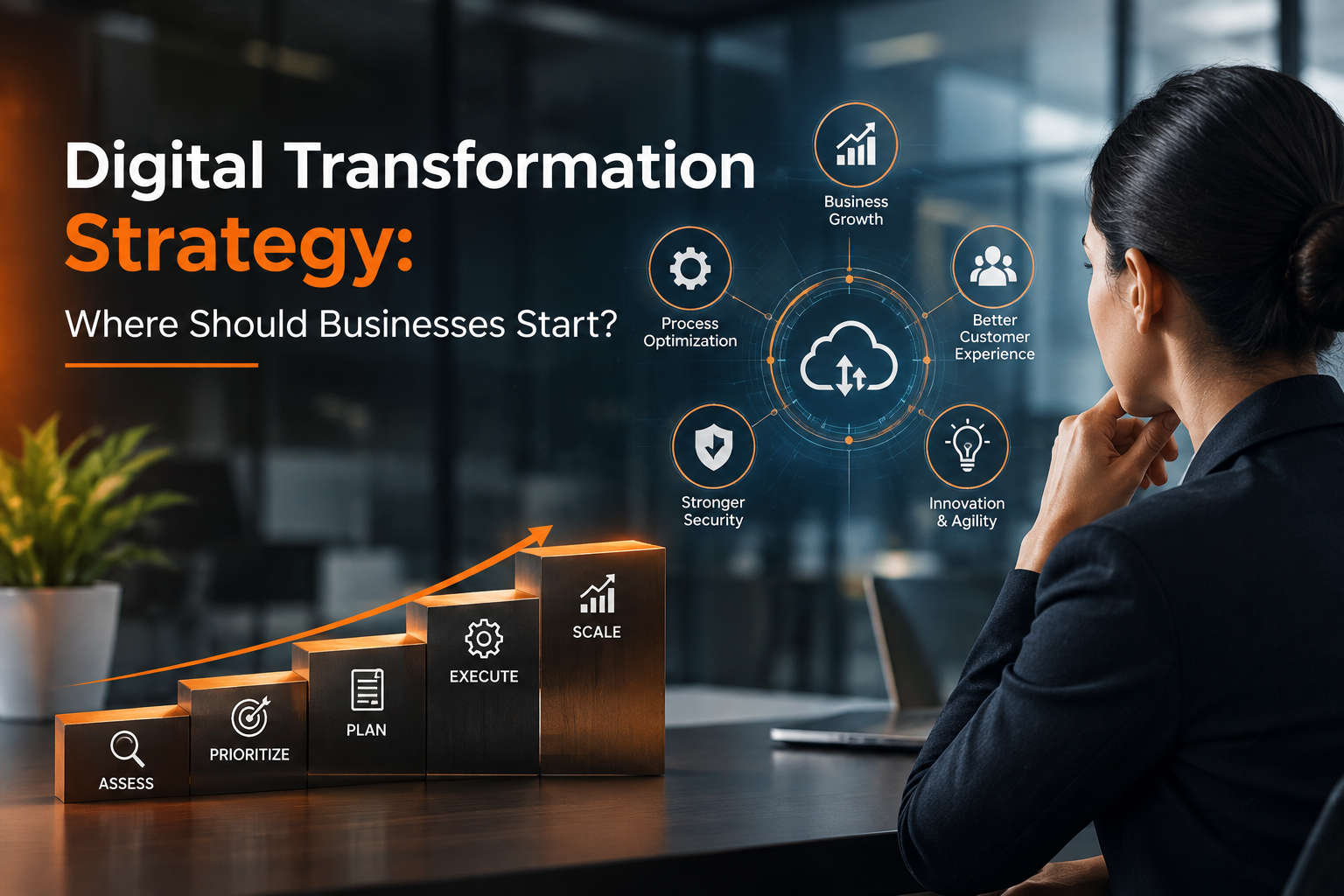
Digital Transformation Strategy: Where Should Businesses Start?
Digital Transformation Strategy: Where Should Businesses Start?
Digital transformation is no longer limited to adopting new software or moving business operations to the cloud. For modern businesses, it involves rethinking processes, improving customer experiences, using data more effectively, and aligning technology with long-term business objectives.
However, starting a digital transformation journey without a clear strategy can lead to unnecessary technology investments, disconnected systems, and inefficient workflows. Businesses need a structured approach that connects technology decisions with measurable business goals.
What Is a Digital Transformation Strategy?
A digital transformation strategy is a structured plan for using digital technologies to improve business operations, customer experiences, decision-making, and overall performance.
It can involve several areas, including:
- Business process automation
- Cloud technology adoption
- Data and analytics
- Artificial intelligence
- Cybersecurity
- Software modernization
- System integration
- Digital customer experiences
- IT infrastructure optimization
The objective is not simply to introduce more technology. The objective is to use technology where it can create measurable business value.
Why Businesses Need a Clear Transformation Strategy
Businesses often adopt different technologies to solve individual problems. Over time, this can create disconnected systems, duplicate data, manual processes, and higher operational costs.
A strategic approach helps organizations:
- Identify technology gaps
- Prioritize digital initiatives
- Reduce inefficient manual processes
- Improve collaboration between teams
- Strengthen data management
- Enhance customer experiences
- Prepare infrastructure for future growth
- Connect technology investments with business objectives
Without proper planning, digital transformation can become a collection of unrelated technology projects rather than a coordinated business strategy.
Where Should Businesses Start?
1. Define Clear Business Objectives
The first step should be understanding what the business wants to achieve.
Instead of starting with a technology such as AI, cloud computing, or automation, businesses should begin with specific challenges.
For example:
- Are operational costs increasing?
- Are employees spending too much time on repetitive tasks?
- Are different departments using disconnected systems?
- Is customer data difficult to access?
- Are existing applications limiting growth?
- Are security risks increasing?
Clear objectives provide direction for every technology decision that follows.
2. Assess the Existing Technology Environment
Before investing in new solutions, businesses should evaluate their current technology infrastructure.
An assessment can include:
- Existing software and applications
- IT infrastructure
- Cloud usage
- Data management
- Cybersecurity practices
- Business workflows
- System integrations
- Employee technology requirements
This helps identify what should be retained, improved, integrated, replaced, or automated.
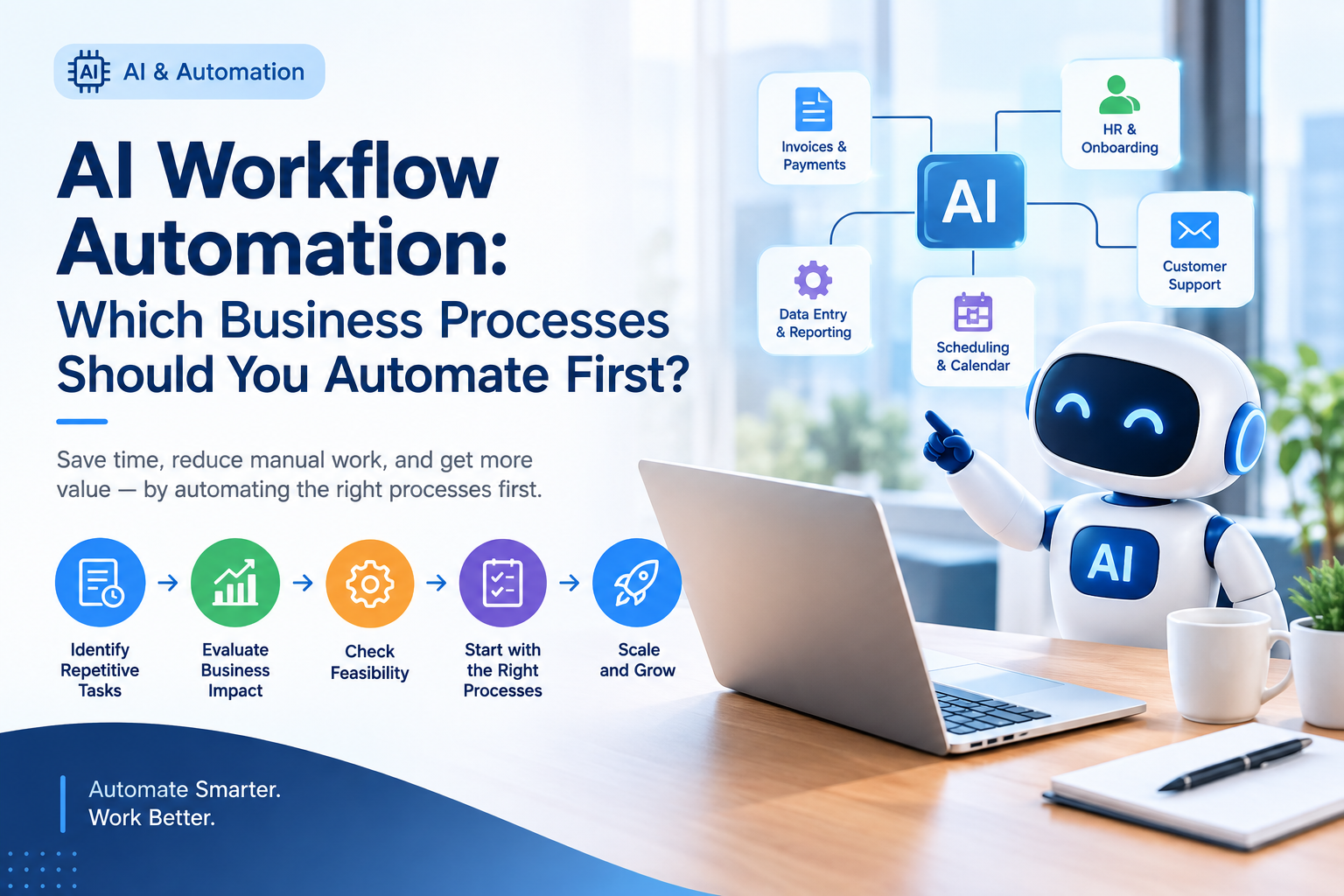
3. Identify Processes That Can Be Automated
Manual and repetitive processes are often strong candidates for digital transformation.
Businesses can evaluate processes such as:
- Data entry
- Customer management
- Reporting
- Document processing
- Internal approvals
- Communication workflows
- Inventory management
- Administrative tasks
Automation can help reduce repetitive work while improving consistency and operational efficiency.
4. Prioritize Digital Initiatives
Not every technology project needs to happen simultaneously.
Businesses should prioritize initiatives based on factors such as:
Business Impact + Urgency + Cost + Complexity + Scalability
For example, a business may first improve a critical customer-management process before moving toward more complex AI or enterprise-wide transformation initiatives.
A phased approach can make transformation easier to manage and measure.
5. Align IT Strategy With Business Strategy
Technology should support the organization's broader objectives.
For example, if the business plans to expand into new markets, its technology strategy may need to focus on scalability, cloud infrastructure, cybersecurity, multilingual platforms, and integrated business systems.
If the primary objective is improving operational efficiency, automation, system integration, and workflow optimization may become higher priorities.
This alignment is where professional IT consulting can provide strategic value. Businesses can work with experienced technology consultants to evaluate their current environment, identify opportunities, and develop a practical transformation roadmap.
RIOTECH provides strategic IT consulting focused on IT strategy, digital transformation, business automation, and technology solutions.
Learn more about RIOTECH IT Consulting: https://riotechsoftwares.com/itconsulting.php
6. Build a Scalable Technology Roadmap
A transformation roadmap should define what needs to happen today, what comes next, and what can be addressed later.
A typical roadmap may include:
Phase 1 — Assessment
Analyze existing systems, processes, infrastructure, and business challenges.
Phase 2 — Strategy
Define transformation objectives and prioritize technology initiatives.
Phase 3 — Implementation
Deploy selected solutions, integrations, automation systems, or infrastructure improvements.
Phase 4 — Optimization
Measure performance, identify improvements, and optimize technology investments.
Phase 5 — Continuous Transformation
Regularly evaluate emerging technologies and changing business requirements.
This approach allows businesses to transform progressively instead of attempting a large-scale technology overhaul all at once.
7. Consider Data and System Integration
Digital transformation becomes significantly more effective when business systems can communicate with one another.
Disconnected systems can result in:
- Duplicate data
- Manual data transfers
- Delayed reporting
- Inconsistent information
- Increased operational workload
Integration between CRM, ERP, websites, applications, cloud platforms, analytics tools, and other business systems can create a more connected technology environment.
8. Make Cybersecurity Part of the Strategy
Security should not be treated as an afterthought.
As organizations adopt cloud platforms, connected applications, remote access, automation, and digital services, protecting business information becomes increasingly important.
A transformation strategy should therefore consider:
- Access management
- Data protection
- Secure integrations
- Backup and recovery
- Application security
- Infrastructure security
- Employee security awareness
Security requirements should be considered during planning rather than added after implementation.
9. Measure the Results
Digital transformation should produce measurable outcomes.
Businesses can track indicators such as:
- Process completion time
- Operational costs
- Employee productivity
- Customer response time
- System availability
- Automation levels
- Customer satisfaction
- Revenue generated through digital channels
Regular measurement helps determine whether technology investments are delivering the expected business value.
Common Digital Transformation Mistakes
Businesses can face several challenges when transformation is approached without adequate planning.
Adopting Technology Without a Business Objective
Using technology simply because it is trending can result in unnecessary investments.
Transforming Everything at Once
Large-scale changes without proper prioritization can create operational disruption and implementation challenges.
Ignoring Employees
Employees are directly affected by new systems and workflows. Training and change management are essential for successful adoption.
Neglecting Integration
Adding new applications without considering existing systems can create additional technology silos.
Focusing Only on Technology
Digital transformation is not purely an IT project. It can affect processes, people, customers, and business strategy.
How IT Consulting Can Support Digital Transformation
An experienced IT consulting partner can help businesses move from technology challenges to a structured transformation roadmap.
Consulting support may include:
- IT strategy planning
- Technology assessment
- Digital transformation planning
- Business process analysis
- Automation opportunities
- Technology selection
- System integration planning
- Scalability planning
- Ongoing technology guidance
The goal is to create a technology strategy that supports current business requirements while preparing the organization for future growth.
Final Thoughts
Digital transformation should begin with business objectives, not technology trends.
Businesses can start by assessing their current environment, identifying operational challenges, prioritizing high-impact opportunities, and creating a phased technology roadmap. From process automation and system integration to cloud solutions and emerging technologies, each initiative should have a clear purpose and measurable outcome.
A well-planned digital transformation strategy can help organizations build more efficient, connected, scalable, and future-ready operations.
For businesses looking to develop a structured technology roadmap, RIOTECH IT Consulting provides strategic consulting services focused on digital transformation, IT strategy, business automation, and scalable technology solutions.
Explore RIOTECH IT Consulting:
https://riotechsoftwares.com/itconsulting.php