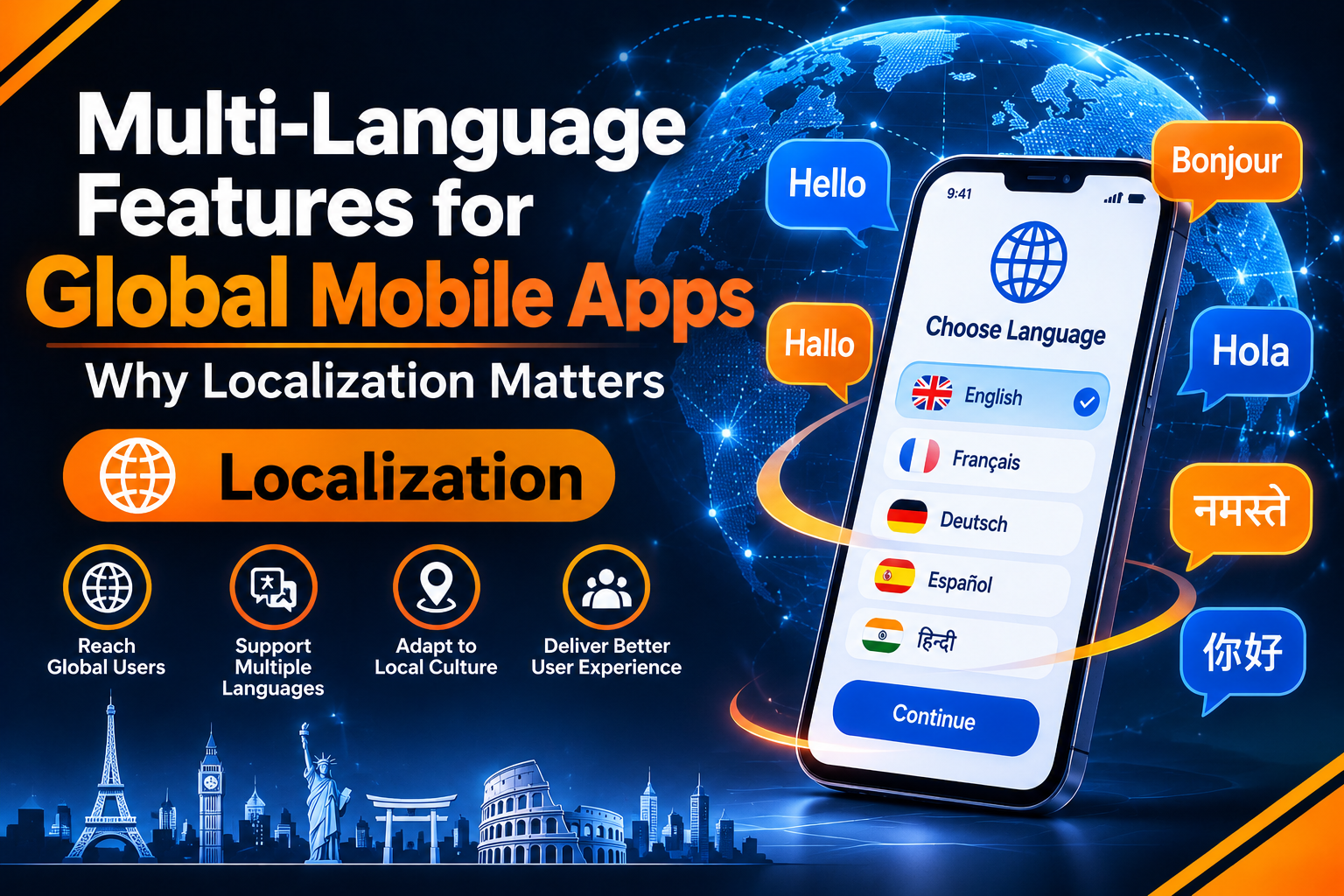
Multi-Language Features for Global Mobile Apps: Why Localization Matters
Introduction
Mobile applications have become an essential part of everyday life, connecting businesses with customers across different countries and regions. As businesses expand internationally, developing applications that support multiple languages has become increasingly important. Users prefer interacting with mobile applications in their native language because it makes navigation easier, improves understanding, and creates a more comfortable experience.
Multi-language features allow mobile applications to communicate with users from different linguistic backgrounds. However, successful global applications require more than simply translating text. They also need proper localization, cultural adaptation, regional formatting, and language-specific user interface adjustments.
With professional Mobile App Development, businesses can build applications that support diverse audiences and provide consistent digital experiences across international markets. Understanding localization strategies helps organizations create mobile applications that are accessible, user-friendly, and suitable for global expansion.
What Are Multi-Language Features in Mobile Applications?
Multi-language features allow users to access an application in their preferred language. These features enable mobile apps to display content, navigation elements, notifications, and other interface components in different languages.
For example, a global shopping application may support English, French, German, Spanish, and Hindi to serve customers across multiple regions.
Common multi-language features include:
Language selection during application setup.
Automatic language detection based on device settings.
Translated menus, buttons, and navigation elements.
Localized notifications and error messages.
Regional date, time, and currency formats.
Support for right-to-left languages.
Language-specific content and descriptions.
Businesses can explore professional mobile solutions at https://www.riotechsoftwares.com/mobile.php to understand how modern application development supports different user requirements.
What Is Localization in Mobile App Development?
Localization is the process of adapting a mobile application to meet the language, cultural, and regional requirements of a specific target audience.
While translation focuses mainly on converting text from one language to another, localization considers the complete user experience.
For example, an application targeting users in India may display prices in Indian Rupees, use regional date formats, and provide Hindi language support. The same application targeting users in Germany may require German translations, Euro currency formatting, and region-specific content.
Important localization elements include:
Language and content translation.
Currency and number formatting.
Regional date and time formats.
Why Multi-Language Features Matter for Global Mobile Apps
Supporting multiple languages provides several advantages for businesses planning to reach international audiences.
1. Expands Global Audience Reach
Language barriers can prevent potential users from understanding application features and services.
Multi-language support allows businesses to connect with users from different countries and linguistic backgrounds. It also creates opportunities to introduce products and services into new markets.
2. Improves User Experience
Users are more comfortable navigating applications when information is available in their preferred language.
Localized menus, instructions, and notifications make applications easier to understand and use. This can improve overall user satisfaction and accessibility.
3. Builds Customer Trust
Applications that communicate in a user's native language create a more familiar experience.
When users can understand product information, payment instructions, and support messages, they may feel more confident interacting with the application.
4. Increases User Engagement
Language accessibility encourages users to explore application features and interact with available services.
Localized notifications, relevant content, and regional communication can help businesses maintain stronger relationships with their audiences.
5. Supports International Business Growth
Businesses entering new markets need digital platforms that can accommodate different customer requirements.
Multi-language mobile applications make it easier to serve international customers, introduce region-specific features, and support business expansion.
Essential Multi-Language Features Every Global Mobile App Needs
Developers should consider several important features when building applications for international audiences.
1. Language Selection Options
Applications should provide a simple language selection option that allows users to choose their preferred language.
This option can be included during registration, onboarding, or within the application settings.
Users should also be able to change their language preferences whenever required without losing their existing application data.
2. Automatic Language Detection
Automatic language detection helps applications identify the preferred language configured on a user's device.
Based on these settings, the application can display the appropriate language automatically.
However, users should always have the option to select another language manually if their preferred language differs from their device settings.
3. Right-to-Left Language Support
Some languages, including Arabic and Hebrew, follow a right-to-left writing direction.
Applications targeting these audiences must support appropriate text alignment, navigation positioning, icons, and interface layouts.
Developers should test these layouts carefully to maintain a consistent user experience.
4. Localized Notifications and Messages
Push notifications, confirmation messages, error alerts, and system instructions should be available in the user's selected language.
Localized communication helps users understand important updates and interact with application features more effectively.
5. Regional Currency and Date Formatting
Global applications often serve users who follow different currency, date, time, and measurement conventions.
For example, an application may need to display prices in USD, EUR, INR, or GBP depending on the selected region.
Using appropriate regional formats improves clarity and prevents confusion during transactions and other application activities.
6. Language-Specific Content Management
Applications should support content management systems that allow businesses to maintain different language versions of their content.
This includes product descriptions, service information, FAQs, promotional messages, and help documentation.
A structured content management approach makes it easier to update translations and maintain consistency across multiple languages.
Best Practices for Implementing Localization in Mobile Apps
Successful localization requires proper planning throughout the mobile application development process.
Businesses and development teams should follow these practices:
Plan Localization Early: Consider language requirements during the initial application design and development stages instead of adding them later.
Use Unicode-Compatible Fonts: Ensure that the application supports different character sets, special symbols, and language-specific typography.
Avoid Hardcoded Text: Store application text in separate language resource files to make translation and updates easier.
Test Every Language Version: Check text alignment, button sizes, navigation, and content visibility across different languages.
Consider Cultural Differences: Adapt images, colours, symbols, and content according to the expectations of target audiences.
Maintain Translation Quality: Use professional translation and review processes to ensure that localized content is accurate and meaningful.
Optimize Application Performance: Manage language resources efficiently so that supporting multiple languages does not negatively affect application speed.
Common Challenges in Multi-Language Mobile App Development
Although multi-language support offers several benefits, developers may face challenges while implementing localization.
Translation Accuracy
Direct translations may not always communicate the intended meaning. Professional translation and contextual reviews help maintain content accuracy.
Interface Design Limitations
Some languages require more space than others. For example, translated text may be longer than the original English content, affecting buttons, menus, and screen layouts.
Cultural Differences
Images, symbols, colours, and communication styles may have different meanings across regions. Developers must consider cultural preferences when adapting application interfaces.
Testing Complexity
Supporting multiple languages increases testing requirements. Each language version must be checked for text visibility, navigation, functionality, and compatibility.
Continuous Content Updates
When application content changes, translated versions must also be updated. Without proper management, users may encounter outdated or inconsistent information.
Addressing these challenges through structured localization planning helps businesses maintain reliable and consistent mobile application experiences.
How Mobile App Development Supports Global Localization
Professional mobile app development plays an important role in creating applications that can support international users.
A well-planned development approach includes scalable architecture, flexible language resources, responsive interface design, and regional configuration options.
Development teams can also integrate localization frameworks, translation management systems, and automated testing processes to simplify multilingual application management.
Businesses looking to develop scalable and internationally accessible applications can explore https://www.riotechsoftwares.com/mobile.php for more information about mobile app development solutions.
Frequently Asked Questions (FAQs)
1. What is localization in mobile app development?
Localization is the process of adapting a mobile application to the language, cultural preferences, and regional requirements of a specific target market.
2. What is the difference between translation and localization?
Translation converts text from one language into another, while localization adapts the complete application experience, including language, currency, formatting, content, and cultural elements.
3. Why do global mobile applications need multi-language support?
Multi-language support helps businesses reach international audiences, improve user experience, increase accessibility, and communicate effectively with customers.
4. How can mobile applications detect a user's preferred language?
Applications can identify the language configured in the user's device settings and use it as the default language, while also providing manual language selection.
5. Does localization affect mobile application performance?
Localization does not necessarily reduce performance. With optimized language resources, efficient coding, and proper testing, applications can support multiple languages without significant performance issues.
Conclusion
Multi-language features and localization are essential for businesses planning to build mobile applications for global audiences. By supporting different languages, regional formats, cultural preferences, and accessible interface designs, organizations can create applications that provide better user experiences across international markets.
A well-planned localization strategy also helps businesses improve customer engagement, build trust, and expand into new regions. Combining these capabilities with professional mobile app development practices ensures that applications remain scalable, accessible, and adaptable to changing user requirements.
To develop user-friendly mobile applications that support global business needs, explore https://www.riotechsoftwares.com/mobile.php.
Visit Website: https://www.riotechsoftwares.com/mobile.php
Recent Posts

03 Nov 2026


31 Oct 2026
30 Oct 2026