Agentic AI in 2026: How AI Agents Are Transforming Enterprise Business Operations
Agentic AI in 2026: How AI Agents Are Transforming Enterprise Business Operations
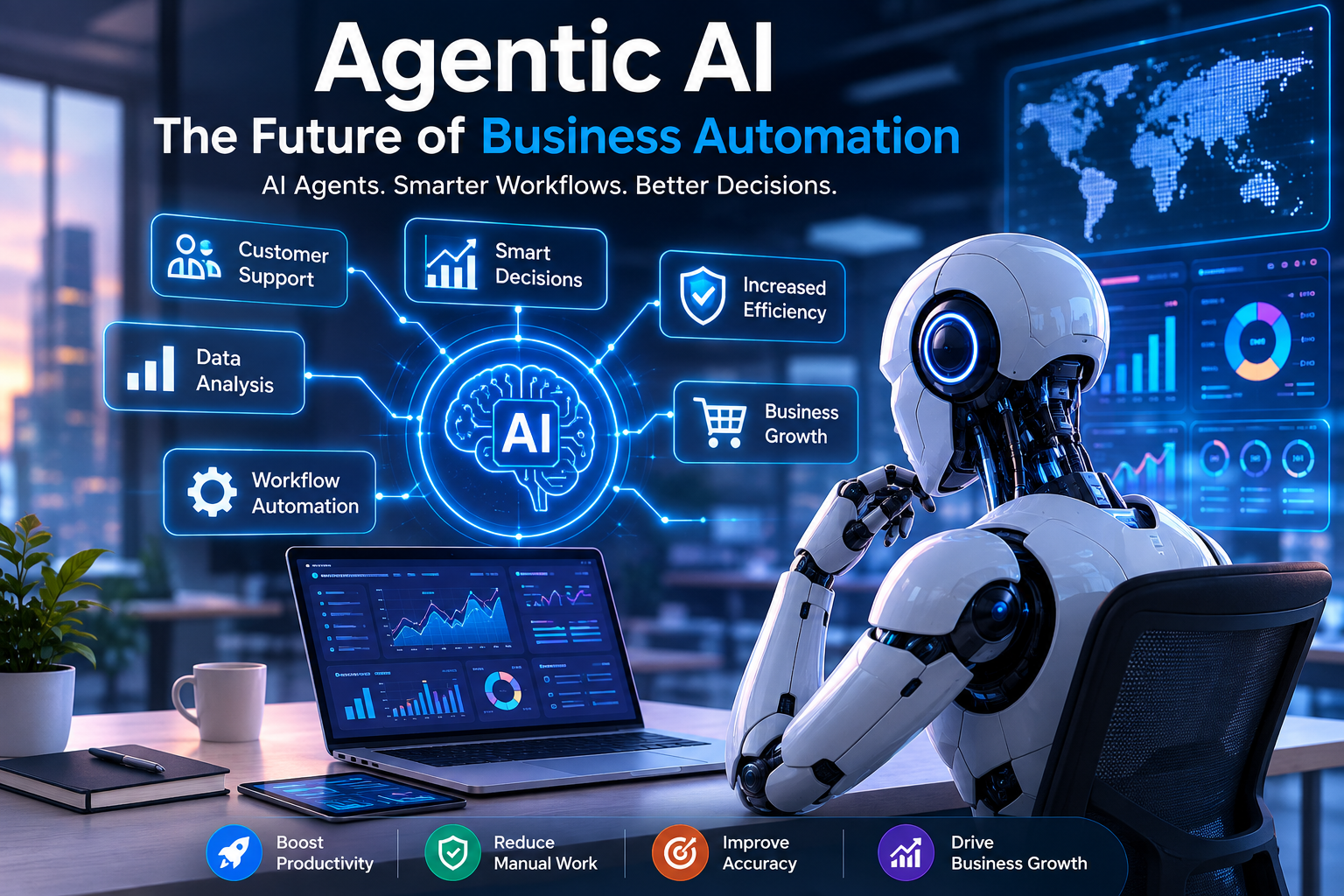
Artificial intelligence is moving beyond simple chatbots and content generation. In 2026, businesses are increasingly exploring agentic AI—AI systems capable of planning tasks, making decisions, using tools, and completing multi-step workflows with limited human intervention.
Gartner has identified multi-agent systems and other AI-driven technologies among the major strategic technology trends for 2026. The shift represents a move from AI that simply responds to users toward AI that can actively participate in business processes.
What Is Agentic AI?
Agentic AI refers to AI systems designed to pursue a defined objective by reasoning through tasks, selecting actions, interacting with software or data, and adapting based on results.
Traditional generative AI generally waits for a prompt and produces an answer. An AI agent can potentially take a broader workflow-oriented approach.
For example, instead of simply generating a sales report, an AI agent could:
- Collect sales data
- Analyze performance
- Identify unusual changes
- Prepare a summary
- Recommend follow-up actions
- Update connected business systems
This makes agentic AI particularly relevant for enterprise automation.
Why Agentic AI Matters for Businesses in 2026
1. Automation of Complex Workflows
Businesses often depend on repetitive workflows involving multiple systems and teams. AI agents can help automate portions of these processes and reduce manual intervention.
2. Faster Decision Support
AI agents can process large amounts of business information and provide recommendations faster than conventional manual analysis.
3. Improved Operational Efficiency
Automating repetitive activities can allow employees to focus more heavily on strategic, creative, and customer-facing responsibilities.
4. Intelligent Customer Service
AI agents can support customer-service workflows by understanding requests, retrieving relevant information, and assisting with resolution processes.
5. Connected Enterprise Systems
The real value of agentic AI increases when agents can securely interact with CRM, ERP, analytics, communication, and workflow platforms.
Agentic AI vs Traditional Automation
Traditional automation generally follows predefined rules.
Agentic AI can introduce greater flexibility by allowing systems to interpret objectives, determine intermediate steps, and adapt to changing conditions.
This does not mean businesses should remove human oversight. For sensitive processes, organizations still need permissions, monitoring, validation, and clear accountability.
Multi-Agent Systems: The Next Step
One emerging direction is the use of multi-agent systems, where multiple specialized AI agents collaborate on different parts of a larger workflow.
For example:
- One agent analyzes customer data
- Another prepares a sales forecast
- Another checks compliance requirements
- Another generates an executive summary
This architecture can make complex AI workflows more modular and scalable.
Challenges Businesses Must Consider
Agentic AI also introduces new risks and implementation challenges.
Organizations should consider:
- Data privacy
- Access permissions
- AI security
- Human oversight
- Accuracy and reliability
- Integration with existing software
- Cost management
- Auditability and governance
The objective should not simply be to deploy more AI. Businesses need to deploy AI that is secure, measurable, and aligned with business objectives.
How Businesses Can Prepare for Agentic AI
A practical starting point is to identify business processes where employees spend significant time on repetitive digital tasks.
- Organizations can then:
- Map the existing workflow.
- Identify suitable AI opportunities.
- Define security and access controls.
- Start with a controlled pilot.
- Measure business outcomes.
- Integrate successful workflows into broader operations.
The Future of AI-Powered Business Automation
Agentic AI is likely to become an important component of enterprise software as businesses look for more intelligent ways to automate workflows.
The key advantage will not simply be having an AI agent. It will be building an environment where AI, business data, software systems, security controls, and human expertise work together effectively.
FAQs
What is agentic AI?
Agentic AI is an approach to artificial intelligence in which AI systems can pursue objectives, plan tasks, use tools, and perform multi-step workflows with varying levels of autonomy.
Is agentic AI the same as generative AI?
No. Generative AI primarily creates content in response to prompts, while agentic AI is designed to take actions and manage workflows toward defined objectives.
How can businesses use AI agents?
Businesses can use AI agents for customer support, data analysis, workflow automation, sales operations, research, reporting, software development, and other digital processes.
Is agentic AI secure?
Security depends on implementation. Organizations should establish authentication, authorization, monitoring, data protection, human oversight, and governance before deploying autonomous AI workflows.
Conclusion
Agentic AI is changing the conversation around enterprise automation. Instead of using AI only as an assistant, businesses are beginning to explore AI systems that can actively coordinate tasks and workflows.
For organizations planning their next stage of digital transformation, the priority should be to identify practical use cases, establish strong governance, and build secure AI-ready infrastructure.
Riotech helps businesses explore modern technology solutions designed around automation, scalability, security, and digital transformation. Contact our team to discuss your technology requirements.