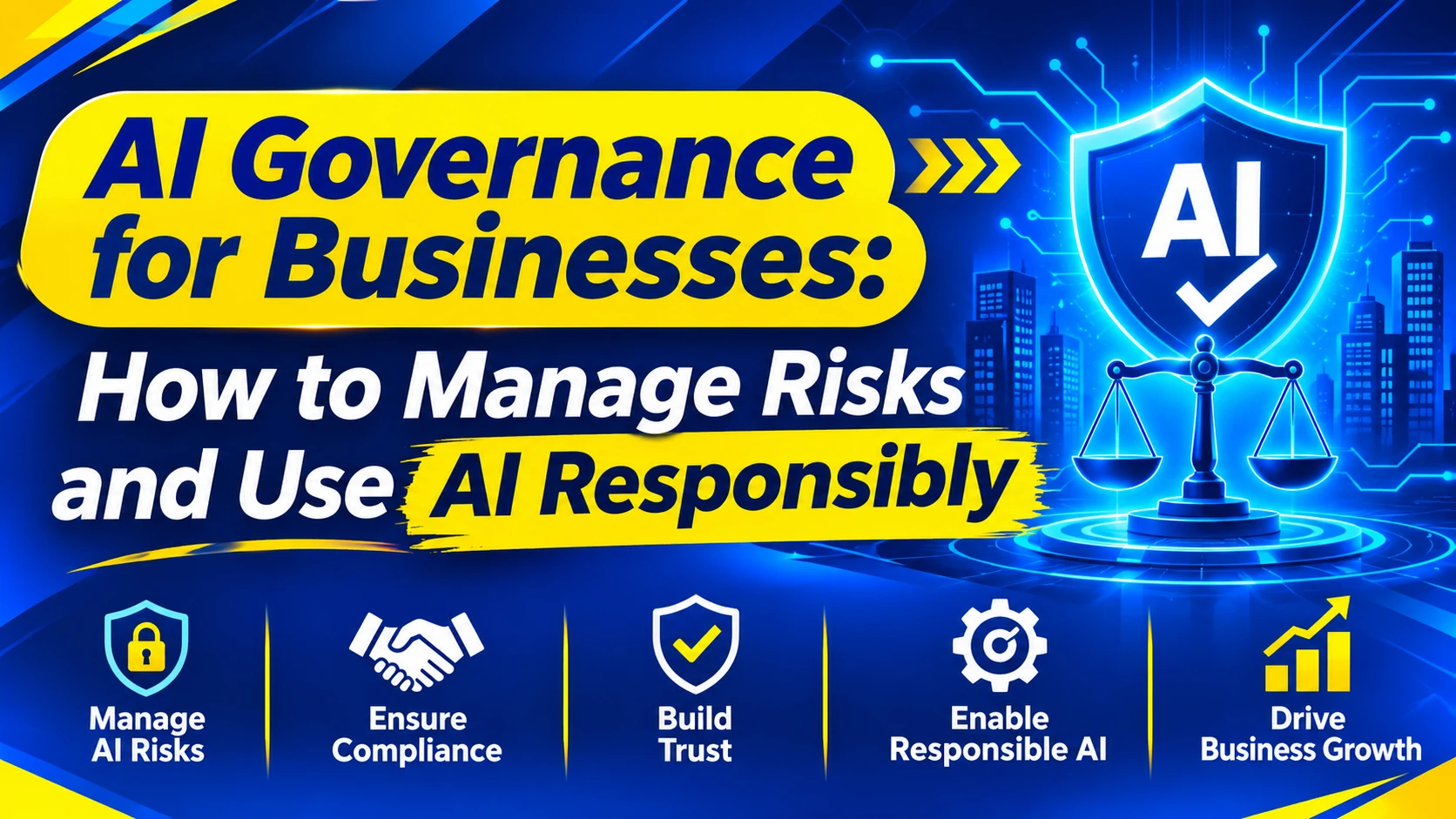
AI Governance for Businesses: How to Manage Risks and Use AI Responsibly
Introduction
Artificial intelligence (AI) is changing the way businesses work. Companies use AI to answer customer questions, study data, create content, and automate tasks.
AI can save time and improve work. But it can also create risks.
For example, an AI tool may share incorrect information. It may also produce unfair results or expose private data.
Businesses need clear rules to prevent these problems. These rules are part of AI governance.
AI governance helps companies use AI safely. It also makes sure that people remain responsible for important decisions.
In this article, we will explain what AI governance means, why it matters, and how businesses can put it into practice.
What Is AI Governance?
AI governance means setting rules for how a business uses artificial intelligence.
These rules guide how AI tools are selected, tested, used, and monitored.
They also explain who is responsible when an AI system makes a mistake.
For example, a company may use AI to review job applications. If the tool rejects suitable candidates unfairly, the company needs a way to find and fix the problem.
AI governance helps businesses manage such risks.
Its main goals are to:
- Keep business and customer data safe.
- Reduce errors and unfair results.
- Make AI decisions easier to review.
- Keep people involved in important decisions.
- Build trust among customers and employees.
In simple terms, AI governance helps businesses use AI with clear rules and proper control.
Businesses planning to introduce AI into their operations can also explore Riotech AI Solutions for AI automation, machine learning, chatbots, and data analytics.
Why Is AI Governance Important?
Businesses are using AI in more parts of their work. Without clear rules, mistakes can affect customers, employees, and company operations.
Here are five reasons why AI governance is important.
1. It Helps Reduce Risks
AI tools can give wrong answers or make poor recommendations.
For example, an AI tool may give a business incorrect sales predictions. If the company depends on those results, it may make poor decisions.
AI governance helps companies test their tools and find problems early.
2. It Protects Private Data
Many AI tools use business and customer information.
This may include names, email addresses, payment details, and company documents.
If employees share private information with an unapproved AI tool, that data may be exposed.
AI governance sets rules for using and protecting this information.
Businesses should also review their security practices. Riotech Cyber Security Services cover areas such as network protection, data security, and threat monitoring.
3. It Makes AI Use Clearer
Businesses should know when and how AI is being used.
Employees and customers should not be confused about decisions made with AI.
Clear information also helps people understand the limits of an AI tool.
4. It Helps Businesses Follow Rules
Some industries and countries have specific rules for data and AI use.
Businesses must understand which rules apply to their work.
AI governance helps them keep records, check risks, and follow relevant requirements.
5. It Builds Customer Trust
Customers want businesses to protect their information.
They also expect fair treatment and reliable services.
When a company uses AI carefully and explains its use, customers may feel more confident about its services.
Key Parts of an AI Governance Framework
An AI governance framework is a set of rules and processes for managing AI systems.
It helps a business control how AI tools are used.
Here are six important parts of this framework.
1. Clear AI Usage Rules
Every business should have clear rules for using AI tools.
These rules should explain:
- Which AI tools employees can use.
- What information they can share.
- Which tasks AI can perform.
- When a manager must approve an AI result.
- Who is responsible for each AI system.
For example, a company may allow employees to use AI for writing emails but not for sharing private customer records.
2. Data Protection
AI tools need data to work. Businesses must protect this data.
They should decide who can access it and how it can be used.
Useful steps include:
- Store business data securely.
- Give access only to approved employees.
- Avoid sharing private information with unapproved tools.
- Check data before using it.
- Remove data that is no longer needed, where appropriate.
- These steps help reduce data leaks and misuse.
Businesses that use cloud-based AI applications should also consider secure infrastructure, data backups, and access controls. Explore Riotech Cloud Solutions for cloud infrastructure, cloud security, and backup services.
3. Risk Checks
Before using an AI tool, businesses should check what could go wrong.
For example:
- Can the tool give incorrect answers?
- Can it expose private information?
- Can it produce unfair results?
- Can someone misuse it?
- Could an error harm customers or the business?
The answers help companies decide what safety checks are needed.
4. Human Review
AI should not control every important business decision.
People should review AI results when the decision could have a serious impact.
For example, AI may help a bank review loan applications. However, the bank should have suitable checks before making important decisions.
Human review helps businesses catch errors and take responsibility.
5. Regular Monitoring
An AI tool may work well at first but produce different results later.
This can happen when data, user needs, or business conditions change.
Businesses should regularly check:
- Are the results correct?
- Is the tool working as expected?
- Are there new security risks?
- Are users reporting problems?
- Does the tool still meet business needs?
Regular checks help companies find problems and fix them.
6. Records and Responsibility
Businesses should keep basic records of their AI systems.
These records can include:
- The name and purpose of each AI tool.
- The type of data it uses.
- The results of safety checks.
- Known risks and problems.
- The people responsible for the tool.
Good records help businesses understand what happened when an AI system makes a mistake.
Common AI Governance Challenges
Setting up AI governance can be difficult. Businesses may face several problems during the process.
1. Lack of Knowledge
Some employees do not know how AI tools work or what risks they create.
This can lead to unsafe use.
Solution: Train employees on approved AI tools, data safety, and company rules.
2. Fast Changes in AI Technology
New AI tools and features appear regularly.
A rule that works today may not cover a new tool tomorrow.
Solution: Review AI policies often and update them when needed.
3. Data Safety Problems
Employees may share company or customer information with AI tools without checking the risks.
Solution: Create clear data-sharing rules and use approved tools for business work.
4. Finding Hidden Errors
Some AI errors are not easy to find during early testing.
A tool may give good results in one situation but fail in another.
Solution: Test AI tools with different examples and check their results after launch.
5. Cost of Implementation
Businesses may need new tools, staff training, and expert support.
This can increase costs, especially for small companies.
Solution: Start with the AI tools that have the biggest impact. Add more checks as the business grows.
How to Implement AI Governance in a Business
Businesses do not need to change everything at once. They can follow these seven steps.
Step 1: List the AI Tools You Use
First, find out which AI tools are being used in the company.
Ask:
- Which teams use AI?
- What tasks do they perform?
- What data do the tools access?
- Who manages these tools?
This gives the business a clear picture of its AI use.
Step 2: Check the Risks
Review each tool and identify possible problems.
Pay special attention to tools that use private data or help make important decisions.
Decide which tools need stronger checks.
Step 3: Create Simple Rules
Write clear rules for employees.
Explain which tools are approved and what information they can share.
Also, explain when a person must review AI-generated results.
Step 4: Test Before Use
Do not start using an AI tool without checking how it works.
Test its answers, accuracy, and safety.
Check whether it can produce unfair or misleading results.
Step 5: Keep Checking Performance
Review AI tools after they are launched.
Look for errors, security issues, and user complaints.
Fix problems as soon as possible.
Step 6: Train Your Team
Employees should know how to use AI safely.
Training should cover:
- Safe use of AI tools.
- Protection of private data.
- Checking AI-generated answers.
- Company AI policies.
- Reporting problems.
Step 7: Update Your Rules
AI technology and business needs change over time.
Review your policies regularly. Update them when you introduce new tools or find new risks.
Businesses that need help planning their technology systems can explore Riotech IT Consulting Services. These services include IT strategy planning, technology consulting, and business automation.
Examples of AI Governance in Different Industries
AI governance is useful in many industries. Here are four simple examples.
1. Banking
Banks use AI to find unusual transactions and study loan applications.
AI governance helps banks protect customer data and check automated results.
It also helps them review important decisions and reduce unfair treatment.
2. Healthcare
Hospitals and healthcare companies use AI to study medical images and support medical research.
They must protect patient information and check AI results carefully.
Doctors and other qualified professionals should remain involved in important medical decisions.
3. Retail and Online Shopping
Online stores use AI to suggest products and understand customer needs.
These tools may use customer activity and purchase history.
AI governance helps stores protect customer data and check whether product suggestions are suitable.
4. Human Resources
Companies may use AI to sort job applications and support hiring teams.
However, AI tools can produce unfair results.
HR teams should check how these tools work and review important hiring decisions.
Best Practices for Responsible AI Use
Businesses can follow these simple practices to manage AI safely.
- Set clear goals: Know why you need an AI tool.
- Use reliable data: Check the quality of data before using it.
- Protect private information: Do not share sensitive data with unapproved tools.
- Test AI tools: Check results before using them in daily work.
- Keep people involved: Review important AI decisions.
- Monitor results: Check for errors and changes in performance.
- Train employees: Teach teams how to use AI safely.
- Keep records: Document important decisions and system changes.
- Review policies: Update rules when business needs or technology changes.
These practices help businesses build safer AI systems.
AI Governance vs. AI Compliance
AI governance and AI compliance are related, but they do not mean the same thing.
AI governance covers the rules and processes a business uses to manage AI.
AI compliance means following the laws and requirements that apply to its AI activities.
For example, a business may create rules for employee use of AI. This is part of AI governance.
The same business may also need to follow data protection laws. This is part of compliance.
Both are important for responsible AI use.
Important AI Governance Frameworks and Standards
Businesses can use established frameworks and standards to guide their AI policies.
Three important references are explained below.
1. NIST AI Risk Management Framework
The National Institute of Standards and Technology (NIST) created the AI Risk Management Framework, also called the NIST AI RMF.
It helps organizations understand and manage AI risks.
The framework has four main functions:
- Govern: Set rules, roles, and responsibilities.
- Map: Understand the AI system and its risks.
- Measure: Check and assess those risks.
- Manage: Decide how to reduce or handle the risks.
Businesses can use this framework to build a clear AI risk management process.
Official resource: NIST AI Risk Management Framework
2. ISO/IEC 42001
ISO/IEC 42001 is an international standard for AI management systems.
It helps organizations set up and improve processes for managing AI.
Businesses can use it to create clear responsibilities and manage AI-related risks.
Official resource: ISO/IEC 42001 – Artificial Intelligence Management Systems
3. European Union AI Act
The European Union AI Act sets rules for AI systems in the EU.
It uses a risk-based approach. This means different AI systems may have different requirements based on their level of risk.
Businesses that develop, provide, or use AI in relevant EU markets should check which requirements apply to them.
Official resource: European Commission – Regulatory Framework on Artificial Intelligence
These frameworks and standards can guide businesses. However, each company should choose an approach that fits its AI tools, industry, and legal needs.
The Future of AI Governance
AI is becoming a common part of business operations.
Companies are using AI chatbots, content tools, AI agents, and automated systems.
As more businesses adopt AI, the need for clear rules will also grow.
In the coming years, businesses will need to focus more on:
Protecting customer and company data.
Checking AI-generated information.
Reducing unfair AI decisions.
Keeping people involved in important decisions.
Finding security problems early.
Updating AI policies as technology changes.
Companies that manage these areas well can use AI with greater confidence.
Frequently Asked Questions About AI Governance
1. What is AI governance in simple words?
AI governance means setting rules for how a business uses artificial intelligence. It helps protect data, reduce risks, and make sure people remain responsible for important decisions.
2. Why do businesses need AI governance?
Businesses need AI governance to use AI safely. It helps prevent data leaks, reduce errors, manage risks, and build customer trust.
3. Do small businesses need AI governance?
Yes. Small businesses also use AI for writing, marketing, customer support, and daily tasks. Simple rules can help them protect their data and use AI safely.
4. Who manages AI governance in a company?
AI governance is a shared responsibility. Business leaders, IT teams, security staff, legal teams, and employees may all have a role.
5. What are the main risks of AI?
Common risks include incorrect answers, data leaks, unfair results, security problems, and misuse of information.
6. Is AI governance the same as AI ethics?
No. AI ethics focuses on values such as fairness and transparency. AI governance turns these values into company rules and daily processes.
7. Which AI governance framework should businesses use?
Businesses can start by studying the NIST AI Risk Management Framework. They can also review ISO/IEC 42001 to understand AI management systems.
8. Does AI governance stop businesses from using AI?
No. AI governance does not stop AI adoption. It helps businesses use AI with proper checks and clear responsibilities.
Conclusion
AI can help businesses save time, improve services, and automate daily work. But it also brings risks that companies must manage.
AI governance gives businesses a clear way to manage these risks.
Companies can start by setting simple rules, protecting data, testing AI tools, and training employees.
They should also monitor AI systems and review their policies regularly.
As AI becomes more common, responsible AI use will be important for business growth.
AI success is not only about using new technology. It is also about using it safely and responsibly.
Need Help with AI Solutions and Business Technology?
Adopting AI requires the right technology, proper security, and a clear implementation plan.
Riotech provides technology services that help businesses explore AI, improve digital security, and build modern business systems.
Whether you want to automate business tasks, develop an AI chatbot, improve data security, or plan your technology infrastructure, the right technical support can help you move forward.
Explore our services:
- AI Solutions: AI automation, machine learning, chatbots, and data analytics.
- Cyber Security: Network protection, data security, and threat monitoring.
- IT Consulting: IT strategy, technology consulting, and business automation.
- Cloud Solutions: Cloud infrastructure, cloud security, backup, and recovery.
Ready to explore the right technology for your business?
Contact Riotech to discuss your business requirements and explore suitable technology solutions.
References
- NIST - AI Risk Management Framework
- ISO - ISO/IEC 42001: Artificial Intelligence Management Systems
- European Commission - Regulatory Framework on Artificial Intelligence