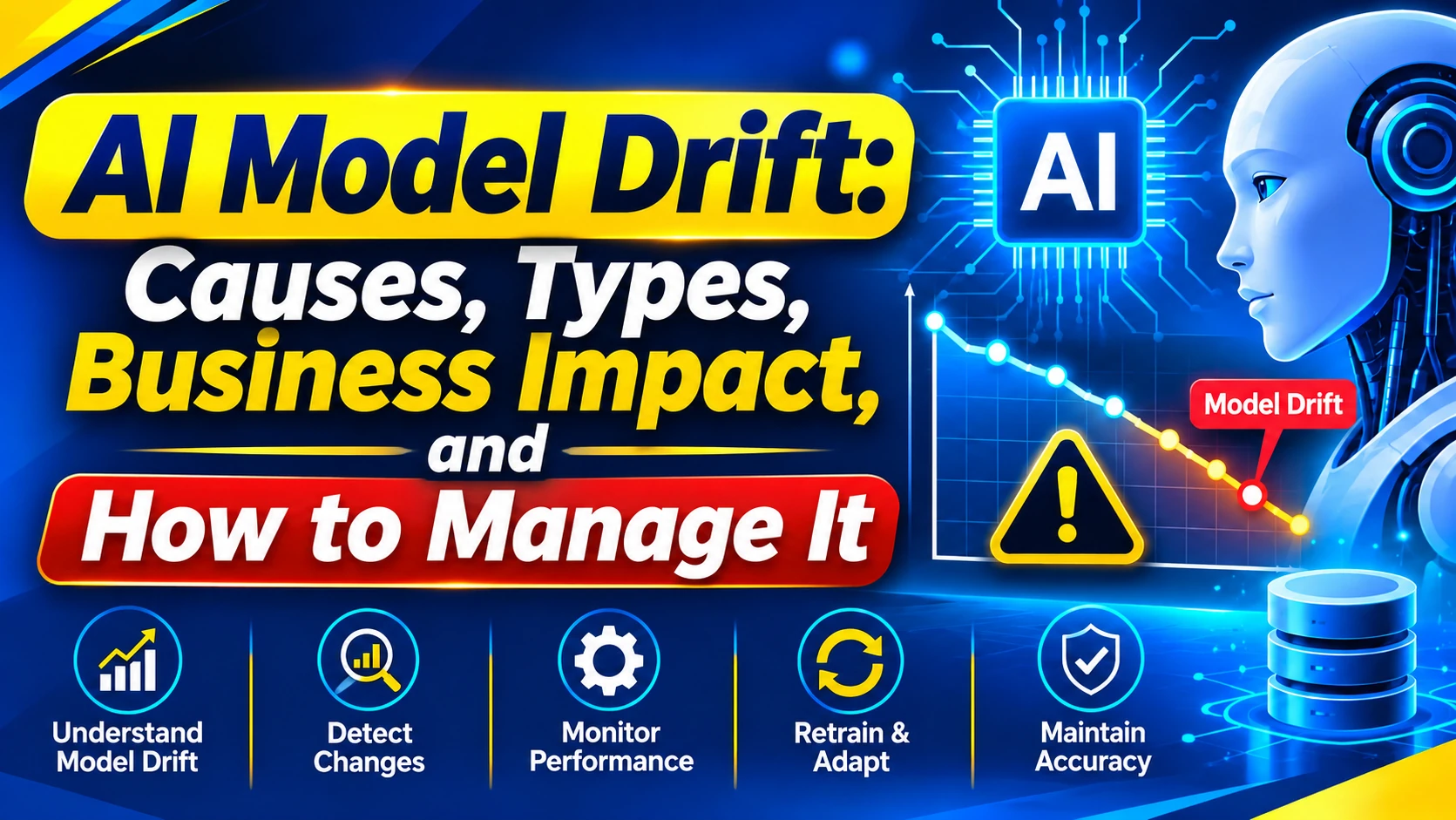
AI Model Drift: Causes, Types, Business Impact, and How to Manage It
Introduction
AI Model Drift is a change in the data patterns or relationships that a machine learning model uses to make predictions. When real-world conditions change, an AI model may become less accurate or produce less useful results. This can affect business decisions, customer experiences, and daily operations.
Artificial Intelligence (AI) helps businesses automate tasks, study data, and make better decisions. Many companies use machine learning models for recommendations, fraud detection, sales forecasting, and customer analysis.
However, these models do not always perform well forever.
Customer interests change. Market conditions shift. New types of data become available. As a result, the patterns learned by an AI model may no longer match real-world conditions.
This problem is known as AI Model Drift.
For example, an online shopping website may recommend products based on previous customer purchases. If customer interests change, those recommendations may become less useful.
Regular model monitoring helps businesses identify these changes and take action when needed.
This guide explains what AI Model Drift is, why it happens, its main types, and how businesses can manage it.
What Is AI Model Drift?
AI Model Drift occurs when changes in real-world data or patterns affect the way a machine learning model makes predictions.
A machine learning model learns from historical data during training. After deployment, it uses what it has learned to process new data.
But real-world data keeps changing.
For example, a shopping platform may train a recommendation model using customers' previous purchases. Over time, customers may develop new interests or buying habits.
The model may continue recommending products based on old patterns. These recommendations may no longer match customer needs.
This is an example of AI Model Drift.
Drift does not always mean that a model has failed. It means that something may have changed and needs to be checked.
Businesses should compare new data and model results with earlier performance. This helps them understand whether the change is harmless or requires action.
Why Does AI Model Drift Occur?
AI Model Drift usually happens because real-world conditions change after a model is deployed.
Here are five common reasons.
1. Changes in Customer Behavior
Customer preferences do not remain the same.
People may change what they buy, which services they use, or how they interact with a website.
For example, an online store may notice that customers are buying more mobile accessories than before. A recommendation model trained on older shopping habits may not recognize this change quickly.
As a result, it may suggest products that customers are no longer interested in.
2. Changes in Market Conditions
Markets change due to competition, prices, economic conditions, and new trends.
These changes can affect the data used by machine learning models.
For example, a sales forecasting model may be trained using data from a period of stable prices. If prices suddenly increase, its earlier predictions may become less reliable.
The model may need updated data to reflect the new market conditions.
3. Outdated Training Data
Machine learning models depend on useful and relevant training data.
If the training data becomes outdated, it may no longer represent current customer behavior or business conditions.
For example, a customer segmentation model trained several years ago may not accurately describe today's customers.
Businesses should review their training data regularly. This helps them identify information that may no longer be useful.
4. Changes in Data Sources
AI models receive data from databases, websites, applications, APIs, and other systems.
Sometimes, these systems are updated.
An update may change the way data is collected, stored, or shared.
For example, a website update may change how customer activity is recorded. If the model still expects the old data format, it may process the information incorrectly.
This can affect model predictions.
5. Seasonal and Unexpected Events
Some changes happen only during specific periods. Others occur without much warning.
Examples include:
- Holiday shopping seasons.
- Changes in customer demand.
- New government regulations.
- Sudden market disruptions.
- Major industry developments.
For example, an inventory forecasting model may predict normal demand during most months. During a holiday sale, customer demand may increase sharply.
The model must be monitored to check whether its predictions still match actual demand.
Types of AI Model Drift
There are three commonly monitored types of AI Model Drift:
Data Drift
Concept Drift
Prediction Drift
Each type describes a different kind of change.
1. Data Drift
Data Drift occurs when the statistical distribution of incoming data changes compared with the data used during model training.
In simple terms, the new information entering a model starts looking different from the information it learned from.
For example, a website may initially have more desktop users than mobile users. Over time, mobile users may become the larger group.
The data entering a customer analytics model has now changed.
This is an example of Data Drift.
Businesses can detect Data Drift by comparing new production data with an earlier reference dataset.
However, a change in data does not always mean that model accuracy has decreased.
2. Concept Drift
Concept Drift occurs when the relationship between input data and the actual outcome changes over time.
In simple words, the patterns that once helped a model make correct predictions may no longer work.
For example, a fraud detection model may learn to identify suspicious transactions using older fraud patterns.
Over time, fraud methods may change. Criminals may start using different techniques.
The model may then struggle to identify new types of suspicious activity.
This is an example of Concept Drift.
It can be difficult to detect because the incoming data may look normal. The relationship between the data and the actual outcome has changed.
3. Prediction Drift
Prediction Drift occurs when the distribution of a model's predicted results changes over time.
For example, a fraud detection model may start flagging more transactions as suspicious than it did in previous months.
This change may happen because customer activity has changed, new transaction patterns have appeared, or the model itself has been updated.
Prediction Drift is a signal that needs investigation. It does not automatically mean that the model is producing incorrect results.
Businesses should compare predictions with actual outcomes whenever reliable results are available.
Data Drift vs. Concept Drift vs. Prediction Drift
These three types of drift describe different changes in a machine learning system.
| Comparison | Data Drift | Concept Drift | Prediction Drift |
|---|---|---|---|
| What changes? | Input data | Relationship between inputs and outcomes | Model predictions |
| Main focus | Incoming information | Underlying patterns | Predicted results |
| Example | More mobile users than desktop users | New fraud patterns | More transactions flagged as suspicious |
| How to monitor? | Compare data distributions | Check actual outcomes | Compare prediction distributions |
More than one type of drift can occur at the same time.
That is why businesses should monitor data, predictions, and actual model performance together.
How Does AI Model Drift Affect Businesses?
AI Model Drift can affect more than the technical performance of a machine learning model.
It can also create problems for business operations and customers.
1. Poor Business Decisions
Businesses use AI predictions to plan sales, manage stock, and assess risks.
If predictions become unreliable, managers may make decisions using outdated information.
For example, an inventory system may recommend ordering too many or too few products. This can affect stock availability and purchasing costs.
2. Reduced Customer Experience
Many websites use AI to recommend products and services.
These recommendations depend on customer data and changing interests.
If a model does not adapt to new preferences, customers may receive irrelevant suggestions.
This can reduce customer satisfaction and engagement.
3. Financial Losses
Incorrect predictions can lead to financial problems.
For example, an outdated fraud detection model may fail to identify new suspicious transactions.
A sales forecasting model may also predict the wrong demand. This can lead to poor purchasing and inventory decisions.
4. Operational Problems
AI systems often help employees complete tasks faster.
But when a model produces unreliable results, employees may need to check more outputs manually.
This increases workload and reduces the benefits of automation.
5. Loss of Customer Trust
Customers expect digital services to provide useful and reliable results.
Repeatedly receiving incorrect recommendations or decisions can reduce their trust.
Businesses should therefore treat AI Model Monitoring as an ongoing responsibility.
7 Effective Ways to Manage AI Model Drift
Businesses can manage AI Model Drift through regular monitoring, data checks, and controlled model updates.
The following seven practices can help.
1. Monitor Model Performance Regularly
Businesses should check how well their models perform after deployment.
The right evaluation metrics depend on the purpose of the model.
Common metrics include:
- Accuracy: Shows how many predictions are correct.
- Precision: Shows how many positive predictions are actually correct.
- Recall: Shows how many actual positive cases the model identifies.
- F1-score: Combines precision and recall into one score.
- Mean Absolute Error (MAE): Measures the average size of prediction errors.
- Root Mean Squared Error (RMSE): Measures prediction errors and gives more weight to larger errors.
For example, a fraud detection model needs to identify suspicious transactions while avoiding too many false alarms.
Precision and recall can help measure how well it performs.
Businesses should select metrics that match their business goals.
2. Check Changes in Incoming Data
New data should be checked regularly.
Businesses can compare production data with the data used during model training.
This can help identify:
- Changes in data values.
- Missing information.
- Incorrect data formats.
- Unusual numerical values.
- Changes in customer categories.
- Unexpected data collection patterns.
- Some statistical methods can help measure these changes.
Examples include:
- Population Stability Index (PSI).
- Kolmogorov-Smirnov test.
- Jensen-Shannon divergence.
Each method has a different purpose. The right choice depends on the type of data and the monitoring requirement.
3. Set Automated Alerts
Automated alerts help teams identify possible problems early.
Businesses can set alerts when model performance or data changes beyond an acceptable limit.
For example, a fraud detection system may send an alert if its precision falls below a defined level.
Alerts can also be used to identify:
- Sudden changes in input data.
- Unusual prediction patterns.
- Missing or incorrect data.
- Changes in model performance.
- Teams should review these alerts before making changes to the model.
4. Retrain Models With Updated Data
Retraining means updating a machine learning model using new training data.
It can help a model learn from recent customer behavior and changing business conditions.
For example, an online shopping platform may update its recommendation model using recent customer interactions.
However, retraining should not happen automatically whenever drift is detected.
Before retraining, businesses should:
- Find the reason for the change.
- Check the quality of new data.
- Select relevant training data.
- Train the updated model.
- Test its performance.
- Compare it with the existing model.
The updated model should be deployed only after proper evaluation.
5. Maintain Model Versions
Model versioning means keeping records of different versions of a machine learning model.
It helps teams understand what changed and when.
A version record may include:
- Model configuration.
- Training data details.
- Evaluation results.
- Deployment date.
- Changes made to the model.
- Versioning makes it easier to compare models and investigate problems.
- It also helps teams return to an earlier version if a new model performs poorly.
6. Use AI Model Monitoring Tools
Monitoring tools help businesses track changes in data and model performance.
Some commonly used platforms include:
Google Cloud Vertex AI Model Monitoring: Helps monitor production model inputs and identify changes in feature distributions.
Microsoft Azure Machine Learning: Provides model monitoring capabilities for checking data quality, drift, and model performance.
Evidently AI: Offers tools for checking data quality, detecting drift, and evaluating machine learning models.
WhyLabs: Provides observability tools for monitoring data and machine learning applications.
These tools can reduce manual work.
However, the right platform depends on the company's infrastructure, technical needs, and budget.
7. Conduct Regular Model Audits
A model audit is a review of a deployed AI system.
It helps businesses check whether the model is still working as expected.
A regular audit may include:
- Checking model performance.
- Reviewing training and production data.
- Finding possible errors.
- Checking results across relevant user groups.
- Reviewing model documentation.
- Examining security and operational risks.
Audits are especially important when AI systems support financial, healthcare, or other high-impact decisions.
AI Model Drift vs. Model Decay: What Is the Difference?
AI Model Drift and model decay are related, but they do not mean the same thing.
Model Drift describes changes in data or patterns. Model Decay describes a decline in the model's predictive performance.
| Aspect | AI Model Drift | Model Decay |
|---|---|---|
| Meaning | Changes in data patterns or relationships | Decline in prediction performance |
| Main focus | Changes in the environment | Model effectiveness |
| Possible causes | Data Drift and Concept Drift | Drift, outdated data, or other issues |
| How to detect? | Monitor data and patterns | Evaluate actual performance |
| Possible action | Investigate the change | Improve, retrain, or replace the model |
For example, a website may start receiving more mobile visitors than desktop visitors.
This change may indicate Data Drift.
However, if the model continues making accurate predictions, its performance may not have declined.
On the other hand, if changing customer behavior causes more prediction errors, the model may also experience performance decay.
This is why businesses should investigate drift before deciding to retrain or replace a model.
How to Build a Reliable AI Model Monitoring Strategy
A good monitoring strategy helps businesses detect changes and respond in a planned way.
Here are six practical steps.
Step 1: Record Initial Model Performance
Before deployment, record the model's performance.
Choose suitable metrics and define acceptable performance levels.
These records will act as a baseline for future comparisons.
Step 2: Monitor Production Data
Check the data entering the model after deployment.
Compare it with an appropriate reference dataset.
Look for unusual changes, missing values, and data quality problems.
Step 3: Check Model Predictions
Monitor the predictions generated by the model.
When actual outcomes become available, compare them with the predictions.
This helps determine whether the model is still making useful predictions.
Step 4: Investigate the Changes
If monitoring identifies a problem, find its possible cause.
It may be due to seasonal demand, changing customer behavior, a data pipeline update, or a change in the relationship between inputs and outcomes.
Step 5: Test Model Updates
If an update is required, test the new model before deployment.
Compare its results with the existing model.
Use suitable validation data to check whether the update improves performance.
Step 6: Keep Clear Records
Record monitoring results, detected problems, and model updates.
Also, define who is responsible for reviewing alerts and approving changes.
Clear records make future maintenance easier.
The Role of MLOps in Managing AI Model Drift
MLOps stands for Machine Learning Operations.
It combines machine learning development with software engineering and operational practices.
MLOps helps teams manage a model throughout its lifecycle. This includes development, testing, deployment, monitoring, and maintenance.
It supports AI Model Drift management in several ways.
Data Quality Checks: Help identify missing values, incorrect formats, and unexpected changes in incoming data.
Model Monitoring: Helps teams track model performance and changes in predictions.
Model Versioning: Keeps records of model versions and their training data.
Automated Testing: Helps test updated models before production deployment.
Retraining Workflows: Supports planned model updates when new data is available.
Monitoring Reports: Help teams review model behavior and investigate possible problems.
MLOps cannot prevent every type of drift. However, it gives teams a structured way to detect changes and manage model updates.
Industry Guidance and Technical References for AI Model Monitoring
Several organizations and technology providers publish guidance on AI risk management and model monitoring.
These resources can help businesses and technical teams understand monitoring practices.
1. NIST AI Risk Management Framework
The National Institute of Standards and Technology (NIST) provides an AI Risk Management Framework.
It helps organizations identify, assess, and manage risks related to AI systems.
Its Measure function covers the evaluation and monitoring of AI system performance and behavior.
Reference: NIST AI Risk Management Framework - Measure
2. Google Cloud Model Monitoring
Google Cloud provides documentation on monitoring machine learning models in production.
It explains how teams can monitor input features and identify changes in data distributions.
Reference: Google Cloud Model Monitoring
3. Microsoft Azure Machine Learning Monitoring
Microsoft provides guidance on monitoring deployed machine learning models.
Its documentation covers data quality, data drift, and model monitoring.
Reference: Microsoft Azure Machine Learning Model Monitoring
4. Evidently AI Documentation
Evidently AI provides tools and documentation for evaluating machine learning systems.
Its resources cover data quality, data drift, and model evaluation.
Reference: Evidently AI Documentation
Editorial Note: These resources cover different machine learning environments. Monitoring methods and implementation requirements may vary depending on the model, application, infrastructure, and business goals.
Conclusion
AI Model Drift can affect any business that uses machine learning models.
Customer behavior, market conditions, and data patterns can change over time. These changes may affect how well a model performs after deployment.
Businesses can manage AI Model Drift through regular monitoring, data quality checks, performance evaluation, and controlled model updates.
MLOps also helps teams manage models throughout their lifecycle.
The key is to monitor models after deployment, investigate meaningful changes, and update them only when needed.
Reliable AI performance does not end with model deployment. It requires regular monitoring, testing, and improvement.
Build Smarter AI Solutions With Riotech
Businesses need technology solutions that match their goals and operational requirements.
Riotech offers technology services related to AI automation, machine learning, AI chatbots, data analytics, and custom software solutions.
These technologies can help businesses explore automation, improve customer interactions, and make better use of their data.
If you are planning an AI-powered application or exploring machine learning for your business, the right development approach can help you move forward.
Explore Riotech Services:
AI Solutions and Machine Learning
Looking to bring AI into your business? Contact Riotech to discuss your project requirements and explore suitable technology solutions.
Frequently Asked Questions (FAQs)
1. What is AI Model Drift?
AI Model Drift occurs when changes in real-world data or patterns affect the predictions made by a machine learning model. It can reduce the model's usefulness over time.
2. What are the main types of AI Model Drift?
The three commonly monitored types are Data Drift, Concept Drift, and Prediction Drift. They describe changes in input data, relationships between inputs and outcomes, and predicted results.
3. What causes AI Model Drift?
Common causes include changing customer behavior, market conditions, outdated training data, seasonal demand, and changes in data collection systems.
4. How can businesses detect AI Model Drift?
Businesses can compare production data with reference data, monitor prediction patterns, evaluate model performance, and use automated monitoring tools.
5. Does AI Model Drift always reduce model accuracy?
No. A change in data or predictions does not always mean that accuracy has declined. Businesses should compare predictions with actual outcomes before deciding what action is needed.
6. What is the difference between Data Drift and Concept Drift?
Data Drift occurs when the distribution of input data changes. Concept Drift occurs when the relationship between input data and the actual outcome changes.
7. How often should AI models be retrained?
There is no fixed retraining schedule for every model. It depends on the application, data changes, business needs, and model performance.
Some models may need frequent updates. Others may remain useful for longer periods.
8. What is the role of MLOps in AI Model Drift management?
MLOps helps teams monitor models, manage versions, test updates, evaluate performance, and support controlled retraining.
9. Can AI Model Drift be prevented completely?
No. Real-world data and business conditions continue to change. However, regular monitoring and timely maintenance can help reduce its impact.
10. Which tools are used to monitor AI Model Drift?
Common tools include Google Cloud Vertex AI Model Monitoring, Microsoft Azure Machine Learning, Evidently AI, and WhyLabs. The best option depends on the organization's technical requirements and infrastructure.