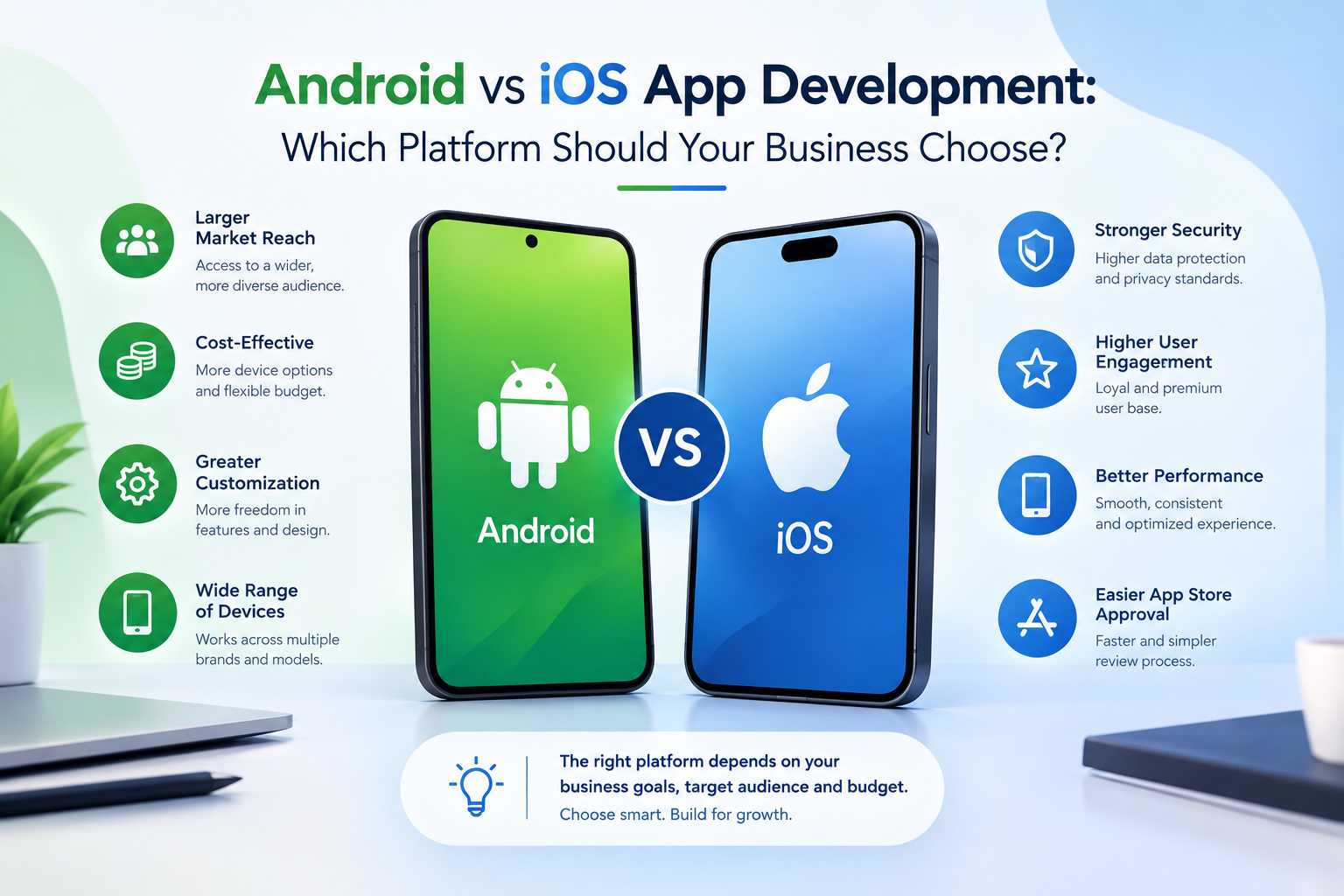
Android vs iOS App Development: Which Platform Should Your Business Choose?
Android vs iOS App Development: Which Platform Should Your Business Choose?
Mobile applications have become an important part of how businesses connect with customers, deliver services, process transactions, and build long-term digital relationships. However, before developing an application, businesses often face an important question: Should they build for Android, iOS, or both?
Android and iOS offer different development environments, device ecosystems, distribution models, and user experiences. The right choice depends less on which platform is universally better and more on your target audience, business objectives, budget, required features, and long-term growth strategy.
For businesses planning a new application, understanding these differences can help create a more practical and scalable mobile strategy.
Android vs iOS App Development: Understanding the Difference
Android and iOS are the two major mobile application ecosystems. Android development commonly uses Kotlin and Java, while iOS development primarily uses Swift and Apple's development tools. Android also supports a much wider range of devices and manufacturers, whereas Apple's ecosystem provides a more controlled hardware and software environment.
This difference affects several aspects of development, including testing, UI design, performance optimization, maintenance, and application deployment.
Android App Development
Android provides businesses with access to a broad range of smartphones, tablets, and other connected devices. Its open ecosystem allows applications to reach users across different manufacturers, device categories, and price segments.
Key Benefits of Android Development
1. Broad Device Reach
Android applications can reach users across a wide variety of devices and markets. This can be particularly useful for businesses targeting diverse customer groups.
2. Flexible Distribution
Android provides multiple distribution possibilities in addition to Google Play, depending on the application and business requirements.
3. Wider Device Variety
Businesses can develop applications for different screen sizes, hardware configurations, and device categories.
Android Development Considerations
The diversity of Android devices also creates additional testing requirements. Developers may need to consider different screen resolutions, hardware capabilities, operating-system versions, manufacturer customizations, and performance conditions.
For this reason, a professional Android development strategy should include compatibility testing and performance optimization across the relevant device range.
iOS App Development
iOS provides a more controlled ecosystem because Apple manages both the operating system and its hardware environment. This can make device compatibility and testing more predictable compared with a highly fragmented device ecosystem.
Key Benefits of iOS Development
1. Consistent User Experience
The relatively controlled Apple ecosystem allows developers to design and test applications across a more standardized range of devices.
2. Strong Ecosystem Integration
iOS applications can be designed to work within Apple's broader ecosystem, including iPhone and iPad, with additional opportunities across Apple platforms where relevant.
3. Modern Development Tools
Swift and Apple's development environment provide businesses with a dedicated technology stack for building native iOS applications.
iOS Development Considerations
iOS development requires businesses to consider Apple's development environment, platform guidelines, App Store requirements, and device ecosystem. These factors should be included in the project planning process from the beginning.
Android vs iOS: Key Business Comparison
| Factor | Android | iOS |
|---|---|---|
| Device ecosystem | Broad range of manufacturers and devices | More controlled Apple ecosystem |
| Primary development languages | Kotlin, Java | Swift |
| Testing | Requires consideration of many device configurations | Generally more standardized |
| Distribution | Google Play and other supported options | Primarily App Store |
| Hardware diversity | High | More limited |
| Customization opportunities | Broad | More controlled |
| Best approach | Depends on target audience and requirements | Depends on target audience and requirements |
Neither platform should automatically be selected without understanding the application's intended users and business model.
Which Platform Should Your Business Choose?
The answer depends on your specific business requirements.
Choose Android When Your Priority Is Broad Device Coverage
Android can be suitable when your customers use a wide range of smartphones or when your business needs to serve diverse device segments.
Businesses targeting broad international audiences may also consider Android because of its extensive global device ecosystem.
Choose iOS When Your Audience Is Primarily Apple Users
If your existing customers, employees, or target audience predominantly use Apple devices, an iOS-first strategy may make practical sense.
Businesses should analyze their actual customer data rather than relying only on general market statistics when making this decision.
Choose Both Platforms When Your Audience Uses Both
For many customer-facing applications, limiting the product to a single platform can exclude part of the intended audience.
If both Android and iOS users are important to the business, developing for both platforms can provide broader coverage. Businesses can choose between separate native applications or cross-platform technologies depending on their functionality, performance requirements, budget, and development strategy.
What About Cross-Platform App Development?
Businesses do not always have to choose between completely separate Android and iOS applications.
Cross-platform technologies such as Flutter and React Native can allow teams to build applications for multiple platforms while sharing a significant portion of the development effort. RIOTECH also provides cross-platform application development using Flutter and React Native.
Cross-platform development can be useful when:
- The application needs Android and iOS versions
- Development resources are limited
- The business wants to reduce duplicated development work
- The application does not require extensive platform-specific functionality
- Faster multi-platform deployment is important
However, native development can still be appropriate when an application requires highly platform-specific capabilities, specialized performance optimization, or deep integration with a particular ecosystem.
Factors to Consider Before Choosing a Platform
Before starting development, businesses should evaluate more than just operating-system popularity.
1. Target Audience
Analyze your customers' devices, locations, preferences, and usage patterns.
2. Application Features
Determine whether your application requires platform-specific capabilities such as advanced hardware integration, specialized notifications, or ecosystem-specific features.
3. Development Budget
Building and maintaining applications across multiple platforms requires appropriate planning for development, testing, updates, and ongoing support.
4. Time to Market
If launching quickly is important, your development approach should balance speed with application quality and long-term maintainability.
5. Long-Term Maintenance
Mobile applications require regular updates for operating-system changes, security improvements, bug fixes, device compatibility, and new functionality.
6. Scalability
Your initial platform decision should support the future expansion of the application rather than focusing only on the first release.
How RIOTECH Can Help With Mobile App Development
Choosing the right platform is only the beginning. A successful mobile application also requires thoughtful UI/UX design, secure architecture, reliable backend integration, performance optimization, testing, and ongoing maintenance.
RIOTECH Softwares provides mobile application development services for businesses looking to build scalable digital products. Its mobile development services include Android development, iOS development, cross-platform applications, Flutter development, React Native development, and UI/UX design.
Businesses can explore RIOTECH's Mobile App Development services to discuss their application requirements and development strategy.
Conclusion
The decision between Android and iOS app development should be based on business objectives rather than a simple platform preference.
Android can provide broad device coverage and flexibility, while iOS offers a more controlled ecosystem and consistent hardware environment. Businesses that need to serve users across both ecosystems can also consider cross-platform development.
The most effective approach is to evaluate your target audience, application requirements, budget, timeline, technical needs, and long-term growth plans before selecting a development strategy.
With the right technology and development partner, businesses can build mobile applications that provide a reliable user experience while supporting their broader digital growth strategy.