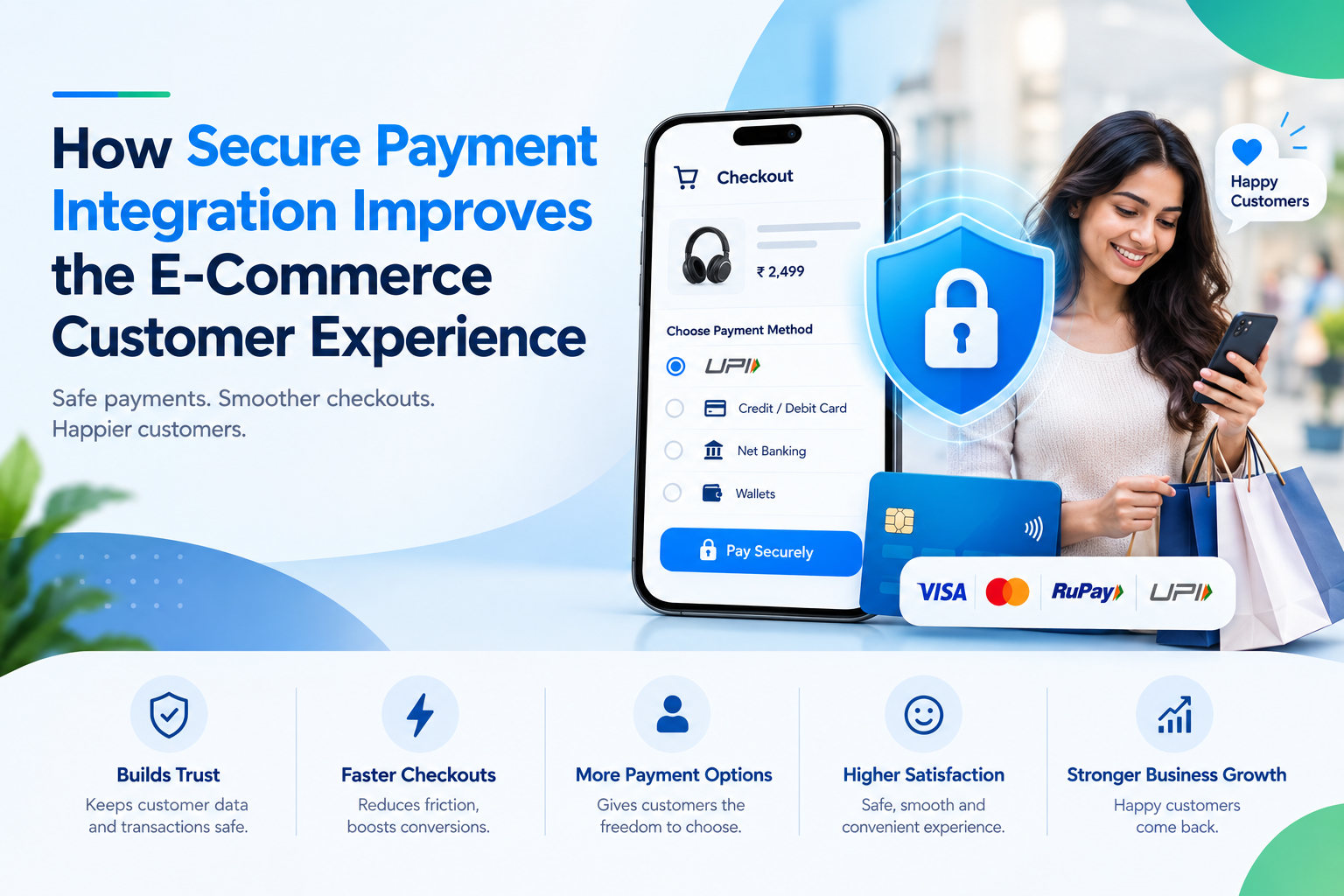
How Secure Payment Integration Improves the E-Commerce Customer Experience
How Secure Payment Integration Improves the E-Commerce Customer Experience
E-commerce has transformed the way customers discover, compare, and purchase products and services. While product quality, pricing, and website design influence buying decisions, the payment experience can ultimately determine whether a customer completes a purchase.
Customers expect online payments to be fast, convenient, transparent, and secure. If a checkout page appears unreliable, takes too long to load, provides limited payment options, or creates uncertainty about payment security, customers may abandon their purchase.
This makes secure payment integration an important part of modern e-commerce website development. A well-designed payment system not only helps protect transaction information but can also create a smoother checkout experience and strengthen customer confidence.
Why Payment Security Matters in E-Commerce
Online transactions involve sensitive information and require businesses to establish appropriate security controls. Customers need confidence that their payment information is handled securely when they purchase from an online store.
A secure payment infrastructure can help businesses:
- Protect sensitive payment information
- Reduce exposure to fraudulent transactions
- Provide a reliable checkout experience
- Build customer trust
- Support different payment methods
- Improve transaction reliability
- Strengthen the overall reputation of an online store
Security should therefore be considered part of the customer experience rather than simply a technical requirement.
What Is Secure Payment Integration?
Secure payment integration is the process of connecting an e-commerce website or application with a payment gateway or payment service so customers can complete transactions securely.
Depending on the business model and payment provider, an integrated payment solution can support options such as:
- Credit and debit cards
- Internet banking
- Digital wallets
- Bank transfers
- Mobile payments
- Buy-now-pay-later services
- Other locally supported payment methods
The payment system should be integrated with the website's checkout process in a way that balances security, usability, reliability, and performance.
1. Secure Payments Build Customer Trust
Trust is one of the most important factors in online shopping.
Customers may hesitate to purchase from a website if they are unsure about how their payment information will be handled. A professional checkout experience, secure payment infrastructure, recognizable payment options, and clear security information can help reduce this uncertainty.
When customers feel confident during checkout, they are more likely to complete their transactions and return to the website for future purchases.
Payment security can therefore contribute to a stronger relationship between an e-commerce business and its customers.
2. A Better Checkout Experience Reduces Friction
The checkout stage is one of the most important parts of the customer journey.
Even after customers have selected products and added them to their cart, unnecessary steps can make the payment process frustrating.
A well-integrated payment solution can help simplify the process by providing:
- Clear payment instructions
- Fewer unnecessary checkout steps
- Responsive payment pages
- Appropriate validation messages
- Reliable transaction processing
- Mobile-friendly payment experiences
The objective is to make the payment process as straightforward as possible while maintaining appropriate security controls.
3. Multiple Payment Options Improve Convenience
Different customers prefer different payment methods.
Some customers may prefer cards, while others may use digital wallets, bank transfers, or other payment options. Providing relevant payment choices can make an online store more accessible to a wider customer base.
However, businesses should not simply add every available payment method. Payment options should be selected according to the target audience, market, transaction requirements, and business model.
A properly integrated payment system can bring these options together within a consistent checkout experience.
4. Secure Payment Processing Protects Sensitive Information
Payment transactions can involve sensitive financial information. Businesses therefore need to consider security throughout the payment process.
Security standards such as the Payment Card Industry Data Security Standard (PCI DSS) provide requirements for protecting payment account data. Businesses should understand which responsibilities apply to their specific payment architecture and service providers.
Using established payment providers, maintaining secure systems, applying appropriate access controls, and keeping software updated are all important parts of an effective security strategy.
5. Authentication Can Add Another Layer of Protection
Modern payment ecosystems can use additional authentication mechanisms to help verify transactions.
For example, 3-D Secure is designed to support authentication for card-not-present transactions and can provide an additional security layer when implemented appropriately.
The exact authentication experience can vary depending on the payment provider, card issuer, region, transaction, and risk assessment.
For customers, a well-designed authentication flow should provide security without creating unnecessary confusion during checkout.
6. Mobile-Friendly Payments Are Essential
A significant portion of online shopping takes place through smartphones.
A payment process that works well on desktop but performs poorly on mobile can create unnecessary friction. Small buttons, difficult forms, slow-loading pages, or poorly designed payment screens can negatively affect the customer experience.
A modern e-commerce payment system should therefore be designed and tested across relevant mobile devices and screen sizes.
Mobile-friendly payment experiences should focus on:
- Responsive layouts
- Easy-to-use form fields
- Clear buttons and instructions
- Fast page loading
- Appropriate error messages
- Simple navigation
- Reliable payment confirmation
7. Reliable Payment Integration Reduces Failed Transactions
Payment failures can occur for many reasons, including connectivity issues, incorrect payment information, bank declines, gateway problems, or technical errors.
A good payment integration should provide clear feedback when a transaction cannot be completed.
For example, instead of displaying a generic error message, the checkout experience should guide customers toward an appropriate next step when possible.
Useful transaction handling can include:
- Clear success confirmations
- Informative failure messages
- Retry options
- Order-status updates
- Payment-status synchronization
- Appropriate transaction logging
This can prevent customers from becoming uncertain about whether an order was successfully placed.
8. Payment Security Supports Brand Reputation
Customers often associate the checkout experience with the overall professionalism of a business.
A reliable and secure payment process can reinforce a company's credibility, while repeated payment failures or unclear transaction handling can damage customer confidence.
For e-commerce businesses, security should therefore be considered part of the broader brand experience.
A professional online store should provide consistency across the entire customer journey—from product discovery and shopping cart management to payment, confirmation, and post-purchase support.
9. Secure Payments Can Support Customer Retention
The customer relationship does not end after the first purchase.
When customers have a smooth checkout experience, receive accurate payment confirmation, and can easily understand their order status, they have a more consistent overall experience with the brand.
Businesses can further improve retention by providing:
- Clear order confirmations
- Digital receipts
- Transparent payment status
- Reliable refund processes
- Secure account management
- Responsive customer support
A positive payment experience can become one component of a broader customer-retention strategy.
10. Payment Integration Should Work With the E-Commerce Architecture
Payment integration should not be treated as an isolated feature.
It needs to work properly with other parts of an e-commerce platform, including:
- Shopping cart
- Product catalog
- Inventory management
- Order management
- Customer accounts
- Tax calculation
- Shipping systems
- Notifications
- Analytics
- Refund and cancellation workflows
For example, when a customer successfully completes payment, the system may need to update inventory, create an order, generate a confirmation, and notify relevant systems.
A properly planned architecture helps ensure these processes work together reliably.
How Businesses Can Improve E-Commerce Payment Security
Businesses can take several practical steps to improve their payment environment.
Use Trusted Payment Providers
Choose established payment providers that support appropriate security standards and business requirements.
Keep Software Updated
E-commerce platforms, plugins, libraries, and server-side components should be maintained and updated to address security and compatibility issues.
Use HTTPS
Secure HTTPS connections help protect data exchanged between customers and the website.
Apply Strong Access Controls
Administrative access to payment and e-commerce systems should be limited to authorized users and protected appropriately.
Monitor Transactions
Businesses should monitor transaction activity and investigate unusual patterns or potential security incidents.
Test the Checkout Process
Regular testing can help identify broken payment flows, compatibility problems, mobile usability issues, and transaction-handling errors.
Choosing the Right Payment Integration for Your Business
There is no single payment solution that is ideal for every e-commerce business.
Before selecting a payment gateway or integration approach, businesses should evaluate:
Target Market:
Which payment methods are commonly used by your customers?
Business Model:
Does the business sell physical products, digital products, subscriptions, services, or a combination?
Transaction Volume:
Will the payment infrastructure be able to handle the expected transaction volume?
Security Requirements:
What security and compliance requirements apply to the business?
Integration Requirements:
Does the payment solution integrate effectively with the existing website, shopping cart, order management, and accounting systems?
Scalability:
Can the payment infrastructure support future business growth and expansion into new markets?
Why Choose RIOTECH for E-Commerce Development?
A successful e-commerce website requires more than an attractive product catalog. It needs a reliable combination of user experience, payment processing, security, performance, backend integration, and ongoing technical support.
RIOTECH Softwares provides E-Commerce Development solutions designed to help businesses build functional and scalable online stores. Its e-commerce services include solutions around online stores, shopping carts, payment gateway integration, inventory management, and related e-commerce functionality.
Businesses planning to develop or improve their online store can explore RIOTECH's E-Commerce Development services to discuss their requirements and digital commerce goals.
Conclusion
Secure payment integration is an important part of the modern e-commerce customer experience. Customers want more than the ability to pay online—they expect the process to be secure, convenient, reliable, and easy to understand.
From protecting payment information and supporting authentication to providing multiple payment options and a mobile-friendly checkout experience, payment integration can influence several stages of the customer journey.
Businesses should therefore evaluate payment security and usability together. The right solution should fit the company's target audience, business model, technology architecture, security requirements, and long-term growth plans.
By combining secure payment infrastructure with a well-designed e-commerce experience, businesses can create a checkout process that supports customer confidence and smoother online transactions.
Frequently Asked Questions
What is secure payment integration in e-commerce?
Secure payment integration connects an e-commerce website with a payment gateway or payment service while incorporating appropriate security measures for processing online transactions.
Why is payment security important for e-commerce businesses?
Payment security helps protect sensitive transaction information, supports customer confidence, and reduces risks associated with unauthorized or fraudulent transactions.
How does payment integration improve customer experience?
A well-designed payment integration can provide a faster, clearer, more convenient, and reliable checkout experience while supporting relevant payment methods.
Should an e-commerce website offer multiple payment methods?
Offering relevant payment methods can improve convenience for customers. The exact options should depend on the target market, business model, payment costs, and technical requirements.
What is a payment gateway?
A payment gateway is a technology that facilitates the secure transmission and processing of payment information between a customer, merchant, and payment-processing infrastructure.
Is mobile payment integration important?
Yes. Since many customers shop through smartphones, businesses should ensure that their payment and checkout experience works effectively across relevant mobile devices.
How can businesses improve payment security?
Businesses can use reputable payment providers, maintain secure systems, implement appropriate access controls, keep software updated, monitor transactions, and regularly test their checkout infrastructure.
Why is payment gateway integration important for an online store?
Payment gateway integration enables customers to complete transactions through supported payment methods while connecting payment processing with the store's order and checkout workflows.