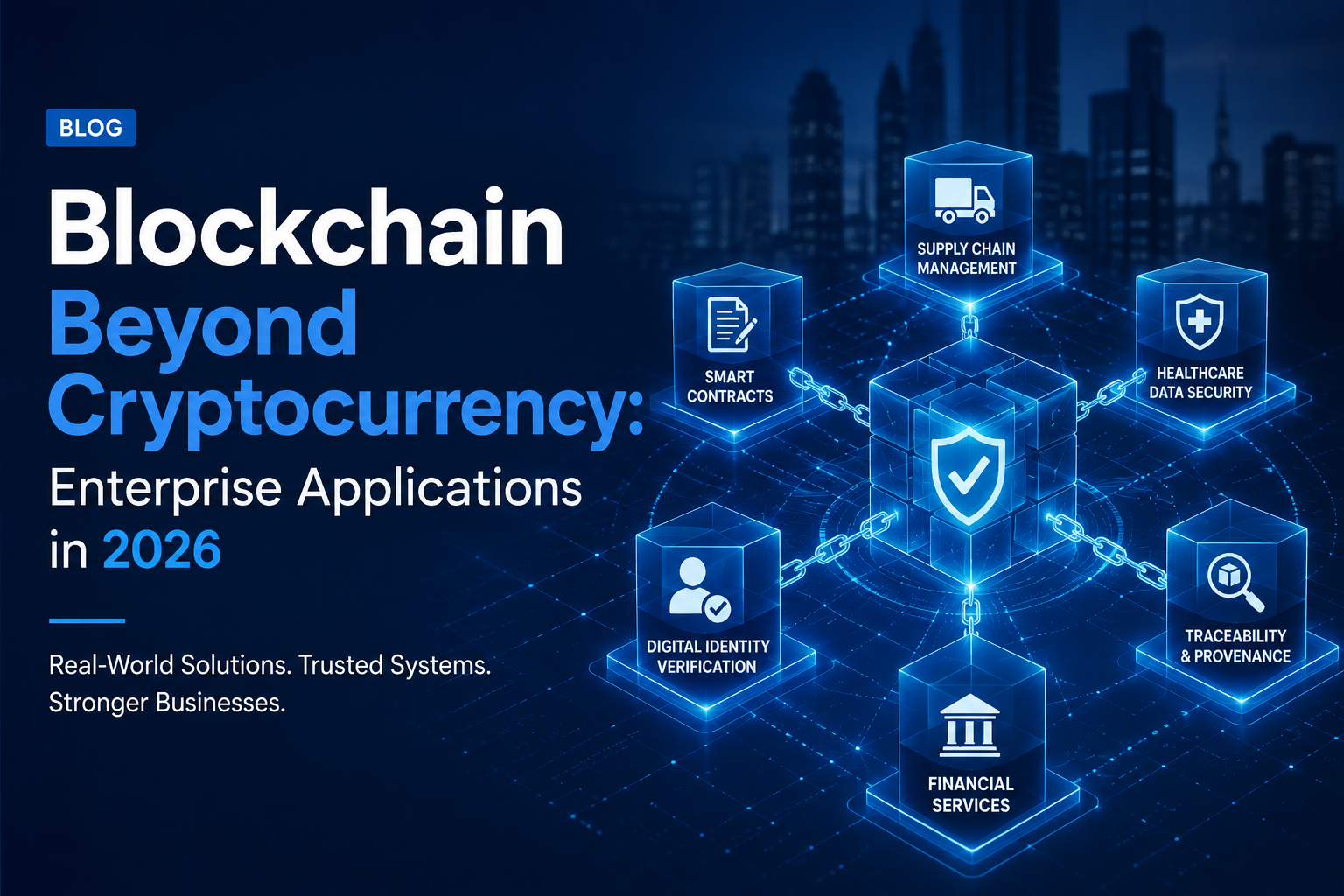
Blockchain Beyond Cryptocurrency: Enterprise Applications in 2026
Blockchain Beyond Cryptocurrency: Enterprise Applications in 2026
Blockchain has evolved far beyond its association with Bitcoin and cryptocurrency. In 2026, enterprises are increasingly exploring blockchain as a technology for building trusted digital ecosystems, improving transparency, automating transactions, and creating secure records across organizational boundaries.
The enterprise opportunity is not simply about replacing traditional databases with blockchain. Instead, the technology is most valuable where multiple parties need to share information, verify transactions, maintain an auditable history, or execute predefined business rules without relying entirely on a central intermediary.
Financial institutions are already moving toward blockchain-based infrastructure for areas such as asset ownership and tokenized securities. India, for example, is planning a tokenized corporate bond pilot in September 2026, highlighting how blockchain is becoming relevant to mainstream financial infrastructure.
For businesses, the question in 2026 is no longer “Can blockchain replace cryptocurrency?” but rather “Where can blockchain create measurable business value?”
What Makes Blockchain Valuable for Enterprises?
Traditional databases work extremely well when a single organization controls the data and system. Blockchain becomes more interesting when several independent stakeholders need to maintain confidence in the same information.
Key enterprise benefits include:
- Data integrity: Records can be made tamper-evident.
- Shared visibility: Authorized participants can access a common source of truth.
- Traceability: Transactions and events can be tracked across their lifecycle.
- Automation: Smart contracts can execute predefined business rules.
- Reduced reconciliation: Shared records can reduce repeated verification between organizations.
- Auditability: Blockchain can provide a persistent transaction history.
- Digital asset management: Physical and financial assets can be represented digitally through tokenization.
However, blockchain is not automatically the right solution for every business problem. If one organization controls the data and a conventional database can efficiently meet the requirements, blockchain may introduce unnecessary complexity.
1. Supply Chain Transparency and Traceability
Supply chains involve manufacturers, suppliers, distributors, logistics companies, retailers, regulators, and customers. Each participant may maintain separate records, making it difficult to establish a reliable end-to-end view.
Blockchain can create a shared record of important events such as:
- Product manufacturing
- Shipment movement
- Quality inspections
- Certifications
- Ownership transfers
- Delivery confirmation
- Product origin
This can help organizations improve product provenance, detect inconsistencies, and respond more efficiently to supply-chain disputes.
The technology is particularly relevant to industries such as pharmaceuticals, food, agriculture, automotive, and luxury goods, where authenticity and traceability are critical.
However, enterprises must also recognize an important limitation: blockchain can preserve the integrity of submitted information, but it cannot guarantee that inaccurate information entered at the source is true.
2. Asset Tokenization
One of the most significant enterprise blockchain developments in 2026 is the tokenization of real-world assets.
Tokenization involves representing ownership or economic rights associated with assets digitally on a blockchain. Potential applications include:
- Bonds
- Investment funds
- Real estate
- Private equity
- Commodities
- Financial securities
- Intellectual property
Tokenization can enable more efficient ownership tracking, automated compliance processes, fractional ownership models, and faster settlement.
The financial sector is already demonstrating this direction. Recent developments include institutional adoption of blockchain-based record systems and tokenized financial products.
For enterprises, tokenization could eventually connect traditional financial infrastructure with programmable digital assets.
3. Smart Contracts and Business Automation
Smart contracts are programs that automatically execute predefined conditions on a blockchain.
Instead of relying entirely on manual verification, organizations can encode specific business rules into digital workflows.
For example:
Supplier delivers goods → IoT system confirms delivery → blockchain records the event → smart contract verifies conditions → payment workflow is triggered.
Potential applications include:
- Automated supplier payments
- Insurance claims processing
- Trade finance
- Royalty distribution
- Procurement workflows
- Escrow arrangements
- Contract compliance
This can reduce administrative work and accelerate processes involving multiple parties.
The biggest opportunity is not simply automating individual transactions but connecting blockchain with existing ERP, CRM, IoT, AI, and payment systems.
4. Digital Identity and Credential Verification
Identity verification remains a major challenge for enterprises.
Organizations frequently need to verify customers, employees, suppliers, partners, certifications, and professional credentials.
Blockchain-based identity systems can support verifiable credentials that allow authorized parties to validate information without repeatedly requesting and storing the same documents.
Potential applications include:
- Customer verification
- Employee credentials
- Academic certificates
- Professional licenses
- Supplier verification
- KYC processes
- Access management
The objective is not necessarily to place sensitive personal information directly on a blockchain. Instead, blockchain can be used as part of an architecture for verifying credentials while keeping sensitive information appropriately protected.
5. Financial Services and Faster Settlement
Financial services remain one of the strongest areas for enterprise blockchain adoption.
Blockchain can support:
- Tokenized securities
- Cross-border transactions
- Trade finance
- Digital asset custody
- Settlement infrastructure
- Shared transaction records
- Automated compliance
Traditional financial transactions often involve multiple intermediaries and reconciliation processes. Blockchain-based systems can provide a shared transaction layer that reduces duplication and improves visibility.
The growing use of tokenized financial products in 2026 demonstrates that blockchain is increasingly being considered as financial infrastructure rather than simply a cryptocurrency technology.
6. Healthcare Data and Pharmaceutical Tracking
Healthcare organizations manage highly sensitive information across hospitals, laboratories, insurers, pharmaceutical companies, and patients.
Blockchain can potentially support secure verification and controlled sharing of information while maintaining an auditable history.
Potential enterprise applications include:
- Pharmaceutical supply-chain tracking
- Medical credential verification
- Clinical research data provenance
- Insurance claims
- Consent management
- Medical-device records
- Drug authenticity verification
A blockchain architecture should not be treated as a replacement for healthcare databases. Instead, it can serve as a trust and verification layer within a broader secure data ecosystem.
7. Intellectual Property and Royalty Management
Creative industries face ongoing challenges related to ownership, licensing, attribution, and royalty distribution.
Blockchain can provide a verifiable record of ownership and transactions involving digital assets.
Possible applications include:
- Music royalties
- Digital media licensing
- Software licenses
- Patent records
- Digital content ownership
- Automated royalty payments
Smart contracts can also support predefined royalty rules, allowing payments to be distributed automatically when specified conditions are met.
8. AI and Blockchain Working Together
One of the emerging enterprise trends in 2026 is the convergence of artificial intelligence and blockchain.
The two technologies address different challenges.
AI can analyze, predict, recommend, and automate decisions.
Blockchain can record, verify, and enforce transactions and shared states.
For example, an AI system could identify a potential supply-chain disruption. Blockchain could maintain the verified record of supplier events, shipment milestones, and contractual obligations.
This creates a model in which:
AI provides intelligence → Blockchain provides verification → Smart contracts provide automation.
This combination is particularly relevant to supply chains, financial services, compliance, digital identity, and enterprise automation.
9. Sustainability and Carbon Tracking
Enterprises are under increasing pressure to demonstrate environmental performance.
Blockchain can help establish traceable records for sustainability-related information, including:
- Carbon credits
- Renewable energy certificates
- Product provenance
- Supply-chain emissions
- Sustainability claims
- Environmental reporting
A shared ledger can make it easier for multiple stakeholders to verify when and where an environmental event occurred.
The value depends heavily on the quality of the underlying data and the governance framework used to validate it.
10. Enterprise Collaboration Through Consortium Networks
Not every enterprise blockchain needs to be public.
Many business applications are better suited to permissioned or consortium networks, where participating organizations have defined roles and access rights.
For example, manufacturers, suppliers, logistics providers, and retailers could participate in a shared network while maintaining appropriate privacy and governance controls.
This approach can provide a balance between:
Transparency + Privacy + Governance + Performance
Enterprise blockchain therefore does not necessarily mean complete decentralization. In many cases, controlled participation is more practical for regulated business environments.
Key Challenges Enterprises Must Consider
Despite its potential, blockchain adoption still comes with significant challenges.
Scalability
Enterprise systems may process thousands or millions of transactions. Blockchain infrastructure must be capable of handling required workloads without unacceptable latency or costs.
Integration
Blockchain rarely operates alone. Successful deployments usually require integration with ERP, CRM, cloud platforms, APIs, payment systems, IoT devices, and existing databases.
Regulatory Compliance
Tokenized assets, digital identities, financial transactions, and cross-border applications can be subject to complex regulations.
Privacy
Enterprises must carefully determine what information should be stored on-chain and what should remain in private databases or off-chain systems.
Governance
Technology is only one part of a multi-party blockchain network. Organizations also need clear rules governing participation, permissions, upgrades, dispute resolution, and data standards.
Security
Smart contracts and blockchain infrastructure require rigorous security testing. A technically immutable system does not automatically mean the overall application is secure.
How Businesses Should Approach Blockchain in 2026
The most effective enterprise blockchain strategy starts with the business problem, not the technology.
Before investing, organizations should ask:
- Are multiple independent organizations involved?
- Do participants need a shared source of truth?
- Is transaction or data integrity particularly important?
- Is reconciliation creating significant cost or delay?
- Can smart contracts meaningfully automate the process?
- Are there regulatory or privacy requirements that affect architecture?
- Can the expected benefits be measured through clear KPIs?
If the answer to most of these questions is yes, blockchain may be worth evaluating.
A practical implementation approach is to begin with a focused proof of concept, measure business impact, validate security and governance requirements, and then scale the solution gradually.
The Future of Enterprise Blockchain
Enterprise blockchain is moving toward a more practical phase.
The focus is shifting away from cryptocurrency speculation toward tokenization, trusted data exchange, digital identity, automated settlement, supply-chain visibility, and enterprise collaboration.
Financial institutions are already demonstrating how blockchain can become part of mainstream infrastructure, while other sectors are selectively adopting it where shared trust and traceability provide a measurable advantage.
The future is therefore unlikely to be a world where every business process runs on blockchain. Instead, blockchain will increasingly become one component of a broader technology ecosystem involving AI, cloud computing, IoT, cybersecurity, APIs, and enterprise applications.
Conclusion
Blockchain has grown beyond cryptocurrency into a technology capable of addressing specific enterprise challenges around trust, transparency, automation, ownership, and data verification.
In 2026, the strongest opportunities are emerging where businesses need multiple parties to coordinate around reliable records and programmable transactions.
For enterprises, the goal should not be to adopt blockchain simply because it is a trending technology. The real opportunity lies in identifying processes where blockchain can deliver measurable improvements in efficiency, transparency, security, compliance, and collaboration.
Organizations that take a business-first approach and combine blockchain with AI, cloud, automation, and existing enterprise systems can build a stronger foundation for the next generation of digital business.
Frequently Asked Questions
Is blockchain still relevant beyond cryptocurrency in 2026?
Yes. Enterprise applications increasingly focus on areas such as asset tokenization, supply-chain traceability, digital identity, smart contracts, financial settlement, and secure multi-party data sharing.
What is the biggest enterprise use case for blockchain?
There is no single universal use case. Financial services and asset tokenization are among the most active areas, while supply-chain traceability, identity, and smart-contract automation also offer significant potential.
Can blockchain replace traditional databases?
Usually, no. Blockchain is better viewed as a complementary technology for situations requiring shared verification, tamper-evident records, or multi-party coordination.
How does blockchain work with AI?
AI can analyze data and make recommendations, while blockchain can provide verifiable records and smart contracts can automate agreed actions. This combination can strengthen enterprise automation and accountability.
What should a company consider before adopting blockchain?
Businesses should evaluate the problem, participants, data requirements, privacy, regulatory obligations, scalability, integration requirements, governance, security, and expected return on investment.
Final Takeaway
Blockchain in 2026 is no longer primarily about cryptocurrency. It is becoming a business infrastructure technology for organizations that need trusted data, programmable transactions, verifiable ownership, and transparent collaboration.
For enterprises ready to explore these opportunities, the key is to focus on practical use cases where blockchain solves a real business problem rather than adopting the technology for its own sake.
Looking to explore blockchain solutions for your business? RioTech can help organizations evaluate, design, and develop technology solutions aligned with their operational and digital transformation goals.