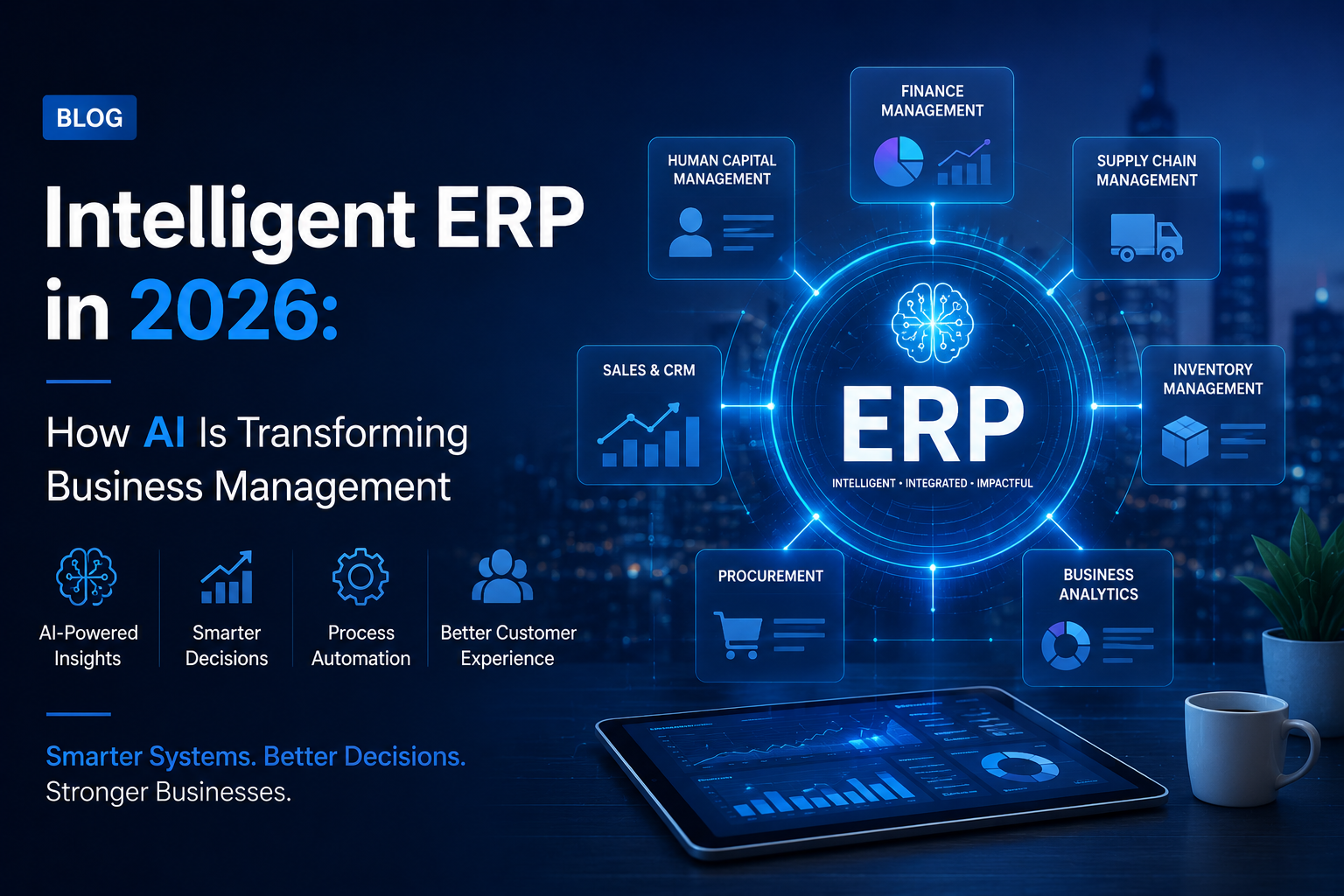
Intelligent ERP in 2026: How AI Is Transforming Business Management
Intelligent ERP in 2026: How AI Is Transforming Business Management
Enterprise Resource Planning (ERP) systems have long been the backbone of business operations, connecting finance, procurement, inventory, sales, human resources, manufacturing, and other critical functions within a centralized platform.
In 2026, ERP is entering a new phase.
The integration of Artificial Intelligence (AI), machine learning, automation, predictive analytics, and natural language interfaces is transforming traditional ERP platforms into intelligent business management systems capable of analyzing information, identifying patterns, predicting outcomes, and supporting faster decision-making.
This evolution is giving rise to Intelligent ERP—a model in which enterprise software does more than record what has already happened. It helps organizations understand what is happening, anticipate what could happen next, and recommend appropriate actions.
For businesses seeking greater efficiency and agility, AI-powered ERP is becoming an important component of digital transformation.
What Is Intelligent ERP?
Intelligent ERP refers to ERP platforms enhanced with AI, machine learning, automation, analytics, and intelligent decision-support capabilities.
Traditional ERP primarily focuses on:
- Recording transactions
- Managing business data
- Standardizing processes
- Generating reports
- Connecting departments
- Intelligent ERP extends these capabilities by enabling systems to:
- Predict business trends
- Detect anomalies
- Automate repetitive tasks
- Recommend business actions
- Identify operational risks
- Generate insights from large datasets
- Interact with users through natural language
- Continuously improve decision-making
The objective is not simply to add AI features to ERP software. The broader goal is to create an intelligent operating environment where business data can actively support strategic and operational decisions.
Why AI Is Transforming ERP in 2026
Businesses generate enormous amounts of data across multiple departments and systems. Traditional reporting can tell organizations what happened, but analyzing that information manually can take significant time.
AI changes this model by processing large volumes of structured and unstructured data much faster.
For example, an intelligent ERP system can identify declining sales, detect unusual expenses, forecast inventory requirements, or highlight potential cash-flow problems before they become major operational issues.
This moves ERP from a reactive system to a more proactive decision-support platform.
1. AI-Powered Financial Management
Finance is one of the areas where AI can deliver significant value within ERP systems.
Intelligent ERP can help automate and analyze financial processes such as:
- Invoice processing
- Expense classification
- Accounts payable
- Accounts receivable
- Cash-flow forecasting
- Financial reconciliation
- Budget analysis
- Fraud and anomaly detection
AI-powered systems can analyze historical financial information and identify patterns that may indicate future cash-flow requirements or unusual transactions.
Instead of spending excessive time reviewing routine financial data, finance teams can focus more on analysis, planning, and strategic decision-making.
2. Predictive Demand and Inventory Management
Inventory management is a major challenge for businesses operating across complex supply chains.
Holding too much inventory increases costs, while insufficient inventory can lead to stockouts and lost sales.
AI-powered ERP systems can analyze factors such as:
- Historical sales
- Seasonal patterns
- Customer behavior
- Supplier performance
- Market trends
- Lead times
- Inventory movement
Based on these signals, the system can generate more intelligent demand forecasts and recommend inventory levels.
This can help organizations reduce excess inventory while improving product availability.
3. Intelligent Supply Chain Management
Modern supply chains are increasingly complex and vulnerable to disruptions.
AI-enabled ERP platforms can monitor operational data and identify potential risks before they significantly affect business operations.
For example, the system could detect:
Supplier delays → Inventory risk → Production impact → Recommended alternative action
AI can also help organizations evaluate supplier performance, forecast procurement requirements, optimize logistics, and identify potential bottlenecks.
This enables companies to move from reactive supply-chain management toward more predictive operations.
4. Automated Procurement
Procurement involves numerous repetitive activities, including supplier comparisons, purchase orders, approvals, invoice matching, and contract management.
AI can automate many of these processes.
An intelligent ERP platform can:
- Identify purchasing patterns
- Recommend suppliers
- Detect unusual pricing
- Automate purchase-order workflows
- Match invoices with purchase orders
- Identify potential savings
- Predict procurement requirements
AI-powered procurement can therefore reduce manual effort while improving purchasing visibility and control.
5. AI-Driven Sales and Customer Insights
ERP systems increasingly connect with CRM and customer-facing applications.
When combined with AI, business data can provide deeper insights into customer behavior and sales performance.
AI can help organizations:
- Forecast sales
- Identify high-value customers
- Analyze purchasing patterns
- Predict customer churn
- Recommend follow-up actions
- Identify cross-selling opportunities
- Evaluate sales pipeline performance
Sales teams can use these insights to prioritize opportunities instead of relying entirely on manual analysis.
6. Human Resources and Workforce Management
AI is also changing how ERP platforms support HR operations.
Intelligent ERP systems can analyze workforce information to support:
- Workforce planning
- Employee scheduling
- Attendance analysis
- Payroll processing
- Skills management
- Training recommendations
- Workforce forecasting
AI can help HR teams identify workforce trends and potential resource gaps, enabling organizations to make more informed staffing decisions.
However, organizations should use AI responsibly when handling employee data and ensure that automated recommendations remain subject to appropriate human oversight.
7. Natural Language ERP Interfaces
One of the most visible changes in ERP technology is the move toward natural language interaction.
Instead of navigating multiple reports and menus, employees can increasingly interact with enterprise systems using conversational queries.
For example:
“Show me this quarter's sales performance.”
“Which products are likely to experience stock shortages next month?”
“Compare procurement costs across suppliers.”
“Identify unusual expenses from the last 30 days.”
The system can interpret the request, analyze relevant business information, and present an appropriate response.
This can make complex ERP functionality more accessible to employees who may not have advanced technical or analytical skills.
8. AI-Powered Business Forecasting
Forecasting is one of the strongest applications of AI in ERP.
Traditional forecasting often depends heavily on historical trends and manually configured models.
AI can analyze a broader range of variables and identify complex relationships within business data.
Organizations can use AI-assisted forecasting for:
- Revenue
- Demand
- Cash flow
- Inventory
- Workforce requirements
- Procurement
- Production
- Customer behavior
Better forecasting can help businesses make more informed decisions and prepare for changing market conditions.
9. Intelligent Process Automation
ERP platforms contain many repetitive workflows.
AI combined with automation can help organizations streamline activities such as:
- Data entry
- Invoice approvals
- Order processing
- Expense verification
- Report generation
- Document classification
- Payment workflows
- Customer communication
This creates a more efficient operating model in which employees spend less time on repetitive administrative work.
The greatest benefit comes when AI and automation are integrated into complete business processes rather than implemented as isolated features.
10. Real-Time Business Intelligence
Traditional ERP reporting often requires users to manually generate reports and analyze information.
Intelligent ERP can provide more real-time visibility into business performance.
Executives and managers can receive insights related to:
- Revenue
- Profitability
- Inventory
- Customer activity
- Operational costs
- Employee performance
- Supply-chain conditions
AI can also highlight unusual patterns and prioritize the information that requires attention.
This creates a more proactive approach to business management.
11. AI and ERP Security
As ERP systems contain highly valuable business information, cybersecurity is a critical consideration.
AI can support ERP security by identifying unusual behavior, detecting suspicious transactions, and monitoring access patterns.
Potential applications include:
- Anomaly detection
- Fraud detection
- Unusual login monitoring
- Privilege misuse detection
- Transaction monitoring
- Automated security alerts
However, AI should complement—not replace—traditional security controls such as identity management, access policies, encryption, monitoring, and regular security assessments.
12. Generative AI in ERP
Generative AI is adding another layer of intelligence to ERP platforms.
Instead of simply analyzing structured data, generative AI can help users interact with business information through natural language and generate useful outputs.
Potential applications include:
- Business report generation
- Financial summaries
- Management insights
- Document creation
- Policy assistance
- Internal knowledge search
- Workflow assistance
- Natural-language data analysis
For example, an executive could ask:
“Why did operating costs increase this quarter?”
The system could analyze relevant ERP information and generate a concise explanation based on available data.
This can significantly reduce the time required to extract and interpret business insights.
Intelligent ERP vs Traditional ERP
| Traditional ERP | Intelligent ERP |
|---|---|
| Records business transactions | Understands business patterns |
| Historical reporting | Predictive analytics |
| Manual analysis | AI-assisted insights |
| Rule-based automation | Intelligent automation |
| Static workflows | Adaptive workflows |
| Dashboard-driven interaction | Natural-language interaction |
| Reactive decision-making | Proactive decision support |
| Manual forecasting | AI-assisted forecasting |
The transition does not mean traditional ERP becomes obsolete. Instead, AI enhances the capabilities that already make ERP valuable.
Benefits of Intelligent ERP for Businesses
Organizations implementing AI-powered ERP can potentially achieve improvements across several areas.
Improved Decision-Making
AI provides faster access to relevant business insights, helping managers make decisions based on current information.
Higher Operational Efficiency
Automation reduces repetitive manual activities and allows employees to focus on higher-value work.
Better Forecasting
AI can identify patterns and relationships that may improve demand, financial, and operational forecasts.
Reduced Costs
Optimized inventory, procurement, workflows, and resource utilization can help reduce unnecessary operational expenses.
Greater Visibility
Organizations can gain a more connected view of business performance across departments.
Improved Scalability
Intelligent automation can help businesses handle growing transaction volumes without increasing manual effort at the same rate.
Challenges of Implementing Intelligent ERP
Despite its potential, AI-powered ERP implementation requires careful planning.
Data Quality
AI is only as effective as the data it receives. Inaccurate, incomplete, or inconsistent enterprise data can lead to unreliable insights.
Integration Complexity
Organizations often operate multiple legacy applications. Integrating these systems with an intelligent ERP platform can be technically challenging.
Data Privacy
ERP systems contain sensitive financial, customer, employee, and operational information. Businesses must implement strong access controls and data protection measures.
AI Governance
Organizations need clear policies regarding how AI makes recommendations, how decisions are reviewed, and who is accountable for outcomes.
Employee Adoption
Employees need appropriate training to understand how AI-powered ERP tools work and how they should be used.
Cost and ROI
AI-enabled ERP transformation requires investment in software, infrastructure, integration, training, and security. Businesses should establish measurable KPIs before implementation.
How Businesses Can Prepare for Intelligent ERP
Organizations do not necessarily need to replace their entire ERP environment immediately.
A practical transformation strategy can begin with clearly defined business priorities.
Step 1: Identify High-Value Processes
Find repetitive or data-intensive processes where AI could provide measurable benefits.
Step 2: Evaluate Existing ERP Infrastructure
Assess current ERP capabilities, integrations, data quality, and limitations.
Step 3: Establish Data Governance
Create standards for data quality, access, security, ownership, and compliance.
Step 4: Start With Targeted AI Use Cases
Begin with areas such as forecasting, invoice processing, inventory optimization, or reporting.
Step 5: Integrate AI With Existing Systems
Connect ERP with CRM, analytics platforms, cloud services, automation tools, and other business applications where necessary.
Step 6: Measure Business Impact
Track KPIs such as processing time, operational costs, forecasting accuracy, inventory levels, and employee productivity.
Step 7: Scale Gradually
Once successful use cases are validated, expand AI capabilities across additional departments and workflows.
The Future of Intelligent ERP
The future of ERP is likely to become increasingly autonomous, predictive, and conversational.
ERP systems will increasingly move toward models where software can continuously monitor business operations, identify opportunities or risks, recommend actions, and automate approved workflows.
The combination of AI + ERP + Automation + Cloud + Analytics can create a connected digital business environment.
In the future, employees may spend less time searching for information and more time acting on insights generated by intelligent systems.
However, successful implementation will depend on more than technology. Organizations will need strong data governance, cybersecurity, employee adoption, responsible AI practices, and clearly defined business objectives.
Conclusion
Intelligent ERP represents a significant evolution in enterprise business management.
By combining traditional ERP capabilities with AI, predictive analytics, automation, and natural-language interfaces, businesses can move from simply managing historical information toward continuously analyzing operations and supporting proactive decisions.
In 2026, organizations should view AI-powered ERP not simply as another software upgrade, but as an opportunity to redesign how business processes operate.
Companies that strategically integrate intelligent ERP with their existing technology ecosystem can improve efficiency, strengthen decision-making, reduce operational complexity, and build a more agile foundation for future growth.
The future of ERP is not just about managing enterprise resources. It is about making those resources more intelligent.
Frequently Asked Questions
What is Intelligent ERP?
Intelligent ERP is an ERP system enhanced with AI, machine learning, automation, predictive analytics, and intelligent decision-support capabilities.
How does AI improve ERP systems?
AI can automate repetitive processes, identify patterns, generate predictions, detect anomalies, and provide actionable insights from enterprise data.
What are the main benefits of AI-powered ERP?
Key benefits include improved forecasting, greater operational efficiency, faster decision-making, better resource management, automation, and enhanced business visibility.
Can AI replace employees in ERP operations?
AI is primarily used to automate repetitive tasks and support employees with insights and recommendations. Human oversight remains important for complex and high-impact decisions.
Is Intelligent ERP suitable for small and medium-sized businesses?
Yes. Businesses of different sizes can adopt intelligent ERP capabilities, particularly through cloud-based solutions and targeted AI applications that address specific operational needs.
How can a business start implementing Intelligent ERP?
Organizations should begin by identifying high-value processes, assessing their existing ERP and data environment, selecting practical AI use cases, and implementing solutions incrementally.
RioTech Perspective
At RioTech, we understand that modern businesses need technology that does more than store information. Intelligent enterprise systems should help organizations connect operations, automate workflows, analyze data, and make better decisions.
By combining ERP development, AI, automation, cloud technologies, and modern software engineering, businesses can create technology ecosystems designed for efficiency, scalability, and long-term digital transformation.
Ready to explore how Intelligent ERP can transform your business? Connect with RioTech to discuss your enterprise technology requirements.