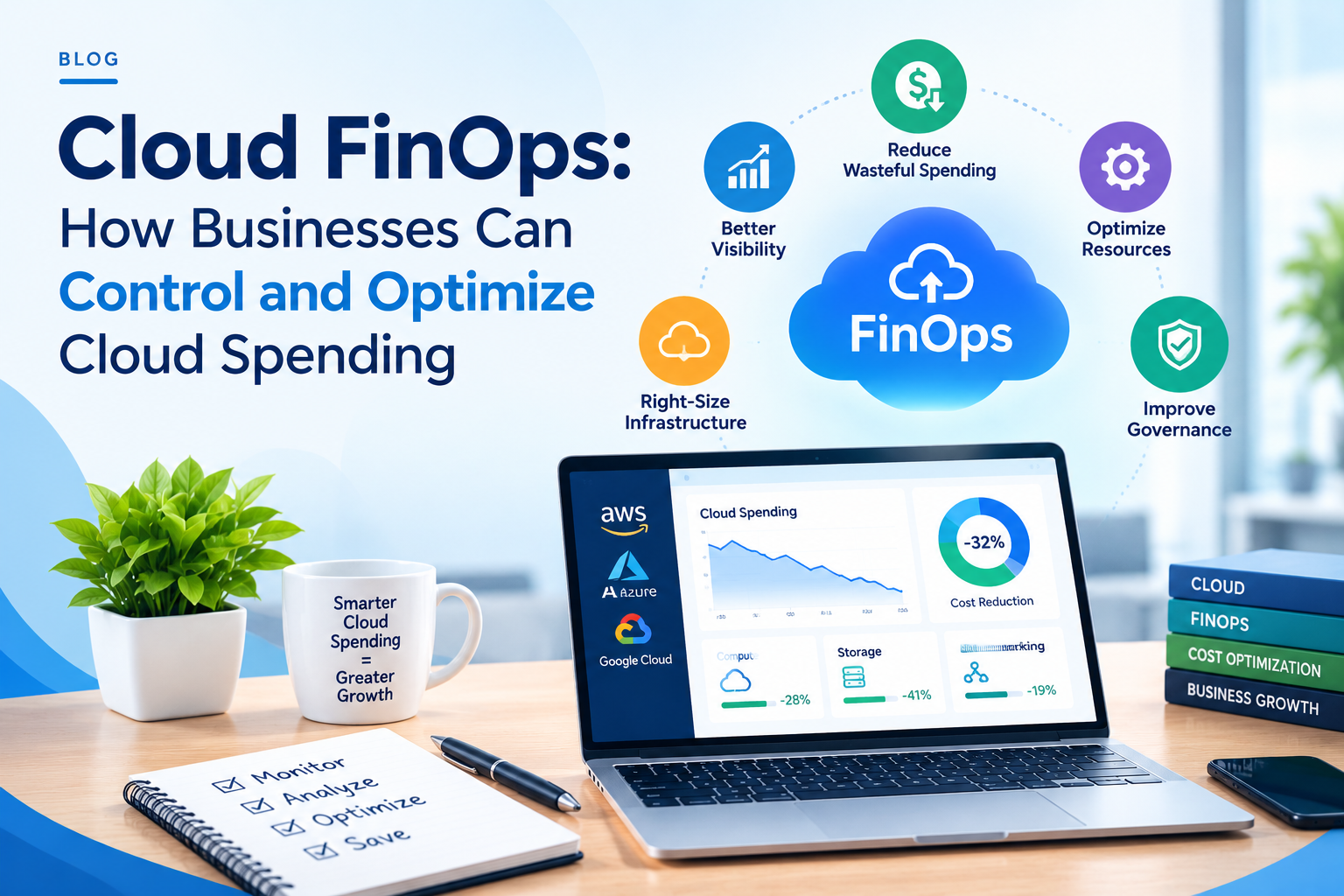
Cloud FinOps: How Businesses Can Control and Optimize Cloud Spending
Cloud FinOps: How Businesses Can Control and Optimize Cloud Spending
Cloud computing has transformed the way businesses build, deploy, and scale digital applications. Organizations can quickly access computing resources, storage, databases, and software services without investing heavily in physical infrastructure. However, as cloud environments become larger and more complex, controlling cloud spending has become a major challenge.
This is where Cloud FinOps comes into play.
Cloud FinOps combines financial management, cloud operations, engineering, and business decision-making to help organizations understand where their cloud money is being spent and how those resources can be optimized. Instead of treating cloud costs as a fixed IT expense, FinOps creates a culture where teams continuously monitor, analyze, and improve cloud usage.
For businesses adopting cloud technologies, implementing FinOps can help reduce unnecessary expenses while maintaining performance, security, and scalability.
What Is Cloud FinOps?
Cloud FinOps, short for Cloud Financial Operations, is a structured approach to managing and optimizing cloud costs.
Traditional IT infrastructure often involves predictable hardware and maintenance expenses. Cloud environments work differently because businesses typically pay according to their resource consumption. Compute instances, storage, databases, network traffic, APIs, and other services can all contribute to the monthly cloud bill.
FinOps helps organizations answer important questions such as:
- Which teams or applications are consuming the most cloud resources?
- Are businesses paying for unused or underutilized infrastructure?
- Which workloads should be optimized, resized, or moved?
- Are cloud resources being used according to business requirements?
- How can cloud spending be forecast more accurately?
The goal is not simply to reduce cloud spending. Instead, FinOps focuses on maximizing business value from every amount spent on cloud infrastructure.
Why Cloud Spending Becomes Difficult to Control
Cloud platforms provide flexibility, but that flexibility can also create financial challenges.
1. Unused Resources
Development and testing environments are sometimes left running after they are no longer required. Unused virtual machines, databases, storage volumes, and IP addresses can continue generating costs.
2. Overprovisioned Infrastructure
Businesses may allocate more CPU, memory, or storage than applications actually require. Over time, these unnecessary resources can significantly increase cloud expenditure.
3. Lack of Cost Visibility
When multiple departments, applications, and projects share the same cloud environment, it can become difficult to determine who is responsible for specific expenses.
4. Rapid Cloud Growth
As businesses launch new applications and services, cloud consumption can increase quickly. Without proper monitoring, organizations may discover unexpected cost increases only after receiving their monthly bill.
5. Complex Pricing Models
Cloud providers offer multiple pricing options, including on-demand resources, reserved capacity, committed-use discounts, and spot or interruptible resources. Choosing the wrong pricing model can lead to unnecessary expenditure.
Key Strategies for Cloud Cost Optimization
A successful FinOps strategy requires continuous monitoring and optimization rather than a one-time cost-cutting exercise.
1. Establish Cloud Cost Visibility
The first step is understanding exactly where cloud money is going.
Organizations should categorize expenses by:
- Department
- Application
- Project
- Environment
- Business unit
- Development team
- Production workload
Using proper tagging and resource naming standards makes it easier to track cloud expenditure and identify cost trends.
2. Identify and Remove Unused Resources
Regular cloud audits can uncover resources that are no longer required.
Businesses should review:
- Idle virtual machines
- Unused storage
- Detached disks
- Old snapshots
- Unused databases
- Inactive load balancers
- Unused development environments
Removing unnecessary resources can produce immediate savings without affecting production workloads.
3. Right-Size Cloud Resources
Right-sizing means matching cloud resources to actual workload requirements.
For example, if an application consistently uses only a small portion of the CPU and memory allocated to it, the infrastructure may be unnecessarily large.
Monitoring actual resource utilization allows teams to select more appropriate instance sizes and configurations.
4. Automate Resource Scheduling
Not every cloud environment needs to operate 24/7.
Development, testing, and staging environments may only be required during working hours. Automated schedules can shut down non-production resources when they are not being used and restart them when required.
This approach can reduce waste while allowing development teams to continue using cloud infrastructure efficiently.
5. Use Appropriate Pricing Models
Businesses should evaluate different cloud pricing options based on workload characteristics.
Long-running and predictable workloads may benefit from committed-use or reserved pricing models, while flexible workloads may be suitable for more variable pricing options.
The right approach depends on workload stability, business requirements, availability needs, and usage patterns.
6. Optimize Storage Costs
Cloud storage can become a significant expense as data volumes grow.
Organizations can introduce storage lifecycle policies that automatically move older or less frequently accessed data to lower-cost storage tiers.
Businesses should also regularly review backups, snapshots, logs, and archived data to determine whether everything needs to remain in high-performance storage.
7. Monitor Network and Data Transfer Costs
Cloud costs are not limited to compute and storage.
Data transfer between regions, cloud services, applications, and external systems can also contribute significantly to expenses.
Optimizing application architecture, reducing unnecessary data transfers, and selecting appropriate deployment locations can help control network-related costs.
The Role of Automation in FinOps
Manual cloud cost management becomes increasingly difficult as infrastructure grows.
Automation can help organizations continuously identify potential savings opportunities.
For example, automated systems can:
- Detect idle resources
- Send budget alerts
- Shut down unused environments
- Identify overprovisioned instances
- Monitor abnormal spending
- Generate cost reports
- Track resource utilization
- Recommend optimization opportunities
By combining cloud monitoring with automation, organizations can move from reactive cost management to proactive optimization.
Cloud FinOps and Business Teams
FinOps should not be limited to the IT department.
Successful FinOps requires collaboration between:
Engineering teams — optimize infrastructure and application performance.
Finance teams — monitor budgets, forecasts, and financial impact.
Business teams — evaluate whether cloud spending is producing meaningful business value.
Management — establish cloud governance and strategic priorities.
This collaboration creates shared accountability for cloud spending.
Cloud Cost Optimization vs. Cloud Cost Cutting
An important distinction is that FinOps is not simply about cutting costs.
Reducing infrastructure at the expense of application performance, security, or reliability can ultimately increase business costs.
For example, an organization might reduce server capacity to save money but experience slower applications and customer dissatisfaction.
A better approach is to optimize resources while maintaining the required level of:
- Performance
- Availability
- Security
- Scalability
- User experience
The objective is better cloud value, not simply a smaller cloud bill.
How Businesses Can Build a FinOps Culture
Organizations looking to implement FinOps can start with a structured approach:
Step 1: Measure
Create visibility into current cloud expenditure and resource consumption.
Step 2: Categorize
Assign costs to teams, applications, projects, and business units.
Step 3: Set Budgets
Establish realistic spending limits and alerts for different workloads.
Step 4: Optimize
Right-size infrastructure, remove unused resources, optimize storage, and improve architecture.
Step 5: Automate
Introduce automated monitoring, scheduling, alerts, and optimization workflows.
Step 6: Continuously Review
Cloud environments change constantly, so cost optimization should be treated as an ongoing process.
Benefits of Cloud FinOps
A well-implemented FinOps strategy can provide several advantages:
- Better visibility into cloud expenditure
- Reduced resource wastage
- More accurate cloud budgeting
- Improved resource utilization
- Greater financial accountability
- Better infrastructure planning
- Improved collaboration between technical and finance teams
- More predictable cloud spending
- Increased business value from cloud investments
The Future of Cloud FinOps
As businesses increasingly adopt cloud-native applications, AI workloads, data platforms, and distributed infrastructure, cloud cost management will become even more important.
AI and automation can further improve FinOps by analyzing usage patterns, forecasting spending, detecting anomalies, and recommending infrastructure changes.
The future of FinOps will therefore move beyond simply monitoring invoices toward intelligent, automated, and continuous cloud optimization.
Businesses that establish strong financial governance early can scale their cloud environments more confidently while maintaining control over technology spending.
How RioTech Can Help
Effective cloud management requires more than selecting a cloud provider. Businesses need secure infrastructure, continuous monitoring, scalable architecture, backup strategies, and ongoing optimization.
RioTech Softwares provides cloud solutions designed to help businesses build secure, scalable, and reliable cloud environments. Its cloud services include cloud migration, cloud security, backup and recovery, server management, infrastructure solutions, and cloud monitoring.
Whether a business is migrating existing infrastructure to the cloud or optimizing an established cloud environment, the right technology strategy can improve efficiency while keeping costs under control.
Learn more about RioTech's technology and cloud solutions at https://riotechsoftwares.com/.
Conclusion
Cloud computing provides businesses with flexibility and scalability, but without proper financial management, cloud expenditure can grow rapidly.
Cloud FinOps provides a practical framework for improving visibility, controlling waste, optimizing infrastructure, and aligning cloud spending with business objectives.
By combining monitoring, automation, right-sizing, cost allocation, governance, and continuous optimization, organizations can build a more efficient cloud environment without compromising performance or scalability.
For businesses planning their next stage of digital transformation, adopting FinOps can turn cloud spending from an unpredictable expense into a strategic investment.
Recent Posts


12 Sep 2026