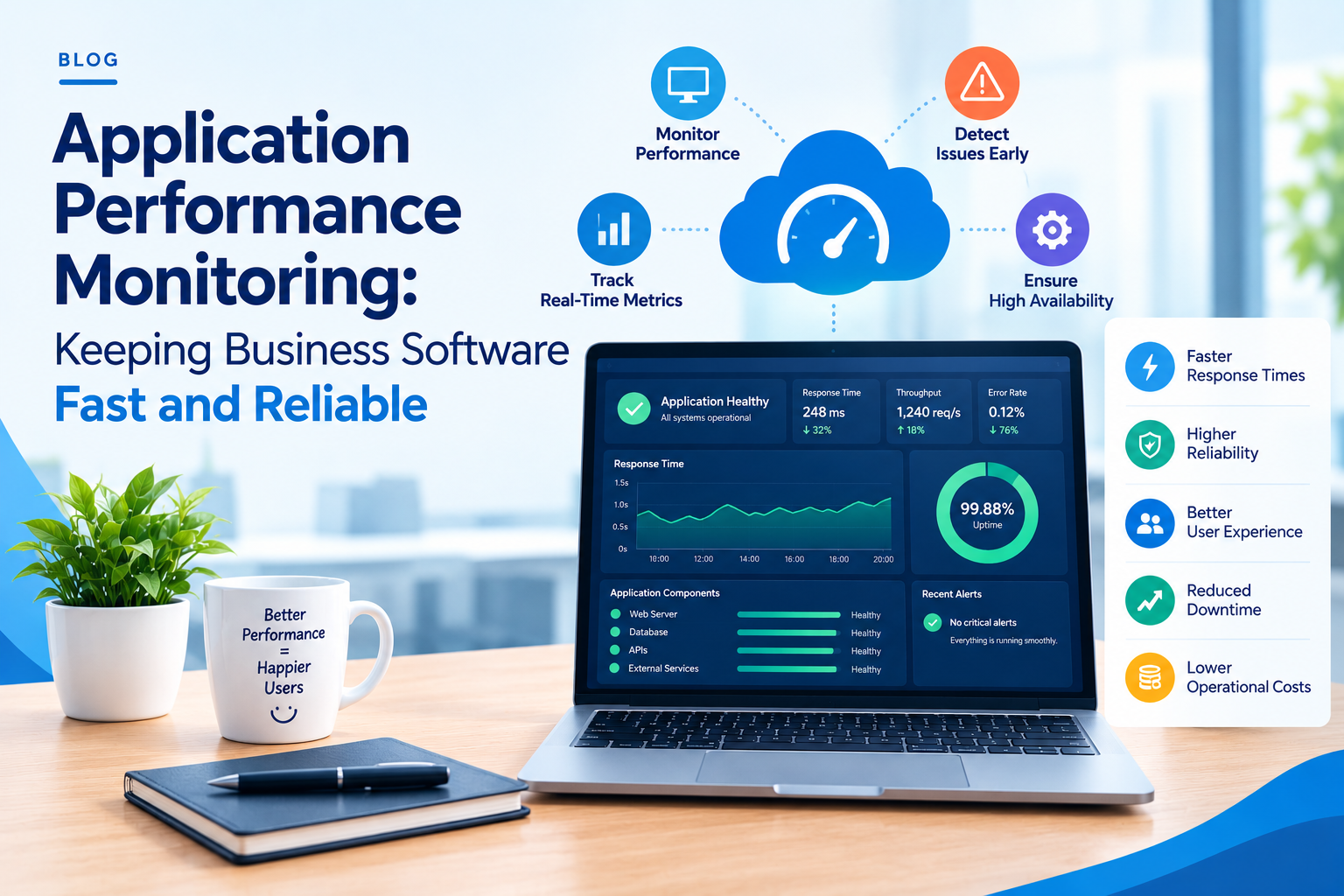
Application Performance Monitoring: Keeping Business Software Fast and Reliable
Application Performance Monitoring: Keeping Business Software Fast and Reliable
Modern businesses depend on software applications for almost every critical operation, from customer management and financial processing to e-commerce, communication, and internal workflows. As these applications become more complex, maintaining speed, stability, and reliability becomes increasingly important.
Even a small performance issue can affect productivity, customer experience, revenue, and brand reputation. This is where Application Performance Monitoring (APM) plays an important role.
Application Performance Monitoring provides businesses with continuous visibility into application performance, helping technical teams identify slowdowns, errors, bottlenecks, and potential failures before they become major problems.
What Is Application Performance Monitoring?
Application Performance Monitoring (APM) is a technology approach used to monitor the performance, availability, and overall health of software applications.
An APM solution collects and analyzes application data such as:
- Response times
- Application errors
- Server performance
- Database queries
- API performance
- User experience
- Infrastructure resource usage
- Transaction performance
This information helps IT teams understand what is happening inside an application and quickly determine the root cause of performance problems.
Why Application Performance Matters for Businesses
Application performance directly affects both employees and customers. A slow application can increase operational delays, while application downtime can interrupt important business processes.
Some key business impacts include:
1. Better Customer Experience
Customers expect websites and applications to respond quickly. Slow page loading, failed transactions, or unresponsive features can lead users to abandon a service.
APM helps businesses identify performance issues that affect the user experience and address them more efficiently.
2. Reduced Downtime
Unexpected application failures can result in lost productivity and revenue. Continuous monitoring allows IT teams to detect abnormal behavior and respond before an issue causes significant downtime.
3. Faster Troubleshooting
Without monitoring, developers may have to investigate multiple systems manually to identify the source of a problem.
APM provides detailed performance information, making it easier to locate problematic services, APIs, databases, or infrastructure components.
4. Improved Application Reliability
Continuous monitoring helps organizations identify recurring issues and performance patterns. Over time, businesses can use this information to improve application architecture and reliability.
5. Better Resource Utilization
APM can reveal whether applications are consuming excessive CPU, memory, database resources, or network capacity.
This helps organizations optimize infrastructure and avoid unnecessary resource consumption.
How Application Performance Monitoring Works
APM typically works by collecting performance information from different layers of an application environment.
Application Monitoring
APM tools track application behavior, execution times, exceptions, and transaction performance.
Infrastructure Monitoring
Servers, containers, virtual machines, and cloud infrastructure can be monitored to identify resource-related performance problems.
Database Monitoring
Slow database queries are a common cause of application performance issues. Monitoring helps identify inefficient queries, database bottlenecks, and connection problems.
API Monitoring
Modern applications often depend on APIs and third-party services. Monitoring API response times and failures helps businesses identify external or internal service-related issues.
User Experience Monitoring
Some APM solutions track real user interactions to determine how customers experience the application in real-world conditions.
Common Application Performance Problems
Businesses can face several application performance challenges, including:
- Slow application response times
- High server resource consumption
- Database bottlenecks
- API failures
- Memory leaks
- Application crashes
- Poorly optimized code
- Network latency
- Increased error rates
- Third-party service failures
Without proper monitoring, these problems may remain hidden until they significantly affect users.
Key Metrics Businesses Should Monitor
Effective APM depends on tracking the right performance indicators.
Response Time
Response time measures how quickly an application responds to user requests. Increasing response times can indicate performance bottlenecks.
Error Rate
Monitoring application errors helps teams identify unstable services and recurring failures.
Throughput
Throughput measures the number of requests or transactions an application handles over a specific period.
Resource Utilization
CPU, memory, storage, and network usage can help identify infrastructure-related bottlenecks.
Database Performance
Query execution time, connection usage, and database errors can reveal database-related problems.
Availability
Application availability measures whether a service is accessible and operational when users need it.
Benefits of Implementing APM
A well-designed APM strategy can provide several long-term benefits:
Proactive Issue Detection: Identify unusual application behavior before it becomes a major incident.
Faster Root-Cause Analysis: Connect application, infrastructure, database, and API performance data to identify the source of an issue.
Improved User Experience: Detect performance problems that directly affect customers.
Higher Productivity: Reduce the time developers and IT teams spend troubleshooting issues.
Better Scalability: Understand application behavior as traffic and workloads increase.
Operational Visibility: Gain a clearer picture of how different components interact within the technology environment.
APM in Cloud and Distributed Environments
Modern applications increasingly operate across cloud platforms, containers, microservices, APIs, and distributed infrastructure. This makes traditional monitoring approaches less effective.
In a distributed architecture, a single user request may pass through multiple services before generating a response. If one component becomes slow, the entire transaction can be affected.
APM helps organizations trace transactions across these environments and understand how individual components contribute to overall application performance.
Application Performance Monitoring and Business Growth
Performance monitoring should not be treated only as an IT responsibility. Application reliability can directly influence business growth.
A faster and more stable application can improve customer satisfaction, employee productivity, operational efficiency, and digital service reliability.
As businesses adopt more cloud services, automation, AI applications, and interconnected systems, performance visibility becomes increasingly important.
Best Practices for Effective APM
Businesses can improve their APM strategy by following a few important practices:
- Define performance objectives based on business requirements.
- Monitor critical applications continuously rather than only during incidents.
- Track user experience alongside infrastructure metrics.
- Set alerts for abnormal performance patterns.
- Monitor APIs and third-party dependencies.
- Analyze historical performance data to identify recurring issues.
- Use distributed tracing for microservices and cloud-native applications.
- Regularly optimize application and database performance.
The Future of Application Performance Monitoring
APM is evolving as applications become more distributed and complex. Artificial intelligence and machine learning are increasingly being used to detect unusual behavior, identify performance patterns, and assist with root-cause analysis.
AI-driven monitoring can help technical teams move from reactive troubleshooting toward more proactive and predictive operations.
Future APM platforms are likely to combine application monitoring, infrastructure monitoring, user experience analytics, observability, and automated intelligence into a more unified approach.
Conclusion
Application Performance Monitoring is essential for businesses that rely on digital applications to deliver products, services, and internal operations. By continuously monitoring application behavior, infrastructure, databases, APIs, and user experience, organizations can detect problems faster and maintain reliable software performance.
As digital environments become more complex, businesses need greater visibility into their technology ecosystem. A strong APM strategy can help organizations improve application reliability, reduce downtime, enhance user experience, and support sustainable digital growth.
For professional software development, IT solutions, and digital technology services, Riotech Softwares helps businesses build, maintain, and optimize technology solutions designed for modern business requirements.
Visit https://riotechsoftwares.com/ to learn more about Riotech Softwares and its technology solutions.