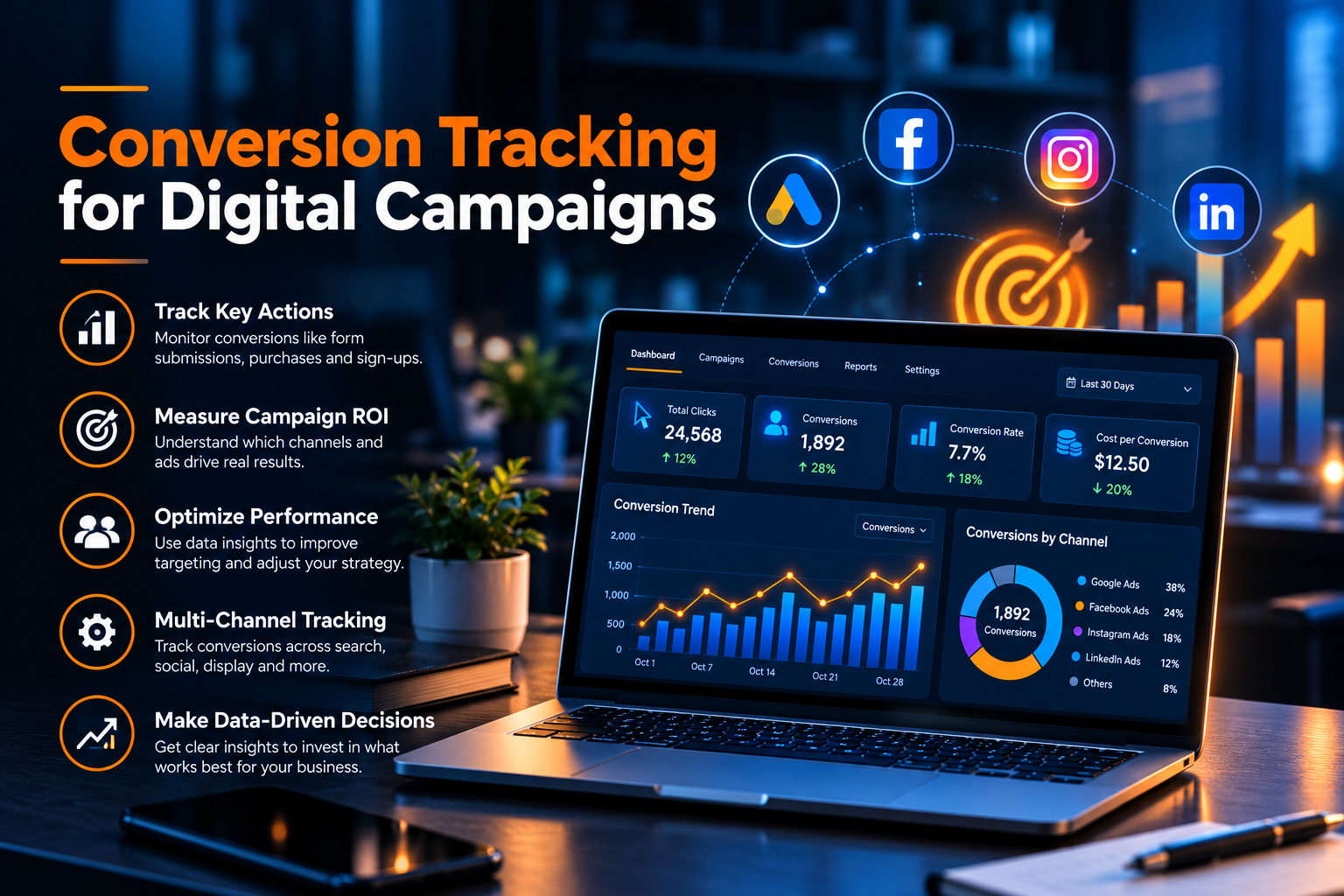
Conversion Tracking for Digital Campaigns
Introduction
Digital marketing campaigns help businesses reach potential customers through search engines, social media, paid advertisements, email marketing, and other online channels. However, campaign success cannot be measured by clicks and impressions alone. Businesses also need to understand whether visitors are taking meaningful actions, such as submitting enquiry forms, making purchases, requesting quotes, or signing up for services.
Conversion tracking helps marketers measure these actions and evaluate how effectively their campaigns achieve business goals. By collecting and analysing conversion data, businesses can identify successful marketing channels, improve campaign performance, and make better decisions about advertising budgets.
To learn more about digital marketing strategies and services, visit https://www.riotechsoftwares.com/digitalmarketing.php.
What Is Conversion Tracking?
Conversion tracking is the process of recording specific actions that users take after interacting with a digital marketing campaign. These actions are known as conversions because they indicate that a visitor has completed a desired step in the customer journey.
Examples of conversions include:
Purchasing a product through an online store.
Submitting a contact or enquiry form.
Calling a business after clicking an advertisement.
Downloading a brochure or resource.
Registering for a webinar or newsletter.
Requesting a consultation or service quotation.
The most relevant conversions depend on the organization's business model and marketing objectives. For an e-commerce business, purchases may be the primary goal, while a service provider may focus on qualified leads and consultation requests.
Why Conversion Tracking Matters in Digital Marketing
1. Measures Campaign Effectiveness
Conversion tracking helps marketers understand whether campaigns are generating meaningful results. A campaign may receive considerable traffic but produce very few enquiries or sales. Tracking conversions provides a clearer picture of performance beyond basic engagement metrics.
By comparing campaign results with established goals, businesses can identify which strategies are delivering value and which require improvement.
2. Improves Advertising Budget Allocation
Marketing budgets are more effective when spending decisions are supported by reliable data. Conversion tracking can reveal which campaigns, keywords, audiences, and platforms generate the most valuable actions.
Marketers can use these insights to adjust budgets, test alternative approaches, and reduce spending on campaigns that consistently underperform.
3. Helps Understand Customer Behaviour
Tracking conversion events provides insight into how users interact with websites and landing pages. Businesses can examine whether visitors click calls to action, complete forms, add products to carts, or leave before finishing an action.
Understanding these behaviours helps marketers identify obstacles in the customer journey and improve the overall user experience.
4. Supports Better Return on Investment
Return on investment (ROI) and related performance metrics help businesses assess the value generated by their marketing activities. When conversion data is connected with campaign costs and, where possible, revenue, marketers can make more informed decisions about future investments.
For paid advertising, metrics such as cost per conversion and return on ad spend can help evaluate campaign efficiency.
Essential Steps for Setting Up Conversion Tracking
Step 1: Define Clear Conversion Goals
Before setting up tracking, determine what success looks like for each campaign. Goals should align with business objectives and the stage of the customer journey.
For example, a lead generation campaign may measure completed enquiry forms, while an online store may track completed purchases. Defining the primary and secondary conversions helps ensure that reporting remains relevant.
Step 2: Choose Suitable Tracking Tools
Different platforms provide different tracking capabilities. Depending on the campaign, marketers may use Google Analytics 4, Google Ads conversion tracking, Google Tag Manager, Meta Pixel, or other platform-specific tools.
The choice should depend on the advertising channels, website setup, privacy requirements, and business goals. Using a consistent tracking plan can help reduce discrepancies between reports.
Step 3: Configure Conversion Events
Once goals and tools are selected, the relevant events must be configured correctly. These may include form submissions, purchases, phone calls, registrations, or other valuable actions.
For example, an enquiry form should ideally record a successful submission rather than count every visit to the page containing the form. E-commerce tracking should capture valid purchase events and the appropriate transaction details.
Step 4: Test Tracking Before Launch
Testing is essential to confirm that conversion events are recorded accurately. Marketers should verify that actions trigger the correct events, that duplicate conversions are not being counted, and that relevant campaign information is captured.
Regular testing after website updates, tag changes, or checkout modifications can help prevent reporting errors.
For assistance with digital marketing planning and campaign performance, visit https://www.riotechsoftwares.com/digitalmarketing.php.
Key Metrics for Campaign Measurement
Conversion tracking becomes more useful when combined with relevant performance metrics.
Conversion Rate
Conversion rate measures the proportion of visits or users that complete a desired action, depending on how the metric is defined.
Formula:
Conversion Rate = (Conversions ÷ Total Visits) × 100
For example, if a landing page receives 1,000 visits and generates 40 form submissions, the conversion rate is 4% when calculated using visits as the denominator.
Cost Per Conversion
Cost per conversion indicates how much a campaign spends to generate a tracked conversion.
Formula:
Cost Per Conversion = Total Campaign Cost ÷ Number of Conversions
This metric helps marketers compare campaign efficiency, provided the conversions being compared have similar definitions and value.
Return on Ad Spend (ROAS)
ROAS measures the revenue attributed to advertising relative to advertising expenditure.
Formula:
ROAS = Attributed Advertising Revenue ÷ Advertising Spend
For example, if a campaign generates ₹50,000 in attributed revenue from ₹10,000 in advertising spend, its ROAS is 5:1. This does not automatically represent profit because other business costs must also be considered.
Lead Quality
For lead generation campaigns, conversion volume alone may not show the full picture. A campaign that produces fewer but more relevant enquiries may deliver greater business value than one generating many unqualified leads.
Where possible, connect campaign data with CRM or sales outcomes to understand which channels generate meaningful business opportunities.
How Conversion Tracking Improves Campaign Optimization
Conversion tracking allows marketers to move from assumptions to evidence-based decisions. When the data shows that a particular audience, keyword, creative, or landing page generates stronger results, marketers can investigate why it performs well and test ways to improve it further.
For example, a business may discover that one advertising campaign generates many clicks but few enquiries. By reviewing landing page content, form usability, audience relevance, and conversion data, the team can identify possible causes and test improvements.
Continuous measurement also helps businesses evaluate changes over time. Rather than making decisions based on a single result, marketers should consider trends, sample size, lead quality, and external factors before changing campaign strategies.
Explore digital marketing solutions at https://www.riotechsoftwares.com/digitalmarketing.php.
Need for Conversion Tracking in Digital Campaigns
Businesses need conversion tracking to understand whether their digital marketing investments are producing valuable outcomes. Without reliable measurement, marketers may struggle to identify effective channels, evaluate advertising costs, or understand where potential customers leave the conversion journey.
A structured tracking process connects campaign activity with business objectives and provides useful information for planning, reporting, and optimization.
Transform Your Campaign Measurement Strategy
A well-planned conversion tracking strategy can transform campaign reporting from a collection of clicks and impressions into a clearer view of customer actions and business performance. By setting meaningful goals, implementing accurate event tracking, and reviewing the right metrics, organizations can identify opportunities to improve campaign effectiveness.
Combining reliable analytics with continuous testing and optimization helps businesses make informed marketing decisions. For digital marketing support and campaign improvement strategies, visit https://www.riotechsoftwares.com/digitalmarketing.php.
Conclusion
Conversion tracking is an important part of effective digital marketing because it helps businesses measure results, understand customer behaviour, and allocate budgets more intelligently. From form submissions and phone calls to online purchases and qualified leads, tracking the right actions makes campaign performance easier to evaluate.
With clear objectives, accurate implementation, regular testing, and consistent analysis, organizations can improve campaign measurement and build stronger data-driven marketing strategies.
Useful Resources
Digital marketing services: https://www.riotechsoftwares.com/digitalmarketing.php
Google Analytics and conversion measurement
Campaign performance analysis and optimization
Visit Website
Explore digital marketing services and solutions at https://www.riotechsoftwares.com/digitalmarketing.php.
Recent Posts
10 Oct 2026