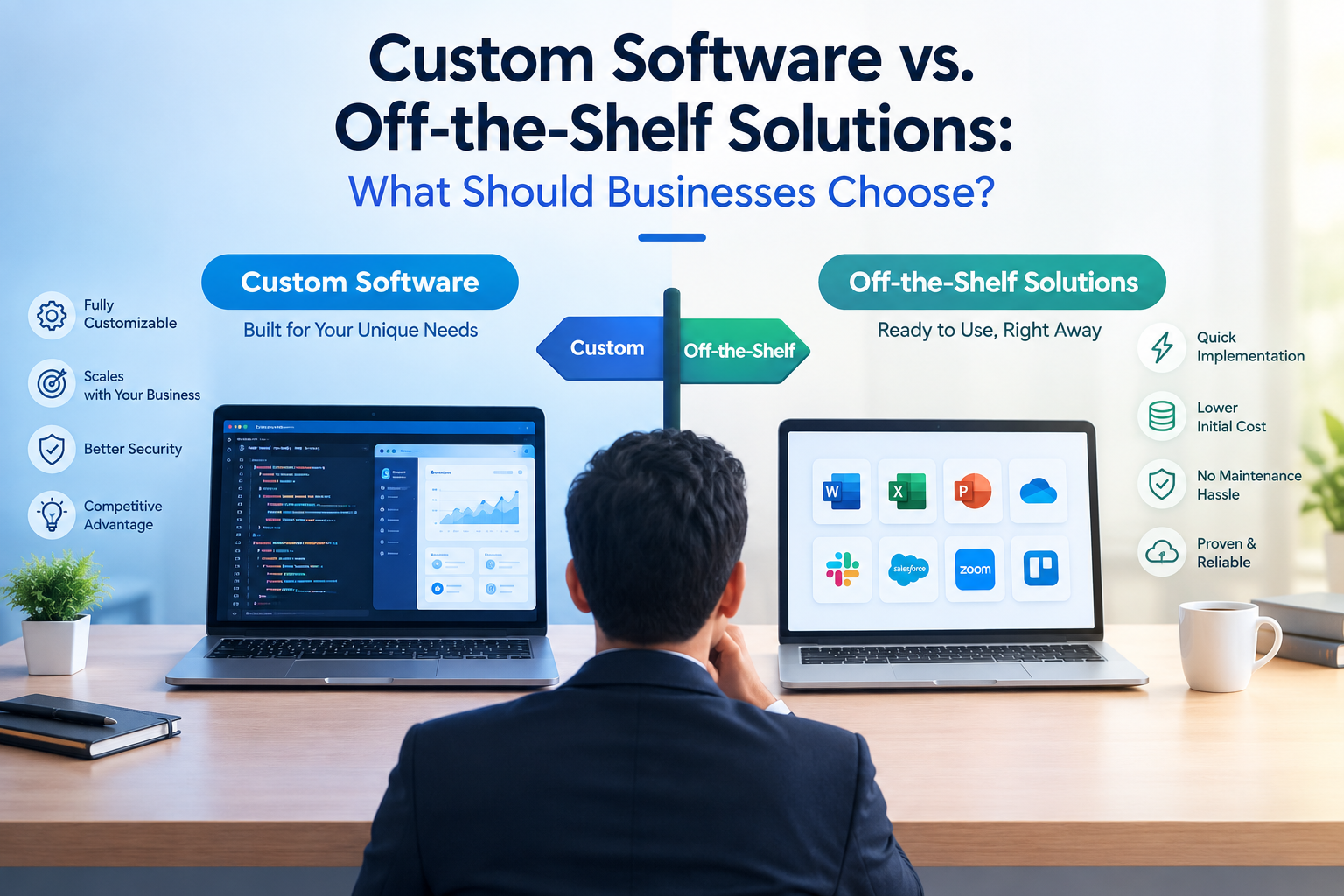
Custom Software vs. Off-the-Shelf Solutions: What Should Businesses Choose?
Custom Software vs. Off-the-Shelf Solutions: What Should Businesses Choose?
Choosing the right software can have a significant impact on a company's productivity, operational efficiency, customer experience, and long-term growth.
Today, businesses generally have two major options: custom software development or off-the-shelf software solutions.
Off-the-shelf software is pre-built for a broad range of businesses and can usually be deployed quickly. Custom software, on the other hand, is developed specifically around an organization's processes, requirements, and long-term objectives.
So, which approach is better?
The answer depends on the business's budget, requirements, scalability, integration needs, security expectations, and growth plans.
What Is Off-the-Shelf Software?
Off-the-shelf software is a ready-made application developed for a large number of users or businesses.
Examples include software for:
- Customer relationship management
- Accounting
- Project management
- Human resources
- Communication
- Marketing
- Inventory management
- Business collaboration
The primary advantage is convenience. Businesses can typically subscribe to or purchase an existing solution and begin using it without building the entire system from scratch.
Benefits of Off-the-Shelf Software
1. Faster Deployment
Ready-made software can often be implemented much faster than developing a completely new application.
2. Lower Initial Cost
Businesses generally avoid the large upfront development investment associated with custom software.
3. Established Features
Popular software products often provide a wide range of features that have already been developed and tested across many users.
4. Regular Updates
Many software providers continuously release updates, security improvements, and new functionality.
5. Vendor Support
Businesses may receive technical support, documentation, training, and other services from the software provider.
What Is Custom Software Development?
Custom software is developed specifically for an individual business or organization.
Instead of adapting business processes to an existing application, the software is designed around the company's actual requirements.
Custom software can be developed for areas such as:
- CRM
- ERP
- Fintech
- Healthcare
- Logistics
- E-commerce
- Education
- Manufacturing
- Enterprise operations
- Customer portals
- Mobile applications
For example, a company with a unique sales workflow may require a CRM that integrates directly with its internal database, ERP, customer portal, and reporting system.
A generic CRM may not provide that exact workflow.
Custom development can be designed specifically for it.
Custom Software vs. Off-the-Shelf Software
| Factor | Custom Software | Off-the-Shelf Software |
|---|---|---|
| Development | Built specifically for the business | Pre-built |
| Initial cost | Usually higher | Usually lower |
| Deployment | Generally takes longer | Usually faster |
| Customization | High | Limited to available options |
| Scalability | Can be designed around growth | Depends on vendor |
| Integration | Can be tailored to requirements | Depends on available integrations |
| Control | Greater control | Vendor-controlled |
| Maintenance | Business/development partner responsibility | Usually vendor-managed |
| Unique workflows | Excellent fit | May require compromises |
| Long-term flexibility | High | Depends on product roadmap |
When Should Businesses Choose Off-the-Shelf Software?
Off-the-shelf software can be a good option when a company's requirements are relatively standard.
For example, if a business simply needs:
- Basic accounting
- Standard project management
- Team communication
- Email marketing
- Basic CRM functionality
- Common HR processes
a ready-made solution may provide everything required.
Businesses should consider off-the-shelf software when speed, simplicity, and predictable initial costs are more important than complete customization.
When Should Businesses Choose Custom Software?
Custom software becomes more attractive when a business has unique or complex requirements.
1. Unique Business Processes
If your business operates differently from standard industry workflows, a generic application may force employees to change their processes.
Custom software can be designed around the existing workflow.
2. Complex Integrations
Businesses often use multiple systems.
For example:
CRM + ERP + Payment Gateway + Website + Mobile App + Analytics
If existing software cannot integrate effectively with these systems, custom development may provide a better solution.
3. Scalability Requirements
Growing businesses may need software that can evolve as their operations expand.
Custom applications can be designed with future requirements in mind.
4. Specialized Features
Some businesses require functionality that is not available in standard software.
Examples include:
- Industry-specific workflows
- Advanced dashboards
- Specialized reporting
- Complex approval systems
- Custom pricing engines
- Automated business processes
5. Greater Control
Custom software gives businesses more control over functionality, integrations, user roles, and development priorities.
Cost: Which Option Is Cheaper?
This is one of the most common questions businesses ask.
At first glance, off-the-shelf software usually appears cheaper.
However, businesses should evaluate total cost of ownership, not just initial cost.
An off-the-shelf solution may involve:
- Monthly or annual subscriptions
- Additional user fees
- Premium feature charges
- Integration costs
- Customization expenses
- Migration costs
- Vendor-dependent pricing
Custom software typically involves greater initial development investment but may provide greater control over long-term functionality.
Therefore, the cheapest option initially is not always the most cost-effective option over several years.
Scalability and Business Growth
Software should support business growth rather than become a limitation.
An off-the-shelf product may work well for a small company but become restrictive when the business requires:
- More users
- More data
- New workflows
- Advanced automation
- Additional integrations
- International operations
- Specialized reporting
Custom software can be architected around expected growth.
However, scalability still depends on good software architecture, infrastructure, testing, and ongoing maintenance. Custom development does not automatically guarantee scalability.
Integration: A Major Decision Factor
Modern businesses rarely operate using a single application.
A typical organization may have:
Website → CRM → ERP → Payment System → Accounting → Analytics
If these systems cannot communicate effectively, employees may need to manually transfer information between platforms.
API-based integrations can help connect business applications and automate data exchange.
Custom software can be particularly useful when a business requires specialized integrations that standard software does not support.
Security Considerations
Security is another important factor.
Off-the-shelf software providers may invest heavily in security because their products serve many customers. However, businesses still need to evaluate the provider's security practices, access controls, data handling, compliance, and integration architecture.
With custom software, businesses have greater control over how the application is designed and integrated, but they also have greater responsibility for ensuring that security is properly implemented.
Important areas include:
- Authentication
- Authorization
- Encryption
- Secure APIs
- Access controls
- Data protection
- Logging
- Monitoring
- Vulnerability management
Security should be considered throughout the development lifecycle rather than added after the software is completed.
Custom Software Does Not Mean Building Everything From Scratch
A common misconception is that custom software requires every component to be developed from zero.
Modern software development can combine:
- Open-source technologies
- Cloud services
- APIs
- Third-party platforms
- AI services
- Databases
- Development frameworks
- Reusable components
This allows development teams to create customized solutions while still leveraging established technologies.
The goal is to build only what creates specific business value.
The Hybrid Approach
Businesses do not always have to choose between completely custom software and completely off-the-shelf software.
A hybrid approach can combine both.
For example:
Ready-made CRM + Custom Integration Layer + Custom Customer Portal + Business Automation
This approach can allow businesses to use established products for standard functionality while developing custom components for unique requirements.
For many growing organizations, this can be a practical middle ground.
How to Decide Which Solution Is Right for Your Business
Before making a decision, businesses should evaluate the following questions:
1. Are Your Business Processes Standard or Unique?
If your workflows are standard, off-the-shelf software may be sufficient.
If they are highly specialized, custom software may provide greater value.
2. How Important Is Speed?
If you need software immediately, a ready-made solution may be preferable.
If long-term flexibility is more important, custom development may be worth the additional development time.
3. How Complex Are Your Integrations?
If you need multiple systems to work together, evaluate the integration capabilities of both options carefully.
4. What Is Your Long-Term Growth Plan?
Consider where the business will be in three to five years, not only what it needs today.
5. What Is the Total Cost?
Compare development or subscription costs along with:
- Maintenance
- Integrations
- Upgrades
- Training
- Migration
- Support
- Scaling
6. Do You Need a Competitive Advantage?
If software functionality is directly connected to your competitive advantage, custom development may provide more flexibility.
A Simple Decision Framework
Businesses can use this general framework:
Choose Off-the-Shelf Software when:
- Requirements are standard
- Deployment needs to be fast
- Budget is limited
- Existing features meet business needs
- Extensive customization is unnecessary
Choose Custom Software when:
- Requirements are unique
- Existing software creates workflow limitations
- Multiple complex integrations are required
- Specialized features are essential
- Long-term flexibility is important
- Software is strategically important to the business
Choose a Hybrid Approach when:
- Standard software covers most requirements
- A few areas require significant customization
- Existing platforms offer useful integrations
- The business wants to control development costs
The Role of AI in Modern Software Development
Artificial intelligence is also changing how businesses approach software development.
AI can support software projects through:
- Intelligent automation
- Predictive analytics
- AI-powered customer support
- Document processing
- Data analysis
- Recommendation systems
- Workflow automation
- AI agents
This means businesses should consider not only whether software should be custom or ready-made, but also where AI can create additional business value.
For example, a custom CRM could incorporate AI-powered lead scoring, automated customer summaries, intelligent recommendations, or workflow automation.
The Future of Business Software
The future of business software is likely to be increasingly connected, intelligent, and modular.
Organizations will continue to combine:
Cloud + APIs + AI + Automation + Custom Development + SaaS
Rather than choosing one technology for everything, businesses can create technology ecosystems where different systems work together.
The key is selecting an architecture that aligns technology investment with business objectives.
How Riotech Can Help
Choosing between custom software and off-the-shelf solutions requires more than comparing features and prices.
Businesses need to evaluate their workflows, integrations, scalability requirements, security needs, and long-term technology strategy.
Riotech provides software development and technology solutions designed around business requirements.
From custom software development and web applications to mobile apps, API integrations, fintech solutions, cloud technologies, and business automation, Riotech can help organizations evaluate and implement technology that supports their operational and growth objectives.
Explore Riotech's technology solutions at:
https://www.riotechsoftwares.com/
Conclusion
There is no single software solution that is right for every business.
Off-the-shelf software can provide speed, convenience, and lower initial investment when standard functionality is sufficient.
Custom software can provide flexibility, specialized functionality, deeper integrations, and greater control when business requirements are unique.
For some organizations, a hybrid approach may provide the best balance.
The right decision should ultimately be based on business requirements rather than technology trends.
Before investing in software, businesses should ask a simple question:
"Does this technology adapt to our business, or will our business have to adapt to the technology?"
The answer can help determine whether custom software, off-the-shelf software, or a combination of both is the right choice for long-term growth.