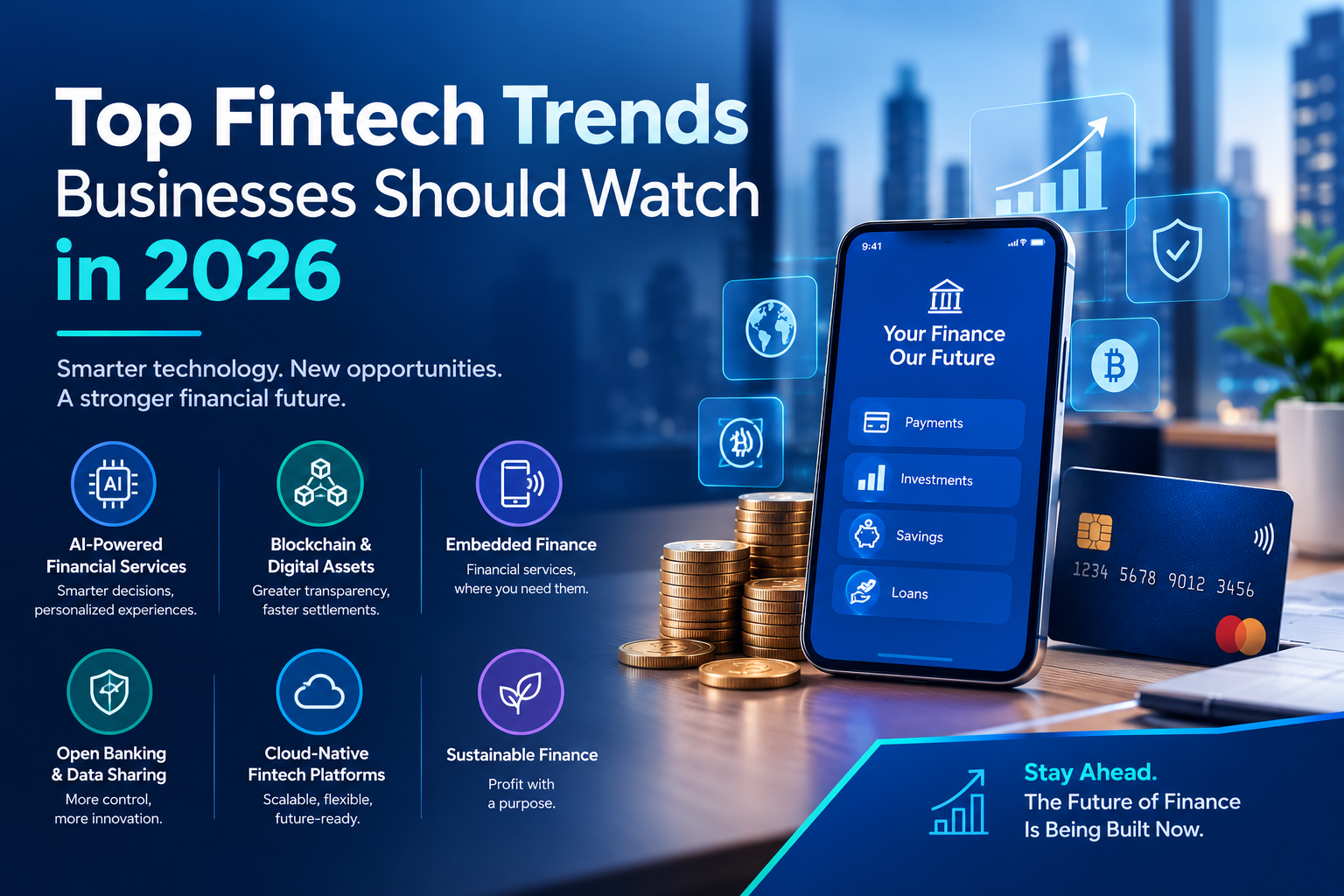
Top Fintech Trends Businesses Should Watch in 2026
Top Fintech Trends Businesses Should Watch in 2026
The financial technology industry is entering a new phase in 2026. Financial services are no longer being transformed by digitalization alone. Artificial intelligence, automation, cloud computing, embedded finance, blockchain, real-time payments, and advanced cybersecurity are increasingly becoming important components of modern financial ecosystems.
For banks, fintech companies, insurers, payment providers, and businesses offering financial products, understanding these trends is essential for staying competitive.
The biggest opportunity is not simply adopting new technology. It is finding the right technologies that can improve customer experience, operational efficiency, security, compliance, and financial decision-making.
1. Artificial Intelligence Is Becoming Central to Fintech
Artificial intelligence is one of the most important fintech trends in 2026.
Financial organizations can use AI to analyze large datasets, identify patterns, automate repetitive tasks, personalize services, and support decision-making.
Common applications include:
- Fraud detection
- Credit risk analysis
- Customer support
- Financial forecasting
- Document processing
- Personalized financial recommendations
- Compliance monitoring
- Transaction analysis
AI is also becoming increasingly integrated into business workflows rather than being used only as a standalone chatbot.
2. AI Agents Are Moving Toward Financial Workflows
AI agents represent another emerging development in fintech.
Unlike traditional chatbots that primarily answer questions, AI agents can be designed to perform multi-step tasks using connected systems and APIs.
For example, an AI-powered financial workflow could:
- Receive a customer request.
- Verify relevant information.
- Retrieve account data.
- Analyze the request.
- Apply predefined business rules.
- Update the appropriate system.
- Escalate the case when human approval is required.
This could help financial organizations automate complex operational processes while maintaining defined controls and oversight.
3. Intelligent Automation Is Reducing Manual Processes
Fintech organizations manage many repetitive activities, from document processing to transaction reconciliation.
Automation combined with AI can help reduce manual intervention.
Potential applications include:
- Invoice processing
- Customer onboarding
- KYC workflows
- Reconciliation
- Report generation
- Data validation
- Payment processing
- Document classification
The objective is not automation for its own sake. Businesses should focus on processes where automation can deliver measurable improvements in speed, accuracy, and cost efficiency.
4. Embedded Finance Is Expanding
Embedded finance allows financial products and services to be integrated directly into non-financial digital platforms.
Instead of requiring customers to visit a separate banking or financial application, financial functionality can become part of the platform they already use.
Examples include:
- Embedded payments
- Embedded lending
- Digital insurance
- Business banking services
- Buy-now-pay-later solutions
- Financial accounts within software platforms
This trend creates opportunities for technology companies to integrate financial capabilities directly into their products.
5. Real-Time Payments Are Becoming More Important
Customers and businesses increasingly expect transactions to happen quickly.
Real-time payment infrastructure can enable faster transfers, improved cash-flow management, and better transaction visibility.
For businesses, faster payments can potentially improve:
- Cash-flow management
- Customer convenience
- Payment reconciliation
- Transaction visibility
- Operational efficiency
As instant payment systems continue to develop globally, businesses need technology architectures capable of supporting secure and scalable payment experiences.
6. Open Banking and API-Based Finance
Open banking continues to encourage greater connectivity between financial institutions, technology providers, and third-party applications.
APIs allow systems to exchange data and services in a structured way.
Businesses can use financial APIs for applications such as:
- Account verification
- Payment initiation
- Financial data aggregation
- Transaction analysis
- Identity verification
- Lending workflows
API-driven financial ecosystems can help businesses build new financial products without developing every underlying capability from scratch.
7. Blockchain Is Moving Beyond Cryptocurrency
Blockchain remains relevant to fintech, but its business applications extend beyond cryptocurrencies.
Organizations are exploring blockchain for:
- Digital identity
- Asset tokenization
- Cross-border transactions
- Smart contracts
- Record management
- Supply-chain finance
- Transaction verification
One particularly interesting area is asset tokenization, where real-world assets can be represented digitally and managed using blockchain-based infrastructure.
For businesses, the value of blockchain depends on whether it solves a genuine problem involving trust, transparency, ownership, or transaction coordination.
8. Cloud Technology Is Powering Scalable Fintech Platforms
Cloud computing has become a critical component of modern financial technology infrastructure.
Cloud platforms can help businesses build systems that are:
- Scalable
- Flexible
- Accessible
- Easier to integrate
- Faster to deploy
Modern fintech applications may use cloud infrastructure for databases, analytics, APIs, AI workloads, application hosting, and security services.
However, financial organizations must carefully manage data protection, compliance, availability, and access controls when moving sensitive workloads to cloud environments.
9. Cybersecurity Is Becoming a Strategic Priority
As financial services become increasingly digital, cybersecurity becomes more important.
Fintech organizations are attractive targets because they handle valuable financial and personal information.
Businesses need to protect:
- Customer information
- Payment data
- Financial records
- Authentication systems
- APIs
- Cloud infrastructure
- Digital identities
Modern security strategies increasingly involve technologies and practices such as zero-trust principles, multi-factor authentication, encryption, continuous monitoring, identity management, and automated threat detection.
Security should be integrated into fintech architecture from the beginning rather than added after deployment.
10. RegTech Is Helping Businesses Manage Compliance
Financial organizations operate in highly regulated environments.
Regulatory technology, commonly known as RegTech, uses technology to make compliance processes more efficient.
AI and automation can assist with:
- Compliance monitoring
- Transaction monitoring
- Risk assessment
- Regulatory reporting
- Customer verification
- Document analysis
- Suspicious activity detection
Automated compliance processes can help organizations manage large volumes of financial data while reducing repetitive manual work.
11. Personalized Financial Experiences
Customers increasingly expect financial services to be personalized.
AI and data analytics can help businesses understand customer behavior and provide more relevant experiences.
For example, financial platforms can potentially use customer data to provide:
- Personalized product recommendations
- Customized financial insights
- Relevant offers
- Spending analysis
- Personalized notifications
However, personalization must be balanced with transparency, privacy, and responsible use of customer data.
12. Fintech Cybersecurity and Fraud Detection Will Evolve
Fraud techniques are becoming increasingly sophisticated.
Traditional rule-based fraud detection may not always be sufficient for identifying new patterns.
AI and machine learning can analyze transaction behavior and identify anomalies that may indicate fraudulent activity.
Potential applications include:
- Transaction monitoring
- Account takeover detection
- Payment fraud prevention
- Identity verification
- Behavioral analysis
- Anomaly detection
Combining AI with human investigation can provide a stronger approach to managing financial fraud.
13. Digital Identity and Smarter KYC
Digital identity technologies are becoming increasingly important for financial services.
Customer onboarding traditionally requires significant documentation and verification.
AI, biometrics, digital identity platforms, and automated verification systems can help streamline these processes.
A modern digital onboarding workflow could include:
Identity submission → Verification → Risk assessment → Compliance checks → Account creation
The challenge is ensuring that faster onboarding does not compromise security or regulatory requirements.
How Businesses Can Prepare for Fintech Trends in 2026
Businesses do not need to adopt every new fintech technology.
Instead, organizations should begin by identifying specific business challenges.
Step 1: Identify Operational Bottlenecks
Find processes that are slow, expensive, repetitive, or error-prone.
Step 2: Evaluate Technology Opportunities
Determine whether AI, automation, APIs, cloud technology, blockchain, or analytics could address the problem.
Step 3: Modernize the Technology Architecture
Legacy systems can make it difficult to implement new financial technologies. API-based integration and modular architecture can help organizations gradually modernize their infrastructure.
Step 4: Prioritize Security
Financial technology solutions must be designed with security, privacy, and access controls in mind.
Step 5: Start Small and Scale
Instead of attempting a complete transformation immediately, businesses can begin with a controlled pilot project and expand after measuring results.
The Future of Fintech in 2026 and Beyond
The fintech industry is moving toward a more connected and intelligent ecosystem.
The convergence of:
AI + Automation + APIs + Cloud + Blockchain + Real-Time Payments + Cybersecurity
can create new opportunities for financial institutions and technology-driven businesses.
The most successful organizations will not necessarily be those that adopt the largest number of technologies. They will be the organizations that understand which technology solves which business problem.
Fintech is increasingly becoming an essential part of digital business infrastructure rather than a separate technology category.
How Riotech Can Help
Modern fintech solutions require a combination of technology expertise, secure development, integration capabilities, and a clear understanding of business requirements.
Riotech helps businesses leverage modern technology to develop scalable digital solutions, automate processes, integrate systems, and improve operational efficiency.
Whether your organization is exploring AI-powered applications, business automation, fintech solutions, API integration, cloud technologies, or custom software development, choosing the right technology architecture is essential for long-term growth.
Explore technology solutions with Riotech:
https://www.riotech.com/
Conclusion
Fintech in 2026 is being shaped by more than digital payments and mobile banking.
Artificial intelligence, AI agents, intelligent automation, embedded finance, open banking, blockchain, cloud computing, cybersecurity, and RegTech are creating new possibilities for businesses across the financial ecosystem.
Organizations that strategically adopt these technologies can improve efficiency, strengthen customer experiences, reduce operational complexity, and create new digital services.
The key is to focus on business value.
The future of fintech belongs to businesses that combine financial expertise with intelligent, secure, and scalable technology.