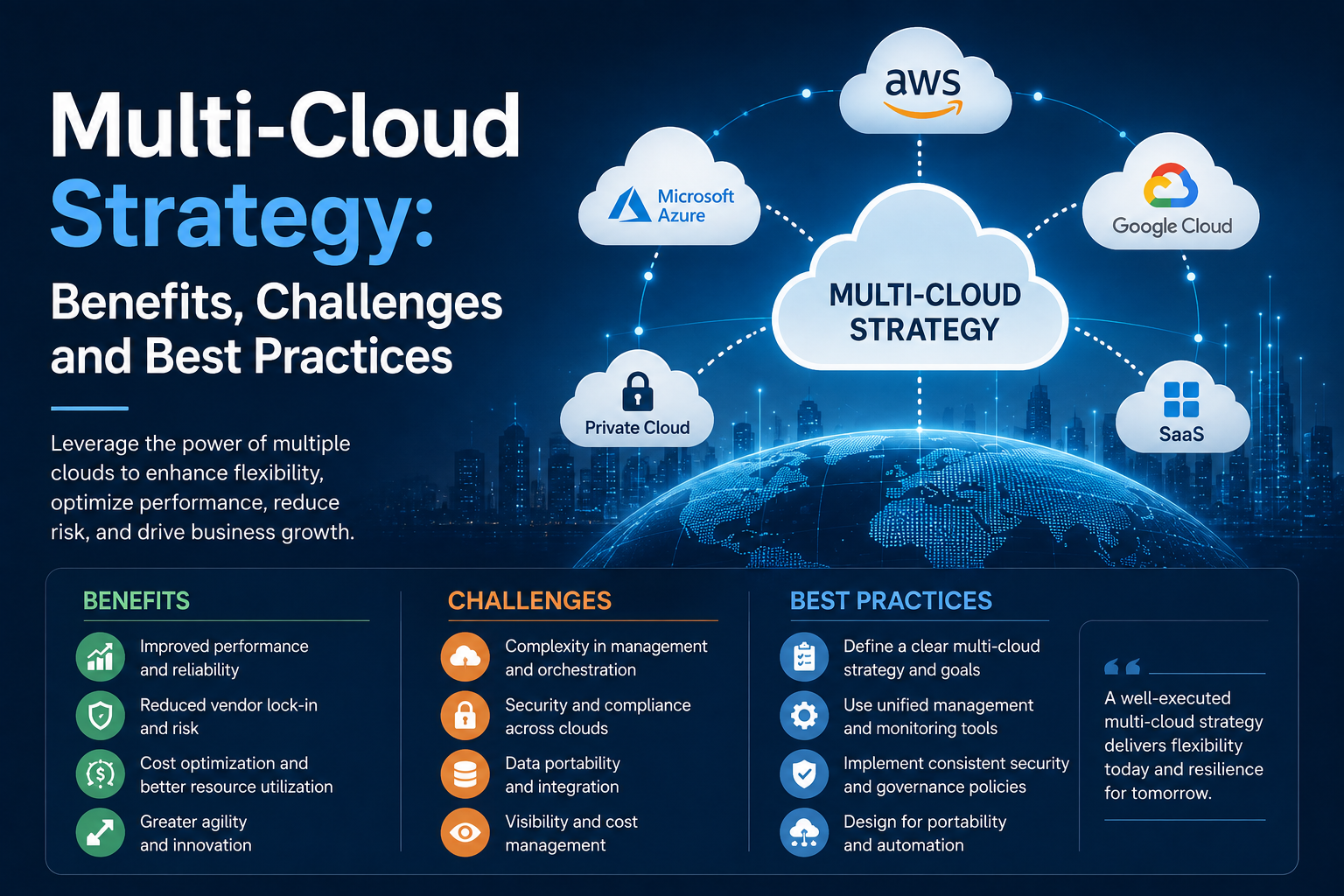
Multi-Cloud Strategy: Benefits, Challenges and Best Practices
Multi-Cloud Strategy: Benefits, Challenges and Best Practices
Cloud computing has transformed how businesses build, deploy, and manage digital applications. As organizations increasingly depend on cloud infrastructure, many are moving beyond a single cloud provider and adopting a multi-cloud strategy.
A multi-cloud approach allows businesses to use services from two or more cloud providers based on their specific technical, operational, security, and business requirements. Instead of depending entirely on one platform, organizations can distribute workloads across different cloud environments.
However, using multiple cloud providers also introduces additional complexity. Without proper planning, businesses can face higher costs, security challenges, fragmented operations, and difficulties managing applications across different platforms.
A successful multi-cloud strategy therefore requires more than simply using multiple cloud providers. It requires careful architecture, governance, security, monitoring, and cost management.
What Is a Multi-Cloud Strategy?
A multi-cloud strategy is an approach in which an organization uses cloud services from multiple cloud providers.
For example, a business might use one provider for application hosting, another for analytics, and another for specialized database or AI services.
The objective is to select the best environment for each workload rather than forcing every application onto a single platform.
A multi-cloud environment may include:
- Cloud infrastructure
- Managed databases
- Storage services
- AI and machine learning platforms
- Analytics services
- Application hosting
- Backup and disaster recovery
- Security services
- Development and testing environments
Multi-cloud is different from hybrid cloud. Hybrid cloud generally combines private infrastructure with public cloud environments, while multi-cloud specifically involves multiple cloud providers. An organization can also use both approaches simultaneously.
Why Are Businesses Adopting Multi-Cloud?
Businesses are increasingly looking for flexibility in how they deploy and operate technology.
Depending entirely on one cloud provider can create operational dependencies. A multi-cloud strategy can provide alternatives when business requirements change.
Organizations may adopt multi-cloud to:
- Reduce vendor dependency
- Improve business continuity
- Meet regional requirements
- Access specialized cloud services
- Improve application performance
- Support geographic expansion
- Optimize infrastructure costs
- Increase resilience
- Support different business workloads
However, multi-cloud should not be adopted simply because it is a technology trend. Businesses need a clear strategic reason for using multiple providers.
Key Benefits of a Multi-Cloud Strategy
1. Reduced Vendor Lock-In
One of the biggest advantages of multi-cloud is reduced dependency on a single provider.
When applications, data, and workloads are designed around one platform's proprietary services, migrating away can become difficult and expensive.
Using multiple cloud environments can give organizations greater flexibility when evaluating infrastructure options.
However, avoiding lock-in completely can be difficult, especially when applications depend heavily on provider-specific services.
2. Improved Business Resilience
Multi-cloud architecture can improve resilience by distributing workloads across different environments.
If a significant issue affects one cloud environment, organizations with appropriate architecture and disaster-recovery planning may be able to shift critical workloads to another environment.
This can help reduce the impact of infrastructure disruptions.
However, simply having multiple cloud accounts does not automatically create resilience. Applications, data replication, networking, and recovery procedures must be designed accordingly.
3. Access to Specialized Services
Different cloud providers offer different strengths and services.
A business can select platforms based on specific requirements, such as:
- Artificial intelligence
- Machine learning
- Data analytics
- High-performance computing
- Enterprise databases
- Application development
- Global infrastructure
This allows businesses to choose technology based on workload requirements rather than adopting a one-size-fits-all approach.
4. Greater Flexibility
Multi-cloud gives organizations more options when their business requirements change.
For example, a company expanding into a new geographic market may select a provider based on regional infrastructure availability, compliance requirements, or latency considerations.
This flexibility can be particularly useful for growing businesses with diverse technology requirements.
5. Potential Cost Optimization
Multi-cloud can create opportunities to optimize infrastructure costs by comparing pricing and services across providers.
Organizations can identify which platforms provide better economics for particular workloads.
However, multi-cloud does not automatically reduce costs.
Running multiple environments can actually increase expenses if organizations fail to monitor usage, duplicate services, or maintain unnecessary infrastructure.
Cost optimization therefore requires continuous monitoring and governance.
6. Better Geographic Coverage
Cloud providers have different infrastructure footprints across regions.
Businesses operating internationally can use multiple providers to improve application availability and performance in specific markets.
This can help organizations design infrastructure closer to their customers and meet regional business requirements.
Challenges of a Multi-Cloud Strategy
Although multi-cloud offers significant advantages, it also introduces several challenges.
1. Increased Complexity
Managing multiple cloud environments is more complicated than managing a single platform.
IT teams need to understand different:
- Management consoles
- APIs
- Security models
- Networking systems
- Identity platforms
- Monitoring tools
- Pricing structures
Without standardization, operational complexity can grow quickly.
2. Security Management
Security becomes more complicated when workloads and data are distributed across multiple environments.
Organizations need consistent policies for:
- Identity and access management
- Encryption
- Network security
- Vulnerability management
- Logging
- Compliance
- Data protection
A security policy that works in one environment may not automatically translate to another.
Centralized governance and security monitoring are therefore essential.
3. Cost Visibility
Tracking costs across multiple providers can be difficult.
Each provider may use different pricing models, billing structures, discounts, and service classifications.
Businesses need centralized cost monitoring to understand:
What are we spending, where are we spending it, and why?
Cloud FinOps practices can help organizations improve cost visibility and accountability.
4. Data Management
Moving data between cloud providers can create technical and financial challenges.
Large datasets may require significant bandwidth, time, and infrastructure resources to transfer.
Businesses should carefully consider:
- Data residency
- Data replication
- Backup
- Disaster recovery
- Data transfer costs
- Data synchronization
- Compliance requirements
before distributing data across multiple environments.
5. Skills and Talent Requirements
A multi-cloud environment requires professionals who understand multiple cloud platforms and their associated technologies.
Organizations may need expertise in:
- Cloud architecture
- DevOps
- Kubernetes
- Networking
- Cybersecurity
- Infrastructure as Code
- Cloud monitoring
- Automation
Training existing teams or working with experienced technology partners can help address these challenges.
6. Application Portability
Applications built heavily around proprietary cloud services may be difficult to move between providers.
Businesses should determine which workloads need portability and which can benefit from provider-specific capabilities.
Trying to make every application completely cloud-agnostic can sometimes increase development and operational complexity unnecessarily.
Best Practices for Implementing a Multi-Cloud Strategy
1. Start With Business Objectives
Technology should follow business requirements.
Before selecting cloud providers, identify the primary objectives.
Ask:
- Why do we need multiple clouds?
- Which business problems are we solving?
- Which workloads require multiple environments?
- What are our resilience requirements?
- What are our compliance obligations?
- What level of portability do we need?
Clear objectives create a stronger foundation for the strategy.
2. Classify Your Workloads
Not every application needs to run across multiple cloud providers.
Classify workloads according to factors such as:
- Business criticality
- Performance
- Security
- Compliance
- Data sensitivity
- Scalability
- Portability
- Cost
This helps determine which workloads should remain in a single environment and which may benefit from multi-cloud deployment.
3. Establish Centralized Governance
Organizations should establish consistent governance across cloud environments.
Governance should address:
- Access management
- Security policies
- Resource provisioning
- Compliance
- Naming conventions
- Data management
- Cost controls
- Monitoring
Centralized governance provides greater visibility and reduces configuration inconsistencies.
4. Use Infrastructure as Code
Infrastructure as Code (IaC) can help organizations standardize cloud deployments.
Tools and practices based on IaC allow infrastructure configurations to be defined through code and managed consistently.
This can improve:
- Deployment consistency
- Automation
- Version control
- Disaster recovery
- Infrastructure documentation
It can also make large-scale infrastructure changes easier to manage.
5. Standardize Monitoring and Observability
Organizations need visibility across all cloud environments.
A strong observability strategy should monitor:
- Application performance
- Infrastructure health
- Security events
- Availability
- Resource utilization
- Network performance
- Costs
Centralized dashboards and alerts can help teams identify problems before they significantly affect business operations.
6. Build a Strong Identity Strategy
Identity should be treated as a core component of multi-cloud security.
Organizations should establish centralized identity principles and enforce:
- Least-privilege access
- Multi-factor authentication
- Role-based access
- Privileged access controls
- Regular access reviews
Consistent identity management reduces the risk of unauthorized access across cloud environments.
7. Automate Wherever Possible
Manual cloud management becomes increasingly difficult as the number of environments grows.
Automation can help with:
- Application deployment
- Infrastructure provisioning
- Security checks
- Compliance monitoring
- Backups
- Scaling
- Cost controls
- Incident response
Automation improves consistency while reducing repetitive operational work.
8. Develop a Cloud Cost Management Strategy
Cost optimization should be built into the multi-cloud strategy from the beginning.
Businesses should regularly evaluate:
- Unused resources
- Over-provisioned infrastructure
- Data transfer expenses
- Storage costs
- Reserved capacity
- Licensing
- Workload utilization
Cost ownership should also be assigned to teams or business units where appropriate.
9. Design for Disaster Recovery
A multi-cloud environment should have clearly defined recovery objectives.
Businesses should establish:
RTO — Recovery Time Objective: How quickly the system must be restored.
RPO — Recovery Point Objective: How much data loss is acceptable.
Based on these requirements, organizations can design appropriate backup, replication, and recovery strategies.
Multi-Cloud vs Single Cloud: Which Is Better?
There is no universal answer.
A single-cloud strategy can provide simplicity, easier management, and potentially lower operational complexity.
A multi-cloud strategy can provide greater flexibility, provider diversification, and access to specialized services.
The right approach depends on factors such as:
- Business size
- Application architecture
- Compliance requirements
- Budget
- IT capabilities
- Business continuity requirements
- Geographic footprint
- Workload characteristics
For some organizations, a well-managed single-cloud environment may be the most practical choice. For others, multi-cloud can provide strategic advantages.
How to Build a Successful Multi-Cloud Roadmap
A practical implementation can follow these stages:
Phase 1: Assessment
Evaluate existing infrastructure, applications, data, dependencies, and business requirements.
Phase 2: Strategy
Define why multi-cloud is required and determine the role of each cloud provider.
Phase 3: Architecture
Design networking, security, identity, data, applications, and disaster-recovery architecture.
Phase 4: Pilot
Start with a controlled workload instead of immediately migrating critical systems.
Phase 5: Migration
Move workloads according to the defined roadmap while continuously testing performance and security.
Phase 6: Governance
Implement centralized monitoring, security, compliance, and cost-management processes.
Phase 7: Optimization
Regularly evaluate workload performance, infrastructure costs, security posture, and business outcomes.
The Future of Multi-Cloud
As businesses adopt AI, data analytics, automation, edge computing, and cloud-native applications, multi-cloud architectures are likely to become increasingly relevant.
However, future cloud strategies will focus less on simply using multiple providers and more on intelligent workload placement, automation, interoperability, security, and cost optimization.
Businesses will need to determine where each workload delivers the greatest value while maintaining consistent governance across the technology environment.
The organizations that approach multi-cloud as a strategic operating model—not simply an infrastructure decision—will be better positioned to manage this complexity.
Conclusion
A multi-cloud strategy can provide businesses with greater flexibility, resilience, specialized capabilities, and reduced dependency on a single cloud provider. At the same time, it introduces challenges involving security, cost management, data movement, operational complexity, and technical skills.
The key to success is careful planning.
Businesses should begin with clear objectives, evaluate workloads individually, establish centralized governance, automate infrastructure management, strengthen security, and continuously monitor costs and performance.
With the right architecture and implementation strategy, multi-cloud can become a powerful foundation for scalable and resilient digital operations.
Riotech Softwares helps businesses design and implement modern software and cloud solutions aligned with their operational and growth requirements.