Microservices vs. Monolithic Architecture: Which Is Right for Your Business?
Microservices vs. Monolithic Architecture: Which Is Right for Your Business?
Choosing the right software architecture is one of the most important decisions a business makes when developing or modernizing an application. The architecture directly influences scalability, development speed, maintenance, performance, security, and long-term costs.
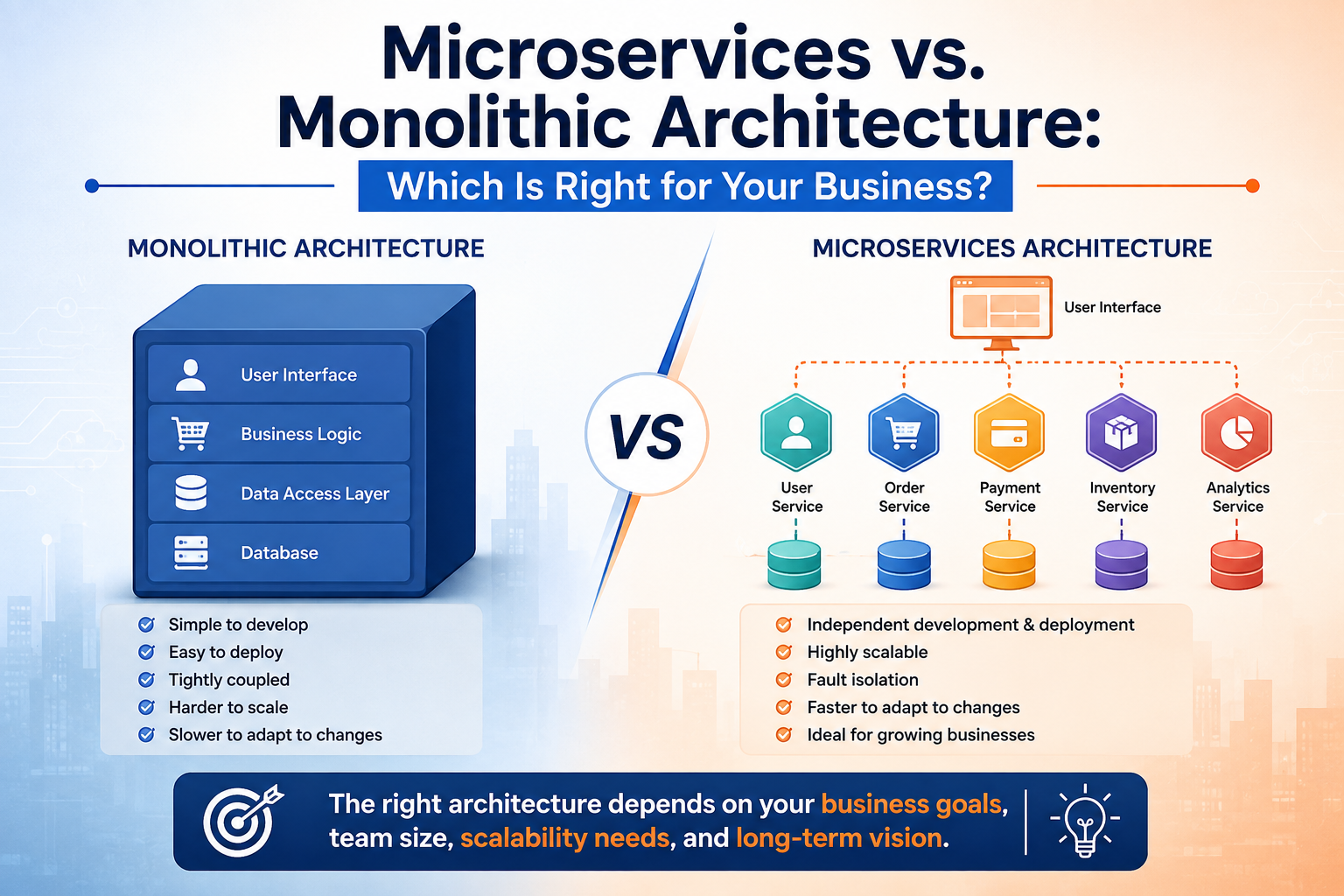
Two widely used approaches are monolithic architecture and microservices architecture. While monolithic applications organize most functionality into a single application, microservices divide an application into smaller, independently deployable services.
But which approach is better?
The answer depends on your business requirements, application complexity, development resources, growth plans, and operational capabilities. There is no universal architecture that works for every organization.
In this guide, we compare microservices and monolithic architecture and explain how businesses can determine which approach is the right fit.
What Is Monolithic Architecture?
A monolithic architecture is a software development approach in which the application's core components are built and deployed as a single unit.
For example, an e-commerce application may contain:
- User authentication
- Product management
- Shopping cart
- Payment processing
- Order management
- Reporting
All these functions can exist within one application and are generally deployed together.
Benefits of Monolithic Architecture
1. Simpler Development
For smaller applications, a monolithic structure can be easier to design and develop because developers work within one codebase.
2. Easier Deployment
The entire application can be packaged and deployed as a single unit, reducing deployment complexity.
3. Straightforward Testing
Testing application functionality can be relatively simple because components operate within the same environment.
4. Lower Operational Complexity
Small businesses may not need the additional infrastructure, monitoring, orchestration, and service-management capabilities commonly associated with microservices.
Challenges of Monolithic Architecture
As applications grow, monolithic systems can become increasingly difficult to manage.
Common challenges include:
- Large and complex codebases
- Slower release cycles
- Difficult independent scaling
- Greater impact from application changes
- Longer deployment processes
- Increasing maintenance complexity
A small monolithic application can therefore become challenging when business requirements and user demand increase significantly.
What Is Microservices Architecture?
Microservices architecture divides an application into multiple smaller services. Each service is responsible for a specific business capability and can potentially be developed, deployed, and scaled independently.
For example, an enterprise application could have separate services for:
- Customer management
- Payments
- Inventory
- Authentication
- Notifications
- Analytics
These services communicate through APIs or messaging systems while working together as a complete application.
Benefits of Microservices Architecture
1. Independent Scalability
Businesses can scale individual services according to demand instead of scaling the entire application.
2. Faster Deployment
Development teams can update and deploy specific services without necessarily redeploying the entire application.
3. Greater Development Flexibility
Different services can potentially use different technologies when there is a strong technical reason to do so.
4. Improved Fault Isolation
A problem in one service does not necessarily require the entire application to become unavailable, provided the system is designed with appropriate resilience mechanisms.
5. Better Support for Large Teams
Microservices can allow larger development teams to work on separate business capabilities with clearer ownership boundaries.
Microservices vs. Monolithic Architecture: Key Differences
| Factor | Monolithic Architecture | Microservices Architecture |
|---|---|---|
| Structure | Single application | Multiple independent services |
| Deployment | Entire application | Individual services |
| Scalability | Usually application-wide | Service-specific |
| Development | Simpler for smaller systems | Better suited to complex systems |
| Maintenance | Can become difficult as it grows | Services can be maintained independently |
| Infrastructure | Generally simpler | More complex |
| Testing | Relatively straightforward | Requires distributed testing |
| Deployment Speed | Can slow down as application grows | Individual services can be released independently |
| Fault Isolation | More limited | Better when properly designed |
| Operational Cost | Often lower initially | Can be higher due to infrastructure requirements |
When Should Your Business Choose Monolithic Architecture?
Monolithic architecture can be an excellent choice when your business is developing a relatively small or straightforward application.
It may be suitable when:
- You are building an MVP or early-stage product.
- The application has limited complexity.
- Your development team is small.
- You want to minimize infrastructure complexity.
- Requirements are still changing rapidly.
- Independent service scaling is not yet necessary.
For many businesses, starting with a well-structured monolith can be a practical strategy. Architecture should support business needs rather than introduce unnecessary complexity.
When Should Your Business Consider Microservices?
Microservices may be more appropriate for organizations managing large, complex, or rapidly growing applications.
Consider microservices when:
- Different parts of the application need independent scaling.
- Multiple development teams work on different business capabilities.
- Frequent independent releases are required.
- The application has clearly defined business domains.
- System availability and resilience are major priorities.
- Your organization has the technical expertise to manage distributed systems.
However, moving to microservices simply because they are considered modern is not always the right decision.
The Hidden Complexity of Microservices
Microservices offer significant advantages, but they also introduce additional engineering challenges.
A distributed application may require:
- API management
- Service discovery
- Centralized logging
- Distributed tracing
- Monitoring and observability
- Containerization
- Automated deployment pipelines
- Service-to-service authentication
- Resilience and failure handling
- Data consistency strategies
This means microservices can increase both infrastructure and operational complexity.
For this reason, businesses should evaluate the total cost of ownership rather than focusing only on development benefits.
Can Businesses Use a Hybrid Approach?
Yes.
A business does not always have to choose between a pure monolith and a fully distributed microservices architecture.
A modular monolith can provide a middle ground by keeping the application as one deployable unit while separating functionality into well-defined modules.
Another approach is gradual modernization, where a business identifies specific components that need independent scalability or deployment and gradually separates them into services.
This can reduce migration risk while allowing organizations to modernize strategically.
How to Choose the Right Architecture
Before selecting an architecture, businesses should evaluate several factors.
1. Application Complexity
Simple applications may benefit from the simplicity of a monolith, while highly complex systems may require service-level separation.
2. Business Growth
If your application is expected to experience rapid growth, consider how different components will need to scale over time.
3. Development Team
Microservices require strong engineering practices and experience with distributed systems. Your team's capabilities should influence the decision.
4. Budget
Microservices can require additional infrastructure, monitoring, DevOps capabilities, and operational resources.
5. Deployment Requirements
If different application components need to be released independently, microservices may provide an advantage.
6. Long-Term Strategy
Architecture should align with your product roadmap, modernization strategy, expected users, integration requirements, and future business objectives.
Final Verdict: Microservices or Monolithic?
Neither architecture is universally better.
Monolithic architecture can be the right choice for smaller applications, startups, MVPs, and businesses that prioritize simplicity and lower operational complexity.
Microservices architecture can be a strong choice for complex enterprise applications that require independent scaling, frequent deployments, team autonomy, and greater architectural flexibility.
The best approach is the one that aligns technology decisions with your business goals, application requirements, team capabilities, and growth strategy.
At Riotech Softwares, businesses can evaluate their existing technology landscape and choose an architecture that supports scalability, maintainability, and long-term digital growth.
Frequently Asked Questions
Is microservices better than monolithic architecture?
Not necessarily. Microservices are beneficial for certain complex and scalable applications, while monolithic architecture can be more efficient for smaller or less complex systems.
Is microservices more expensive?
It can be. Microservices may require additional infrastructure, monitoring, DevOps practices, and operational expertise. The cost depends on the application's size and complexity.
Can a monolithic application be converted into microservices?
Yes. Businesses can gradually modernize a monolithic application by identifying business capabilities and separating suitable components into independent services.
Should startups use microservices?
Not always. Startups with simple applications may benefit from beginning with a modular monolith and adopting microservices when scale and complexity justify the transition.
What is a modular monolith?
A modular monolith is a single deployable application that is internally divided into well-defined modules. It can provide organizational benefits similar to microservices while maintaining simpler deployment and operations.
Build an Architecture That Supports Your Business
Technology architecture should be a strategic business decision, not simply a choice between the latest development trends.
Whether your organization is building a new application, scaling an existing platform, or modernizing legacy software, the right architecture can improve agility, performance, and long-term maintainability.
Riotech Softwares helps businesses develop and modernize technology solutions designed around their specific business objectives and growth requirements.