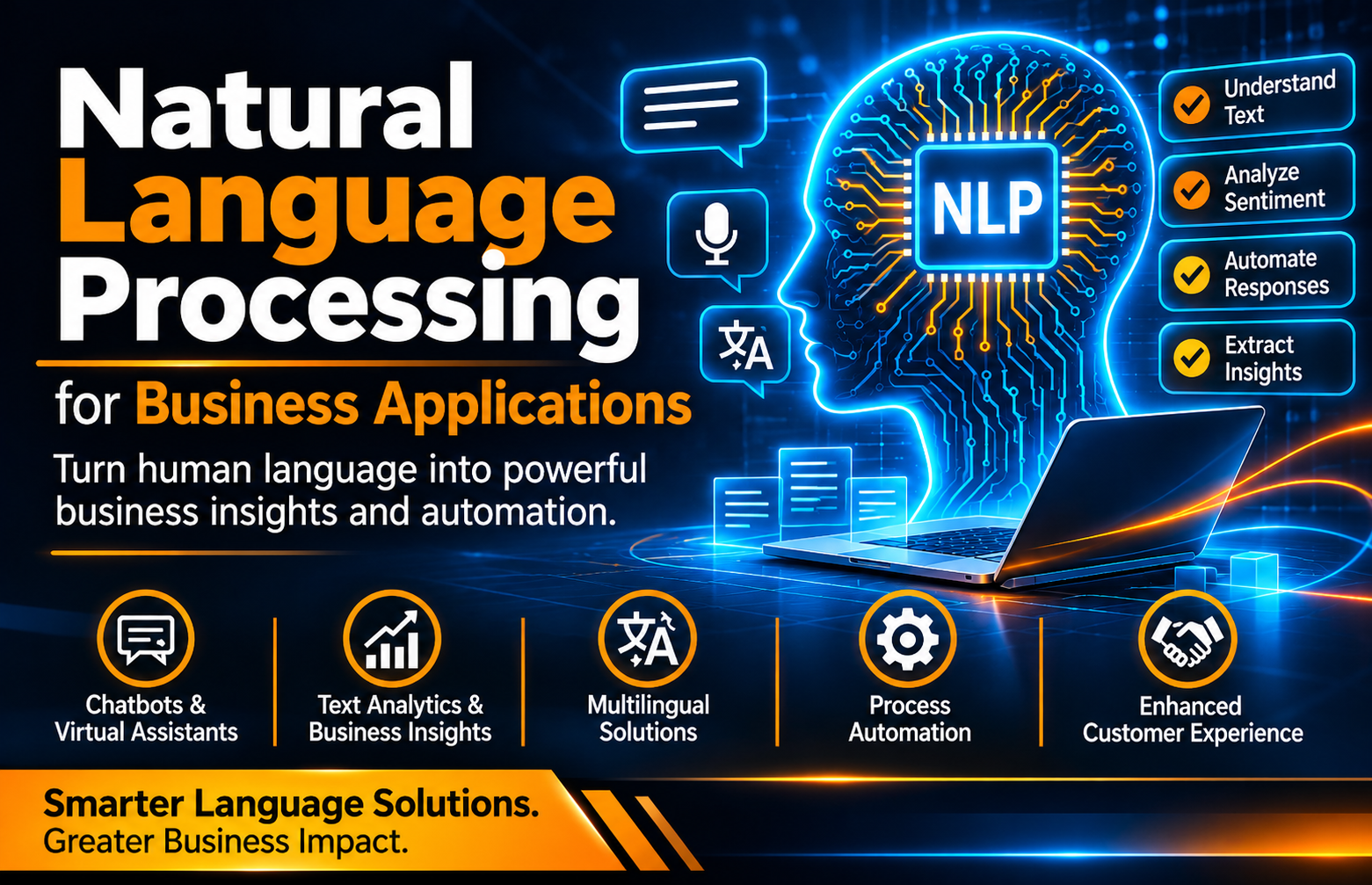
Natural Language Processing for Business Applications
Introduction
Businesses generate and receive large amounts of text-based information every day through emails, customer queries, documents, feedback forms, social media, and online conversations. Understanding this information manually can be time-consuming and challenging, especially when organizations manage multiple communication channels.
Natural Language Processing (NLP) is an important branch of Artificial Intelligence (AI) that enables computers to understand, interpret, analyze, and generate human language. It helps businesses process unstructured text, automate communication, and extract meaningful information from everyday interactions.
With modern AI solutions, organizations can use NLP technologies to improve customer experiences, streamline internal workflows, and make more informed business decisions. Companies can explore intelligent digital solutions through https://www.riotechsoftwares.com/aisolution.php.
Understanding Natural Language Processing
Natural Language Processing combines artificial intelligence, machine learning, and computational linguistics to help computer systems work with human language.
Unlike traditional software that depends on predefined commands, NLP systems can analyze written or spoken language and identify meaning, context, intent, and relationships between words.
Common NLP capabilities include:
Text classification and categorization.
Sentiment analysis.
Language translation.
Speech recognition.
Text summarization.
Named entity recognition.
Question answering and conversational AI.
These capabilities allow businesses to manage language-based information more efficiently and develop smarter digital applications.
1. Automating Customer Support and Communication
Customer support departments regularly receive questions about products, services, payments, orders, and technical issues. Responding to every request manually can increase workloads and create communication delays.
NLP-powered chatbots and virtual assistants can understand customer questions and provide relevant responses based on available information.
Businesses can use these systems to:
Answer frequently asked questions.
Identify customer requirements.
Route queries to appropriate departments.
Provide automated responses.
Support customer communication across different channels.
By integrating NLP into customer service operations, organizations can improve response management while allowing employees to focus on more complex customer requirements.
Explore intelligent automation possibilities through https://www.riotechsoftwares.com/aisolution.php.
2. Extracting Valuable Insights from Business Data
Organizations receive customer feedback, reviews, surveys, emails, and reports containing valuable information. However, reviewing large volumes of text manually can make it difficult to identify common patterns.
NLP-based text analytics helps businesses examine unstructured information and identify important trends.
For example, sentiment analysis can classify customer feedback as positive, negative, or neutral. Text classification can organize incoming messages according to their subject or purpose.
These capabilities help management teams understand customer expectations, recognize recurring concerns, and identify opportunities for improvement.
3. Improving Document Processing and Information Management
Many organizations handle large collections of invoices, contracts, applications, reports, and business documents.
Manual document processing can involve repetitive work and increase the possibility of human errors.
NLP technologies can assist with:
Extracting important information from documents.
Identifying names, dates, amounts, and business terms.
Categorizing documents automatically.
Summarizing lengthy reports.
Searching documents using natural language.
These capabilities can reduce repetitive administrative work and make business information easier to access.
4. Supporting Multilingual Business Communication
Businesses operating across different countries often communicate with customers, suppliers, and employees who speak different languages.
Language barriers can affect customer engagement and create difficulties in international business operations.
NLP-powered translation and language-processing tools help organizations understand and manage multilingual communication.
Businesses can use these technologies for:
Translating customer messages.
Processing multilingual documents.
Supporting international customer service.
Understanding feedback in different languages.
Developing multilingual conversational applications.
With suitable language intelligence solutions, organizations can communicate more effectively with diverse audiences.
5. Enhancing Business Decision-Making
Business decisions depend on accurate information and a clear understanding of customer requirements and market developments.
NLP helps organizations analyze large amounts of text-based information and convert it into useful insights.
For instance, businesses can analyze customer reviews to understand product expectations, examine support conversations to identify recurring problems, and summarize reports to highlight important findings.
When combined with other AI technologies, NLP can support faster information analysis and more informed decision-making.
Organizations looking to implement intelligent technologies can explore the AI services offered at https://www.riotechsoftwares.com/aisolution.php.
6. Personalizing Customer Experiences
Modern customers expect businesses to understand their requirements and provide relevant communication.
NLP can help applications interpret customer questions, preferences, and previous interactions to deliver more contextual responses.
For example, an AI-powered recommendation system can analyze customer queries and suggest relevant products, services, or information.
Personalized communication can help businesses improve customer engagement, create more relevant interactions, and build stronger customer relationships.
Challenges of Implementing Natural Language Processing
Although NLP offers several business advantages, organizations should consider certain challenges before implementing these technologies.
Language Complexity: Human language contains different expressions, regional variations, abbreviations, and context-dependent meanings.
Data Quality: Inaccurate, incomplete, or inconsistent information can affect NLP processing results.
Data Privacy: Businesses must handle customer conversations and sensitive documents responsibly.
Integration Requirements: NLP applications may require integration with existing business software, databases, and communication platforms.
Continuous Improvement: Language models and NLP applications require monitoring and updates to maintain relevance and accuracy.
Selecting appropriate technologies and defining clear implementation requirements can help businesses address these challenges.
Frequently Asked Questions (FAQs)
1. What is Natural Language Processing in business?
Natural Language Processing is an AI technology that enables computers to understand, analyze, and generate human language. Businesses use it to automate communication, analyze customer feedback, and process documents.
2. How does NLP improve customer service?
NLP-powered chatbots and virtual assistants can understand customer questions, provide relevant responses, categorize requests, and support automated communication.
3. Can NLP analyze customer feedback?
Yes. NLP can analyze reviews, surveys, and customer messages to identify sentiment, recurring concerns, and common customer expectations.
4. Is NLP useful for multilingual businesses?
Yes. NLP supports language translation, multilingual text processing, and communication across different languages.
5. How is NLP connected to Artificial Intelligence?
NLP is a branch of Artificial Intelligence that focuses on enabling computer systems to understand, interpret, and generate human language.
Conclusion
Natural Language Processing is transforming how businesses communicate, manage information, and understand customer requirements. From automated customer support and document processing to sentiment analysis and multilingual communication, NLP offers practical capabilities for modern business operations.
By combining language intelligence with suitable AI solutions, organizations can reduce repetitive tasks, improve information accessibility, and develop more efficient digital workflows.
Businesses interested in adopting intelligent technologies can explore https://www.riotechsoftwares.com/aisolution.php to learn more about AI-powered business solutions.
Recent Posts
05 Nov 2026

03 Nov 2026

31 Oct 2026