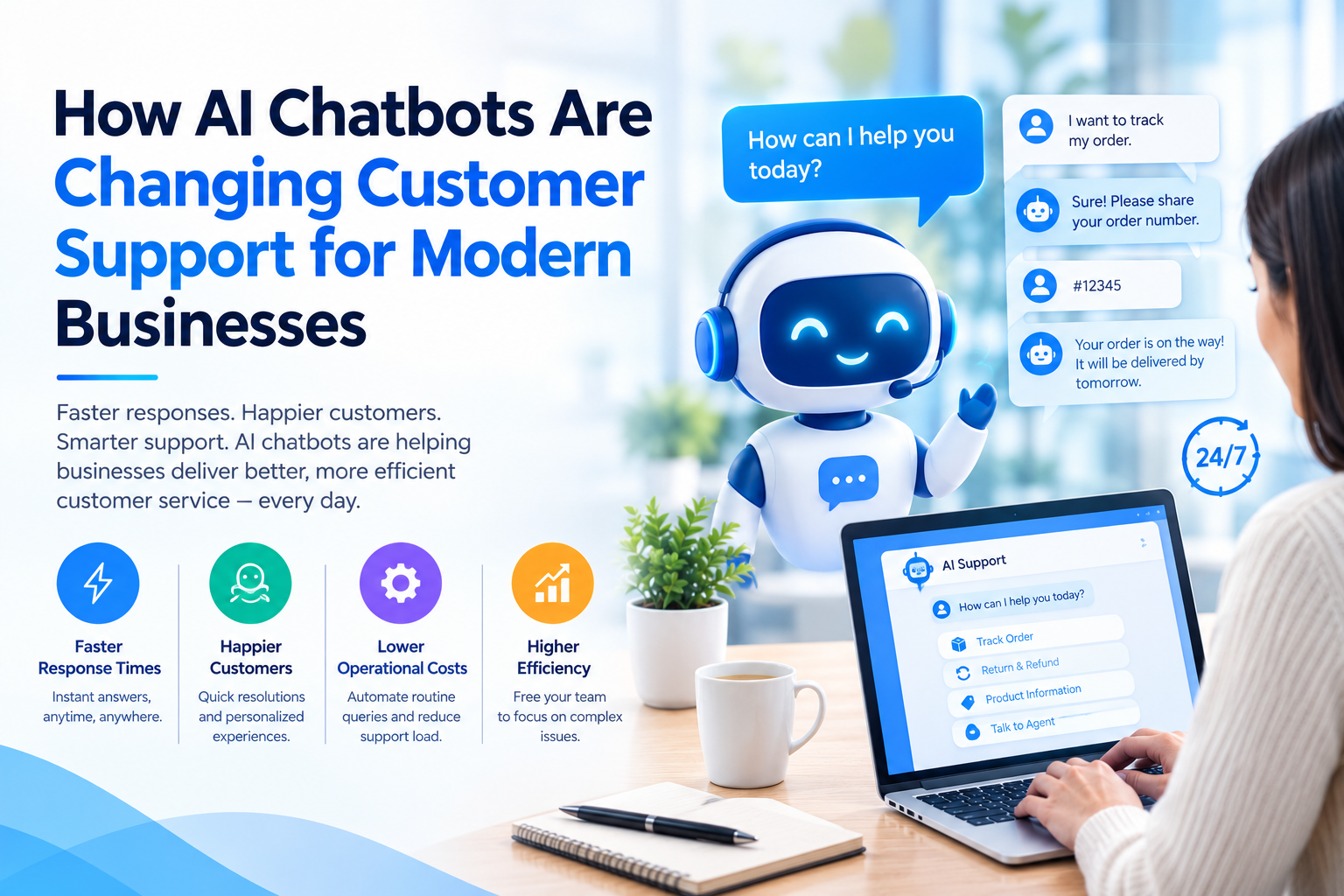
How AI Chatbots Are Changing Customer Support for Modern Businesses
How AI Chatbots Are Changing Customer Support for Modern Businesses
Customer expectations are changing rapidly. People want quick answers, convenient communication, and support whenever they need it. Traditional customer support models that rely entirely on human agents may struggle to handle large volumes of repetitive questions, especially outside regular business hours.
AI chatbots are helping businesses address this challenge by providing automated, intelligent, and scalable customer support. From answering frequently asked questions to guiding customers through services and collecting information, AI-powered chatbots are becoming an important part of modern customer experience strategies.
What Are AI Chatbots?
AI chatbots are software applications that use artificial intelligence technologies to communicate with users through text or conversational interfaces. Unlike basic rule-based chatbots, modern AI chatbots can understand natural-language queries, identify customer intent, and provide relevant responses.
Businesses can integrate AI chatbots into websites, mobile applications, messaging platforms, and customer service systems to provide automated assistance.
AI chatbots can be used for:
- Answering frequently asked questions
- Providing product and service information
- Collecting customer enquiries
- Supporting lead generation
- Tracking requests and orders
- Guiding users through websites
- Scheduling appointments
- Routing complex queries to human agents
- Providing support outside normal business hours
1. 24/7 Customer Support
One of the major advantages of AI chatbots is their ability to provide support around the clock.
Customers may have questions outside standard business hours. An AI chatbot can respond immediately instead of requiring customers to wait until the support team becomes available.
This can be particularly useful for businesses serving customers across different time zones.
2. Faster Response Times
Response speed plays an important role in customer experience. Customers often expect immediate answers to simple questions.
AI chatbots can process routine enquiries within seconds. Instead of waiting for an available support representative, customers can receive automated assistance immediately.
For example, a chatbot can answer questions about:
- Business hours
- Pricing
- Services
- Product availability
- Booking procedures
- Return policies
- Basic troubleshooting
This allows human support teams to focus on more complex customer requirements.
3. Handling Repetitive Customer Queries
Customer support teams frequently receive the same questions repeatedly. Handling these enquiries manually can consume valuable employee time.
AI chatbots can automate many repetitive interactions and provide consistent responses.
For example, an online business may receive hundreds of questions related to delivery, payment methods, account access, or order status. A properly integrated chatbot can handle many of these routine requests automatically.
4. Improving Lead Generation
AI chatbots are not limited to customer service. They can also support sales and lead-generation activities.
A chatbot can interact with website visitors, understand their requirements, and collect basic information such as:
- Name
- Email address
- Business requirements
- Product or service interest
- Preferred contact method
The collected information can then be transferred to a CRM or lead-management system, allowing sales teams to follow up with qualified prospects.
5. Personalized Customer Interactions
Modern AI systems can use available customer and business data to provide more relevant interactions.
For example, a chatbot connected with appropriate business systems may provide information based on a customer's previous interactions, account details, or current request.
Personalization can make automated support feel more relevant while reducing unnecessary communication steps.
6. Reducing Pressure on Support Teams
AI chatbots are not necessarily designed to replace human customer support representatives. Instead, they can work alongside support teams.
A chatbot can handle common and straightforward questions while more complicated cases are transferred to human agents.
This creates a practical support workflow:
Customer Query → AI Chatbot → Automated Resolution or Human Escalation
Human agents can therefore spend more time on cases that require investigation, judgment, or direct assistance.
7. Consistent Customer Service
Human support responses can sometimes vary depending on the representative, workload, or time of day.
AI chatbots can provide standardized responses based on approved business information and workflows.
This can help businesses maintain greater consistency across common customer interactions.
However, chatbot responses should be regularly reviewed and updated to ensure that customers receive accurate and relevant information.
8. Integration With Business Systems
The value of an AI chatbot can increase significantly when it is connected with other business applications.
Depending on the business requirements, chatbot systems can potentially integrate with:
- CRM platforms
- ERP systems
- Customer databases
- E-commerce platforms
- Ticketing systems
- Payment systems
- Knowledge bases
- Business APIs
Such integrations can allow chatbots to move beyond simple question-and-answer functionality and participate in broader customer-service workflows.
9. AI Chatbots and Business Automation
AI chatbots can become part of a larger business automation strategy.
For example, when a customer submits an enquiry, an automated workflow could:
- Receive the customer message.
- Identify the customer's intent.
- Retrieve relevant information.
- Provide an initial response.
- Create a support ticket when necessary.
- Notify the appropriate team.
- Escalate the conversation if human assistance is required.
This combination of AI and workflow automation can help businesses reduce repetitive manual processes and improve operational efficiency.
10. Important Considerations Before Implementing an AI Chatbot
Although AI chatbots provide significant opportunities, businesses should plan their implementation carefully.
Data Security
Customer information should be protected through appropriate security measures, access controls, and data-management practices.
Accuracy
Businesses should ensure that chatbot responses are based on reliable and regularly updated information.
Human Escalation
Customers should have a clear path to human support when their issue cannot be resolved automatically.
Integration
The chatbot should be connected with the relevant business systems where necessary to provide useful and accurate information.
Monitoring
Businesses should monitor chatbot conversations, customer feedback, response accuracy, and unresolved queries to identify areas for improvement.
How Businesses Can Get Started With AI Chatbots
A successful chatbot implementation does not require automating every customer interaction from the beginning.
Businesses can start with a specific use case, such as frequently asked questions, lead collection, appointment scheduling, or basic customer support.
A practical implementation process can include:
Step 1: Identify Common Customer Queries
Analyze existing support conversations and identify repetitive questions.
Step 2: Select the Right Use Case
Choose a customer-service process where automation can provide measurable value.
Step 3: Prepare Business Information
Create an accurate knowledge base containing products, services, policies, FAQs, and other relevant information.
Step 4: Integrate Business Systems
Connect the chatbot with CRM, databases, APIs, or other systems when required.
Step 5: Establish Human Escalation
Define situations where conversations should automatically be transferred to a human representative.
Step 6: Monitor and Improve
Track chatbot performance and continuously improve responses based on customer interactions and business requirements.
The Future of AI-Powered Customer Support
AI chatbots are becoming an important component of modern digital customer-service strategies. As AI technology continues to develop, businesses can combine conversational AI with automation, analytics, CRM systems, and other enterprise technologies to create more connected customer experiences.
The focus should not simply be on adding a chatbot to a website. Businesses should consider how AI can improve the complete customer-support workflow while maintaining accuracy, security, transparency, and appropriate human involvement.
Why Choose Riotech for AI Solutions?
Riotech provides AI solutions designed to help businesses explore automation, machine learning, AI chatbots, and intelligent digital systems. Its AI Solutions offering focuses on improving business operations, customer experience, and data-driven processes.
Businesses looking to implement AI-powered customer support can explore Riotech's AI Solutions services to understand how intelligent automation and chatbot technologies can be incorporated into their digital operations.
Conclusion
AI chatbots are transforming customer support by providing faster responses, 24/7 assistance, automated interactions, and scalable customer-service capabilities.
When implemented strategically, AI chatbots can handle repetitive enquiries, support lead generation, improve response times, and allow human support teams to focus on more complex customer needs.
The most effective approach is to combine AI automation with reliable business data, secure integrations, continuous monitoring, and human support where required. For businesses preparing for the next stage of digital transformation, AI chatbots can become an important part of a modern customer experience strategy.