AI Virtual Assistants: Business Use Cases Beyond Customer Support
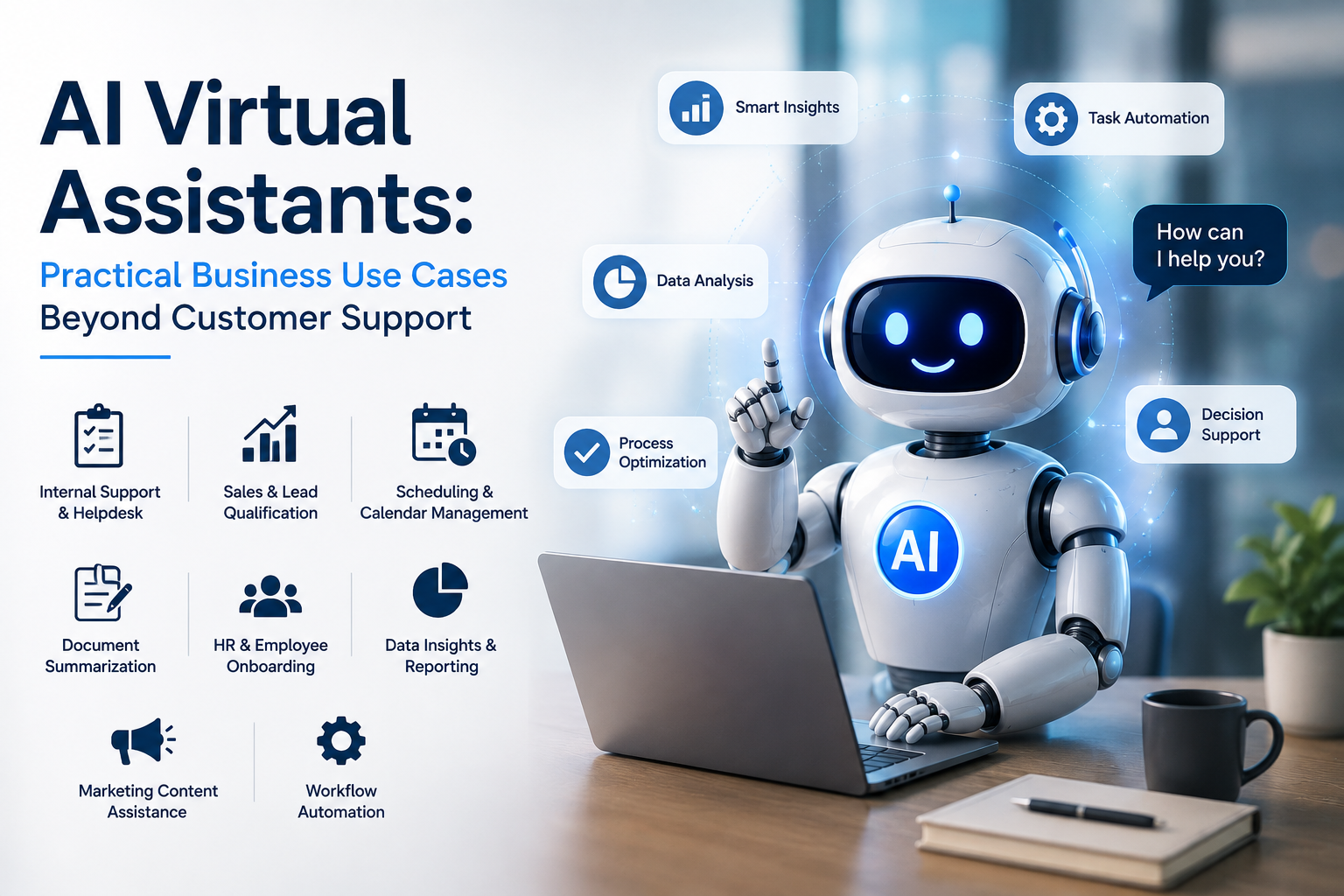
AI Virtual Assistants: Practical Business Use Cases Beyond Customer Support
AI virtual assistants are rapidly becoming a practical business technology, moving beyond traditional customer-service chatbots. Modern AI assistants can understand natural language, process business information, automate repetitive workflows, and support employees across multiple departments.
For businesses looking to improve productivity, reduce operational effort, and make faster decisions, AI virtual assistants can act as intelligent digital colleagues rather than simply answering customer questions.
What Are AI Virtual Assistants?
AI virtual assistants are software systems powered by artificial intelligence, natural language processing, machine learning, and increasingly generative AI. They can understand requests, retrieve information, generate responses, and in some cases perform actions across business applications.
Unlike traditional rule-based chatbots, modern AI assistants can handle more flexible conversations and work with large amounts of business data.
When integrated with systems such as CRM, ERP, HR platforms, project-management tools, and internal knowledge bases, they can support employees throughout their daily workflows.
1. Employee Helpdesk and Internal Support
One of the most practical applications is providing employees with instant access to internal information.
Instead of asking HR or IT teams repetitive questions, employees can use an AI assistant to find information about:
- Company policies
- Leave procedures
- IT troubleshooting
- Employee benefits
- Onboarding processes
- Internal documentation
- Workplace guidelines
This reduces the number of repetitive requests handled manually by HR and IT teams.
2. IT Support and Troubleshooting
AI virtual assistants can support IT departments by handling first-level technical issues.
For example, employees can ask:
- Why can't I access the company VPN?
- How do I reset my password?
- How can I configure my email?
- Why is a business application not working?
- How do I connect to the corporate network?
The assistant can provide troubleshooting instructions based on approved documentation and escalate complex problems to IT professionals when necessary.
3. Sales Assistance
AI assistants can become useful tools for sales teams by helping them access information quickly.
A sales employee could ask an assistant to:
- Summarize a customer's history
- Find previous interactions
- Prepare meeting notes
- Identify follow-up opportunities
- Draft personalized emails
- Retrieve product information
- Summarize sales pipeline data
When connected to a CRM, an AI assistant can reduce the time sales professionals spend searching for information.
4. Marketing Content Support
Marketing teams can use AI virtual assistants for repetitive content-related activities.
They can help create:
- Campaign ideas
- Social media drafts
- Email copy
- Content briefs
- SEO outlines
- Product descriptions
- Marketing reports
The assistant can also help summarize campaign performance and organize information for marketing teams.
However, human review remains important to maintain brand consistency, accuracy, and strategic quality.
5. HR and Employee Onboarding
Employee onboarding involves many repetitive questions and documentation tasks.
An AI virtual assistant can guide new employees through the onboarding process by explaining:
- Company policies
- Required documents
- Training schedules
- Workplace procedures
- Benefits information
- Software access
- Team resources
This allows HR teams to focus more on strategic employee engagement instead of repeatedly answering basic questions.
6. Knowledge Management
Businesses often have valuable information distributed across documents, emails, databases, and internal systems.
Finding the right information can consume significant employee time.
AI assistants can provide a conversational interface for accessing approved company knowledge. Employees can ask questions in natural language rather than manually searching through multiple documents.
For example:
"What is our current process for handling enterprise software implementation?"
The assistant can retrieve relevant information from authorized knowledge sources and present it in a concise format.
7. Finance and Administrative Support
AI assistants can also help finance and administrative teams with routine activities.
Potential use cases include:
- Explaining expense policies
- Finding invoice information
- Summarizing financial documents
- Preparing routine reports
- Answering procurement questions
- Supporting budget-related information requests
Organizations should apply appropriate access controls when assistants work with sensitive financial information.
8. Project Management
Project teams deal with large amounts of information every day.
An AI assistant can help project managers summarize:
- Project status
- Meeting discussions
- Action items
- Task progress
- Risks and dependencies
- Upcoming deadlines
For example, after a project meeting, an AI assistant could convert meeting notes into structured action items and identify tasks that require follow-up.
9. Business Intelligence and Data Access
AI assistants can make business information easier for non-technical employees to understand.
Instead of navigating complex dashboards, users may be able to ask questions such as:
- "Which region generated the highest sales this quarter?"
- "What were our biggest customer acquisition changes?"
- "Which products are showing declining demand?"
When properly connected to business intelligence systems, conversational interfaces can make data more accessible to decision-makers.
10. Document Processing
Businesses process contracts, reports, proposals, invoices, forms, and other documents every day.
AI virtual assistants can help employees:
- Summarize lengthy documents
- Extract important information
- Compare documents
- Identify missing information
- Classify files
- Generate document-based answers
This can significantly reduce manual information-processing work in document-heavy business environments.
AI Assistants vs. Traditional Chatbots
The difference between traditional chatbots and modern AI virtual assistants is becoming increasingly important.
| Traditional Chatbot | AI Virtual Assistant |
|---|---|
| Mostly rule-based | AI and language-model driven |
| Handles predefined questions | Understands flexible requests |
| Limited workflows | Can support multi-step tasks |
| Usually customer-facing | Internal and external use |
| Requires predefined responses | Can generate contextual responses |
| Limited data interaction | Can integrate with business systems |
The goal is not necessarily to replace traditional automation but to combine AI capabilities with existing business workflows.
Challenges Businesses Should Consider
AI virtual assistants can deliver significant benefits, but organizations should implement them carefully.
Data Security
Business assistants may interact with sensitive company information. Strong authentication, authorization, encryption, and access controls are essential.
Accuracy
AI-generated information can sometimes be incorrect. Important business decisions should not rely solely on unchecked AI responses.
Integration
The value of an AI assistant increases when it can securely interact with existing systems such as CRM, ERP, HR, databases, and collaboration platforms.
Human Oversight
AI should support employees rather than remove necessary human judgment. Critical decisions should include appropriate human review.
Governance
Organizations should establish clear policies covering data access, AI usage, monitoring, privacy, and accountability.
How Businesses Can Start With AI Virtual Assistants
Businesses do not need to automate everything at once. A practical implementation approach can start with one clearly defined workflow.
Step 1: Identify repetitive tasks
Find processes where employees repeatedly search for information or perform routine activities.
Step 2: Select a focused use case
Start with an area such as IT support, employee onboarding, knowledge management, or sales assistance.
Step 3: Connect reliable data sources
Integrate approved business documents and systems while maintaining access controls.
Step 4: Establish security and governance
Define who can access information and how AI-generated outputs should be reviewed.
Step 5: Measure results
Track metrics such as time saved, response speed, employee adoption, and task completion.
The Future of AI Virtual Assistants in Business
AI virtual assistants are evolving from simple question-answering tools into systems capable of supporting complete business workflows.
The next stage of adoption will increasingly focus on AI agents that can understand objectives, access authorized systems, coordinate multiple steps, and assist employees with complex processes.
For businesses, the biggest opportunity is not simply adding an AI chatbot to a website. It is identifying where intelligent assistance can remove operational friction and help people work more efficiently.
Conclusion
AI virtual assistants have applications far beyond customer support. From IT and HR to sales, marketing, project management, finance, document processing, and business intelligence, they can become valuable tools for improving everyday operations.
The most successful implementations will combine AI capabilities, reliable business data, secure integrations, and human oversight.
For organizations exploring practical AI adoption, the right approach is to start with a specific business problem, measure the results, and expand the technology where it delivers measurable value.
Riotech Softwares helps businesses explore and implement technology solutions that support digital transformation, automation, and operational efficiency. Learn more about technology solutions and digital transformation opportunities at Riotech Softwares.