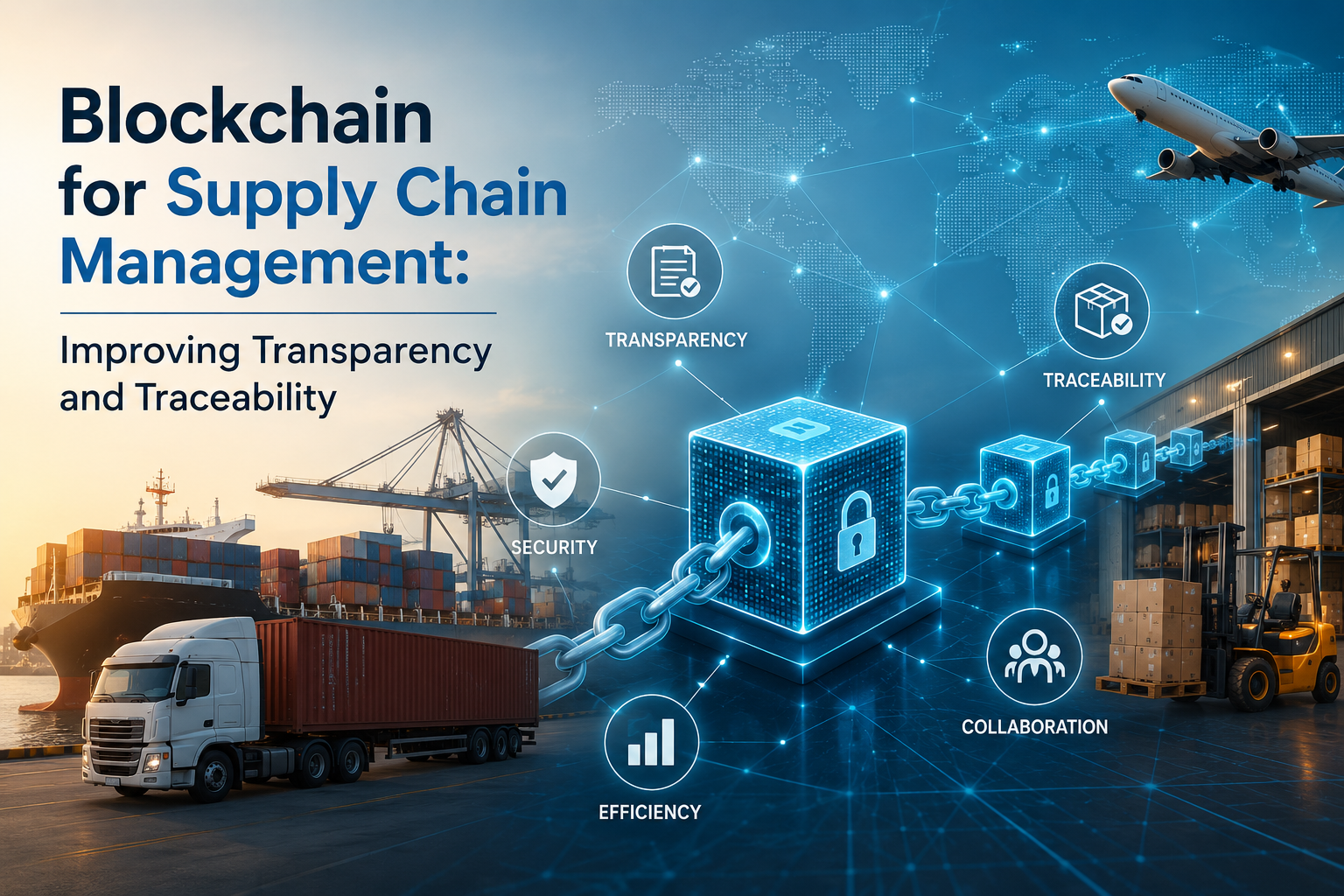
Blockchain for Supply Chain Management: Transparency & Traceability
Blockchain for Supply Chain Management: Improving Transparency and Traceability
Supply chains have become increasingly complex, involving manufacturers, suppliers, logistics providers, distributors, retailers, and customers across multiple locations. With so many participants involved, maintaining accurate records and ensuring product traceability can be challenging.
Blockchain for supply chain management offers a way to create a more transparent, secure, and traceable flow of information. By maintaining a shared and tamper-resistant digital record, blockchain can help businesses improve visibility across supply chain operations while reducing information gaps and manual verification.
What Is Blockchain in Supply Chain Management?
Blockchain is a distributed ledger technology that records transactions across a network of participants. Instead of relying on a single centralized database, authorized participants can access a shared record of relevant supply chain activities.
For example, a product may pass through several stages:
Raw Material → Manufacturing → Quality Check → Warehousing → Transportation → Distribution → Customer
Blockchain can record important events at each stage, creating a digital history that can be verified by authorized stakeholders.
This can make it easier to determine where a product originated, who handled it, when it moved, and whether specific conditions were maintained during transportation.
Why Transparency Matters in Modern Supply Chains
Lack of visibility can create several operational challenges, including:
- Difficulty verifying supplier information
- Limited product traceability
- Delays in identifying supply chain disruptions
- Duplicate or inconsistent records
- Counterfeit products
- Manual documentation and reconciliation
- Limited visibility between supply chain partners
Blockchain can help address these issues by providing a consistent source of information that participating organizations can verify.
How Blockchain Improves Supply Chain Traceability
1. End-to-End Product Tracking
Blockchain can create a record of a product's journey from its origin to its final destination.
Businesses can track information such as:
- Product origin
- Supplier details
- Manufacturing events
- Shipment information
- Warehouse transfers
- Distribution activities
- Delivery status
This improves visibility and helps organizations understand the complete lifecycle of a product.
2. Greater Data Transparency
Traditional supply chains often involve separate systems maintained by different organizations. This can make information sharing difficult.
A blockchain-based network can allow authorized participants to access relevant transaction records, reducing information gaps and improving collaboration between supply chain partners.
3. Improved Product Authentication
Counterfeit products can create significant financial and reputational risks for businesses.
Blockchain can support product authentication by associating products or batches with verifiable digital records. When combined with technologies such as QR codes, RFID, or IoT devices, businesses can provide additional information about product provenance.
4. Faster Identification of Problems
When a quality issue occurs, businesses need to identify affected products quickly.
Blockchain-based traceability can help organizations identify the relevant batch, supplier, manufacturing stage, or distribution point. This can make investigations and targeted recalls more efficient.
5. Better Supplier Accountability
Blockchain can create a verifiable record of activities performed by different supply chain participants.
For example, businesses can record supplier certifications, inspection results, shipment events, and compliance-related information. This can improve accountability and support more informed supplier management.
Blockchain and Smart Contracts
Smart contracts can further enhance blockchain-based supply chain systems.
A smart contract is a program that automatically executes predefined actions when specified conditions are met.
For example:
Shipment Delivered → Delivery Confirmed → Contract Condition Met → Payment Process Initiated
This can reduce manual intervention and help streamline processes involving multiple organizations.
However, smart contracts should be designed carefully because automated execution depends on the accuracy of the underlying data and business rules.
Combining Blockchain with IoT and AI
Blockchain becomes even more valuable when integrated with other technologies.
Blockchain + IoT
IoT devices can collect real-time information such as:
- Temperature
- Location
- Humidity
- Movement
- Environmental conditions
Blockchain can provide a verifiable record of selected IoT events.
This is particularly useful for industries where product conditions matter during transportation, such as pharmaceuticals, food, and other temperature-sensitive products.
Blockchain + AI
AI can analyze supply chain data to identify patterns, forecast demand, detect anomalies, and support decision-making.
Blockchain can provide a trusted data layer, while AI can turn that data into operational insights.
Together, these technologies can contribute to more intelligent and transparent supply chain management.
Key Benefits for Businesses
Implementing blockchain in supply chain operations can provide several potential benefits:
| Benefit | Business Impact |
|---|---|
| Transparency | Better visibility across supply chain partners |
| Traceability | Easier tracking of products and transactions |
| Authentication | Improved ability to verify product origins |
| Data Integrity | Reduced risk of unauthorized record modification |
| Faster Audits | Easier access to relevant transaction history |
| Accountability | Clearer record of supply chain activities |
| Automation | Reduced manual processes through smart contracts |
| Risk Management | Faster identification of disruptions and issues |
Challenges of Blockchain Adoption
Despite its potential, blockchain is not a solution for every supply chain problem.
Businesses should consider several factors before implementation.
Integration With Existing Systems
Blockchain platforms need to work with existing ERP, CRM, warehouse management, logistics, and other enterprise systems.
Data Accuracy
Blockchain can protect recorded information from unauthorized alteration, but it cannot automatically guarantee that the original information was accurate.
If incorrect information enters the system, the blockchain will preserve that incorrect record.
Scalability
Large supply chains may generate significant amounts of transaction data. Organizations need to select an architecture capable of handling their expected workload.
Partner Adoption
A supply chain blockchain network becomes more valuable when multiple participants use it. Getting suppliers, logistics providers, manufacturers, and distributors to adopt a common system can be challenging.
Privacy and Access Control
Not every participant should have access to every piece of supply chain information. Permissioned blockchain networks and appropriate access controls can help organizations manage sensitive data.
How Businesses Can Start With Blockchain
Organizations considering blockchain should begin with a specific business problem rather than implementing the technology simply because it is emerging.
A practical approach can include:
- Identify a supply chain problem
Determine where transparency or traceability is currently limited. - Define the required data
Decide what information needs to be recorded and shared. - Map the stakeholders
Identify suppliers, manufacturers, logistics partners, distributors, and other participants. - Select the right blockchain architecture
Evaluate public, private, or permissioned approaches based on business requirements. - Integrate existing technologies
Connect ERP, IoT, warehouse, logistics, and other relevant systems. - Run a pilot project
Start with a specific product, supplier, or supply chain process. - Measure business outcomes
Evaluate improvements in traceability, operational efficiency, verification, and risk management before expanding.
The Future of Blockchain in Supply Chain Management
As supply chains become more digital and interconnected, businesses will increasingly need reliable methods for sharing and verifying information.
Blockchain can play an important role in this transformation by creating trusted records across organizational boundaries. When combined with IoT, AI, cloud computing, smart contracts, and advanced analytics, blockchain can become part of a broader digital supply chain ecosystem.
The goal is not simply to put supply chain data on a blockchain. The real value comes from creating better visibility, stronger traceability, improved collaboration, and more reliable decision-making.
Conclusion
Blockchain for supply chain management can help businesses build more transparent and traceable operations. From tracking product origins and verifying transactions to supporting recalls and improving supplier accountability, the technology has applications across multiple industries.
However, successful adoption requires more than blockchain alone. Businesses need the right data architecture, integration strategy, governance, security controls, and participation from supply chain partners.
Organizations looking to modernize their technology infrastructure can explore digital solutions and technology services from Riotech Softwares through Riotech Softwares.
Blockchain can create the foundation for a more transparent supply chain — but its greatest value comes when trusted data is transformed into better business decisions.