API-First Development: Why Businesses Need Connected Software
API-First Development: Why Modern Businesses Need Connected Software Systems
Modern businesses rely on multiple digital systems to manage customers, operations, finance, communication, analytics, and internal workflows. However, when these systems operate independently, businesses often face data silos, duplicated processes, manual work, and limited visibility.
API-first development provides a modern approach to solving this challenge. By designing application programming interfaces (APIs) as a core part of the development process, businesses can create software systems that communicate efficiently, integrate with third-party platforms, and adapt to changing business requirements.
For organizations looking to build scalable and connected digital infrastructure, API-first development is becoming an important technology strategy.
What Is API-First Development?
API-first development is an approach where APIs are designed and planned before the implementation of the application's user interface or backend functionality.
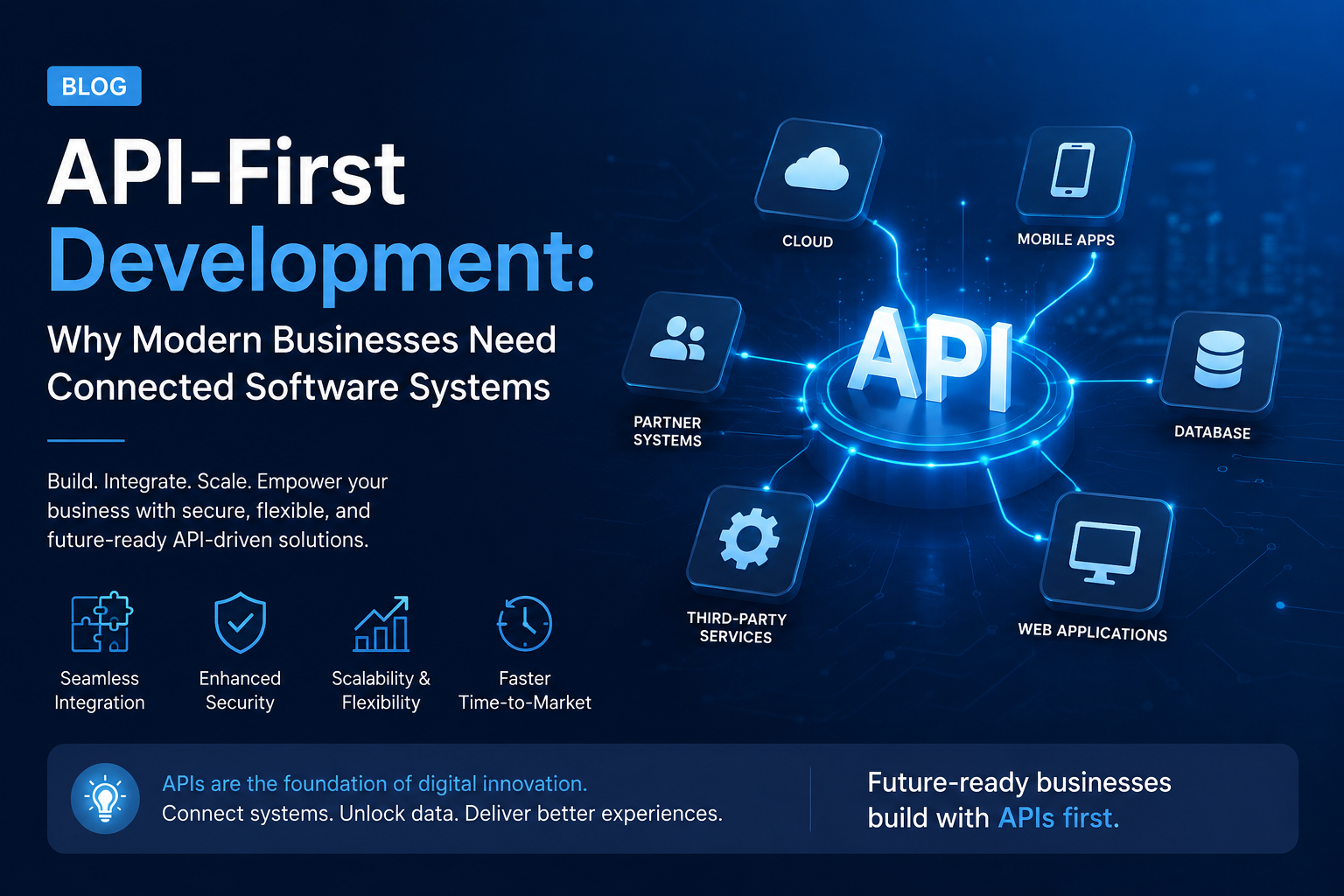
An API acts as a communication layer between different software applications. It allows systems to securely exchange data and functionality without requiring them to share the same underlying technology.
For example, an organization may use:
- A CRM for customer management
- An ERP for business operations
- A payment gateway for transactions
- An analytics platform for reporting
- A mobile application for customers
- Cloud-based services for infrastructure
APIs can connect these systems, allowing information to move between them efficiently.
Rather than treating APIs as an additional feature, API-first development makes them a fundamental part of the software architecture.
Why Connected Software Systems Matter
Businesses increasingly depend on multiple applications to operate efficiently. The challenge is ensuring these applications work together as one connected ecosystem.
Connected software systems can help organizations:
- Reduce manual data entry
- Improve data consistency
- Automate business workflows
- Connect internal and external applications
- Improve customer experiences
- Enable real-time data exchange
- Support mobile and web applications
- Scale technology infrastructure more efficiently
For example, when a customer submits an order through a website, an API can connect the website with inventory, payment, CRM, shipping, and notification systems. This creates a coordinated workflow instead of requiring employees to manually transfer information between platforms.
Key Benefits of API-First Development
1. Faster Integration
API-first architecture makes it easier to connect new applications and services with existing infrastructure.
Businesses can integrate CRM platforms, payment systems, cloud services, analytics tools, AI solutions, and other applications without rebuilding their entire technology stack.
2. Better Scalability
Modern businesses need software that can grow with them.
Well-designed APIs allow different components of an application ecosystem to scale independently. This can make it easier to add new services, users, applications, and integrations as business requirements evolve.
3. Improved Automation
APIs are essential for business process automation.
For example, an API-driven workflow can automatically:
- Capture a new customer lead.
- Store the information in a CRM.
- Trigger an email or notification.
- Assign the lead to a sales representative.
- Update reporting dashboards.
This reduces repetitive manual tasks and allows employees to focus on higher-value activities.
4. Consistent Data Across Systems
Disconnected applications often create duplicate or inconsistent information.
API-based integration allows systems to exchange data through defined processes, helping businesses maintain more consistent information across applications.
A connected architecture can ensure that an update made in one system is reflected in other relevant systems.
5. Better Customer Experiences
Customers expect seamless digital experiences across websites, mobile applications, support channels, and other touchpoints.
APIs enable these channels to communicate with shared backend services, helping businesses provide consistent customer information and functionality across platforms.
For example, a customer may place an order through a mobile application and later check its status through a website. APIs can help ensure both platforms access the same relevant information.
6. Easier Adoption of Emerging Technologies
API-first architecture can also support the integration of emerging technologies such as artificial intelligence, machine learning, cloud platforms, IoT, and automation tools.
Instead of rebuilding existing applications, businesses can expose selected services through APIs and connect them with newer technologies.
This can make digital transformation more flexible and manageable.
API-First vs. Traditional Development
In a traditional development approach, APIs may be created primarily to support a specific application. This can result in tightly coupled systems that are harder to reuse or integrate.
API-first development takes a different approach.
| Traditional Approach | API-First Approach |
|---|---|
| Application-focused | Integration-focused |
| APIs may be added later | APIs are designed early |
| Greater dependency between components | More modular architecture |
| Integration can become complex | Integration is planned from the beginning |
| Limited API reusability | APIs can support multiple applications |
| Changes may affect multiple systems | Components can evolve more independently |
The goal is not simply to create more APIs. The goal is to create well-designed interfaces that support long-term business and technology requirements.
The Role of API-First Development in Digital Transformation
Digital transformation is not only about adopting new software. It is about creating an interconnected technology environment where systems, data, and processes work together.
API-first development can serve as a foundation for this transformation.
Consider a business using an ERP, CRM, e-commerce platform, cloud infrastructure, and AI-powered analytics. APIs can provide the integration layer connecting these systems.
This allows businesses to gradually modernize their technology environment instead of replacing everything at once.
Security Must Be a Priority
Connectivity also introduces security considerations.
Every API that exposes business data or functionality must be properly protected. Organizations should consider:
- Authentication and authorization
- Encryption
- API gateways
- Rate limiting
- Input validation
- Access controls
- Monitoring and logging
- Threat detection
- Secure API lifecycle management
Security should be incorporated into API design from the beginning rather than treated as an afterthought.
Best Practices for API-First Development
Businesses planning an API-first strategy should consider the following practices:
Design APIs Around Business Requirements
APIs should solve meaningful business and integration problems rather than simply expose database functions.
Establish Clear Standards
Consistent naming, documentation, versioning, authentication, and error-handling standards make APIs easier to maintain.
Prioritize Documentation
Good API documentation helps internal teams, partners, and developers understand how services should be used.
Plan for Versioning
Business requirements change over time. API versioning can help organizations introduce improvements without unexpectedly breaking existing integrations.
Build With Reusability in Mind
An API should ideally be designed so that it can support multiple applications and use cases where appropriate.
Monitor API Performance
Tracking availability, response times, errors, traffic, and usage patterns helps identify problems before they affect business operations.
When Should a Business Consider API-First Development?
API-first development can be particularly valuable for organizations that:
- Operate multiple business applications
- Need frequent third-party integrations
- Are developing mobile and web applications
- Want to automate business processes
- Are modernizing legacy systems
- Plan to introduce AI or cloud services
- Need scalable digital infrastructure
- Work with external technology partners
- Want to build a platform or digital ecosystem
For smaller applications with limited integration requirements, a full API-first strategy may not always be necessary. The right approach depends on the organization's architecture, business objectives, and long-term technology roadmap.
The Future of Connected Software
The future of business software is increasingly interconnected. Organizations will continue using combinations of cloud platforms, SaaS applications, AI systems, mobile applications, IoT devices, and specialized business tools.
In this environment, isolated applications can become a limitation.
API-first development provides a structured way to connect these technologies while supporting flexibility, scalability, and automation. Combined with strong security, documentation, governance, and architecture practices, APIs can become a strategic foundation for modern digital businesses.
Conclusion
API-first development is more than a software development methodology. It is an architectural strategy for building connected, scalable, and adaptable business systems.
By designing APIs as a core part of the development process, organizations can simplify integrations, automate workflows, improve data connectivity, support multiple digital channels, and prepare their technology infrastructure for future innovation.
For businesses planning their next-generation software platforms, API-first development can provide the connectivity required to turn separate applications into a cohesive digital ecosystem.
RioTech Softwares LLP helps businesses build modern software solutions designed around scalability, integration, automation, and evolving business requirements. A well-planned API strategy can be an important step toward creating a more connected and future-ready technology environment.
Frequently Asked Questions
What is API-first development?
API-first development is a software development approach where APIs are designed as a primary part of the architecture before application implementation. This helps applications and services communicate consistently.
Why are APIs important for modern businesses?
APIs allow different software systems to exchange data and functionality, making it easier to integrate applications, automate processes, and build connected digital experiences.
Is API-first development suitable for small businesses?
It can be. The value depends on the number of systems, integrations, applications, and future scalability requirements of the business.
How does API-first development support AI adoption?
APIs can provide AI systems with controlled access to business applications and data, making it easier to integrate AI-powered features into existing software ecosystems.
Is API-first development secure?
API-first development can be secure when APIs are designed with appropriate authentication, authorization, encryption, validation, monitoring, and access controls from the beginning.