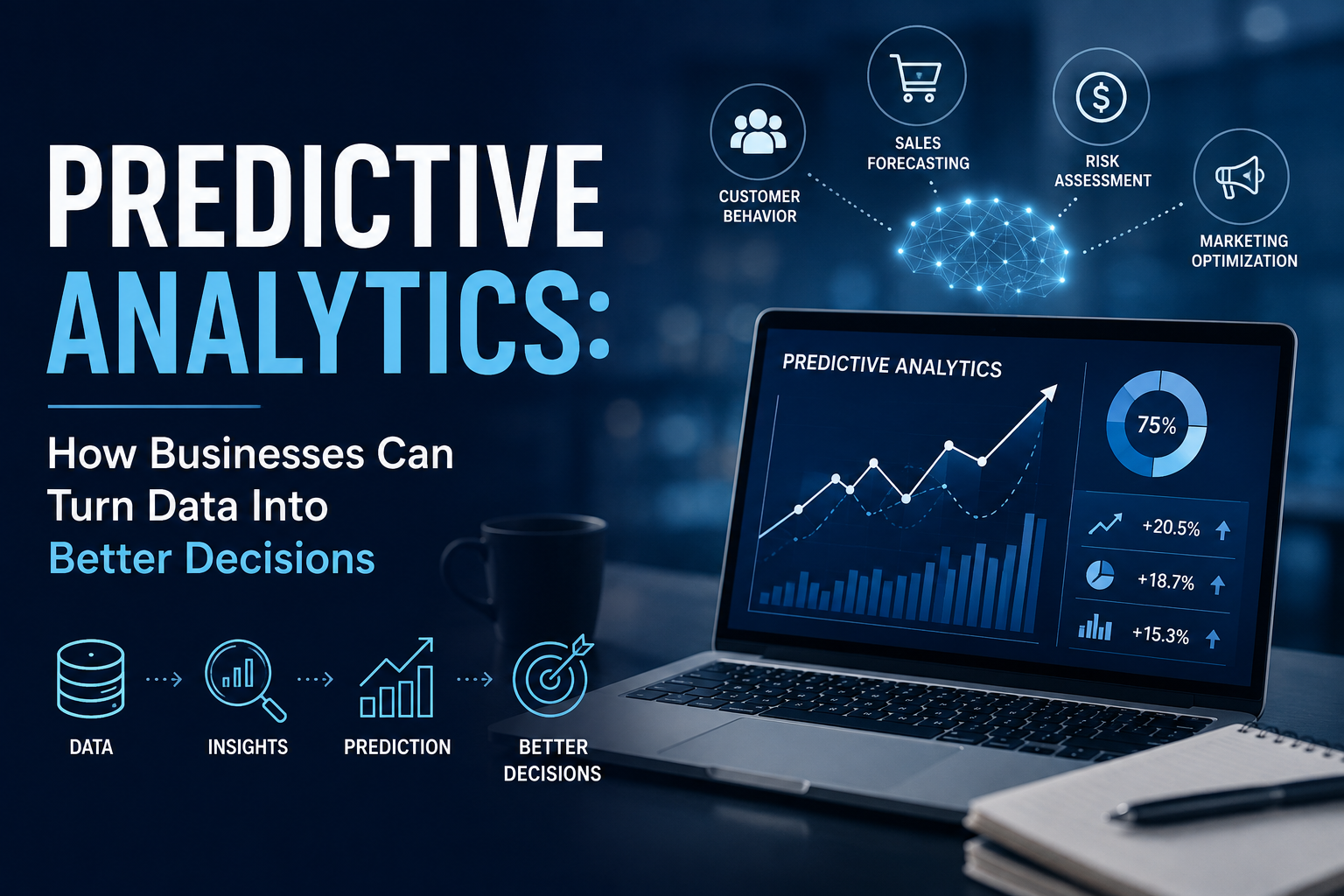
Predictive Analytics: How Businesses Can Turn Data Into Better Decisions
Predictive Analytics: How Businesses Can Turn Data Into Better Decisions
Businesses generate more data than ever before. Customer interactions, sales transactions, website activity, operational records, financial information, and market trends all contribute to an increasingly valuable digital asset: business data.
However, collecting data is only the first step. The real competitive advantage comes from understanding what that data can reveal about the future.
This is where predictive analytics becomes important.
Predictive analytics uses historical and current data, statistical techniques, machine learning, and artificial intelligence to identify patterns and estimate what is likely to happen next. Instead of relying entirely on assumptions or intuition, businesses can use predictive insights to make more informed decisions, manage risks, improve customer experiences, and identify new opportunities.
For modern organizations, predictive analytics is becoming an important component of data-driven decision-making.
What Is Predictive Analytics?
Predictive analytics is the process of analyzing existing and historical data to identify patterns and make predictions about future events or outcomes.
It typically combines:
- Historical business data
- Statistical analysis
- Machine learning algorithms
- Artificial intelligence
- Data mining
- Forecasting models
- Real-time or near-real-time information
For example, an e-commerce company can analyze previous purchases, customer behavior, seasonal trends, and product interactions to predict which customers are most likely to purchase a particular product.
Similarly, a manufacturing company can analyze equipment data to identify patterns that may indicate a future machine failure.
The objective is not to predict the future with absolute certainty. Instead, predictive analytics provides businesses with probability-based insights that can improve decision-making.
Predictive Analytics vs. Traditional Business Intelligence
Traditional business intelligence primarily focuses on understanding what has already happened.
For example:
Descriptive analytics:
"What happened to our sales last quarter?"
Predictive analytics takes the analysis further:
Predictive analytics:
"What are our sales likely to look like next quarter?"
This distinction allows organizations to move from simply reporting historical performance toward proactively planning for potential future outcomes.
| Analytics Type | Main Question | Example |
|---|---|---|
| Descriptive | What happened? | Sales decreased by 8% |
| Diagnostic | Why did it happen? | Customer demand declined in a specific region |
| Predictive | What may happen next? | Sales may decline further next month |
| Prescriptive | What should we do? | Increase targeted promotions in that region |
Predictive analytics therefore becomes particularly valuable when businesses need to anticipate changes rather than simply react to them.
How Predictive Analytics Helps Businesses
1. Better Sales Forecasting
Sales forecasting is one of the most common applications of predictive analytics.
Businesses can analyze historical sales, seasonal patterns, customer demand, pricing, marketing activity, and market conditions to estimate future sales.
Better forecasts can help organizations:
- Plan inventory
- Allocate resources
- Set realistic sales targets
- Manage budgets
- Optimize production
- Prepare for demand fluctuations
Instead of relying solely on manual estimates, businesses can use data-driven forecasts to support strategic planning.
2. Improved Customer Understanding
Customer behavior often contains valuable signals about future actions.
Predictive models can analyze customer interactions, purchase history, engagement, browsing behavior, and preferences to estimate:
- Which customers may make another purchase
- Which customers may stop engaging
- Which products customers may prefer
- Which leads are more likely to convert
- Which customers may respond to a particular offer
These insights can help businesses create more personalized customer experiences.
3. Lead Scoring and Sales Optimization
Sales teams often spend significant time evaluating leads.
Predictive analytics can help prioritize prospects by analyzing factors such as:
- Previous interactions
- Company characteristics
- Engagement levels
- Website activity
- Purchase history
- Communication patterns
The system can assign a probability or score to potential leads, helping sales teams focus their efforts on prospects with stronger conversion potential.
This can improve sales efficiency while reducing time spent on low-priority opportunities.
4. Predictive Maintenance
For industries that depend on machinery and equipment, unexpected failures can result in significant downtime and financial losses.
Predictive analytics can analyze equipment data, sensor readings, maintenance records, temperature, vibration, usage patterns, and other variables to identify signs of potential failure.
Businesses can then schedule maintenance before a major breakdown occurs.
This approach can help organizations reduce:
- Unexpected downtime
- Maintenance costs
- Equipment damage
- Production interruptions
5. Fraud Detection and Risk Management
Financial institutions, e-commerce companies, insurance providers, and other organizations face constantly changing fraud risks.
Predictive analytics can identify unusual patterns in transactions and user behavior.
For example, a system may detect:
- Unusual transaction amounts
- Unexpected login patterns
- Multiple transactions from unusual locations
- Abnormal purchasing behavior
- Suspicious account activity
These insights can help businesses identify potentially fraudulent activity faster and strengthen risk management processes.
6. Smarter Inventory Management
Maintaining the right inventory level is a major challenge for many businesses.
Excess inventory increases storage costs, while insufficient inventory can result in lost sales and dissatisfied customers.
Predictive analytics can analyze historical demand, seasonal trends, product performance, market conditions, and purchasing behavior to forecast future demand.
Businesses can use these predictions to make more informed inventory decisions.
7. More Effective Marketing
Marketing teams can use predictive analytics to understand which campaigns, audiences, channels, and offers are more likely to generate results.
For example, predictive models can help estimate:
- Customer conversion probability
- Campaign performance
- Customer lifetime value
- Churn probability
- Product affinity
- Response to marketing offers
This enables businesses to allocate marketing budgets more strategically and focus resources on high-potential opportunities.
The Role of AI and Machine Learning
Artificial intelligence and machine learning are making predictive analytics more powerful.
Traditional statistical models can identify relationships within data, while machine learning algorithms can analyze large and complex datasets and improve their predictions as more relevant data becomes available.
AI-powered predictive analytics can process information from multiple sources and identify patterns that may be difficult to detect manually.
For example, an organization may combine:
- CRM data
- Website analytics
- Sales records
- Customer support data
- Financial information
- Social media activity
- Operational data
A predictive system can analyze these data sources together to generate more comprehensive business insights.
The Predictive Analytics Process
Implementing predictive analytics typically involves several stages.
Step 1: Define the Business Problem
The first step is identifying what the organization wants to predict.
Examples include:
- Future sales
- Customer churn
- Equipment failure
- Fraud risk
- Product demand
- Lead conversion
A clearly defined business objective helps determine what data and model are required.
Step 2: Collect Relevant Data
The quality of predictions depends heavily on the quality of the underlying data.
Businesses may collect information from:
- CRM systems
- ERP platforms
- Websites
- Mobile applications
- Financial systems
- Customer service platforms
- IoT devices
- Marketing platforms
Step 3: Clean and Prepare the Data
Raw business data often contains missing values, duplicates, inconsistencies, or outdated information.
Data preparation is therefore essential before developing a predictive model.
Step 4: Build and Train the Model
Data scientists and machine learning systems can use appropriate algorithms to identify patterns and relationships within the data.
The model is then tested against relevant datasets to evaluate its performance.
Step 5: Deploy and Monitor
A predictive model must be monitored after deployment.
Business conditions can change, and a model that performs well today may become less accurate as customer behavior, market conditions, or operational processes change.
Continuous monitoring and periodic retraining help maintain model effectiveness.
Challenges Businesses Should Consider
Although predictive analytics offers significant benefits, implementation requires careful planning.
Data Quality
Poor-quality data can produce unreliable predictions. Organizations should establish strong data collection, validation, and governance processes.
Data Privacy
Businesses must ensure that customer and organizational data is processed securely and according to applicable privacy requirements.
Model Accuracy
Predictive models are not perfect. Predictions should be treated as decision-support information rather than absolute certainty.
Integration
Predictive analytics becomes more valuable when insights can reach the systems where decisions are made. Integration with CRM, ERP, marketing, operations, and other business platforms is therefore important.
Skills and Expertise
Successful implementation may require expertise in data engineering, statistics, machine learning, software development, and business analysis.
Best Practices for Implementing Predictive Analytics
Businesses can improve the success of predictive analytics initiatives by following several principles:
- Start with a measurable business problem.
- Prioritize high-quality and relevant data.
- Choose models based on the business requirement.
- Integrate predictive insights into existing workflows.
- Monitor model performance continuously.
- Protect sensitive business and customer information.
- Keep human decision-making involved where appropriate.
- Measure business outcomes, not just model accuracy.
The ultimate goal should be business value rather than simply implementing an advanced analytics platform.
The Future of Predictive Analytics
Predictive analytics is expected to become increasingly integrated with AI-powered business applications.
Future systems will increasingly move from simply providing dashboards and reports toward proactively identifying opportunities, risks, and recommended actions.
For example, an intelligent business platform could identify a likely decline in customer engagement, predict its potential impact, and recommend a targeted retention strategy.
When predictive analytics is combined with automation and AI agents, businesses can move toward more proactive and intelligent operations.
Conclusion
Predictive analytics allows businesses to move beyond simply understanding the past and start preparing for what may happen next.
By analyzing historical and real-time data, organizations can improve forecasting, understand customers, optimize operations, reduce risks, improve marketing performance, and make more informed strategic decisions.
However, successful predictive analytics depends on more than algorithms. High-quality data, secure infrastructure, appropriate technology, skilled implementation, and clear business objectives are equally important.
For organizations looking to become more data-driven, predictive analytics can provide a powerful foundation for transforming business data into actionable intelligence.
RioTech Softwares LLP helps businesses explore modern technology solutions that support automation, analytics, AI, and digital transformation. With the right strategy and implementation, predictive analytics can help organizations make smarter decisions today while preparing for tomorrow.
Frequently Asked Questions
What is predictive analytics in business?
Predictive analytics uses historical and current business data, statistical methods, and machine learning to estimate future outcomes and support better decisions.
What are common uses of predictive analytics?
Common applications include sales forecasting, customer churn prediction, lead scoring, fraud detection, predictive maintenance, inventory planning, risk management, and marketing optimization.
How is predictive analytics different from AI?
Predictive analytics focuses on forecasting likely outcomes using data and analytical models. AI is a broader field that includes machine learning, reasoning, automation, natural language processing, and other capabilities. AI can be used as part of predictive analytics.
Can small businesses use predictive analytics?
Yes. Cloud platforms and modern analytics tools have made predictive capabilities increasingly accessible to smaller organizations. Businesses can begin with focused use cases that address measurable problems.
Is predictive analytics always accurate?
No. Predictions are based on available data and assumptions within a model. Data quality, changing market conditions, and unexpected events can affect accuracy. Predictive analytics should therefore support—not completely replace—business judgment.