Post-Quantum Cryptography in 2026: Why Businesses Need to Prepare Now
Post-Quantum Cryptography in 2026: Why Businesses Need to Prepare Now
Quantum computing is no longer only a subject for research laboratories. As quantum technologies continue to develop, businesses are beginning to consider a major cybersecurity challenge: Can today's encryption protect tomorrow's data?
The answer is becoming increasingly important.
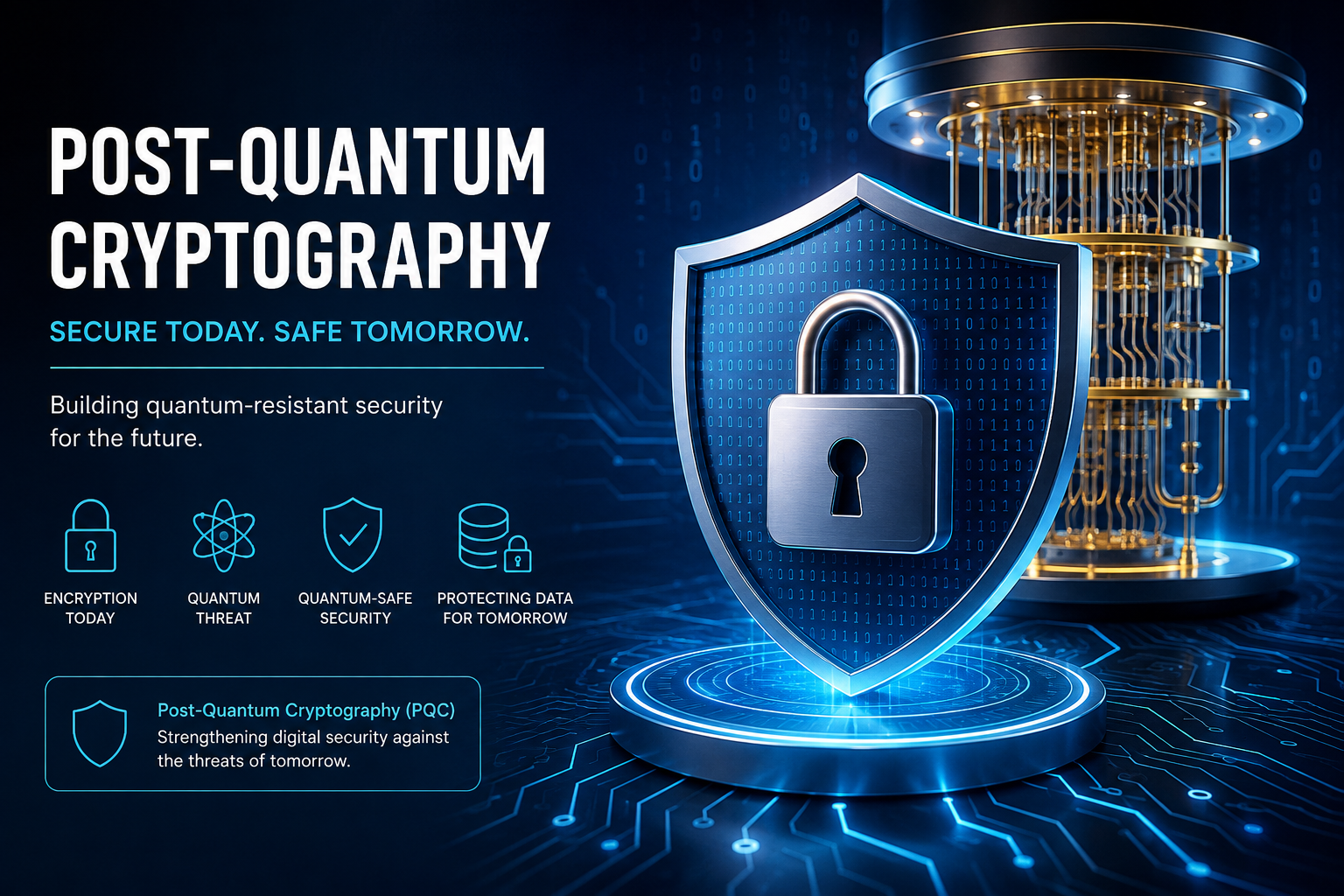
Post-Quantum Cryptography (PQC) is designed to protect digital systems against future attacks from sufficiently powerful quantum computers. In 2026, organizations are moving from simply discussing quantum risk toward planning practical migration strategies.
The National Institute of Standards and Technology (NIST) has already finalized three primary post-quantum cryptography standards and recommends that organizations begin transitioning to quantum-resistant cryptography.
For businesses handling sensitive customer information, financial records, intellectual property, healthcare data, or long-term confidential information, preparing for this transition should become part of the broader cybersecurity strategy.
What Is Post-Quantum Cryptography?
Post-Quantum Cryptography refers to cryptographic algorithms designed to remain secure against attacks from both traditional computers and future quantum computers.
Many existing public-key cryptographic systems rely on mathematical problems that are difficult for conventional computers to solve. A sufficiently capable quantum computer could potentially solve some of these problems much more efficiently.
PQC aims to provide alternative cryptographic mechanisms that are resistant to these quantum-based attacks.
NIST has standardized three major algorithms:
- ML-KEM for key establishment
- ML-DSA for digital signatures
- SLH-DSA for hash-based digital signatures
These standards are already available for implementation.
Why Is PQC Important in 2026?
The biggest mistake organizations can make is waiting until a powerful quantum computer exists before starting migration.
Replacing cryptography across an enterprise can take years because encryption is embedded in applications, APIs, databases, cloud infrastructure, devices, certificates, communication protocols, and third-party services.
NIST's current migration guidance recommends beginning with cryptographic discovery and inventory so organizations understand where vulnerable cryptography is being used.
This makes 2026 an important planning and implementation period.
The "Harvest Now, Decrypt Later" Risk
One of the major concerns associated with quantum computing is known as Harvest Now, Decrypt Later.
An attacker could potentially collect encrypted information today and store it until quantum technology becomes capable of breaking the encryption.
This is particularly concerning for information that needs to remain confidential for many years.
Examples include:
- Financial records
- Intellectual property
- Government information
- Healthcare data
- Customer information
- Research and development data
- Strategic business documents
Even if the data is currently encrypted, organizations should consider how long that protection needs to remain effective.
Which Businesses Should Prioritize PQC?
Post-quantum readiness is relevant across industries, but organizations with long-lived sensitive information should give it particularly high priority.
Financial Services
Banks, payment companies, insurance providers, and financial platforms manage highly sensitive information and rely heavily on cryptographic systems.
Healthcare
Healthcare organizations store patient information that may need protection for many years.
Government and Public Sector
Government systems often contain confidential information with long-term security requirements.
Technology Companies
Software companies, cloud providers, SaaS platforms, and technology vendors may have cryptography embedded throughout their products.
Manufacturing and Critical Infrastructure
Connected industrial systems and operational technology can have long deployment lifecycles, making cryptographic migration more complex.
How Businesses Can Prepare for Quantum-Safe Security
1. Build a Cryptographic Inventory
The first step is understanding where encryption and digital signatures are being used.
Organizations should identify:
- Algorithms
- Certificates
- Keys
- Applications
- APIs
- Cloud services
- Network protocols
- Hardware
- Third-party dependencies
Without visibility, migration becomes difficult to prioritize.
2. Identify High-Risk Systems
Not every system needs to be migrated at exactly the same time.
Organizations should prioritize systems containing highly sensitive or long-lived information.
3. Evaluate Vendors
Third-party software and cloud platforms can contain cryptographic dependencies that businesses may not directly control.
Organizations should ask vendors about their PQC roadmaps and compatibility plans.
4. Design for Crypto Agility
Crypto agility means designing systems so cryptographic algorithms can be replaced without completely rebuilding the application.
This can make future security upgrades significantly easier.
NIST published updated guidance on crypto agility in June 2026, highlighting its importance in preparing for evolving cryptographic requirements.
5. Test Before Migration
PQC algorithms can have different performance and implementation characteristics compared with traditional cryptography.
Businesses should test compatibility, performance, interoperability, and operational impact before large-scale deployment.
PQC and Cloud Security
Modern businesses increasingly depend on cloud platforms, SaaS applications, APIs, and distributed infrastructure.
This creates a complex cryptographic environment.
A quantum-ready strategy therefore needs to consider not only internal applications but also:
- Cloud workloads
- Identity systems
- VPNs
- APIs
- TLS connections
- Digital certificates
- Backup systems
- Storage
- Third-party integrations
A strong PQC strategy should cover the complete technology ecosystem rather than one isolated application.
The Business Benefits of Preparing Early
Quantum readiness is not only about avoiding future cybersecurity risks.
- Early preparation can also help businesses:
- Improve cryptographic visibility
- Reduce technology debt
- Modernize security architecture
- Improve compliance readiness
- Strengthen vendor management
- Build more flexible applications
- Reduce future migration costs
Organizations that start early can gradually modernize their infrastructure instead of attempting a rushed transformation later.
A Practical PQC Roadmap for 2026
Businesses can approach the transition through five stages:
Discover → Assess → Prioritize → Test → Migrate
First, identify existing cryptographic systems.
Next, assess their quantum vulnerability and business importance.
Then prioritize high-value systems.
After that, test quantum-resistant algorithms in controlled environments.
Finally, migrate systems progressively while monitoring compatibility and performance.
Conclusion
Post-Quantum Cryptography is becoming an important part of long-term cybersecurity planning.
The quantum threat may not arrive tomorrow, but cryptographic migration cannot be completed overnight. NIST has already released standards that organizations can begin implementing, making the transition from awareness to action increasingly practical.
For businesses, the right strategy is not to wait for quantum computers to become a mainstream threat.
The right time to build quantum-resistant security is before it becomes an emergency.
Frequently Asked Questions
What is Post-Quantum Cryptography?
Post-Quantum Cryptography is a class of cryptographic methods designed to protect digital information against attacks from future quantum computers as well as conventional computers.
Why should businesses start preparing for PQC now?
Cryptographic migration can take years because encryption is integrated across applications, infrastructure, devices, cloud platforms, and third-party services.
Has NIST released PQC standards?
Yes. NIST has finalized three primary PQC standards: ML-KEM, ML-DSA, and SLH-DSA.
What is Harvest Now, Decrypt Later?
It describes a scenario in which attackers collect encrypted information today with the intention of decrypting it in the future when technology makes that possible.
How can a business begin its PQC migration?
The recommended starting point is to create a cryptographic inventory, identify vulnerable systems, assess risk, and develop a prioritized migration roadmap.
Riotech Perspective
Modern cybersecurity requires preparation for both today's threats and tomorrow's technologies. Riotech helps businesses approach digital transformation with secure, scalable, and future-ready technology strategies.
Ready to strengthen your organization's digital security? Connect with Riotech to discuss your technology and cybersecurity requirements.