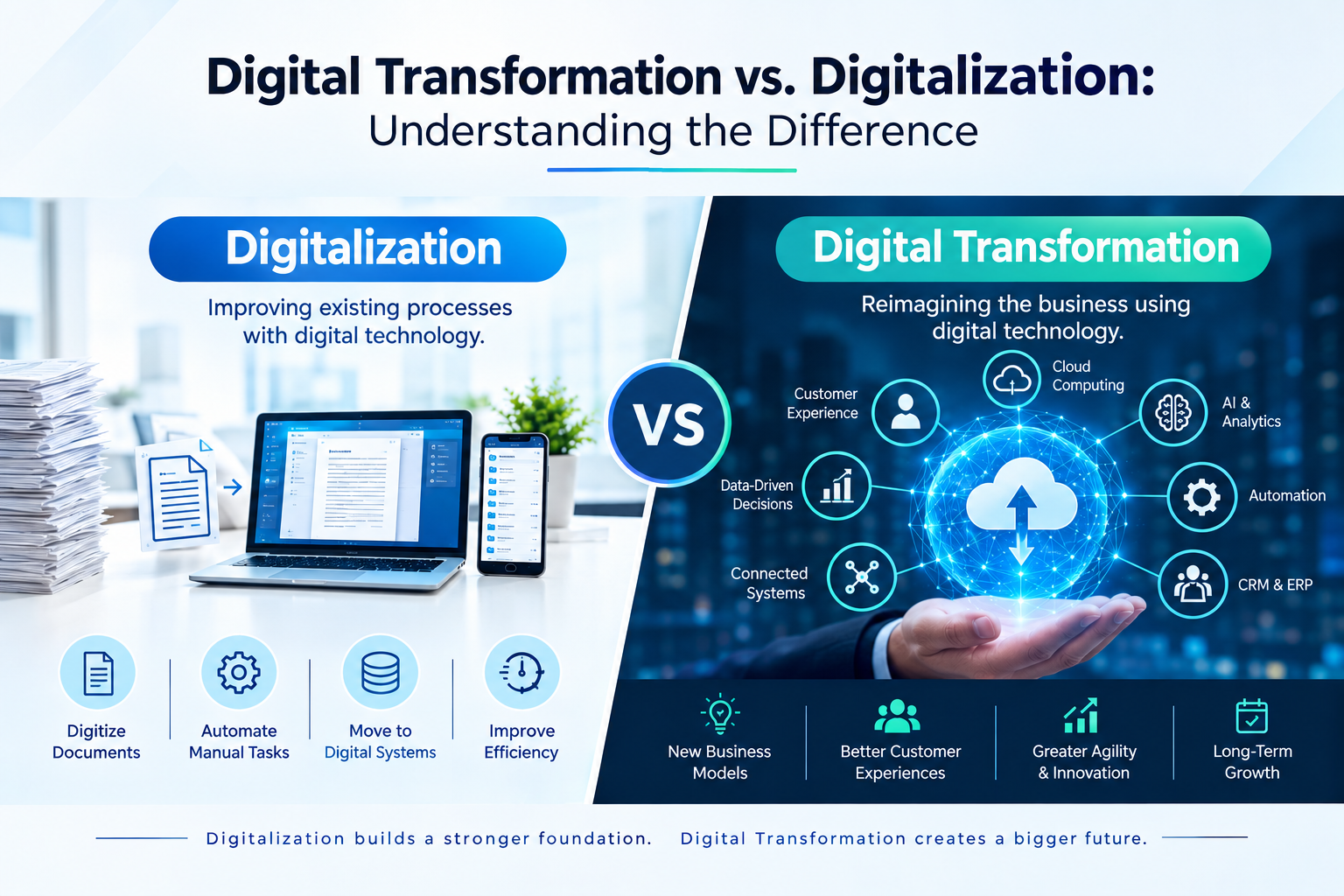
Digital Transformation vs. Digitalization: Understanding the Difference
Digital Transformation vs. Digitalization: Understanding the Difference
Businesses today are adopting digital technologies at an unprecedented pace. Cloud computing, artificial intelligence, automation, analytics, enterprise software, and connected applications are changing how organizations operate and compete.
However, two terms are often used interchangeably: digitalization and digital transformation.
Although they are closely related, they represent different levels of business change.
Digitalization generally focuses on using digital technologies to improve existing processes, while digital transformation involves a broader strategic change in how a business operates, delivers value, and interacts with customers.
Understanding this distinction can help businesses make better technology investments and develop a more effective long-term digital strategy.
What Is Digitalization?
Digitalization is the process of using digital technologies to improve existing business processes, workflows, and operations.
The objective is often to make an existing process:
- Faster
- More efficient
- More accessible
- Easier to manage
- Less dependent on manual work
Example
Consider a company that previously maintained customer records using paper forms and spreadsheets.
The business moves those records into a CRM system.
The fundamental customer-management process remains largely the same, but the information becomes easier to access, organize, update, and analyze.
That is an example of digitalization.
Common Examples of Digitalization
- Converting paper documents into digital files
- Moving manual records into databases
- Using CRM software for customer management
- Automating invoice generation
- Implementing digital payment systems
- Using cloud-based collaboration tools
- Digitizing employee records
- Automating routine reporting
Digitalization can produce significant operational improvements without completely changing the organization's business model.
What Is Digital Transformation?
Digital transformation goes beyond improving individual processes.
It involves using technology to fundamentally rethink how an organization operates, creates value, serves customers, and responds to market changes.
A digital transformation strategy may involve changes to:
- Business processes
- Customer experience
- Products and services
- Organizational workflows
- Technology architecture
- Data strategy
- Business models
- Decision-making processes
Example
Imagine the same company decides to build a completely integrated digital customer platform.
Customers can:
- Create accounts
- Purchase products
- Track orders
- Contact support
- Receive personalized recommendations
- Access services through mobile and web applications
Behind the scenes, CRM, ERP, cloud infrastructure, analytics, APIs, automation, and AI systems work together.
This is more than simply digitizing existing processes.
It represents a transformation in how the business delivers value.
Digitalization vs. Digital Transformation
The simplest way to understand the difference is:
Digitalization = Improving existing processes with digital technology.
Digital Transformation = Reimagining the business using digital technology.
| Digitalization | Digital Transformation |
|---|---|
| Focuses on existing processes | Focuses on broader business change |
| Improves efficiency | Changes how the business operates |
| Often process-specific | Organization-wide or strategic |
| Reduces manual work | Creates new ways of delivering value |
| Usually incremental | Can involve significant organizational change |
| Technology supports existing workflows | Technology enables new workflows and business models |
Why the Difference Matters
Understanding the difference is important because businesses can make the mistake of investing in technology without defining the actual business objective.
For example, purchasing a new software platform does not automatically mean an organization has undergone digital transformation.
If employees continue using inefficient processes around the new technology, the business may simply have digitized an inefficient workflow.
Successful transformation starts with the business problem—not the technology.
Key Technologies Driving Digital Transformation
Modern digital transformation strategies often combine multiple technologies rather than relying on a single solution.
1. Artificial Intelligence
AI can help businesses automate decision-making, analyze large datasets, personalize customer experiences, and improve operational efficiency.
Common applications include:
- AI-powered customer support
- Predictive analytics
- Recommendation systems
- Document processing
- Intelligent automation
- Fraud detection
Generative AI is also creating new opportunities for organizations to automate knowledge-intensive tasks and improve employee productivity.
2. Cloud Computing
Cloud technology provides businesses with scalable infrastructure and access to applications and computing resources without requiring extensive on-premises infrastructure.
Cloud adoption can support:
- Scalable applications
- Remote collaboration
- Data storage
- Business continuity
- Faster software deployment
- Modern application development
Cloud computing is often an important foundation for broader digital transformation initiatives.
3. Business Process Automation
Automation enables organizations to reduce repetitive manual tasks and improve workflow efficiency.
For example, businesses can automate:
Lead Generation → Lead Assignment → Follow-Up → CRM Update → Reporting
Instead of employees manually performing each step, integrated systems can handle much of the workflow automatically.
4. CRM and ERP Systems
CRM platforms help organizations manage customer relationships, sales, marketing, and support.
ERP platforms integrate business functions such as:
- Finance
- Inventory
- Procurement
- Human resources
- Operations
- Supply chain
When properly implemented and integrated, CRM and ERP systems can create a more connected digital business environment.
5. Data Analytics
Digital transformation generates significant amounts of data.
Analytics tools help organizations convert that data into useful business insights.
Companies can use analytics to understand:
- Customer behavior
- Sales performance
- Operational efficiency
- Marketing performance
- Product demand
- Business risks
This supports more data-driven decision-making.
6. APIs and Application Integration
Modern businesses often use multiple applications.
APIs allow different software systems to communicate and exchange information.
For example:
CRM + ERP + Payment Gateway + Website + Mobile App
can be connected through APIs to create a more integrated technology ecosystem.
This reduces data silos and improves information flow across business functions.
Signs Your Business May Need Digital Transformation
Businesses should consider a broader transformation strategy when they experience challenges such as:
Too Many Manual Processes
Employees spend significant time performing repetitive administrative tasks.
Disconnected Systems
Different departments use applications that do not communicate effectively.
Poor Customer Experience
Customers have difficulty accessing services, receiving support, or tracking transactions.
Limited Business Visibility
Management cannot easily access accurate, real-time information.
Legacy Technology
Older systems make it difficult to introduce new features or integrate modern technologies.
Slow Decision-Making
Important business decisions depend heavily on manual reports and outdated information.
Difficulty Scaling
Existing systems cannot efficiently support business growth.
These challenges often indicate that the organization may need more than individual software upgrades.
Digitalization Is Often the First Step Toward Transformation
Digitalization and digital transformation should not be viewed as competing strategies.
In many cases, digitalization is a foundation for digital transformation.
A business may begin by digitizing individual processes:
Paper Records → Digital Records
Then progress toward:
Digital Records → Integrated Systems
And eventually:
Integrated Systems → Automated, Data-Driven Digital Business
This creates a gradual path toward transformation.
A Practical Digital Transformation Roadmap
Businesses do not need to transform everything at once.
A structured approach can reduce complexity and improve the chances of success.
Step 1: Identify Business Problems
Start by identifying inefficient processes, customer pain points, technology limitations, and operational bottlenecks.
Step 2: Define Business Objectives
Technology initiatives should have measurable goals.
For example:
- Reduce processing time
- Improve customer satisfaction
- Reduce operational costs
- Increase sales efficiency
- Improve data visibility
Step 3: Assess Existing Technology
Evaluate current applications, infrastructure, databases, integrations, and security controls.
Step 4: Prioritize High-Impact Initiatives
Not every process requires immediate transformation.
Start with areas where technology can create measurable business value.
Step 5: Integrate Systems
Connect applications and data sources wherever possible to reduce information silos.
Step 6: Introduce Automation and AI
Once processes and data are structured properly, organizations can introduce automation, analytics, and AI capabilities.
Step 7: Measure and Improve
Digital transformation should be an ongoing process.
Organizations should continuously monitor performance, collect feedback, and improve their technology strategy.
Common Mistakes Businesses Should Avoid
Focusing Only on Technology
Buying advanced technology without understanding the underlying business problem can result in wasted investment.
Ignoring Employees
Employees need training, communication, and support when new technologies change established workflows.
Transforming Everything at Once
Large-scale transformation without prioritization can create unnecessary complexity.
Neglecting Cybersecurity
As businesses become more digitally connected, security must be integrated into transformation initiatives.
Failing to Measure Results
Every major technology initiative should have clear performance indicators.
Digital Transformation Is More Than Technology
One of the most important points businesses should understand is that digital transformation is not simply an IT project.
It involves the combination of:
Technology + People + Processes + Data + Strategy
A business can have advanced technology and still struggle with transformation if its processes and organizational strategy remain outdated.
Successful transformation aligns technology with measurable business objectives.
How Riotech Helps Businesses Embrace Digital Transformation
At Riotech Softwares LLP, we help businesses build and modernize digital solutions that support operational efficiency, scalability, and long-term growth.
Our approach can include areas such as:
- Custom software development
- Web application development
- Mobile application development
- Cloud solutions
- Business automation
- CRM and ERP solutions
- API integration
- AI-powered applications
- Enterprise software development
Whether a business is starting with basic digitalization or planning a broader digital transformation initiative, the right technology strategy can help create more efficient and connected operations.
Conclusion
Digitalization and digital transformation are related, but they are not the same.
Digitalization focuses on improving existing processes through digital technology, while digital transformation involves fundamentally changing how a business operates and creates value.
For businesses planning their technology roadmap, understanding this difference is essential.
The goal should not simply be to adopt more technology.
The goal should be to use technology strategically to create better processes, stronger customer experiences, smarter decisions, greater efficiency, and sustainable business growth.
As technologies such as AI, cloud computing, automation, analytics, and connected enterprise systems continue to evolve, businesses that take a strategic approach to digital transformation will be better positioned to adapt to changing market demands.
Frequently Asked Questions
What is the difference between digitalization and digital transformation?
Digitalization improves existing business processes using digital technology, while digital transformation involves broader changes to business operations, customer experiences, processes, and business models.
Is digitalization part of digital transformation?
Yes. Digitalization can serve as an important foundation for digital transformation by creating digital processes and structured data that can later be integrated, automated, and optimized.
Does digital transformation require AI?
No. AI can play an important role, but digital transformation can involve many technologies, including cloud computing, automation, analytics, CRM, ERP, APIs, and modern software applications.
How long does digital transformation take?
There is no universal timeline. The duration depends on the organization's size, technology environment, business objectives, complexity, and transformation roadmap.
Why do digital transformation projects fail?
Common reasons include unclear objectives, poor planning, resistance to change, inadequate employee training, disconnected systems, weak data strategies, and focusing on technology rather than business outcomes.
Can small businesses benefit from digital transformation?
Yes. Small and medium-sized businesses can start with focused initiatives such as process automation, cloud applications, CRM, analytics, and digital customer services before expanding their transformation strategy.
Useful Resources
NIST – Digital Transformation: https://www.nist.gov/
IBM – Digital Transformation: https://www.ibm.com/think/topics/digital-transformation
Microsoft – Digital Transformation: https://www.microsoft.com/en-us/industry/digital-transformation
AWS – Digital Transformation: https://aws.amazon.com/what-is/digital-transformation/
Ready to Build Your Digital Future?
Digital transformation is not about adopting every new technology. It is about choosing the right technologies for the right business challenges.
Partner with Riotech Softwares LLP to develop scalable, secure, and business-focused digital solutions.
Explore Riotech: https://riotechsoftwares.com/