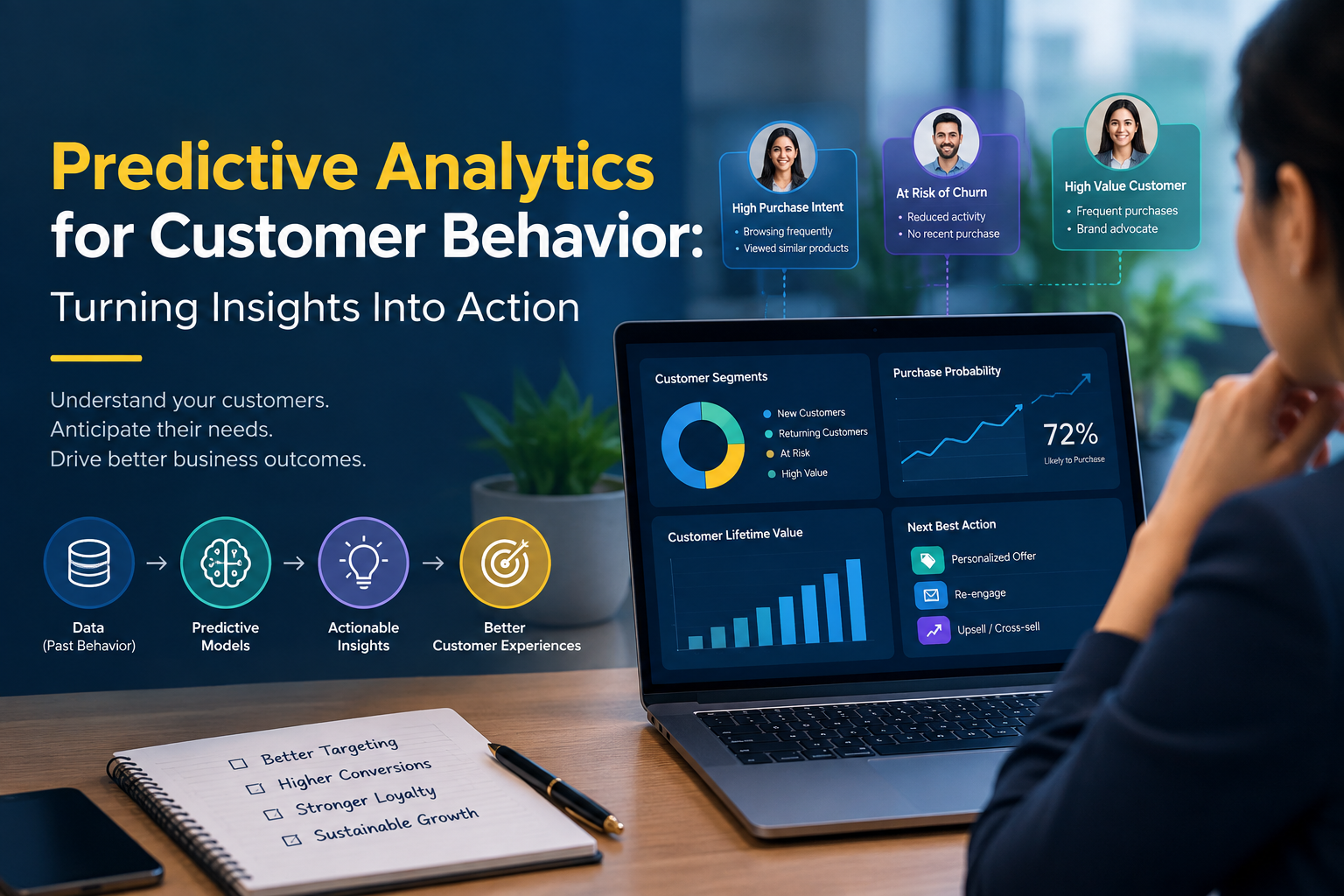
Predictive Analytics for Customer Behavior: Turning Insights Into Action
Predictive Analytics for Customer Behavior: Turning Insights Into Action
Understanding what customers want has always been important for businesses. However, traditional customer analysis often focuses on what has already happened—previous purchases, website visits, support interactions, or campaign responses.
Predictive analytics for customer behavior takes this a step further.
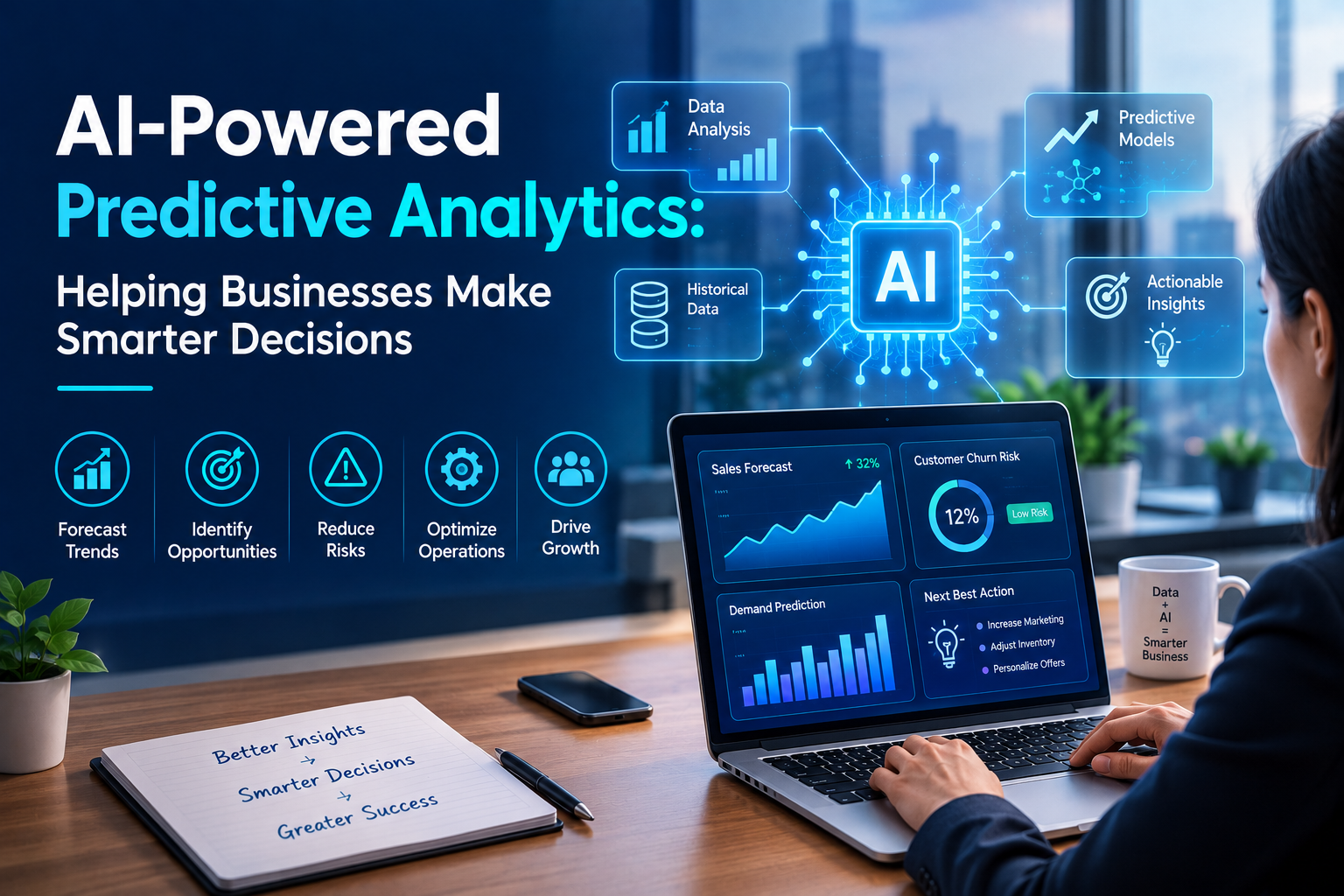
By combining historical data, artificial intelligence, machine learning, and statistical models, businesses can identify patterns and predict what customers are likely to do next. These insights can help organizations improve personalization, increase customer retention, optimize marketing campaigns, and make more informed business decisions.
In today's competitive digital environment, predictive analytics is becoming an important tool for businesses that want to move from reactive decision-making to proactive customer engagement.
What Is Predictive Analytics for Customer Behavior?
Predictive analytics for customer behavior is the process of using historical and real-time customer data to forecast future behaviors, preferences, and actions.
Businesses can analyze data such as:
- Purchase history
- Website and app activity
- Search behavior
- Customer demographics
- Email interactions
- Social media engagement
- Customer support interactions
- Product preferences
- Subscription activity
- Previous campaign responses
Machine learning algorithms can analyze these data points and identify patterns that may not be obvious through manual analysis.
For example, an e-commerce company may identify customers who frequently browse a product category but have not made a purchase. Predictive models can help determine which customers are more likely to convert and allow the company to create targeted campaigns.
How Predictive Analytics Works
A typical predictive analytics process involves several stages.
1. Data Collection
The first step is collecting relevant customer information from different sources.
Data may come from CRM platforms, websites, mobile applications, social media, e-commerce platforms, customer support systems, and marketing tools.
The quality and accuracy of this data directly affect the quality of predictive insights.
2. Data Processing
Raw customer data often contains duplicates, incomplete records, or inconsistent information.
Businesses need to clean and organize the data before using it for predictive modeling.
3. Pattern Identification
Machine learning and statistical techniques analyze historical customer behavior to identify relationships and patterns.
For example, a model may discover that customers who interact with certain product pages multiple times are more likely to make a purchase within a specific period.
4. Predictive Modeling
Algorithms use historical patterns to estimate future outcomes.
Businesses can develop models for:
- Customer churn
- Purchase probability
- Customer lifetime value
- Product recommendations
- Campaign response
- Lead conversion
- Upselling and cross-selling opportunities
5. Actionable Insights
The final and most important step is turning predictions into business actions.
Instead of simply knowing that a customer may leave, a business can proactively offer personalized support, incentives, or relevant products.
Key Applications of Predictive Analytics in Customer Behavior
1. Customer Churn Prediction
Customer retention is often more cost-effective than constantly acquiring new customers.
Predictive analytics can identify customers who show behavioral patterns associated with churn.
Businesses can then take preventive actions such as:
- Personalized offers
- Loyalty rewards
- Customer support outreach
- Product recommendations
- Special retention campaigns
This allows businesses to address potential customer loss before it happens.
2. Personalized Customer Experiences
Customers increasingly expect businesses to understand their individual preferences.
Predictive analytics can help businesses determine what products, services, content, or offers may be relevant to each customer.
For example, an online retailer can recommend products based on previous purchases, browsing patterns, and similar customer behavior.
This creates a more personalized customer journey.
3. Predicting Purchase Intent
Not every website visitor has the same level of purchase intent.
Predictive models can analyze behaviors such as:
- Product page visits
- Time spent on a website
- Cart activity
- Previous purchases
- Pricing-page visits
- Email engagement
These signals can help businesses identify customers who are more likely to make a purchase.
Marketing and sales teams can then prioritize high-intent customers.
4. Customer Lifetime Value Prediction
Customer Lifetime Value (CLV) estimates the potential value a customer can generate over the entire relationship with a business.
Predictive analytics can help businesses identify customers with high future value.
This information can support better decisions around:
- Marketing budgets
- Customer retention
- Loyalty programs
- Premium services
- Personalized offers
Instead of treating every customer the same, businesses can allocate resources based on predicted long-term value.
5. Smarter Product Recommendations
Recommendation engines are one of the most visible applications of predictive analytics.
By analyzing customer behavior and preferences, businesses can recommend products or services that are more likely to be relevant.
This can improve:
- Customer engagement
- Conversion rates
- Average order value
- Cross-selling
- Upselling
6. Marketing Campaign Optimization
Predictive analytics can help marketers determine which customers are most likely to respond to a specific campaign.
Businesses can predict:
- Which customers are likely to convert
- Which communication channels may work best
- Which products customers may be interested in
- When customers are most likely to engage
This enables businesses to create more targeted campaigns instead of relying on broad audience segmentation alone.
Predictive Analytics vs. Traditional Customer Analytics
Traditional analytics primarily answers:
"What happened?"
Predictive analytics focuses on:
"What is likely to happen next?"
For example:
| Traditional Analytics | Predictive Analytics |
|---|---|
| Identifies past purchases | Predicts future purchases |
| Reports customer churn | Predicts potential churn |
| Shows campaign performance | Predicts campaign response |
| Analyzes historical behavior | Forecasts future behavior |
| Provides descriptive insights | Provides actionable predictions |
The combination of both approaches can give businesses a more complete understanding of their customers.
Benefits of Predictive Analytics for Businesses
Better Decision-Making
Businesses can make decisions based on data-driven predictions rather than assumptions.
Improved Customer Retention
Identifying customers at risk of leaving allows companies to take preventive action.
Higher Marketing Efficiency
Businesses can focus campaigns on customers who are more likely to respond.
Increased Revenue Opportunities
Predictive models can identify upselling, cross-selling, and conversion opportunities.
Better Customer Experience
Personalized recommendations and interactions can make customer journeys more relevant.
Improved Operational Efficiency
Automation and predictive insights can help teams prioritize high-value opportunities and reduce unnecessary effort.
Challenges Businesses Should Consider
Although predictive analytics provides significant opportunities, implementation requires careful planning.
Data Quality
Poor-quality or incomplete data can produce inaccurate predictions.
Data Privacy
Businesses must handle customer data responsibly and comply with applicable privacy regulations.
Model Accuracy
Predictive models should be continuously evaluated and improved as customer behavior changes.
Integration
Predictive analytics may need to be integrated with existing CRM, ERP, marketing, e-commerce, or customer-support platforms.
Human Oversight
Predictions should support business decisions rather than completely replace human judgment.
How Businesses Can Turn Predictions Into Action
Predictive analytics delivers value only when insights are connected to real business processes.
A practical approach is:
Collect Data → Analyze Behavior → Predict Outcomes → Identify Opportunities → Automate Actions → Measure Results
For example:
A predictive model identifies a customer with a high probability of churn.
↓
The CRM automatically categorizes the customer as "at risk."
↓
The marketing platform sends a personalized retention offer.
↓
The customer engages with the offer.
↓
The system measures the result and updates future predictions.
This creates a continuous cycle where data supports smarter decisions and actions.
The Future of Predictive Customer Analytics
The future of customer analytics is moving toward more intelligent and automated decision-making.
The combination of AI, machine learning, real-time analytics, automation, and customer data platforms will allow businesses to respond to customer behavior faster.
Instead of analyzing customer behavior only after an interaction occurs, businesses can increasingly anticipate customer needs and respond proactively.
This shift can help organizations build stronger customer relationships while improving operational and marketing efficiency.
Conclusion
Predictive analytics for customer behavior enables businesses to move beyond understanding what customers did in the past and start anticipating what they may do next.
From churn prediction and personalized recommendations to purchase forecasting and marketing optimization, predictive analytics can transform customer data into actionable business intelligence.
However, successful implementation requires more than predictive models. Businesses need reliable data, the right technology infrastructure, strong privacy practices, and a clear strategy for turning insights into measurable actions.
For organizations looking to become more customer-centric and data-driven, predictive analytics can be a powerful step toward smarter decisions, better experiences, and sustainable business growth.
Frequently Asked Questions
What is predictive analytics in customer behavior?
Predictive analytics uses historical and real-time customer data, statistical techniques, and machine learning to forecast future customer behaviors and preferences.
How does predictive analytics improve customer experience?
It helps businesses personalize recommendations, anticipate customer needs, identify potential issues, and deliver more relevant offers and interactions.
Can predictive analytics reduce customer churn?
Yes. Predictive models can identify behavioral patterns associated with customers who may leave, allowing businesses to take proactive retention measures.
Is predictive analytics useful for small businesses?
Yes. Small businesses can use predictive analytics for customer segmentation, sales forecasting, marketing optimization, recommendations, and retention.
What technologies are used in predictive analytics?
Common technologies include artificial intelligence, machine learning, data analytics platforms, CRM systems, cloud computing, data warehouses, and automation tools.
Turn Customer Data Into Actionable Business Insights
Want to understand your customers better and make more data-driven decisions? RioTech Softwares LLP can help businesses leverage modern AI, predictive analytics, automation, and software solutions to transform customer data into meaningful business outcomes.
Explore smarter technology solutions with RioTech Softwares LLP.